We’d love to hear from you.

We welcome your thoughts, experiences, comments, suggestions, questions or personal stories. If you don't hear from us right away, please note that your email is very important to us. We will do our best to respond with 24 hours.


Greenville, SC

Trimarni is place where athletes and fitness enthusiasts receive motivation, inspiration, education, counseling and coaching in the areas of nutrition, fitness, health, sport nutrition, training and life.

We emphasize a real food diet and our coaching philosophy is simple: Train hard, recover harder. No junk miles but instead, respect for your amazing body. Every time you move your body you do so with a purpose. Our services are designed with your goals in mind so that you can live an active and healthy, balanced lifestyle.

Blog

Filtering by Tag: nutrition mistakes

Nutritional Considerations: IM World Championships (Nice, France)

Trimarni

On September 22nd, 2024 the best female professional and age group triathletes from around the world will race 140.6 miles in Nice, France. For the second year, the Ironman World Championship will be split between Nice, France and Kailua-Kona, Hawaii for the men's and women's races. Last year the men raced in Nice, France and this year the women will take the stage in Europe. 

The course consists of a 2.4 mile swim in the salty blue Mediterranean sea, a one-loop 112 mile stunning and spectacular bike course with over 7,800 feet of elevation gain and a four-loop 26.2 mile run on the iconic Promenade des Anglais. 

Although a beautiful race venue, the course brings with it some challenging situations. With a good understanding of the following nutritional considerations, you can improve your chances of delivering a great performance on race day - while enjoying this incredible experience. 

Carb loading
Authentic French Cuisine places great emphasis on using fresh, high quality ingredients to create great flavors. However, much of French food is rich in butter, dairy, meat and oil. Although the food is delicious, consuming large quantities of fat and protein in the days leading up to the race may reduce gastric motility and emptying, contributing to feelings of fullness and nausea, along with increasing the risk for Gi issues during activity. More so, foods rich in protein and fat are more calorie dense, which makes it difficult to effectively carb-load and fill the muscles and liver with glycogen in the days leading up to the race. On the flip side, if you are concerned about eating unfamiliar foods or you have specific dietary needs (ex. vegan/vegetarian/gluten-free) and feel limited with your food options, you may find yourself not eating enough and going into the race feeling depleted and low in energy. 
TIP: Have a plan for carb-loading. Know exactly what foods you will eat (and where) and how much to consume at least 8g/kg/bw of carbohydrates in the 48 hours before the event. By prioritizing a higher-carb consumption in the earlier hours of the day and reducing carb volume in the evening, you can minimize the risk of feeling lethargic, uncomfortably full, gassy, nauseous and bloated on race day morning. With grocery stores and markets at almost every corner, you should have no trouble finding a variety of familiar food options to prepare in your Airbnb/hotel room. 

Sea water 
The salty sea provides great buoyancy for swimming but there's a risk for swallowing air or sea water. The first condition is called aerophagia. Swallowing too much air can cause stomach distress, reflux, burping, belching and GI issues. Examples include not fully exhaling underwater before taking the next breath, mouth-only breathing, rapid breathing and swallowing big gulps of air. As a result gas is trapped in the stomach, which can lead to gas and stomach aches. 
TIP: Keep a steady and rhythmic breathing pattern. Make sure to forcefully exhale when your face is in the water. Try to work with the rhythm of the ocean by changing your cadence of your stroke to keep yourself moving forward (and not slapping waves/chop). Chewing gum, drinking carbonated beverages, and consuming too much caffeine can also increase the risk for stomach pain, reflux and belching. 

Sport nutrition timing 
Whereas general nutrition guidelines advise consuming carbohydrates, fluid and sodium in 10-15 minute intervals to optimize digestion and absorption and to help delay fatigue, a bike course with significant elevation changes, technical long descends, step and gradual uphills and potentially wind in certain sections presents challenges for fueling and hydrating on specific intervals. First off, with a significant amount of climbing in the first 1-2 hours of the bike, your energy requirements may be slightly higher but your gastrointestinal tract (blood flow) may be compromised if you are working too hard to get up the climb. Because proper fueling on the bike can reduce the risk of bonking and becoming progressively dehydrated as the race progresses, keeping your fueling strategy simple to execute is key. The more steps in your fueling/hydration strategy, the more you risk GI issues from consuming concentrated nutrition products. 
TIP: Look for opportunities on the course to coast/ease up on effort in order to take in nutrition when breathing/heart rate is controlled. Start with enough nutrition on your bike to get you through 3 hours of riding (with the help of aid stations for water as needed). Your sport nutrition is your most important currency in racing and it's not worth sacrificing bottles to save weight on the bike. Be mindful that you won't always be able to drink on a schedule - you need to work with the terrain of the course. Therefore, try to take smaller sips more frequently over 10-15 minutes (or a few big gulps every 15 minutes) when your breathing is controlled. Do not go more than 20 minutes without fueling/hydrating. In the 10-15 minutes before a long descend, it's advised to take in a little more nutrition (~50-80 calories) to reduce the risk of dropping blood sugar while coasting (plus digestion will be easier while descending vs. climbing). Be mindful that it takes ~15 minutes to digest nutrition so don't take in more than 25-30g carbs within 15 minutes. Lastly, your nutrition strategy can only work if you are well hydrated. It doesn't matter how many bars, gels or chews you consume, if you are behind on your fluids, your muscles will tire faster and your risk for nause and GI issues increases. Dehydration slows gastric emptying and gut motility. Although gels, bars, chews are convenient and easy to consume, they often lack adequate sodium and they obviously lack adequate fluid.

More is not better
The bike course is demanding and it will require a lot of muscular work, endurance, strength and stamina. There may be times during the bike, but especially during the run, when you may think that you need more nutrition to give you more energy. Although this is true to a point, your gut can only tolerate so many carbohydrates (and fluids) per hour. And if you plan to consume more than 60g carbs per hour, it needs to be a combination of glucose/maltodextrin + fructose and your gut needs to be trained to be able to absorb higher levels. Overfueling and overhydrating present much worse side effects than being a little underfueled and dehydrated. 
TIP: Understand your individual carb, sodium and fluid needs per hour and don't let your sore/tired/fatigued muscles fool you into thinking that taking a few more gels each hour or several cups of sport drink (on top of what you plan to consume) will give you more energy. Think small amounts consumed frequently throughout the run and recognize that your muscles will be tired and sore - it's an Ironman! 


Troubleshooting race day GI issues

Trimarni


The gut is a very important athletic organ because it is responsible for the delivery of nutrients and fluids during exercise. The gut is highly adaptable and should be trained repeatedly in training - just like the muscles and heart. Unfortunately, many athletes are reluctant (or afraid due to body composition concerns, previous GI complaints and 'they sayers') to take in recommended amounts of carbohydrates, calories, sodium and fluids before and during long workouts. Sadly, this results in underfueling in training and far too common, overfueling on race day.

By practicing your pre-race and race day nutrition many times prior to race day, you can improve absorption of nutrition, improve gut tolerance and learn what works (and doesn't work) to reduce the chance of GI distress and to improve performance.

Although GI distress is common among endurance athletes, race day performance-limiting upper- and lower-gastrointestinal (GI) issues are highly preventable.

Although causes are diverse and symptoms vary, there are ways to reduce your risk so that you can perform to your abilities and not spend unwanted time on the side of the road, in the bushes or in the portable toilet.


Don't Make These Race Day Nutrition Mistakes

Trimarni


Preparing for a triathlon is much more than checking off workouts to improve fitness and booking travel accommodations. Nutrition plays an important role in race day readiness. Whether you are training for an Ironman distance triathlon, half marathon or a local sprint triathlon, nutritional preparation is key.

How you fuel during a race primarily depends on the duration of the event and your racing intensity (which is based on your fitness level). Proper fueling will help you maximize recovery, fuel your workouts appropriately, boost your immune system and to maintain a healthy body composition, alongside building confidence for race day.

While you may be able to get away with a haphazard sport nutrition strategies (or not fueling at all) during short workouts, competing at your best requires you to constantly fine-tune sport nutrition strategies to help minimize the fluid, electrolyte and fuel depletion that will occur throughout the event.

Because proper sport nutrition should be part of your ongoing training - and not something you only do during your long workouts or in the three weeks before your race - here are a few common race day nutrition mistakes that could compromise your performance and health on race day.

As a reminder - endurance racing is unpredictable and requires a lot of training, trial and error and a process-driven mindset. Nutrition is just one piece of the puzzle (yet a very important puzzle piece - without it, you can't complete the puzzle).

Accept that not every race is going to be great, a PR or a showcase of previous training. Remind yourself that racing is a test of your current fitness but it's also a day (or a few hours) of self-exploration, body appreciation and to overcome obstacles.


Common Race Day Nutrition Mistakes

Trimarni


I didn't think that I would be writing a blog post about race day nutrition in 2020 but here we are, just two sleeps away from our first triathlon race of the season. Although it's September (which would be viewed as late season racing in years past), it's surreal to think that this will be our first triathlon race in 11 months! 

While not every race day nutrition mistake is a limiter to performance, athletes are quick to place the blame on nutrition when a race day performance doesn't go as planned. 

Here are some common race day nutrition mistakes that may compromise your race day performance (and health): 

  • Overfueling - With pressure to perform at your best, it's understandable that you want to optimize performance. With this comes a need to fuel - a lot - in an effort to offset a slow down. Overfueling before and during the race can leave the belly uncomfortably full and cause lethargy. It's understandable to fear running out of energy during the race but overfueling can cause massive GI distress and nausea. Far too many athletes underfuel in training and overfuel on race day. Remember that the gut needs to be trained to tolerate sport and daily nutrition in large amounts (ex. carbohydrates) and overconcentrated sport drinks will not give you more energy (they simply sit in the gut, undigested). Trust what worked in training. Practice your race day nutrition regularly in training. If your training nutrition consistently fails you on race day or you have no idea what to consume on race day, consult with a sport RD for help.

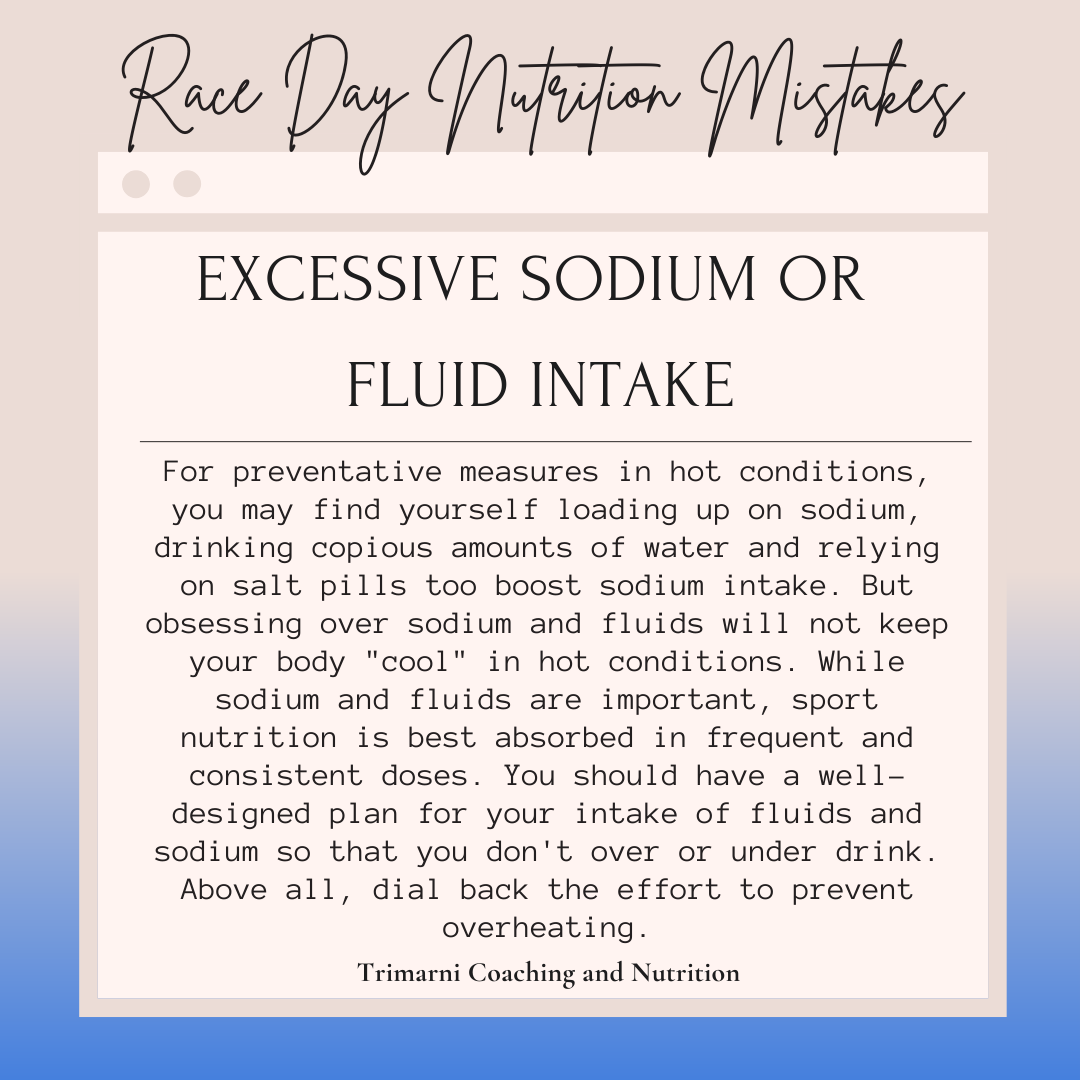
  • Excessive sodium or fluid intake - Worried about the hot race day conditions? Worried about your high sweat rate affecting your race day performance? For preventative measures, you may find yourself loading up on fluids and/or sodium before the race, drinking copious amounts of water before and during the race and pound down the salt pills during the race. Although active muscles will generate more heat than at rest and your body has to produce more sweat in order to assist with the evaporative cooling processes, your body has to adapt to these demands to control core body temperature. Simply focusing on sodium and water will not keep your body "cool" and functioning well. While both are important, don't assume that just because you are taking salt pills that your body is receiving the additional sodium or fluid.\. You should have an effective plan for fueling and hydrating on race day (before and during all parts of the race) to ensure optimal gastric emptying and fluid/electrolyte delivery. Additionally, if you know your body doesn't do well in the heat, dial back the effort to prevent overheating.

  • Understanding your body signals - It's great to have a concrete, well practiced race day nutrition plan. While a plan is great going into a race, any successful athlete knows that racing is dynamic and you need to be an active participant during the race. You can't turn into a robot just to match your detailed, excel spreadsheet pacing and nutrition plan. Racing is a process that requires a lot of decision making, troubleshooting and being proactive. As an example, just because you have a low moment on the bike, this doesn't mean that you are bonking. Or feeling low in energy in the first mile of a run doesn't means you need more calories. It's normal to have waves of emotions, moods and energy levels throughout an athletic event. Use your previous training sessions to remind yourself of similar feelings and how you navigated those symptoms. Because many conditions have similar symptoms (ex. dehydration, the onset of a cramp, low blood sugar or blood pressure), it's recommended to consult with a sport RD to analyze your race day nutrition plan before and after a race to help you perform to your abilities on race day.

  • Anti-inflammatory usage - Racing hurts. Relying on anti-inflammatory pills to try to minimize the soreness, niggles, aches and pains that occur on race day is not healthy or performance enhancing. You don't need these pills for preventive measures. I strongly advise to break this habit immediately. NSAIDs (ex. ibuprofen) work to suppress inflammation but attempting to dull the pain/aches of endurance racing, there are serious side effects such as kidney injury (elevated creatinine), blood pressure changes, stomach damage and reduced ability to recover post race. Say no to anti-inflammatory pills and while you are at it, pass on the energy boosters (caffeine pills, energy drinks) as well before the race. Your body will thank you.

  • Upper GI issues - GI issues are very common in athletes on race day. Upper GI issues include belching, vomiting, bloating and heartburn and cramping. Address the possible culprits to these uncomfortable race day issues to reduce the risk of upper GI problems on race day. It's very typical for athletes who experience upper GI issues to suffer from aerophagia (excessive air swallowing), which result when swimming from rapid/ineffective breathing, tense or short breaths (especially while running), eating too fast, drinking carbonated beverages (or chewing gum/sucking on candies), using a straw-based hydration system on the bike and gulping fluids.

  • Lower GI issues - Most athletes have experienced lower GI issues on race day or during training. Passing gas, diarrhea, loose stools, abdominal cramping and side stitches are extremely common, especially during running due to all the jostling of organs. Although not necessarily lower GI related, nausea, dizziness and headache are also common as they can result from poor gastric emptying of sport nutrition, increasing the risk for dehydration and low blood sugar. Typically, athletes who consume overconcentrated sport nutrition products, lack a solid sport nutrition plan to consume well-formulated drinks to optimize gastric emptying, wait too long to fuel/hydrate (instead of fueling/drinking on a schedule) and don't train to drink while running (ex. utilizing a hydration belt/pack) are most likely to suffer from lower GI issues. 

  • Nutrition blame game - Real talk. So many variables can impact your race day performance. Nerves, stress, poor pacing, weather, terrain and so much more. Consider the training that you did and didn't do and assess your current level of fitness and how you can best perform given the race day environmental conditions, the course/terrain and where you are in your season of athletic development. As simple as it may be to blame your performance on nutrition, sometimes nutrition is not the reason why your performance didn't meet your expectations. Endurance racing is unpredictable and requires a lot of training, trial and error and a process-driven mindset. Accept that not every race is going to be great, a PR or a showcase of previous training. Remind yourself that racing is a test of your current fitness but it's also a day (or a few hours) of self-exploration, body appreciation and the ability to work through situations and overcome obstacles. Sadly, you can't blame everything on nutrition. 

Common race day nutrition mistakes

Marni Sumbal, MS, RD


Don't you love it when everything comes together on race day and you feel incredible at the finish line? Ha - as someone who has raced 12 Ironman events, 4 Ironman World championship events and countless half IM events, I wish I could say that everything always comes together on race day. Some of my "best" performances have included race day mishaps and obstacles to overcome in order to reach the finish line.

For endurance athletes, it's rare to hear of an athlete who never experiences nutrition problems on race day. While not every nutrition issue is a limiter to performance, it seems as if athletes are quick to blame nutrition when a race performance goes wrong.

Recognizing that endurance events place extreme stress on the human body, the athlete who develops, fine-tunes and perfects a fueling and hydration plan in training and practices in key long workouts and low priority races will naturally be at a competitive advantage come race day for nutrition is a critical component of race day success. Keeping in mind that your "fastest" performance in an endurance event is when you can slow down the least, the importance of proper fueling and hydration before and during an endurance event can not be overemphasized. 

Here are some common race day nutrition mistakes that I see athletes making over and over again, but specifically in early season races: 
  1. Overfueling - Knowing that others are watching and you have placed a tremendous amount of pressure on yourself, there's the sudden need to fuel - a lot. Athletes will eat every carb in sight leaving the belly full and the body heavy and lethargic. The athlete fears running out of energy during the race and takes every preventive measure to load up on sport nutrition before and during the race, which causes massive GI distress and nausea. This is the classic case of the athlete who underfuels in training but overfuels on race day. Remember that the gut needs to be trained to tolerate sport and daily nutrition in large amounts (ex. carbohydrates). Trust what worked in training. If your training nutrition fails you on race day, consult with a sport RD for help.
  2. Excessive sodium intake - Worried about the hot race day conditions, you worry about your high sweat rate and being unacclimated to the heat. For preventative measures, you load up on sodium before the race, drink copious amounts of water before and during the race and pound down the salt pills during the race. Although active muscles will generate more heat than at rest and your body has to produce more sweat in order to assist with the evaporative cooling processes, your body has to adapt to these demands to control core body temperature. Simply focusing on sodium and water will not keep your body "cool" and functioning well. While both are important, don't assume that just because you are taking salt pills during a race that you can push hard in hot conditions. You should have an effective plan for fueling and hydrating on race day (before and during all parts of the race) to ensure optimal gastric emptying and fluid/electrolyte delivery. Additionally, if you know your body doesn't do well in the heat, dial back the effort to prevent overheating.
  3. Misreading body signals - Athletes love to have a race plan. While a plan is great going into a race, any successful athlete knows that racing is dynamic and you need to be an active participant during the race. You can't turn into a robot to match your detailed pacing and nutrition plan for racing is a process that requires a lot of decision making. In early season races, it's likely to misread your body signals for it's been a long time since you have been in such a stressful environment. As an example, thinking that a normal low moment on the bike is bonking or feeling low in energy in the first mile of a run means you need more fluids. It's normal to have waves of emotions, moods and energy levels throughout an endurance event. Use your previous training sessions to remind yourself of similar feelings and how you navigated those symptoms without giving up on yourself. Because many conditions have similar symptoms (ex. dehydration and low blood sugar) and without experience, it can be difficult to read your body signals, it's recommended to consult with a sport RD to analyze your race day nutrition plan before and after a race to help you perform to your abilities on race day.
  4. Anti-inflammatory usage - Racing hurts. Don't rely on anti-inflammatories to try to minimize the soreness, niggles, aches and pains that occur on race day. Whether you think you need them or use for preventive measures, you need to break this habit immediately. NSAIDs (ex. ibuprofen) work to suppress inflammation but attempting to dull the pain/aches of endurance racing, there are serious side effects such as kidney injury (elevated creatinine), blood pressure changes, stomach isssues and reduced ability to recover post race. So no to anti-inflammatory pills and while you are at it, pass on the energy boosters (caffeine pills, energy drinks) as well before the race.
  5. Upper GI issues - GI issues are very common in athletes on race day. Upper GI issues include belching, vomiting, bloating and heartburn and cramping. Address the possible culprits to these uncomfortable race day issues to see if you are susceptible to upper GI problems on race day. It's very typical for athletes who experience upper GI issues to suffer from aerophagia (excessive air swallowing), which result when swimming from rapid/ineffective breathing, tense or short breaths (especially while running), eating too fast, drinking carbonated beverages (or chewing gum/sucking on candies), using a straw-based hydration system on the bike and gulping fluids.
  6. Lower GI issues - Most athletes have experienced lower GI issues on race day or in training, typically while running. Passing gas, diarrhea, loose stools, abdominal cramping and side stiches. Although not necessary lower GI related, nausea, dizziness and headache are also common as they can result from poor gastric emptying of sport nutrition, increasing the risk for dehydration and low blood sugar. Typically, athletes who consume overconcentrated sport nutrition products, lack a solid sport nutrition plan to consume well-formulated drinks to optimize gastric emptying, wait too long to fuel/hydrate (instead of fueling/drinking on a schedule) and don't train to drink while running (ex. utilizing a hydration belt/pack) are most likely to suffer from lower GI issues. Nerves, stress and poor pacing may also be to blame.
  7. Nutrition blame game - Let's get real. A lot of things can impact your race day performance. Consider the training that you did and didn't do and assess your current level of fitness, the environmental conditions, the course/terrain and where you are in your season of athletic development. As simple as it may be to blame your performance on nutrition, sometimes nutrition is not the reason for a race performance that didn't meet your expectations. Endurance racing is unpredictable and requires a lot of training, trial and error and a process-driven mindset. Accept that not every race is going to be great, a PR or a showcase of previous training. Remind yourself that racing is a test of your current fitness but it's also a day (or a few hours) of self-exploration, body appreciation and the ability to work through situations and overcome obstacles. Sadly, you can't blame everything on nutrition. 

3 pre-race nutrition mistakes

Marni Sumbal, MS, RD


Many athletes blame a poor race day performance on nutrition, which doesn't surprise me since most athletes underfuel in training and guess their way through race day sport nutrition.

As it relates to long-distance racing, nutrition is a critical component to race day success. While what, when and how you consume sport nutrition during the race can optimize your ability to perform with your body from start to finish, equally, if not more important, is your nutrition going into a race.

From my personal experience as a Board Certified Sport Dietitian, who specializes in working with endurance athletes, here are some of the common pre-race nutrition mistakes that I see often, that keep athletes from reaching athletic excellence.
  1. Unhealthy relationship with carbs - A fear of carbohydrates can keep athletes from properly loading muscle and liver glycogen stores going into a race. On the other edge of the spectrum, eating every carbohydrate in sight can leave you feeling lethargic, heavy and tired. It's important to have a healthy relationship with low-fiber, easy-to-digest carbohydrates, that have been well-practiced in your training and to have a plan to keep you from under/overeating. To avoid feeling heavy going into a race, make your breakfast meal (post workout) your carb-rich meal, lunch can be satisfying and dinner should be light. While all three meals should include carbs, avoid loading yourself with carbs right before bed and instead, eat that carb rich meal in the morning (who doesn't love breakfast foods?) to give yourself plenty of time to digest the meal.
  2. Overhydrating before the race - Every athlete knows that proper hydration can boost performance but drinking large amounts of water in the 24-48 hours before a race, as well as on race day morning, can cause excessive urination, resulting in an electrolyte imbalance. Additionally, overdrinking can cause unwanted fullness, which can keep you from eating every few hours in the 48 hours before a race. Similar to your pre-race carbohydrate eating plan, it is also important to stay up on your fluid intake so that you don't under or overdrink. And to help with restful sleeping, make sure to not overdo it on fluids in the evening hours (which can cause you to wake up frequently throughout the night to run to the bathroom), but instead, spread out your fluid intake throughout the day, tapering off in the 2 hours before bed.
  3. A nervous belly on race morning - Although a nervous belly is to blame by athletes who struggle to eat on race day morning, I am shocked by how many athletes don't have confidence in their pre-race meal. While it can be tough to eat early in the morning, when nerves are high, you should have trust in your pre-race meal, knowing that it has worked for you as a pre-training meals, for most of your longer workout session. By practicing your pre-race meal (foods) in training, even if your belly is nervous, you will know that it's a non-negotiable to skip something that you have confidence in that will help you excel on race day.
While athletes are guilty of making a lot of mistakes going into a race, like resting too much and focusing too heavily on the outcome or things out of their control (ex. weather), nutrition appears to be a big limiter for athletes, simply because there's no well-practiced, thought-out plan going into a race.

Considering that most athletes spend several months training for an event, while bringing months if not years of experience into a race, it is important to recognize that every training session can prepare you for race day. Having confidence in your pre-race nutrition is a game changer. The athletes who have a nutrition plan going into a race typically experience less GI issues on race day, more energy during the race and more confidence, as it's one more thing within their control, assisting in performance excellence.