We’d love to hear from you.

We welcome your thoughts, experiences, comments, suggestions, questions or personal stories. If you don't hear from us right away, please note that your email is very important to us. We will do our best to respond with 24 hours.


Greenville, SC

Trimarni is place where athletes and fitness enthusiasts receive motivation, inspiration, education, counseling and coaching in the areas of nutrition, fitness, health, sport nutrition, training and life.

We emphasize a real food diet and our coaching philosophy is simple: Train hard, recover harder. No junk miles but instead, respect for your amazing body. Every time you move your body you do so with a purpose. Our services are designed with your goals in mind so that you can live an active and healthy, balanced lifestyle.

Blog

Filtering by Tag: race day nutrition

Nutrition tips to help you excel in a warm weather race

Trimarni


As you go from winter to spring to summer, it takes much more effort and energy to maintain a "normal" pace as the temperature rises. As a way to keep your exercising body safe in the heat, your body increases your sweat rate to remove heat from your body through evaporative cooling. As you become dehydrated (from fluid loss), blood volume decreases. In turn, more blood going to the skin means less going to your heart. To maintain cardiac output (the amount of blood pumped by the heart minute), heart rate increases in order to supply the working muscles with blood. But due to a decline in blood availability (for cooling), less blood is available to go to the working muscles. When the body can no longer take care of all of its responsibilities (remember - all of this is happening so you don't die in the heat), your body begins to shut down to keep you safe. If you ignore the signs of overheating, heat builds up in your body, your core temp increases and you are at risk for overheating and may experience heat stroke.
If you've ever struggled running in the heat, you are not alone. There are a few primary reasons why performance declines in warmer temps.

1) An increase in overall body temperature. Similar to a fever, the higher your core temperature, the greater the perceived effort (everything feels harder).

2) In the warmer temps, a significant amount of blood flow is redirected from the working muscles to the skin in order to cool the body. Cooling (which is very important to the health of your body - your organs don't want to overheat!) happens from sweating and evaporation. Therefore, less blood is available to transport oxygen to the working muscles. Less oxygen in the heat is similar to training at altitude. But in humid conditions, the air is full of water vapor and it can't hold any more so sweat has a difficult time evaporating (which means it can't cool you like it would be able to do in low humidity).

3) Dehydration increases in hot conditions. When you are dehydrated, you lose blood volume which causes your blood to get thicker. This makes it harder for your heart to supply blood to your muscles. As a result, your heart has to work even harder to pump that blood. Additionally, when fluid levels drop, you have a harder time controlling body temperature which causes the core temperature to rise even faster.

4) You DO NOT lose sodium without fluids. Dehydration comes from fluid loss - not from sodium loss. If you are simply focusing on sodium and carbs (salt tabs, gels and chews) but not drinking enough water each hour, the sodium and carbs will not do anything to help you avoid dehydration. You must drink enough of a well-formulated sport drink to properly keep yourself hydrated.

The bottom line is that the harder you work in the heat, the more heat is generated from the working muscles. Blood in your body competes for the working muscles (energy), the skin (to cool you) and the gut (aid in absorption and digestion of calories). The greater the metabolic heat production, the more energy is needed to cool the body (top priority to prevent you from overheating) - which means more stress on the cardiovascular system. Heat stress also causes an increase in fluid, electrolyte and glycogen loss (which is why pacing is critical) but the heat impacts the ability to effectively digest and absorb calories and fluids. Thus the greater risk of GI issues in higher heat environments.

As you prepare yourself mentally for your upcoming long distance event, keep in mind that working at a higher effort than your body can dissipate heat is going to produce a build-up of internal heat.

  • Create a race strategy that will allow you to use your fitness in a smart way.
  • Your fastest performance is the one where you minimize a massive slow down.
  • Navigate the conditions you are given on the day, don't chase a PR or metrics. Listen to your body.
  • Focus on what you can control. Make sure to "check-in" with yourself and respond accordingly.
  • Take walk breaks (reset breaks) when you run. The longer you let the heat build up, the greater the slow down (and greater risk of GI issues).
  • Back off the effort. Start out conservatively to minimize the risk of irreversible heat stress. Save your heart beats.
  • Go in with no expectations. Race your own race.
  • Go into the event well-hydrated and fueled so you are in the best state of health possible to perform in the race conditions. Have a plan - don't just figure things out as you go along.
  • Fuel and hydrate consistently and frequently. Moderate amounts of fluids consumed frequently will digest and absorb easier than large or tiny amounts consumed periodically. 
  • Prioritize liquids over solids for easier digestion. As a general rule, the higher the carbohydrate content (and fat/protein) and lower the fluid intake, the slower the absorption rate.
  • Focus on the process. Think of the race as a project, checking off to-do's and overcoming obstacles as you go through each mile.
  • Keep yourself cool on the bike so you can start the run with a slightly lower (or normal) core body temperature. Use water from aid stations to douse the body.
  • Your mour muscles demand more fuel (glycogen) in hot conditions. Muscles are more taxed which can affect efficiency and can also cause greater tissue damage.
  • On the run, your stomach can only empty about 5-7 ounces of fluid every 15 minutes. If you drink more than you can empty from your stomach, you will risk a sloshy stomach. Also, if you only drink water, you risk diluting sodium in the blood. Make sure to rely on a sport drink throughout the race (that’s why I also suggest to wear a hydration belt on the run) and use water only for sipping and cooling.
  • Use ice in your hands, on your head, around your neck and near your groin to help with cooling. Also use a cooling towel.
  • Minimize the risk of a sunburn by using sunscreen.
  • Wear a hydration belt with your sport drinks on hand so you can keep to your own drinking schedule.
  • The harder the effort, the more your body temp will increase as more heat is being generated. The harder you push, the greater the increase in heat production. You will know when your body temp is increasing because you will feel yourself getting warmer. Control your effort to better manage your body temp throughout the entire race.
  • Look for shaded areas on the course to avoid running in the direct sunlight.
  • If you feel overly hot, dizzy or chills. Stop immediately, sit down and get yourself cooled.
If you found this information helpful and you'd like to learn more about sport nutrition (like should you concentrate your bottles during a race, how do I fuel before a long distance triathlon and more?) check out our team membership. 

Race Day Overfueling

Trimarni


The unfortunate truth is that most endurance athletes underfuel in training and overfuel on race day.

Sure you completed your training sessions but did your physiology change? Did you get stronger, more resilient, fitter or faster? Were you able to recover properly to gain the necessary fitness for your upcoming event? Did you gain confidence in your race day fueling and pacing plan?

Underfueling can be from many reasons:
  • Fear of gaining weight
  • A desire to lose weight
  • Trying to be more "metabolically efficient"
  • Not knowing how to use sport nutrition products appropriately
  • Worrying about the sugar from sport nutrition because its not "healthy" 
  • Not feeling that (more) calories are needed during training session
  • Getting by with minimal nutrition
  • Not planning stops accordingly to refill bottles
  • Poor meal planning/feeling rushed to get in a workout
  • Not knowing how much energy/fluids are needed to support the trianing session 
Underfueling does not enhance performance and consequently, not meeting energy and hydration needs can sabotage health. You do not get fitter, stronger, faster or more resilient by underfueling in training. 

Yet come race day, athletes are so worried about running out of energy that suddenly, eating "enough" becomes a priority. Sadly, you can't outfuel a body that was not well-trained. If you underfueled in training, you spent months compromising your ability to maximize your fitness for race day. Loading up on carbs and sodium before and during the race will not give you the fitness that you didn't gain in training. 

Overfueling on race day is often due to fear of not having enough energy. Sadly, no amount of calories on race day can make the body perform at a sustainable effort that was not created in training. If you constantly underfuel in training, not only are you missing an opportunity to maximize fitness but a body that has been underfueled in training will likely underperform on race day because you never gave your body a chance to gain the necessary fitness for race day. Additionally, overfueling on race day will increase the risk for GI issues. 

Yes, you may be checking off workouts, making you think that you are getting yourself race ready but you an underfueled body will constantly underperform in training. A performance minded athlete recognizes that a well-fueled body can adapt well to training. 


Every time you go into a workout underfueled (or avoid sport nutrition or proper recovery), you are missing out on an opportunity to gain fitness and confidence for race day. 

Haphazard Race Day Fueling Mistakes

Trimarni


Practice, practice, practice. 

I can't tell you how many athletes arrive to a long distance race without confidence in their fueling and hydration plan. A precise balance of carbs, fluids and electrolytes are needed to delay the onset of fatigue by sparing liver glycogen, maintaining blood glucose concentrations and off-setting excessive fluid losses from sweating.


You can't 'fake it 'til you make it' when it comes to fueling during a long distance event. It's not uncommon for athletes to underfuel/hydrate in training and then overcomplicate fueling strategies on race day due to fear of running out of energy. Whereas too little of an energy intake (carbs, calories) is detrimental to performance, not having a well-practiced nutrition plan may result in GI issues, or more serious health complications. It seems obvious that if you are going to do something on race day, you should repeatedly do it in training, but far too often is this not the case.


Rushed and busy schedules, poor planning, intentional underfueling due to body composition concerns and a lack of an understanding of how to properly fuel for long distance sport are some of the many reasons why athletes struggle to perform on race day. Don't let this be you. Invest into your sport nutrition plan like you do with your training, coaching, body work and equipment.

If you are confused how to best fuel for your sport, reach out to a sport dietitian to help take away the guessing so you can perform with confidence on race day. 

How to fuel for triathlon race day

Trimarni


Preparing for a triathlon is much more than registering for a race and training to improve fitness. Sport nutrition plays an important role in race day readiness. Whether you are traveling to compete in a full distance triathlon or participating in a local sprint triathlon, dialing in your race day nutrition is key.How you fuel during a race primarily depends on the duration of the event, the weather and your racing intensity. No matter your experience, proper fueling will help you maximize your performance without compromising your health.

While you may be able to get away with a haphazard sport nutrition strategies (or not fueling at all) during your workouts, an enjoyable race day means avoiding these common performance limiters - extreme fatigue, cramping, dehydration, gastrointestinal issues.

Because proper sport nutrition should be part of your training and not something you only do a few times per month (or in the two weeks before your race), I'm providing some easy 'get started' tips to help you dial in your sport nutrition for race day.


If you would like to try out new products, consider ordering from The Feed, where you can order single servings of a wide variety of sport nutrition products.  


Pre-race low residue diet - why it works

Trimarni

There are several scenarios in which athletes do things that may appear unhealthy to an "outsider" in order to keep the body in good health. For example, someone who exercises 60-minutes a day does not require 200+ calories to fuel the workout. But an athlete preparing for a 4-hour ride will plan for at least 60g of carbohydrates per hour in the form of sport nutrition to prolong endurance capacity. 

Another scenario athletes apply is drastically reducing fiber-rich foods (like vegetables) in the 24-72 hours prior to an endurance event.

If you've ever had an upset stomach, you have a gastrointestinal condition such as Crohn's or diverticulitis or prepared for a colonoscopy, there's a good chance you understand the purpose (and benefits) of a temporarily limiting dietary fiber. 

Before discussing the benefits of a low residue diet, first it's important to understand how poop is made. 

The digestive system includes the liver, pancreas, gallbladder and gastrointestinal (GI) tract. The GI tract is a connection of organs - mouth, esophagus, stomach, small intestines, large intestines, anus.

The food you eat goes on an incredible ride through your body - from your mouth to your anus. The purpose of the digestive system is to turn food into nutritients and energy. This is a very important process because the food we eat and the liquids we drink keep us healthy and help our body function properly. Anything left over is turned into waste (or stool) and is then disposed of as a bowel movement. 

The digestive system moves food through the intestines, which can take between 24-72 hours. After food goes through the stomach, food passes from one area of the intestines to the next. Food stays in certain areas for a specific amount of time so the gut can do what it needs to do - absorb nutrients, absorb fluids, process waste, expel waste. 

When food is passed from the small intestines to the large intestines (colon), much of the liquid has been removed and it is now of soft consistency. The colon can now store, process and get rid of waste. The colon hosts a large population of bacteria, which help break down undigested food and neutralize some of the unwanted by-products of food breakdown. As an example, most carbohydrate digestion occurs in the small intestine. Digestion occurs with the help of enzymes. Any carbohydrates that weren't digested in the small intestines (ex. fiber) passes into the large intestines. Unlike the small intestines, there are no enzymes to break down the fiber. Instead, bacteria in the large intestine (gut microbiota), ferment the carbohydrates. To better understand the role of enzymes and bacteria, if someone is lactose intolerant, they don't make enough lactase enzxyme to digest lactose effectively. As a result, lactose passes to the large intestine. Water is drawn in by osmosis and is then fermeted by bacteria. This often results in gas, bloating and diarrhea.  Anytime undigested carbohydrates pass into the large intestines, bacteria needs to break them down - which results in gas. And if the bacteria in the GI tract are imbalanced, bloating, cramping and gas may be extreme. 

When the descending colon is full of stool (feces), it empties contents into the rectum (connects the colon to the anus) and eventually, a bowel movement occurs. The frequency and type of bowel movement can tell a lot about your health. Additionally, because the majority of the immune system is located in your gut, there's a strong relationship between gut health and physical health. 

So now that you understand how a bowel movement is formed, it's time to talk about fiber. 

Dietary fiber is an important indigestible carbohydrate that slows the transit of foods through the large intestine and promotes regular bowel activity. Residue refers to any type of solid substances that may end up in the large intestines after digestion. High fiber foods, like whole grains, fruits, vegetables, nuts and seeds increase colonic residue. Once the fibrous material enters the colon, water is drawn into the space and binds to the fiber to create stool. 

It's important to remember that digestion is a normal process that takes place in resting conditions. Exercise shifts blood flow away from the GI tract and towards the muscles, skin and lungs. As a result, there are significant changes in gut motility, tone and secretion. It's not uncommon for athletes to experience GI distress during exercise. While fiber is extremely important in the daily diet, minimizing foods that could promotes bowel activity, pose a threat to gut bacteria, and increase fecal volume can help reduce the risk of painful and potentially performance-limiting issues on race day such as diarrhea, stomach cramping, gas, reflux, vomiting, nausea or bloating. 

A few things to know: 

  • Even though you are minimizing fiber, you will still have "normal" bowel movements (depending on your regular fiber intake). A low residue diet does not interfere with existing gut contents - those will still be expelled in the mornings during your normal bowel movement. 
  • A low residue diet may result in a slight decrease in body mass as you won't be accumulating stool for a few days. When combined with carb-loading (which adds weight due to additional muscle glycogn and stored water), athletes may mitigate feeling "heavy" alongside a high-carb diet. 
  • The period of implementing a low residue diet ranges between 24-72 hours and depends on the athlete, usual fiber intake, normal bowel movements, and past experiences. Following a low residue diet for more than a few days is not encouraged as it may lead to nutrient deficiences and constipation. 
  • The ultimate goal of following a low residue diet is to reduce the risk of gut discomfort/upset during an event. 
  • Remember - carb loading is not calorie loading. Here's a helpful blog post on the topic. 
Although bagels, pasta, oatmeal and pretzels are common go-to foods for athletes, here are a few of my favorite low residue, carb-rich, pre-race foods. 
  • 1 package Organic Ramen Noodles (without seasoning) - 200 calories, 40g carbs, 1g fiber
  • 2 Pop Tarts (unfrosted) - 420 calories, 74g carbs, 1g fiber
  • 30 Saltine Crackers - 210 calories, 60g carbs, 1g fiber
  • 1.5 cup cooked Basmati rice - 480 calories, 108g, 3g fiber
  • 2 Belgium Waffles - 320 calories, 46g carbs, 1g fiber
  • 9 tbsp cream of wheat - 360 calories, 75g carbs, 3g fiber

Troubleshooting race day GI issues

Trimarni


The gut is a very important athletic organ because it is responsible for the delivery of nutrients and fluids during exercise. The gut is highly adaptable and should be trained repeatedly in training - just like the muscles and heart. Unfortunately, many athletes are reluctant (or afraid due to body composition concerns, previous GI complaints and 'they sayers') to take in recommended amounts of carbohydrates, calories, sodium and fluids before and during long workouts. Sadly, this results in underfueling in training and far too common, overfueling on race day.

By practicing your pre-race and race day nutrition many times prior to race day, you can improve absorption of nutrition, improve gut tolerance and learn what works (and doesn't work) to reduce the chance of GI distress and to improve performance.

Although GI distress is common among endurance athletes, race day performance-limiting upper- and lower-gastrointestinal (GI) issues are highly preventable.

Although causes are diverse and symptoms vary, there are ways to reduce your risk so that you can perform to your abilities and not spend unwanted time on the side of the road, in the bushes or in the portable toilet.


Hot Weather Long-Distance Triathlon Racing - How to Fuel/Hydrate

Trimarni


"Drink as much as you can and take lots of salt tabs!"

This is what I've been reading a lot of lately on social media as it relates to the advice that triathletes are receiving in route to their upcoming hot long distance race. 

Racing in the heat is extremely taxing on the body. The biggest consequences include heat stress/exhaustion/stroke and dehydration. Anytime the weather is above 86-degrees F, there will be some type of stress to your cardiovascular system. For the athlete with a hot weather race on the schedule, you must be smart, flexible, attentive and safe when exercising in the heat. Times will be slow(er) than normal and you can't chase metrics. Your primary goal is racing smart and doing the little things well. It probably won't be your fastest race and on paper, the race results may not showcase your current level of fitness but in such extreme conditions, your only goal is to reach the finish line without compromising your health.

Most athletes will overhydrate before and during a hot weather race. There will be many haphazard nutrition "plans" that involve the excessive consumption of salt pills, excessive consumption of sport drinks and lots and lots of water. Because you will be physiologically limited in the heat, there a limit as to how much sodium, fluid and carbohydrates your body can digest and absorb. You can't replace everything that is lost in sweat (and metabolic heat). 

There are several approaching triathlon races where the weather is predicted to be in the mid to upper 90's. That's hotter than hot when you are racing for 70.3 or 140.6 miles. To be honest, these conditions are not safe for the human body and racing in such brutal conditions poses a significant risk to health. While hot conditions are sure to compromise the health of the body, there are ways to mitigate the stress response to the heat and to safely reach the finish line. By understanding the body response when exercising in hot weather and learning how your fueling and hydration can help you , you will have the necessary tools to fuel and hydrate like a pro. 


Don't Make These Race Day Nutrition Mistakes

Trimarni


Preparing for a triathlon is much more than checking off workouts to improve fitness and booking travel accommodations. Nutrition plays an important role in race day readiness. Whether you are training for an Ironman distance triathlon, half marathon or a local sprint triathlon, nutritional preparation is key.

How you fuel during a race primarily depends on the duration of the event and your racing intensity (which is based on your fitness level). Proper fueling will help you maximize recovery, fuel your workouts appropriately, boost your immune system and to maintain a healthy body composition, alongside building confidence for race day.

While you may be able to get away with a haphazard sport nutrition strategies (or not fueling at all) during short workouts, competing at your best requires you to constantly fine-tune sport nutrition strategies to help minimize the fluid, electrolyte and fuel depletion that will occur throughout the event.

Because proper sport nutrition should be part of your ongoing training - and not something you only do during your long workouts or in the three weeks before your race - here are a few common race day nutrition mistakes that could compromise your performance and health on race day.

As a reminder - endurance racing is unpredictable and requires a lot of training, trial and error and a process-driven mindset. Nutrition is just one piece of the puzzle (yet a very important puzzle piece - without it, you can't complete the puzzle).

Accept that not every race is going to be great, a PR or a showcase of previous training. Remind yourself that racing is a test of your current fitness but it's also a day (or a few hours) of self-exploration, body appreciation and to overcome obstacles.


Common Race Day Nutrition Mistakes

Trimarni


I didn't think that I would be writing a blog post about race day nutrition in 2020 but here we are, just two sleeps away from our first triathlon race of the season. Although it's September (which would be viewed as late season racing in years past), it's surreal to think that this will be our first triathlon race in 11 months! 

While not every race day nutrition mistake is a limiter to performance, athletes are quick to place the blame on nutrition when a race day performance doesn't go as planned. 

Here are some common race day nutrition mistakes that may compromise your race day performance (and health): 

  • Overfueling - With pressure to perform at your best, it's understandable that you want to optimize performance. With this comes a need to fuel - a lot - in an effort to offset a slow down. Overfueling before and during the race can leave the belly uncomfortably full and cause lethargy. It's understandable to fear running out of energy during the race but overfueling can cause massive GI distress and nausea. Far too many athletes underfuel in training and overfuel on race day. Remember that the gut needs to be trained to tolerate sport and daily nutrition in large amounts (ex. carbohydrates) and overconcentrated sport drinks will not give you more energy (they simply sit in the gut, undigested). Trust what worked in training. Practice your race day nutrition regularly in training. If your training nutrition consistently fails you on race day or you have no idea what to consume on race day, consult with a sport RD for help.

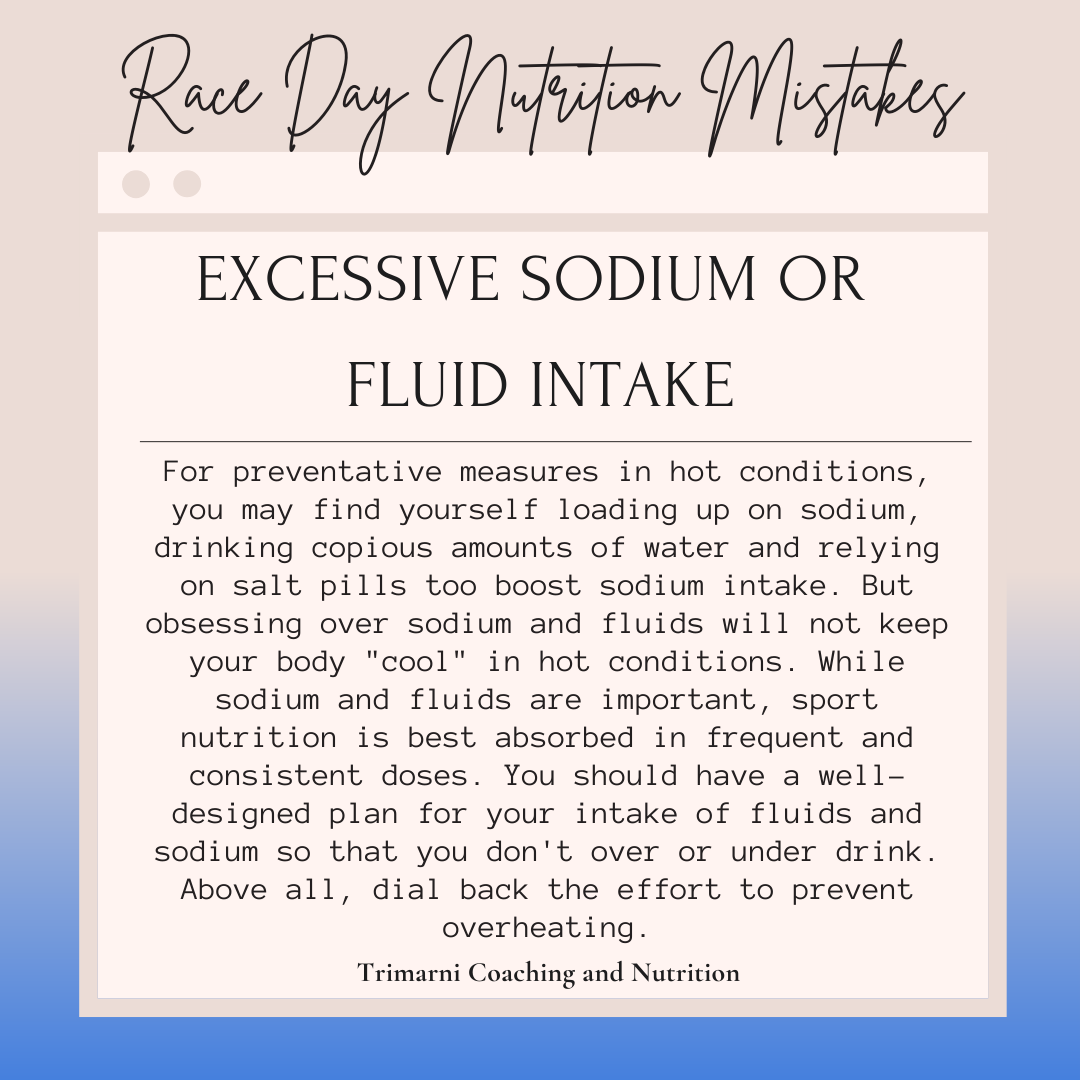
  • Excessive sodium or fluid intake - Worried about the hot race day conditions? Worried about your high sweat rate affecting your race day performance? For preventative measures, you may find yourself loading up on fluids and/or sodium before the race, drinking copious amounts of water before and during the race and pound down the salt pills during the race. Although active muscles will generate more heat than at rest and your body has to produce more sweat in order to assist with the evaporative cooling processes, your body has to adapt to these demands to control core body temperature. Simply focusing on sodium and water will not keep your body "cool" and functioning well. While both are important, don't assume that just because you are taking salt pills that your body is receiving the additional sodium or fluid.\. You should have an effective plan for fueling and hydrating on race day (before and during all parts of the race) to ensure optimal gastric emptying and fluid/electrolyte delivery. Additionally, if you know your body doesn't do well in the heat, dial back the effort to prevent overheating.

  • Understanding your body signals - It's great to have a concrete, well practiced race day nutrition plan. While a plan is great going into a race, any successful athlete knows that racing is dynamic and you need to be an active participant during the race. You can't turn into a robot just to match your detailed, excel spreadsheet pacing and nutrition plan. Racing is a process that requires a lot of decision making, troubleshooting and being proactive. As an example, just because you have a low moment on the bike, this doesn't mean that you are bonking. Or feeling low in energy in the first mile of a run doesn't means you need more calories. It's normal to have waves of emotions, moods and energy levels throughout an athletic event. Use your previous training sessions to remind yourself of similar feelings and how you navigated those symptoms. Because many conditions have similar symptoms (ex. dehydration, the onset of a cramp, low blood sugar or blood pressure), it's recommended to consult with a sport RD to analyze your race day nutrition plan before and after a race to help you perform to your abilities on race day.

  • Anti-inflammatory usage - Racing hurts. Relying on anti-inflammatory pills to try to minimize the soreness, niggles, aches and pains that occur on race day is not healthy or performance enhancing. You don't need these pills for preventive measures. I strongly advise to break this habit immediately. NSAIDs (ex. ibuprofen) work to suppress inflammation but attempting to dull the pain/aches of endurance racing, there are serious side effects such as kidney injury (elevated creatinine), blood pressure changes, stomach damage and reduced ability to recover post race. Say no to anti-inflammatory pills and while you are at it, pass on the energy boosters (caffeine pills, energy drinks) as well before the race. Your body will thank you.

  • Upper GI issues - GI issues are very common in athletes on race day. Upper GI issues include belching, vomiting, bloating and heartburn and cramping. Address the possible culprits to these uncomfortable race day issues to reduce the risk of upper GI problems on race day. It's very typical for athletes who experience upper GI issues to suffer from aerophagia (excessive air swallowing), which result when swimming from rapid/ineffective breathing, tense or short breaths (especially while running), eating too fast, drinking carbonated beverages (or chewing gum/sucking on candies), using a straw-based hydration system on the bike and gulping fluids.

  • Lower GI issues - Most athletes have experienced lower GI issues on race day or during training. Passing gas, diarrhea, loose stools, abdominal cramping and side stitches are extremely common, especially during running due to all the jostling of organs. Although not necessarily lower GI related, nausea, dizziness and headache are also common as they can result from poor gastric emptying of sport nutrition, increasing the risk for dehydration and low blood sugar. Typically, athletes who consume overconcentrated sport nutrition products, lack a solid sport nutrition plan to consume well-formulated drinks to optimize gastric emptying, wait too long to fuel/hydrate (instead of fueling/drinking on a schedule) and don't train to drink while running (ex. utilizing a hydration belt/pack) are most likely to suffer from lower GI issues. 

  • Nutrition blame game - Real talk. So many variables can impact your race day performance. Nerves, stress, poor pacing, weather, terrain and so much more. Consider the training that you did and didn't do and assess your current level of fitness and how you can best perform given the race day environmental conditions, the course/terrain and where you are in your season of athletic development. As simple as it may be to blame your performance on nutrition, sometimes nutrition is not the reason why your performance didn't meet your expectations. Endurance racing is unpredictable and requires a lot of training, trial and error and a process-driven mindset. Accept that not every race is going to be great, a PR or a showcase of previous training. Remind yourself that racing is a test of your current fitness but it's also a day (or a few hours) of self-exploration, body appreciation and the ability to work through situations and overcome obstacles. Sadly, you can't blame everything on nutrition. 

Fine-tune your sport nutrition strategies for your next race

Trimarni


Preparing for a triathlon is much more than checking off workout to improve fitness and booking travel accommodations. Nutrition plays an important role in race day readiness. Whether you are training for an Ironman or a local sprint triathlon, nutritional preparation is key.

How you fuel during a race primarily depends on the duration of the event and your racing intensity (which is based on your fitness level). Nevertheless, proper fueling will help you maximize recovery, fuel your workouts appropriately, boost your immune system and to maintain a healthy body composition, alongside building confidence for race day. While triathletes can get away with a haphazard sport nutrition strategies (or not fueling at all) during short workouts, competing at your best requires you to constantly fine-tune sport nutrition strategies to help minimize the fluid, electrolyte and fuel depletion that may compromise your performance and health on race day.

Because proper sport nutrition should be part of your ongoing training - and not something you only do during your long workouts, in the few weeks before your race - here are several useful tips to help you immediately dial in your fueling and hydration for your upcoming race(s).

  1. Start training well-hydrated – Consume 12-16 fluid ounces in the one to two hours before training and an additional eight to 12 fluid ounces in the 10-20 minutes before training. Because the emptying of liquids from the stomach is influenced by the volume of fluid in the stomach, an increase in volume will increase emptying – helping you optimize hydration during your workout.
  2. Begin drinking early in your training session – Within the first 10-15 minutes of exercise, start hydrating with a sport drink and drink on a regular schedule. Aim to consume 5-8 ounce fluid every 10-15 minutes. One ounce usually equals one large gulp. You may need to set a timer to remind yourself to drink. Big gulps will encourage a large volume of fluid to empty from the stomach more quickly. Because dehydration causes fluids to empty from the stomach more slowly, falling behind on your fluid intake may lead to GI distress (ex. bloating or a sloshy stomach) in the later miles of your workout (especially when running off the bike).
  3. Use a well-formulated sport drink – The ideal sport drink should contain 10-14g carbohydrate (glucose, sucrose, fructose and/or maltodextrin) and at least 120 mg of sodium per every 8 ounce of water. This will help stimulate drinking, facilitate intestinal absorption and maintain body fluids. To avoid taste bud fatigue, learn to develop a taste for different sport drinks (flavors and textures). As you train your gut to tolerate sport nutrition during exercise, you can gradually work your way up in calories, carbohydrates and fluids to find the sweet spot of fueling enough to support your energy/fluid needs for a given intensity, but not too much that you risk GI distress.
  4. Monitor signs of dehydration – Most fluid-related issues are related to poor understanding of fluids needs, lack or limited drinking opportunities, aversion to sport drinks (ex. “too much sugar), mismanaged drinking strategies and an inability to match excessive sweat rates with fluid intake. Reduced performance, headache, fatigue, dry mouth, dizziness, loss of appetite, chills and increased thirst are common signs of dehydration. Practice drinking while you are biking and running and have a plan as to how to carry your nutrition and to replenish your fluid/calorie supply appropriately.
  5. Stock your muscle and liver glycogen stores before demanding training sessions – To fuel your upcoming training session, replenish fuel stores from an overnight fast and restore depleted fuel from a previous session, consume a small to moderate size pre-training meal – similar to the foods and fluids that you will consume on race day. As a general rule, allow 3-4 hours to digest a large meal (450-800 calories, 1.5-3 hours to digest a medium-size meal (250-450 calories) and 30 -90 minutes to digest a mini meal or snack (100-250 calories). Eating in the 1-3 hours before a long workout has consistently shown by research to enhance the quality of your training session and will bring confidence when planning (and consuming) your pre-race meal. 

Extensive scientific research has focused on nutrient timing – what and when you eat/drink before and during exercise. Unfortunately, nutrient timing is a confusing topic because most strategies conflict with the nutrition advice that targets weight loss and healthy eating. Although the above sport nutrition advice may appear “unhealthy” because of the recommended amounts of calories, carbohydrates/sugar and sodium, implementing smart and well-practiced fueling strategies around and during your workouts is critical for your health and builds confidence for your upcoming race. By following the above guidelines, you can reduce your risk for sickness, fatigue and injury so you can achieve race day readiness by staying consistent with training and perform at your best on race day.

For more information on sport nutrition, check out my book: Essential Sports Nutrition.
You may also be interested in my latest book: The 365-day Running Journal

Training for race day success

Trimarni


Training is easy. You feel great when you get your endorphin boost, you can control your environment (or select your terrain), there is no pressure because no one is watching or tracking you and you know that if a workout doesn't go as planned, you always have tomorrow to try again.

On the other hand, race day is stressful! Feeling pressure to perform - especially in an unfamiliar and/or uncontrolled environment - brings anxiety, nerves and expectations. It's easy to compare yourself to other athletes and experience a heightened fear of failure. Never in training do you feel what you feel on race day. Far too many athletes complain that they can train better than they race - finishing a race feeling like they underperformed, relating back to all the amazingly great workouts that they crushed, yet feel defeated as to why they were unable to perform on race day, despite feeling so prepared. 

One of the great challenges for triathletes is translating training into a great race day result. Despite feeling overly confident in training, it's important to master the necessary confidence, physical skills, nutrition readiness and mental strength for race day.

Competing like you train seems like an obvious strategy but a better approach is to train like you want to compete.

If you think about all that you (try to) do on race week/day in order to set yourself up for success, why not put that same focus, energy and attention to detail into training? 
  • Restful sleep
  • Organized and planned diet
  • Good mobility
  • Planning, focus,, oganization and time-management 
  • Relaxation and visualization/meditation
  • Good warm-ups
  • Proper fueling
  • Great daily hydration 
  • Reviewing the course maps
  • Staying in the moment 
  • Rehearsing pacing/strategy/execution
  • Ensuring gear/equipment is in great condition
  • Fine-tuning sport nutrition 
It seems obvious that if you are going to do something on race day, you should repeatedly do it in training - far too often is this not the case. Rushed and busy schedules, poor planning and lack of application causes athletes to lack confidence for race day. 

If you want to perform well on race day (who doesn't?) it is important that you nail the small (yet very important) components in training. 

For example, this means practicing your pre race and race day nutrition many times in training to ensure confidence for race day. The purpose of training is to build physical and mental skills, habits and strategies that will translate into an optimal performance by your body on race day. Sadly, many athlete get really good at performing workouts underfueled and undernourished and expect to put together a fail-proof pre-race and race day fueling and hydration strategy. I think of this like riding a bike - if you are always riding with poor bike handling skills, you can't expect to master bike handling skills on race day, just because it's race day. The same is true for nutrition. If you are putting together a complex, detailed and precise diet and fueling/hydration strategy for the 48 hours before a race and for race day, but you never practice this approach in training (repeatedly), you've been training half prepared but you are expected to compete 100% prepared. Unfortunately, success doesn't happen this way. You must give 100% to your training if you want to compete well on race day.

The more you treat your training decisions like it's race week/race day, the easier you will find it to perform at your highest level when it counts. Simply put, don't do anything drastic on race week/day that you didn't practice in training. 

Prevent that embarrassing race day nutrition disaster

Marni Sumbal, MS, RD


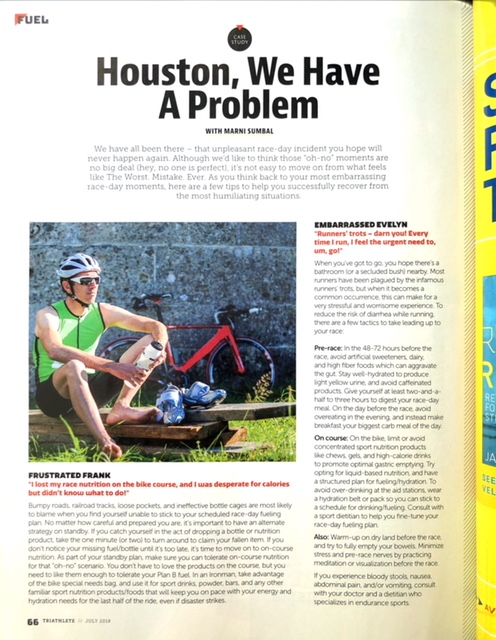
We have all been there - that unpleasant race-day incident that you hope will never happen again. Although we'd like to think those "oh-no" moments are no big deal (hey, no one is perfect), it's not easy to move on from the Worst. Mistake. Ever. As you think back to your most embarrassing race-day moments, check out a few of my nutrition tips in my recent Triathlete Magazine article (July 2018, pg 66), to help you successfully recover from the most humiliating situations. 

Common race day nutrition mistakes

Marni Sumbal, MS, RD


Don't you love it when everything comes together on race day and you feel incredible at the finish line? Ha - as someone who has raced 12 Ironman events, 4 Ironman World championship events and countless half IM events, I wish I could say that everything always comes together on race day. Some of my "best" performances have included race day mishaps and obstacles to overcome in order to reach the finish line.

For endurance athletes, it's rare to hear of an athlete who never experiences nutrition problems on race day. While not every nutrition issue is a limiter to performance, it seems as if athletes are quick to blame nutrition when a race performance goes wrong.

Recognizing that endurance events place extreme stress on the human body, the athlete who develops, fine-tunes and perfects a fueling and hydration plan in training and practices in key long workouts and low priority races will naturally be at a competitive advantage come race day for nutrition is a critical component of race day success. Keeping in mind that your "fastest" performance in an endurance event is when you can slow down the least, the importance of proper fueling and hydration before and during an endurance event can not be overemphasized. 

Here are some common race day nutrition mistakes that I see athletes making over and over again, but specifically in early season races: 
  1. Overfueling - Knowing that others are watching and you have placed a tremendous amount of pressure on yourself, there's the sudden need to fuel - a lot. Athletes will eat every carb in sight leaving the belly full and the body heavy and lethargic. The athlete fears running out of energy during the race and takes every preventive measure to load up on sport nutrition before and during the race, which causes massive GI distress and nausea. This is the classic case of the athlete who underfuels in training but overfuels on race day. Remember that the gut needs to be trained to tolerate sport and daily nutrition in large amounts (ex. carbohydrates). Trust what worked in training. If your training nutrition fails you on race day, consult with a sport RD for help.
  2. Excessive sodium intake - Worried about the hot race day conditions, you worry about your high sweat rate and being unacclimated to the heat. For preventative measures, you load up on sodium before the race, drink copious amounts of water before and during the race and pound down the salt pills during the race. Although active muscles will generate more heat than at rest and your body has to produce more sweat in order to assist with the evaporative cooling processes, your body has to adapt to these demands to control core body temperature. Simply focusing on sodium and water will not keep your body "cool" and functioning well. While both are important, don't assume that just because you are taking salt pills during a race that you can push hard in hot conditions. You should have an effective plan for fueling and hydrating on race day (before and during all parts of the race) to ensure optimal gastric emptying and fluid/electrolyte delivery. Additionally, if you know your body doesn't do well in the heat, dial back the effort to prevent overheating.
  3. Misreading body signals - Athletes love to have a race plan. While a plan is great going into a race, any successful athlete knows that racing is dynamic and you need to be an active participant during the race. You can't turn into a robot to match your detailed pacing and nutrition plan for racing is a process that requires a lot of decision making. In early season races, it's likely to misread your body signals for it's been a long time since you have been in such a stressful environment. As an example, thinking that a normal low moment on the bike is bonking or feeling low in energy in the first mile of a run means you need more fluids. It's normal to have waves of emotions, moods and energy levels throughout an endurance event. Use your previous training sessions to remind yourself of similar feelings and how you navigated those symptoms without giving up on yourself. Because many conditions have similar symptoms (ex. dehydration and low blood sugar) and without experience, it can be difficult to read your body signals, it's recommended to consult with a sport RD to analyze your race day nutrition plan before and after a race to help you perform to your abilities on race day.
  4. Anti-inflammatory usage - Racing hurts. Don't rely on anti-inflammatories to try to minimize the soreness, niggles, aches and pains that occur on race day. Whether you think you need them or use for preventive measures, you need to break this habit immediately. NSAIDs (ex. ibuprofen) work to suppress inflammation but attempting to dull the pain/aches of endurance racing, there are serious side effects such as kidney injury (elevated creatinine), blood pressure changes, stomach isssues and reduced ability to recover post race. So no to anti-inflammatory pills and while you are at it, pass on the energy boosters (caffeine pills, energy drinks) as well before the race.
  5. Upper GI issues - GI issues are very common in athletes on race day. Upper GI issues include belching, vomiting, bloating and heartburn and cramping. Address the possible culprits to these uncomfortable race day issues to see if you are susceptible to upper GI problems on race day. It's very typical for athletes who experience upper GI issues to suffer from aerophagia (excessive air swallowing), which result when swimming from rapid/ineffective breathing, tense or short breaths (especially while running), eating too fast, drinking carbonated beverages (or chewing gum/sucking on candies), using a straw-based hydration system on the bike and gulping fluids.
  6. Lower GI issues - Most athletes have experienced lower GI issues on race day or in training, typically while running. Passing gas, diarrhea, loose stools, abdominal cramping and side stiches. Although not necessary lower GI related, nausea, dizziness and headache are also common as they can result from poor gastric emptying of sport nutrition, increasing the risk for dehydration and low blood sugar. Typically, athletes who consume overconcentrated sport nutrition products, lack a solid sport nutrition plan to consume well-formulated drinks to optimize gastric emptying, wait too long to fuel/hydrate (instead of fueling/drinking on a schedule) and don't train to drink while running (ex. utilizing a hydration belt/pack) are most likely to suffer from lower GI issues. Nerves, stress and poor pacing may also be to blame.
  7. Nutrition blame game - Let's get real. A lot of things can impact your race day performance. Consider the training that you did and didn't do and assess your current level of fitness, the environmental conditions, the course/terrain and where you are in your season of athletic development. As simple as it may be to blame your performance on nutrition, sometimes nutrition is not the reason for a race performance that didn't meet your expectations. Endurance racing is unpredictable and requires a lot of training, trial and error and a process-driven mindset. Accept that not every race is going to be great, a PR or a showcase of previous training. Remind yourself that racing is a test of your current fitness but it's also a day (or a few hours) of self-exploration, body appreciation and the ability to work through situations and overcome obstacles. Sadly, you can't blame everything on nutrition. 

Don't wait until race week to plan your race day meal

Marni Sumbal, MS, RD


The nutrition goal for any performance-minded endurance athlete is to create a fueling and hydration strategy that delivers carbohydrates to the working muscles based on event intensity and duration and to minimize major dehydration and body mass losses. Carbohydrates and fluids play a very important role in your ability to adapt to training, while keeping your body in good health. By incorporating sport nutrition and proper fueling methods (pre and post workout) into your daily regime, you will not only improve health and performance but you will gain confidence for race day, all while keeping your body in optimal health. 

As simple as it sounds to "eat lots of carbs" before your race in order to load liver and muscle glycogen stores with carbohydrates to delay fatigue, pre­-race fueling is a personalized science that requires time and trial and error. Although I am a proponent of carbohydrate consumption before race day, if you have yet to fine-tune your pre-workout fueling in training, train your gut and develop a healthy relationship with carbohydrates, you may end up with a bloated, uncomfortable and heavy feeling in your belly at a time when you want to feel light, empty and comfortable.

Because exogenous carbohydrate oxidation (how well your body digests and absorbs carbs) is limited by the absorption in the intestines, a limiting factor as to why some athletes are more efficient at absorbing and oxidizing sport nutrition (without GI issues) is related to training the body to accept nutrition while working out (training the gut). Additionally, the carbohydrate content of your diet will influence how well you can digest and absorb carbohydrates during training/racing.

The gut is highly trainable and athletes who regularly consume adequate dietary carbohydrates on a daily basis and consume sport nutrition regularly during workouts have an increased capacity to absorb nutrition while training/racing. If you experience dizziness, nausea, stomach cramps, vomiting or diarrhea during training/racing, it's important to reflect on the quality of your current diet, your relationship with food (especially carbohydrates), your overall gut health, stress management and your workout fueling/hydration practices. Although some athletes are more susceptible to gut issues during training/racing, most GI issues can be avoided. Seeing that many triathletes fail to establish an effective fueling/hydration plan in training in order to apply to race day (insert too many fasted workouts or not making the time eat before a workout), there's reason to assume that many race day nutrition-related issues can be prevented in training with better planning and application. 


RACE DAY MEAL TIPS

To optimize endurance performance, consume between 1-­3 grams of carbohydrates, per kg body weight, 3­-3.5 hours before your event. For a 130 lb athlete, this would equal 118­-177g carbohydrates (472-­708 calories). Consume an additional 15­-20g of protein and fat to slow digestion, stabilize blood sugar levels and to prevent hunger.   

What would a well­-planned pre-race meal look like? 
  • ½ cup granola cereal (40g carbs)  
  • 1 cup blueberries (21g carbs)  
  • 1 tbsp nut butter (3g carbs)  
  • 1 cup milk (12g carbs)  
  • 1 banana (27g carbs)  
  • 1/8 cup raisins (16g carbs)  
  • Total: 119g carbs  
  • (optional add 1/2 cup applesauce for an additional 21g carbs)    
While it's not necessary to consume the exact quantity (grams) of carbohydrate before every long workout, it's to your advantage to start experimenting with similar foods that will be well tolerated in a larger portion, come race day morning. 

To help get you started, here are some dietary carbohydrate food suggestions to combine with ~10-15g protein/fat of your choice: 

Sensitive stomach – stick with low fiber/residue carbohydrates 
  • Saltine crackers  
  • Melba toast  
  • Rice or corn based crackers/cereal  
  • Cream of wheat or grits  
  • Crepes
  • White pita bread
  • White rice  
  • Boiled potatoes  
  • Bananas  
  • Applesauce  
  • Pulp-­free juice  
Iron stomach – select energy dense carbohydrates (high energy per gram of food)  
  • Dried fruit – raisins, dates, figs, apricots  
  • Juice  
  • Granola  
  • Syrup and/or honey
  • Jam  
  • Waffles/pancakes/bread 
  • Bagel  
  • Fresh Fruit  
  • Sport bar 

Creating the perfect pre-race meal can be challenging, especially if you fail to routinely apply good fueling strategies before every long workout. Also, if you only race but a few times per year, this leaves little room for error and a lot of hope that your anticipated food choices will work flawlessly come race day.

Don't let all your hard work in training go to waste.

Considering that an escalation of nerves, anxiety, fear or excitement can lead to unwanted digestive problems on race day, it's to your advantage to immediately start dialing in your race day meal so that come race week, you don't say to yourself, "I have no idea what to eat on race day morning?!?!"

3 pre-race nutrition mistakes

Marni Sumbal, MS, RD


Many athletes blame a poor race day performance on nutrition, which doesn't surprise me since most athletes underfuel in training and guess their way through race day sport nutrition.

As it relates to long-distance racing, nutrition is a critical component to race day success. While what, when and how you consume sport nutrition during the race can optimize your ability to perform with your body from start to finish, equally, if not more important, is your nutrition going into a race.

From my personal experience as a Board Certified Sport Dietitian, who specializes in working with endurance athletes, here are some of the common pre-race nutrition mistakes that I see often, that keep athletes from reaching athletic excellence.
  1. Unhealthy relationship with carbs - A fear of carbohydrates can keep athletes from properly loading muscle and liver glycogen stores going into a race. On the other edge of the spectrum, eating every carbohydrate in sight can leave you feeling lethargic, heavy and tired. It's important to have a healthy relationship with low-fiber, easy-to-digest carbohydrates, that have been well-practiced in your training and to have a plan to keep you from under/overeating. To avoid feeling heavy going into a race, make your breakfast meal (post workout) your carb-rich meal, lunch can be satisfying and dinner should be light. While all three meals should include carbs, avoid loading yourself with carbs right before bed and instead, eat that carb rich meal in the morning (who doesn't love breakfast foods?) to give yourself plenty of time to digest the meal.
  2. Overhydrating before the race - Every athlete knows that proper hydration can boost performance but drinking large amounts of water in the 24-48 hours before a race, as well as on race day morning, can cause excessive urination, resulting in an electrolyte imbalance. Additionally, overdrinking can cause unwanted fullness, which can keep you from eating every few hours in the 48 hours before a race. Similar to your pre-race carbohydrate eating plan, it is also important to stay up on your fluid intake so that you don't under or overdrink. And to help with restful sleeping, make sure to not overdo it on fluids in the evening hours (which can cause you to wake up frequently throughout the night to run to the bathroom), but instead, spread out your fluid intake throughout the day, tapering off in the 2 hours before bed.
  3. A nervous belly on race morning - Although a nervous belly is to blame by athletes who struggle to eat on race day morning, I am shocked by how many athletes don't have confidence in their pre-race meal. While it can be tough to eat early in the morning, when nerves are high, you should have trust in your pre-race meal, knowing that it has worked for you as a pre-training meals, for most of your longer workout session. By practicing your pre-race meal (foods) in training, even if your belly is nervous, you will know that it's a non-negotiable to skip something that you have confidence in that will help you excel on race day.
While athletes are guilty of making a lot of mistakes going into a race, like resting too much and focusing too heavily on the outcome or things out of their control (ex. weather), nutrition appears to be a big limiter for athletes, simply because there's no well-practiced, thought-out plan going into a race.

Considering that most athletes spend several months training for an event, while bringing months if not years of experience into a race, it is important to recognize that every training session can prepare you for race day. Having confidence in your pre-race nutrition is a game changer. The athletes who have a nutrition plan going into a race typically experience less GI issues on race day, more energy during the race and more confidence, as it's one more thing within their control, assisting in performance excellence. 

IMWI Race Report: 112 mile bike

Marni Sumbal, MS, RD


It’s no easy task to train for and race in a 140.6 mile event as it is huge undertaking for the body and requires a big commitment in life.

I can’t believe that in the past 14 months, I have crossed 4 Ironman finish lines. For three of those races, I had 3 consecutive PR finishing times (10:43, 10:37, 10:17). Incredibly, in 2013 I raced two Ironman races within 14 weeks from one another and in 2014, I raced two Ironman races within 11 weeks of one another. My body has not only let me  finish every Ironman I have started but I also recently qualified for the Ironman World Championships twice, within the past 14 months.

In the past 14 months, Karel (who just learned how to swim 2 years and 2 months ago) has progressed extremely quickly with his triathlon fitness and is now racing at the top of his age group.
As Karel and I continue learn more about the sport of endurance triathlons, we continue to train and race smarter. And the biggest contributor to us getting faster and stronger over the past few years is training the least amount possible with the most performance gains. We train hard but recover harder. 

In the past two years, I have experienced huge gains in my bike fitness. I contribute a lot of this to being married to a great cyclist and bike tech who knows everything and anything about bikes, bike racing and bike training. Although there have been some tweaks to my new Speed Concept Trek bike thanks to Karel over the past two years (shorter crank length, saddle, wheels/tires, Hawk ceramic bearings, Di2 shifting, RETUL fit) the biggest change has been training less hours on the bike than when I started training for Ironmans.

It is very rare for us to ride more than 5 hours, even for our peak Ironman training. Typically we do one ride around 100-110 miles and maybe one more ride around 5 hours but most of our long rides are around 4-4.5 hours and almost always include a 30-60 min run off the bike. 

The reason why I mention this is because it is possible for you to be a faster cyclist without long hours on the bike. We are firm believers that to get faster, you must ride faster. But you must train faster before you go longer.

Additionally, I can speak first-hand about how my cycling skills have improved while living in Greenville for the past 3 months (and learning from/training with Karel) and this has helped me take my cycling to the next level.

Far too often I hear Ironman athletes talk about wanting to be better runners off the bike and also being faster cyclists. And thus, they train more. And more, and harder and harder and more. 

Sometimes it works but I ask you this, if you could work less hours and get paid more, would you?

 More time to spend with friends/family, more time to get restful sleep, more time to make time for healthy/balanced eating and more time to enjoy life….would you work less....even if you LOVE your job?

Since Ironman athletes can spend up to 40-50% of total race time on the bike, it is extremely important that if you want to have a good race day Ironman performance, you must get faster and stronger on the bike. And to get stronger and faster on the bike, you have to train smart. And when you train smart, it’s NOT just about the miles but instead, knowing how to ride smart.

There are a few tips that I have for you (that we believe in for us and our athletes) to help you improve your cycling time in a triathlon and concurrently your overall finish time.

-Strength train in the off season and think beyond long, slow base miles to improve aerobic and anaerobic fitness. 

-If you train indoors, have a coach who reviews your training files, perform intervals in training and want to use your time wisely when you train, invest in a power meter and bike computer (ex. Garmin Edge) and learn how to use them properly.
-Take good-care of your bike and get regular tune-ups. It’s not just about the parts that you see but also consider how the inside parts are working to help you have a safer, more efficient ride.
-Invest in electronic shifting (Di2). This may be the best investment you will ever make on your bike because you will not only be able to shift more often but you will keep a steadier cadence. You will also ride safer as you will minimize the time your hands are off the bars.
-Be sure your fueling plan not only meets your needs and is easy to digest and absorb (ex. liquid nutrition and not 3 different methods of obtaining calories, fluids and electrolytes) but is also practical for your race day course. Hydration systems should be easy to reach, bottles should be secure and you can actually fuel/hydrate yourself consistently (ex. every 10-15 min) throughout your entire bike ride.
-Get a professional RETUL bike fit from an experienced fitter that understands your fitness, flexibility, race goals/distances and riding style.
-Incorporate longer bricks into your training plan instead of just focusing on long solo bikes and runs. We do not believe in runs longer than 2.5 hours OR bricks/long bikes longer than 6.5 hours.
-Understand your race course so that you can pace and fuel effectively and be mentally prepared for your race day.
-Your bike leg prepares you for the run. Overbiking and underfueling does not make for a strong run off the bike.
-Improve your cadence and use your gears when you ride. Learn the best way to ride hills for your weight/height and improve your skills on turns, descends, rollers, windy sections and climbs.
-Be smart with your race day gear. Wheels, helmet, tires….it’s not about the “fastest” gear in the wind tunnel but instead, what helps you ride your best on your race day course. 


After a 6 minute and 12 second transition (over ½ mile transition!) I was down the helix and ready to wake up my land legs. I immediately took a MAP (BCAA amino pill) and a sip of my custom INFINIT sport drink. I sipped my sport drink at least every 10 minutes (2-3 gulps at a time, typically while sitting up). 

The first 10 miles of the IMWI require you to stay alert. There’s a short no-passing section on a paved trail (can we talk about how much this frustrated Karel- haha) and then there is a section throughout a parking lot. During these first few miles, your bike is quickly introduced to the theme of this course: Hills, bumps and turns.


There’s a good 17 miles or so to get out to the 40 mile loop that we repeat twice. We encounter hill after hill, bump and bump and turn after turn. Yep, that pretty much sums up the ride. But despite this extremely taxing course that provides very little opportunity to recover after each hill, the sights are beautiful. Farm land everywhere and the scenery extends for miles and miles.

I wasted no time to settle into my rhythm on the bike. As I mentioned before, Karel and I both took a lot of risks in this race. Rather than using our power meters to pace ourselves, we simply used it as a tool to give us feedback. We were out racing our competition and because of that, we both knew we could not hold back BUT we still had to ride smart.

It was very important to me to stay up on my calories from my liquid nutrition as there really is no easy way to conserve energy on the IMWI course. As you may guess, Karel and I were not looking for a conservative ride and we know how much energy it takes to ride hilly courses (as we train on hilly courses all the time). It was extremely important that I get in a bit more nutrition throughout the 112 mile bike ride (however not too much that I could not empty it from my gut and absorb it) so for the first time, I used special needs. I carried 3 bottles with me of my custom INFINIT drink that I created and have used in all my past training, each bottle containing around 300 calories. I had the same in my special needs bag. There was a lot of bottle dropping on the course so I made sure that my bottles were secure in my cages by doing my last bit of IMWI training prep on bumpy, hilly roads here in Greenville. I also had some Clif blocks (1 package already open for easy consumption) and a sport bar (already opened) for additional energy.


Miles 1-17:
I felt really good during these miles. There are a few rollers but nothing too difficult or technical. My main focus was keeping a nice high cadence which has been years in the making (I have gone from 78 average cadence in an IM just a few years ago to 91 at IMWI!! This is HUGE! All those cadence-specific intervals in the early season have paid off!) so that my legs would not be too toasted throughout the bike and on the run. Since Karel and I rode most of this section (and 1 loop) of the bike course on Thursday, I was aware that I needed to keep up with my nutrition as it could be very easy to not keep up with it due to all the bumps. Also, early frequent, consumption of liquid nutrition has been shown to postpone fatigue so never neglect your nutrition in the first 1 hour of your IM race. 
I wasn’t sure how many women were ahead of me and since I anticipated a handful of fast swimmers in my age group, I thought that I was around 5-6th in my age group. I passed a few girls within these first few miles and eventually, I was just riding with the boys. 


Loop 1:
Karel and I had several discussions as to how we would each pace this course. We both decided that we would not have a pacing strategy so much (ex. hold back or to focus on specific watts). It is important to understand that Karel and I both race Ironmans differently because of our strengths. 

As a life-long swimmer, I am near the front of my age group when I race so this puts me at a prime spot to see where I am at in my age group. As for Karel, I think his theme is “on your left” when he races for he has a lot of catching up to do after the swim. 

Because of this, I am not forced to play catch up, like Karel. So for both of us racing for a Kona slot at IMWI, Karel is the one who is really digging extra deep, especially in the first hour of the IM.

 (this is not something that I would recommend to other athletes as Karel is an experienced Cat 1 cyclist who has taught his body how to suffer for almost all of his life. He has learned how to think differently as a triathlete but because of bike racing, he has an extremely high pain and anaerobic threshold and often still races like a cyclist). 

So, I primarily went by feel in this race with a close eye on whoever was around me but also to not dig a hole I could not get out of. I do not wear a HR monitor when I race so when I did look at my Garmin Edge, I focused only on cadence and normalized power. I would also look at speed but really this was just to keep me honest with my efforts, along with power. I have all my mini screens set to lap so every 10 miles (markers on the roadside) I hit lap (see very bottom of page) so that I was only focusing on one-10 mile (or around 29-31 minute) segment at a time. This was the best way to pace myself and it is just like how we train….lots and lots of intervals to focus on only one segment at a time. 

I did a really good job with my nutrition on this course and I found myself to be really comfortable on the climbs. I was also handling my bike really well with every turn and descend on the course (I’ve heard there are 91 total turns on the IMWI course). 

There is no one “big” climb on this course but instead, several. Each climb comes with its own description but what makes this challenging course so incredible is the crowds. They are everywhere! There are 3 climbs that are packed with spectators. Tour de France-like feeling. The cheers can be heard before you even get to the climb and even if you are having a low moment, the crowds know how to give you energy that you do not have.


It was close to around 2.5 hours in the race (so around 75 minutes or so of riding, if I remember correctly) when I hear Karel’s voice next to me (and his disc wheel). We talked about our usual topic when we see each other “how was your swim?” and we both told each other our times and wished each other a great race. Hearing Karel tell me that I looked great on the bike gave me a huge boost of confidence. 

I can’t recall the miles but on the first “big” climb (of three), I heard someone in the crowd yell “Go Girls!” Girls, I thought? For so long I had been cheered on by the fans as “you Go Girl!” so suddenly I was being passed. 

It was Stacey and I knew she would be strong on the course due to her past race results. Because I knew of her, I didn’t try to pace off her. Although I reach my higher limits as an athlete because of girls who are faster than me, I was honest with myself as to what I could handle on this course and riding with Stacey was not practical. Rather than getting upset, I stayed focused as I was having a really strong ride. There was no need for me to overlook my success on race day by comparing myself with others. I had a feeling that Stacey would win our age group (unless something happened which I would never wish I any athlete – I need those faster girls to help me be a better athlete!) and I figured 2-3 Kona slots so I was still in the running depending on where I was in our age group off the bike.


Special Needs: 
How long was my spot? 10 second stop according to my Garmin. 

Since we rode by special needs when we started our first loop, I made sure to check where my bag was placed on the ground according to the many rows of bib number ranges. I actually ended up spotting my bag on the beginning of the first loop thanks to my purple ribbons so when I yelled out my bib number and pulled over to the side right next to my bag, the volunteer had my bag ready, I asked her to put the bottles in my rear cages as I quickly stretched out and took one last sip of my last bottle before I tossed it (I had tossed the other two on the course at the feed zones where I also grabbed water to sip and cool my body and then toss) and then put the 3rd bottle in my frame cage and off I went. 
What a great decision to use special needs!


Miles 56-112
One thing that I have learned in Ironman racing and has been repeated to me many times by Gloria (my mental coach) is that there are highs and lows in Ironman racing. You just have to keep yourself going. I certainly am no stranger to lows in racing and I wish I could say there has been an Ironman when I felt good for the entire 112 miles of the bike...or even the entire 140.6 miles. 
Nope, it hasn’t happened. 

From miles 50-80, I was just feeling a low. Performance wise, I was ok but it was just one of those times when I had to keep on trucking along. Since most of my pacing was with guys, as I had only been passed once on the bike by a female, I gave myself a little pep talk that I was riding really strong. Probably stronger than I have ever ridden before!

Strong is very relative as I was not anticipating a "fast" time close to 5:30 on the bike like I did in Kona or 5:29 in IM Austria. A strong, fast 112 mile IMWI ride by a female would be between 5:40-5:45 and that was a goal of mine, that I felt was also achievable with my current fitness and the current weather conditions.


We were blessed with great weather with most of the bike being around 77 degrees but my Garmin told me it did get up to 86 degrees in the sun for about an hour (around 4 hours on the bike so this would be around noonish). 

The clouds went away at times and I found myself a bit warm at times but I made good use of water at the aid stations to keep my body as cool as possible. By the time I got to the last 3 climbs (and saw my homestay Ed and his wife Judy along the course – cheering super loud for me which was awesome and also my new Trimarni friend Kayla) I got some mojo back and it was time to get my mind focused for the marathon.  I continued to take 1 MAP every 30 min or so throughout the bike. 

Riding back into town, on the path again (no pass zone) and up the helix, I was impressed with myself. It’s moments like that when I remove myself from competition for a Kona spot and I thank my body. I thank my body for not only being healthy that I can race in an Ironman but for not failing me and for being so strong when I ask it to be strong. It may not be my fastest 112 mile bike ride in a race but on the hardest Ironman course I have raced, I feel this was my strongest performance and I gave it my absolute best effort, stayed up on my nutrition and paced myself to the best of my ability.
It was certainly NOT an easy ride!


As for Karel…he was on a mission..... Don’t let anyone pass me, move on up.
And wow, did he ever move on up! 
Karel felt good on the bike, stayed up on his nutrition (he had 3 bottles of his custom INFINIT mix that I created + perform on the course, his own nutrition that he brought) and made sure he gave his absolute best effort. That was our only goal. 
No excuses, race the competition and not the finishing time. 


When I gave my bike to the volunteer after I dismounted my bike, I removed my cycling shoes from my feet and carried them inside the Terrace. I grabbed my T2 (bike to run) red gear bag quickly and was greeted by a dozen awesome female volunteers. 
I couldn't stop smiling but quickly did I realize that I am the only female in this changing tent!! 
They gave me the most awesome welcome!

The volunteer lady told me that I was probably the 10th or 11th female but I immediately thought age groupers. I wanted/needed to know AGE GROUP 30-34..where is my competition? Ahead of me, behind me…where am I?

I quickly put on my Brooks Pure Flow Run shoes and grabbed my race belt, my dad’s favorite Corvette hat  and two Infinit Napalm run flasks  and I was out of there with volunteers all around me, cheering me on. But first, I need a potty stop! 

I went pee twice on the bike but because I was working really hard, I was not able to fully empty my bladder in the last 40 miles. Oh how I needed to pee! While in the port-o-potty, I put on my race belt and hat (multi-tasking, Ironman style) and oh did it feel good to just sit. Oh wait, I have a marathon to run! As I was enjoying my brief “rest” in the potty, it just dawned on me…I was only passed by 1 female and she was the female that I thought would win overall amateur for the race and if I am 10th female per the volunteer and there are pro women ahead of me...... Could it be that I am not only 2nd age group but also 2nd amateur female? Holy cow! I got to get out of her. Potty stop is over!

It’s time to run for a Kona spot and find Karel out on the course.


112 mile bike stats:
 
Marni
112 mile bike – 5:42:58, 19.59mph
2nd age group after the swim, 2nd age group after the bike
21st female after the swim, 10th female after the bike
2nd female amateur after the bike


Karel 
5:11:30, 21.57 mph average
89th age group after the swim, 5th age group after the bike
521st overall after the swim, 43rd overall after the bike!!
41st male after the bike


Marni bike splits per Garmin Edge 510 (every 10 mile marker)
Elevation (somewhere around 5,000-5,300)
Normalized power: 160
91 cadence average
Variable Index (VI): 1.07

10 miles: 19.93mph, 96 cadence, 172 NP (normalized power)
20.43mph, 94 cadence, 165 NP
19.13mph, 93 cadence, 175NP
20.89mph, 94 cadence, 166NP
19.68mph, 91 cadence, 177NP
20.13mph, 91 cadence, 145NP
18.64mph, 90 cadence, 165NP
19.77mph, 88 cadence, 155NP
18.66mph, 88 cadence, 151NP
19.21mph, 88 cadence, 148NP
19.02mph, 88 cadence, 128NP

First 56 miles: ~2:47, NP 168, 20.07mph, 93 cadence
Last 56 miles: ~2:53, NP 150, 19.04mph, 88 cadence


A big thank you to Gloria and all of the Team Sumbal followers on race day!!
I can’t believe that I was 2nd overall amateur for all of the bike and I didn’t even know it! 


Thanks Adam B for the pics!


Travel nutrition tips for athletes

Marni Sumbal, MS, RD


I'm very luck to have married someone who loves to travel as much as I do. I love the comfort of my own home and familiar surroundings but I love the experience of traveling somewhere new and creating memories. What makes life even more exciting as I age, is the opportunity to combine two of my passions: racing and traveling. In other words, we love our race-cations.
Not sure if I love to travel to race or race to travel but either way you view it, I love meeting new people, exploring the world and capturing moments to be remembered forever. 


I loved traveling with Campy to cheer Karel on at his Cat 1 cycling events. 

Now, I love our new journey of racing triathlons together.

But I will never forget the many years that Karel was by my side as my number one fan....

Coach and best friend. 

With two athletes in the house - thank goodness for Campy who can always keep us smiling when nerves are at an all time high and the normal traveling uncontrollables (like traffic) cause us to be a bit stressed out. Campy never ever complains and that is comforting. He also always treats us as if we are winners. 

No matter what race we are at, Campy is always eager to explore his new surroundings and cheer us on. 

And although Campy gets the most attention when we travel...

He's usually the first to bed. 

Campy, did you do that?

In my recent Iron Girl column article, I wrote about one of my favorite topics for traveling: Traveling nutrition. I also recently contribute to Ironman.com on a similar topic of eating in a hotel room before a race.

I know for many, eating away from home can be challenging, overwhelming or perhaps something that is looked forward to.

For anyone who is expecting an upcoming travel for a race, here are two of my recent articles to help you put your worries aside. With a little practice, planning and creativity, you will find yourself enjoying your race day experience with a well-fueled body. 

Traveling Nutrition TipsBy Marni Sumbal, MS, RD, LD/N
Trimarni Coaching and Nutrition, LLC

It’s exciting to race on a new course but the downside is limited access to familiar foods. If you’ve ever eaten oatmeal with a fork, heated with water from a hotel coffee maker, you know that destination races require a bit of flexibility and creativity and come with challenges.
Be prepared to race at your best no matter the location. Although there’s no place like home, racing nutrition involves eating a reasonable amount of energy-dense, clean (and safe) food to meet the demands of your upcoming race.

Traveling nutrition tips:
  • Stay hydrated: Bring an empty 20-28 ounce water bottle when flying and fill after security. If driving, bring plenty of water for traveling and racing. 
  • Snack frequently: to control blood sugar and to ensure adequate fuel for race day, stock-up on energy dense foods like trail mix, cereal (ex. granola), bars and raisins along with washed fruits and veggies (chopped/sliced).
  • Do your research: Google it! Check out what’s on the road or around your hotel and review online menus for needed dietary needs (Ex. vegetarian, gluten-free, etc.). Consider food options that can be found at gas stations (ex. milk, bananas), CVS (cereal, oatmeal, nuts) and grocery stores (hard boiled eggs, nut butter, bread, yogurt, produce) to help make your stay a little more like home.
  • Plan ahead: Bring as much as you can that is familiar to you. If you aren't able to travel with silverware/plates/bowls, the hotel my have options to help with meal prep and eating.
  • Amenities: Does your hotel room come with a refrigerator, coffee maker and microwave or a continental breakfast (which may not be open before your race start)? These will help make your stay a little easier as oppose to dining out every meal.
Eating out? No worries! Check out these options for your favorite pre race meals:
- Oatmeal: McDonald's, Starbucks, Au Bon Pain, Jamba Juice, Panera Bread.
- Egg white sandwich: Subway, Dunkin Donuts, Einstein Bagels, Panera Bread
- Baked potato - Wendy's
- Grilled chicken sandwich: Chick-fil-A (comes with a fruit cup), Carl’s Jr., Wendy’s (hold the BBQ sauce) and McDonald’s (hold the mayo).
- Veggie burger and garden salad - Burger King
- Veggie sandwich and soup – Subway, Panera Bread
- Burrito or burrito salad bowl (vegetarian options available) - Moe's Southwestern Grill


IRONMAN.COM

Reheat, repeat: Smart Meals for traveling triathletes

Including two hotel friendly creations - yum!