We’d love to hear from you.

We welcome your thoughts, experiences, comments, suggestions, questions or personal stories. If you don't hear from us right away, please note that your email is very important to us. We will do our best to respond with 24 hours.


Greenville, SC

Trimarni is place where athletes and fitness enthusiasts receive motivation, inspiration, education, counseling and coaching in the areas of nutrition, fitness, health, sport nutrition, training and life.

We emphasize a real food diet and our coaching philosophy is simple: Train hard, recover harder. No junk miles but instead, respect for your amazing body. Every time you move your body you do so with a purpose. Our services are designed with your goals in mind so that you can live an active and healthy, balanced lifestyle.

Blog

Filtering by Tag: triweek

TriWeek: Transitions

Trimarni


With so much focus on improving your swim, bike and run fitness, it’s easy to neglect what happens in between each discipline on race day......the "Transition" area.

Transitions are unique to triathlons as you will need to move from one sport to the next as you make your way from start to finish. The transition area is the place where you keep your race day gear/equipment/nutrition and perform skills like putting on your bike helmet and running shoes. The transition area can be stressful and chaotic but it’s not an area for rest or socialization. It’s important to remember that your race time includes everything that happens from the start of the swim until you reach finish line.


Most triathletes will experience their highest race day heart rate in the first transition area. After exiting the swim, the rush of running to your bike can make even the most experienced triathlete feel a bit winded. Exhaustion, rapid breathing, and nerves can have your fumbling your way through the transition area. As with any component of triathlon, you need a plan.

Transitions offer a unique opportunity to save time with little physical cost. However, as an unfamiliar component of triathlon racing thats only performed a few times per year, the transition area often brings great physical and emotional stress. Even with a "brick" (back to back) workout, it's difficult to match the pressure, nerves, chaoes and elevated heart rate that you will experience on race day.

TIPS FOR A SPEEDY TRANSITION 


  1. Create an auto­pilot plan. You need a simple plan from swim to bike (Transition 1: T1) and bike to run (Transition 2: T2). Leaving decisions to chance costs time and increases the risk for mistakes The less stuff you have,the less overwhelmed you will be. The transition area can be crowded, so keep your space tight and orderly.
  2. Understand the transition layout.­ Study the layout of the transition area when you arrive to the race venue. Look for permanent landmarks (e.g. a light post) to help you quickly locate your designated bike rack. A brightly colored transition towel/mat can also make it easy to spot your gear amidst the chaos.
  3. Understand the rules. Every race is different. Some triathlons require you to put your swim and bike gear into a bag provided to you at athlete check-in. Many races don’t allow personal items and bike pumps to be left in the transition area throughout the race. Rules are typically explained in the athlete guide or at the pre-race athlete briefing.
  4. Visualize. Before you finish the swim and the bike, mentally rehearse the upcoming transition process. By thinking ahead, you can lessen the panic and anxiety that often occurs when it is time to finally commit to the transitioning process.
  5. Laugh it off. No transition will ever be flawless. Wild things happen when you are racing. Stay calm no matter what goes wrong. If anything, give yourself a laugh when you put your helmet on backwards or you stumble over your wobbly feet.
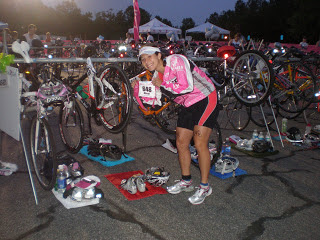

    How to practice transitions in training 
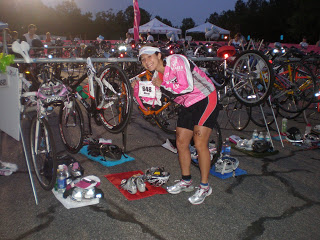
  1. Purchase a floor bike stand for quick transitioning from swim to bike and bike to run. This stand is also ideal for storing your bike in your house/garage as well as when you travel by car to your races. 
  2. Set-up your area for the transition that you want to practice (ex. swim to bike or bike to run). It can be your assigned brick workout or an additional workout just for practice.
  3. For swim to bike, practice running to your bike (barefoot and somewhat wet) and then transition into your bike gear. I do not recommend attaching your shoes to your bike unless you are very experienced with this skill. The key is to make sure you can smoothly mount your bike despite distractions (athletes around you, people cheering, obstacles in your way, etc.). On race day, I suggest to roll your bike a few feet away from the mount line and to the far right/left for a smooth transition on your bike.
  4. For bike to run, practice dismounting before a designated spot (this is called the dismount line. There is also a mount line. Both represent the point where you are allowed to get on and off your bike outside of the transition area). Practice running with your bike to your transition area (with your cycling shoes on). It takes skill to run with your bike - walking your bike in and out of the transition is just fine. Be careful walking/running with cycling shoes on!
  5. Practice, in a specific order, how you will remove your bike gear and then put on your run gear. Because triathletes typically have more to put on in T2 compared to T1, it's important to have a game plan for the order you will put on your gear. It's not necessary to sprint out of the transition area - I suggest to start with a power walk before transitioning to a run as you reach the T2 exit.
  6. You do not need a specific transition workout to practice your transitions. I suggest to spend 10 minutes, once or twice a week, practicing transitions in the weeks leading up to your race. Have your friend/spouse/kids time you and aim for a faster time each time. Most importantly, make sure you have a detailed plan so that your transition is an orderly and smooth process.
  7. As a reminder, it's best to practice your transitions with an elevated heart rate. The entire transition experience will change when your heart rate is high, there are other athletes around you and people are watching you!

    To learn more: Athlete to Triathlete 

TriWeek: Triathlon Cycling

Trimarni


Sandwiched between the swim and run, the bike portion of the triathlon is the longest discipline in both time and distance. With nearly 50% of your race time spent on two wheels, insufficient skills and not enough time in the saddle will cost you valuable time and energy on race day.  Proper bike training will not only help you get faster on the bike but youll minimize the effect of cycling on your running legs.

When it comes to triathlon gear and equipment, cycling is by far the most expensive discipline. Plus, training outdoors has its hazards, especially when you are sharing the road with cars, pedestrians, and nature. For these reasons, many triathletes dont train properly, or spend a considerable amount of time cycling indoors. At the end of the day, preparation for the bike portion of a triathlon is about having the right equipment, doing the right training, and constantly working to improve your bike handling skills.


The cycling culture may look intimidating, but as long as you are riding a bike and having fun, you are part of the club. The way to building bike fitness is fairly straightforward: Go ride your bike. But to truly showcase your cycling fitness, proper bike handling skills and training are critical for safety, confidence, and efficiency. Knowing how to corner, brake, descend, stand, climb, and change your gears will take your bike fitness to an entirely new level. For most triathletes, due too much indoor riding (or a dislike of riding a bike), these fundamental skills are lacking.


Bike handlingAlthough it seems basic, you must learn how to signal a turn, making a u-turn, point to something in the road, and take in nutrition (from a bottle or your pocket) as you ride. All of these tasks require you to ride your bike with only one hand. The only way to become efficient at this skill is to practice. In an empty parking lot, practice lifting one hand at a time off the handlebars to learn how to balance yourself on your bike. Then practice grabbing your water bottle from the cage and looking behind you as if you were able to make a turn.

Cycling Skills: 5 Pro Tips
1. For smoother shifting, braking and turning, anticipation is key. For example, change your gears right before you really need to, especially when approaching a hill. 

2. Don’t wait until you are on the side of the road to perfect your flat-changing skills.

3. Learn the rules of riding on the road. Know how to signal appropriately when making a turn or pointing out a hazard on the road. Try to anticipate the decisions of the drivers (cars) around you.

4. Check your bike (cables, brakes, tires, spokes, chain, etc.) before every ride. Don’t forget to pump your tires. The recommended tire pressure can be found on the sidewall of your tire. Give your bike a quick clean after every ride. 

5. In wet weather, stay off the painted line, watch out for oil, and break earlier than usual, especially when taking a turn. Look out far enough ahead so you can see and react to any obstacles on the road or on the shoulder.
As a newbie triathlete, the improvements you make in fitness will impact your performance more than an expensive set of race wheels, aero helmet, or high-end bike components. That being said, having the essentials will certainly make triathlon bike training much easier.


Purchasing a bike
You may have noticed that a triathlon bike looks very different than a traditional road or hybrid bicycle. The major difference is the geometry of the frame and handlebar set-up. A road bike is typically light, stiff, and responsive. Equipped with drop bars, this allows you to make use of multiple hand positions, which makes for more comfortable climbing and descending. Easy to handle, a road bike also makes it fun to enjoy a casual ride and to constantly work on your bike-handling skills.

A triathlon bike puts you in a more compact, forward, aerodynamic position, lessening drag and letting you apply more direct transfer of power to the crank. This position also lessens the load on your quadriceps to ensure more efficient running off the bike. Built for speed in a straight line, a triathlon bike handles very differently than a road bike. It’s not uncommon for beginner triathletes to feel unstable on a tri-bike compared to a road bike.


Purchasing a bike is a big investment, but your first bike likely won’t be your one-and-only forever bike. Buying from your local bike/triathlon store will help you find the right bike size for your body and budget. Plus, a new bike comes with a warranty and may even come with a service-package from your local bike store (LBS).

For beginners, there's nothing wrong with starting on a hybrid bike (that's how I got started!). However, it's recommended to invest in a road bike. Although clip-on aerobars allow you to rest your elbows on pads to lower your body in a more aerodynamic, tucked, position, the road bike is not set in a position for you to be aerodynamic on the aerobars and ride efficienty in the drops and base bars.

Although an aluminum bike frame is durable, carbon is light, which makes for a smoother ride when on the road. Also, electrical shifting, while quite a pricey upgrade, allows you to change your gears with just a push of a button (electronically) instead of using conventional shift levers and mechanical cables. Not only is electronic shifting quick and precise but you can also shift better under a heavy load – like pedaling uphill or when standing out of the saddle.

For an extra upgrade, you may want to consider disc brakes (over rim breaks), which have more responsive and stronger braking power and control, especially in wet conditions. Regardless of the bike you choose, you need to understand the inner workings of your bike and take care of it. A clean bike is a happy machine.

To learn more: Athlete to Triathlete

TriWeek: Triathlon swimming

Trimarni


Triathlon swimming is much more different than swimming in a pool. The training, swim stroke and demands of triathlon swimmers is very different than that of the competitive pool swimmer. Inefficient stroke habits in the pool will come at a cost in the open water. Recognizing the challenges of the open water triathlon swim (rough water, crowds, no lane lines), triathlon swim training should emphasize technique, strength, stamina and power.

If you lack a swimming background, you may notice that your current fitness level doesnt translate easily to swimming. Unlike the experienced swimmer, who has a fishlike ability to slice through the water, if you are inexperienced and try to swim fast, youll quickly feel exhausted and out of breath. And since improvements are slow to make and getting yourself to the pool can be a logistical challenge, triathlon swim training is usually the first to go for the time-crunched triathlete.

The most basic swimming skill to master is learning how to hold your body in the water. This is called body position. On land, you have great body awareness when it comes to movement. But once you submerge yourself into the water, most of your body weight is dispersed. It can take a while to get used to feeling weightless in the water.

Proper body position will help you move forward in the water with minimal energy wasted. By learning how to keep your head, hips, and feet in a straight line, youll create less drag, making swimming less exhausting. Because your lungs give the upper body natural buoyancy, you need to learn how to hold up your hips and legs. Sinking legs means more mass to move through the water, which in turn means drag to be overcome by excessive kickingwhich wastes a lot of energy.

Recommended "toys" to help with body position, alignment and tautness: Snorkel, buoy (or buoyancy shorts) and ankle strap/lock.
Most of your propulsive force comes from the upper body. A powerful catch and pull (not excessive kicking), moves you forward. By catching, or holding, the water with the fingers, hand, forearm, and upper arms, you are literally grabbing the water and pulling yourself forward. A high (but efficient) stroke rate is key for open water swimming.


Whereas proper body position and alignment will help reduce drag, the hips and legs play an important role in propulsion. When timed appropriately with your stroke, hip movement can contribute to overall power. Although forceful kicking offers little return on investment regarding propulsion, trying to power through the water with only your arms is not the most economical way to swim. When you kick, keep your feet relaxed and pointing away from you (not toward the bottom of the pool). Avoid scissor kicking (crossing your legs), as this can throw your body out of alignment. Kick timing is key. A two-, four-, or six-beat kick pattern will help drive your momentum forward. As for moving through the water, your body shoulder, torso and hips - should roll throughout each stroke.

Before you try to swim faster or longer, do yourself a big favor and spend a significant amount of time improving your body posture and stroke mechanics in the pool. I suggest aiming for 3-5 swim sessions per week of around 30-60 minutes. Frequent swimming will help you keep a good feel for the water while allowing you plenty of opportunities to improve your technique and build endurance. There's no point swimming longer and harder with poor stroke habits.  

Feeling out of breath while swimming? The struggle is real.

Although swimming freestyle has many moving parts, breathing should be rhythmic and timed with your stroke. As one arm is extended in front of you, you’ll breathe to the other side by slightly turning your head (not your entire body) so that your chin is near your shoulder.

Trying to both exhale and inhale when your face is out of the water is counterproductive. Before you turn your head to take a breath, exhale, forcefully, through your mouth and nose when your head is in the water, as if you were blowing out a dozen birthday candles. When you turn your head to breathe, you’ll find it easier to take in air without gasping.

You’ll likely have a preferred side for breathing but learning how breathe to both sides (bilaterally) can help in choppy open water, or if the sun is getting in your eyes. More so, many stroke flaws—like crossing your arms over the midline of the body, scissor kicking, and a sinking outstretched arm—develop when you only breathe to one side.

Open water swimming

As a triathlete, it’s important to think like an open water swimmer. But before you jump into the big blue sea, master your technique in the safe and controlled environment of a swimming pool. Open water swimming requires a special set of mental and physical skillsskills that can only be achieved by swimming in an open body of water. In the open water, practice sighting, staying on course, and managing the unpredictable nature of the open water as you swim at different intensities, surrounded by other people.

Open Water Swimming Tips:


1. Review the course. Take notice of the water movement. Make note of the sighting buoys, particularly the turn buoys. Look for landmarks like a brightly colored building, cellphone tower, flagpole, or large tree to help you navigate the open water and stay on course.

2. The shock of cold water can cause your lungs to contract, causing hyperventilation. Before you take your first stroke, go waist deep, submerge your face in the water, and blow bubbles.

3. Use a copious amount of Vaseline or anti-chafing cream around your ankles, arms, neck-line, and back to minimize chaffing.

4. Don’t ruin your swim by skipping the warm-up. Spend 10-15 minutes on the dry land and then in the water to promote blood flow and elevate the heart rate. During this time, you can also adjust your swimsuit/wetsuit, cap, and goggles.

5. Aerophagia, or the act of ingesting air while swimming, can cause gas, stomach cramping, or belching. Avoid starting out too hard, breathe every other stroke, and forcefully exhale through your nose and mouth when your face is in the water.

To learn more: Athlete to Triathlete

I also suggest: Tower 26: Master open water swimming

It's National Triathlon Week!!

Trimarni

It's National Triathlon Week!

National Triathlon Week is a nationwide USA Triathlon initiative to celebrate the sport of triathlon and all of the members of the multisport community. From June 22-28th, 2020, National Triathlon week is focused on education, celebration and participation in the multisport lifestyle, with each day having a theme. National Triathlon Week, or #TriWeek, is a celebration of triathletes and all members of the multisport community — including officials, coaches, race directors, families and friends of triathletes and so many more.


Why Tri?
Training for a triathlon adds purpose to your exercise regime. As a way to improve health, boost self-confidence, overcome a fear, stretch physical limits or be a role model, there’s no escaping the obvious of being drawn to the challenge of participating in a three-sport event.

Despite your nervous energy, excitement and curiosity, it’s normal to feel a bit overwhelmed by a new multisport endeavor. For example, you may be intimidated by all the gear used in a triathlon. Although triathlon is an equipment-heavy sport compared to running, you don’t have to break the bank just to cross the finish line. Another challenge to this multisport lifestyle is balancing training for three sports with work, family and life. By having clear expectations of the available time that you can realistically dedicate to training each day, you can build your training around your life and still achieve positive fitness adaptations. Even if you come from a great fitness/sport background, it’s important to find the best training prescription for you, within the framework of your life. By best advice is to start conservative and remain flexible. Above all, optimize your available training hours by focusing on quality over quantity. This strategy will ensure a fun, enriching and sustainable triathlon journey.

Over the next week, I'll be sharing information from my most recent book Athlete to Triathlete to help you make the most of your triathlon training journey. If you are new to the sport, returning to the sport, or consider yourself tri-curious, I am excited for you to learn more about this incredible sport, which also serves as a fantastic lifestyle.

How did I get into the sport? 
I came from a swimming background. I swam competitively throughout High School and College. During the summer of my Junior year of college, I learned about a triathlon event on a bulletin board at the local YMCA (where I was teaching spin classes). I had recently found myself enjoying cross country running (as a break from swimming in the fall) and I really enjoyed teaching spin classes. My dad bought me a Trek hybrid bike for my birthday (a few weeks before the race) and I "trained" on the bike by riding around my neighborhood. My dad came with me to the race I was so nervous, excited and scared. I had no idea what to expect. As a 20-year old, I found myself as the only person in the 18-24 age group. The triathlon was fun and challenging but I just loved the atmosphere and the people in the triathlon community. Although I was super sore and exhausted, I was instantly hooked.

After finishing my first sprint triathlon, I signed up for another sprint triathlon a month later (with a pool swim). My biking was my weakest sport and I really struggled - it was frustrating and uncomfortable. I found it incredibly difficult to run off the bike and not get tired. Although I found this second triathlon as a big struggle, I craved more. After graduating from college, I moved from Lexington, KY to Dave, Florida for graduate school. Missing the comraderie of competitive sports and craving a goal (with a finish line), I was searching for a new athletic adventure.

Within a few months, I found myself training for my first marathon (thanks to the advice of a friend at 24-hour fitness, where I was working out to stay in shape). I was a little afraid of this distance and with limited time to train due to grad school, most of my running was on the treadmill. Lucky for me, I had great time-management skills due to many years as a student-athlete. I had intented to register for the Disney marathon in 2005 but the race closed its registration before I had a chance to sign up. New to the running world, I didn't know all of the ins and outs of marathon training and racing. I signed up for the Miami Marathon and completed my first marathon in Jan 2005. Little to my knowledge, I qualified for the Boston marathon after finishing my first marathon (in a time of 3:38). I was so sore, exhausted and tired and couldn't believe what I just did with my body.


Once I realized that endurance sports were calling my name, I bought a triathlon bike (with the money I didn't have from being a poor graduate student) and after finishing the Boston Marathon in April 2006, I signed up for my first half Ironman (Disney) and full distance Ironman (IMFL) in May and November of 2006, respectively.


Although I've been in the sport for 14 years, I am still learning and I still enjoy triathlon training and racing. I've had my share of turbulant lows and setbacks but triathlon provides me much more than finish line experiences. I am not ready to give up. Most of all, I love the opportunities that triathlon has given me - the places I have traveled to, the people I have met and the love I have developed for using and moving my body.

 2019 Ironman World Championship - my 16th Ironman and 5th Ironman World Championship
(Photo: Justin Laau)

TriWeek Virtual Challenge

Check out the #TriWeek Virtual Challenge presented by TOWER 26. It's perfect for all levels of athletes, from beginner to experienced. Sign up today.

TriWeek: Race Day Worries

Trimarni


With the taper-induced phantom pains and niggles and lethargy behind, you may find yourself with a bit of self-doubt, worry and anxiety with only a few nights of sleep before your triathlon race.

While it's perfectly normal to feel some stress, nerves and pressure before an important event, use that powerful energy to fire you up so it brings out the best version of yourself on race day.

Because lack of self-belief and worry can have a disastrous effect on your race day performance, here are a few tips to improve your confidence for race day:

  1. Stop worrying about the uncontrollables - If you find yourself emotionally stressed out in the week or two before a big event, there's a good chance that you are dealing with a roller coaster of emotions dealing with the "what ifs". Worrying about things that are out of your control, like the weather or competition, is self sabotaging. Turn those negative thoughts into something positive so that those thoughts do not paint a bad mental picture and drain your energy before the race.
  2. Stop focusing on the outcome - Too much mental energy on paces, speed. times or results can leave you emotionally drained, worried and anxious. It can also keep you from making good decisions, in the moment. Remove any extra pressure on what needs to happen as an end result and focus on the process of delivering yourself to the finish line. Remind yourself of all the tools that you have gained over the season and that a great race day performance is all about being in the moment and dealing with obstacles as they come about.
  3. List your mantras - Every athlete will have low moments in a race - lots of them. There will be voices in your head that will try to convince you to slow down and maybe even quit when the going gets tough. How will you challenge these voices? What will help you take your focus off your self-doubts and refocus your mind to get you to a positive state of flow? By repeating a powerful statement to yourself over and over again in your mind, you'll find yourself pushing through these low moments and getting through the low moments of racing.
  4. Reflect on your journey - Look at your individual journey to see how far you've come. Don't compare yourself with anyone else. Remember that time when you couldn't do what you can do now? Or when you completed that tough workout that you didn't think was possible? What obstacles did you have to overcome to get to the start line? Focus on the highlighted moments instead of dwelling on what should have or could have been.
  5. Mental preparation - Picture yourself at various points during the race and work through all types of scenarios - the good and the bad. Look at course maps, videos and pictures to help you put images to places on the course. And don't forget to visualize yourself crossing the finish line.
  6. Focus on what you can control - Take care of yourself. Don't worry about anyone else. Focus on what you can control such as your gear and equipment, your sleep, nutrition and hydration as well as your thoughts. Surround yourself with energy givers, not energy suckers and avoid forums/media that cause self-doubt, worry or stress.
  7. Have fun - Remind yourself that this is just a hobby. Your self-worth and athletic worthiness is not determined by one race. Enjoy being on the roller coaster of emotions as it's your body's way of preparing you for action. Make sure to remind yourself why you signed up for this event and how special it will be to cross that finish line. Don't let your nerves and worries suck the fun out of racing. Focus on what you can control, trust your training, visualize success, mentally prepare yourself and don't forget to have fun.