We’d love to hear from you.

We welcome your thoughts, experiences, comments, suggestions, questions or personal stories. If you don't hear from us right away, please note that your email is very important to us. We will do our best to respond with 24 hours.


Greenville, SC

Trimarni is place where athletes and fitness enthusiasts receive motivation, inspiration, education, counseling and coaching in the areas of nutrition, fitness, health, sport nutrition, training and life.

We emphasize a real food diet and our coaching philosophy is simple: Train hard, recover harder. No junk miles but instead, respect for your amazing body. Every time you move your body you do so with a purpose. Our services are designed with your goals in mind so that you can live an active and healthy, balanced lifestyle.

Blog

Filtering by Tag: swimming

'24 South Africa - Day 4 and 5

Trimarni


On Wednesday, we woke up to cooler temps and a cloudy sky. Despite not having AC in our Airbnb, we are sleeping amazingly well - 9-10 hours a night! I absolutely love sleeping and I am feeling so much more refreshed. My recovery from workouts is a lot better too. It's great to not be woken by cats throughout the night. 

After eating and working on the computer, we drove 30 minutes and returned to the race course in Elgin Valley for redemption after a low energy ride and run on Monday. It’s amazing how poorly the body performs when it’s sleep deprived, low in energy and off a normal routine.

I’m happy to report that we both felt 100% better. And the cooler temps in the 70s and cloud cover helped a lot! We each rode the course on our own. Karel did the rock garden twice and waited for me after the big loop before we went to the smaller loop. I made the technical sections fine but I had a few rough patches llike getting stuck in sand, blocked by cow puppies and attacked by bushes, I rode almost 30 min faster than Monday. On Monday I averaged 7.7 mph and my legs were throbbing and my heart was beating crazy fast. But on Wednesday, I averaged 8.8 mph. I felt so much better. 


I went through most of the sport nutrition in my USWE hydration pack (3 scoops INFINIT Fructose in 1.5 L water - we are buying our water from bottles just to be on the safe side) for the 2 hour, 17 mile ride. 

Karel finished with 21 miles and averaged 10 mph. He said that after participating in Breck Epic, the rocks here are like pebbles. It's nothing compared to the "boulders" that he had to ride up and down on in Breck Epic. He said that Breck Epic was the most technical and difficult event that he has ever done but it has given him a lot more confidence for mountain biking. 

After the ride, we each set out for a run. We put the bikes in the car, which we felt was safe as there are cameras around the area, outside the country club. We met a guy from Italy who is here for the race and he followed us for the run. Karel went his own way to backtrack some of the course and I followed the course. I took a short cut to avoid the waist-high creek at the bottom of a hill and ended up meeting Karel.


We made a wrong turn on this road here and later realized that there is a new section of the course that takes us through two more water crossings. Below is us backtracking the course for the last water crossing. 


I finished with 40 minutes of running and 4.3 miles and Karel had 5 miles in 42 minutes. After our successful workout, we stopped at the Orchard to get some bread. Karel also got an apple turnover which he said was perfectly flaky. 

We worked for a few hours in the afternoon and then walked down to the ocean/beach in the evening as the sun was setting. 


Thursday was a "lighter" day of training for us. Our plan was to swim at the indoor 50-meter Strand Pool which was a few miles away. It was raining on and off all day and much cooler outside so we thought swimming locally would be better than driving the 35 minutes to Stellenbosch. When we arrived to the pool the lady at the counter said the heater was broken and we could feel the water to see if we wanted to pay and swim. We felt the water and it was on the cooler side. It would have been doable but not enjoyable. Plus the pool was inside and it was dark and since we are on vacation, we decided that we should swim outside. 

Because the Stellenbosch pool opens at 12pm and it was around 10:30am, we made a few stops at bike stores so that Karel could fix one of his pedals, which he lost the bolt during a previous ride. We first went to Pedal Works, which was a small store and they weren't able to find a bolt that would work. We then went to RA Cycles. They also didn't have the bolt (it's a very specific bolt for the pedal) so he ended up buying a new set of pedals that he has wanted to try out. He got the HT M2 pedals. 


When we arrived to the pool it was raining but it stopped shortly after we got in. The pool got pretty busy but we were able to keep our shared lane to ourselves. The pool was filled with mostly triathletes which was great motivation. I swam 4000 meters and Karel swam 3000 meters. My main set was 4 x 400s - steady strong. I was able to do the last 400 on 5:59. My body position felt a bit off today but it still felt great to be in the water. I didn't want to get out. 

After we swam, Karel got us smoothies from the gym cafe/coffee shop and then we drove back to our Airbnb. 

We worked for a few hours in the afternoon. My Training Peaks account was acting up and I couldn't put up workouts for my athletes so I decided it was a good time to stop working and head outside for a run. I went out for a few miles of easy jogging and finished up with 6 x 25 sec hill strides to activate the posterior chain. The weather was great - it was in the low 70s. I ran for 51 minutes and 5.9 miles. 


When I returned back to the Airbnb, I made a recovery drink and then we rode our mountain bikes a few blocks down the road to order pizza from Mia Bella. The restaurant was super cute with a small brick oven and friendly staff. During our 20 minute wait, we walked over to the SPAR grocery store and Karel went inside to get some fresh strawberries (the produce is sooooo tasty!) and milk. We then picked up our pizzas and rode home (Karel carried the pizzas because his pizza-carrying bike handling skills are much better than mine :) Karel got the Tizka (I can't remember the name) and I got the Margherita (which is a cheese pizza). The pizza was great, especially the thin crust!


I had a hard time falling asleep on Thursday evening but I slept for 10 hours and woke up feeling rested on Friday morning. One more sleep before Xterra South Africa! 

'24 South Africa - Day 3

Trimarni


I was really looking forward to today (Feb 13th/Tuesday). I love swimming and I love swimming outside and during my online hunt for an outdoor swimming pool around the area, I came across a 50-meter outdoor pool in Stellenbosch at Coetzenburg University. I asked the open water swim group on whatsapp about allowing vistors and the group said that visitors were allowed. 

I looked online at the lane availability schedule and noticed that after 8am was a good time to swim. We left our Airbnb around 7am for the 15 mile drive to Stellenbosch but there was a lot of traffic so it took us over an hour. Our route took us through Strand, which goes by the beach, so I made a mental note of this route for my run later in the day. 

The Stellenbosch area has a different vibe to Gordon's Bay as the campus as there are several schools and students and the area is very pretty with lots of fields, trees, and paths for biking. As we got closer to the area, we saw a lot of people on mountain bikes as the area is known for the mountain biking (we biked there last year). 


When we arrived around 8:15am we needed to fill out a lot of personal information on tablets, inside the gym. This took about 15 minutes. When we finally paid (80 rand each or $4.20) the girl behind the counter told us that the outdoor pool was only open until 9am. This crushed me. We drove all that way to only swim for 30 minutes. She said we could use the indoor pool at 9am. 


After swimming for 30 minutes straight to make good use of our time in the outdoor pool we noticed that a small group of triathletes moved over into other lanes to free up the reserved lanes for the swim teams. We asked the coaches on deck if we were allowed to keep swimming and they said the first few lanes were open for gym users. I think the "open" swim times for vistors were until 9am but the pool was still open so we continued to swim. Thankfully we didn't get in trouble and we were able to get in a great workout in the outdoor 50 meter pool. 

The water felt great and it got warm swimming. There were hoses emptying cool water into the pool to help cool off. 

I felt pretty blah to start and it took me an entire 2000 meters to finally start to feel better in the water. I felt heavy in my arms (perhaps from the open water swim the night before) and just low in energy but as I continued to swim, my energy came back and my arms loosened out. 

For my main set I did: 
10 x 100s steady on 1:45 (coming in around 1:23-1:25 long course meters which is around 1:13-1:15 short course yards)
500 w/ buoy smooth (we only brought FINIS Agility paddles and buoy for pool toys)
5 x 100 w/ paddles steady w/ 10 sec rest 

Karel finished with ~4400 meters and I finished with ~4800 meters. 
After our swim, we changed in the outdoor changing area and had some food and drinks in the attached coffee shop. The price of food is very reasonable here. We each got a smoothie and I got a bran raisin muffin and Karel got a flat white all for ~$6 USD (or 114 Rand). My banana whey smoothie was so good. It tasted like a cupcake! Karel got a strawberry smoothie (and he brought a croissant that we got from a store yesterday).


Karel needed to get some CO2s for our bikes (which go by the name bombs here ;) so we went to the local Specialized bike store. This was one of the nicest bike shops that we have ever seen. There was a track outside for kids to ride on (and a few specialized kids bikes laying around). There was also a coffee shop with indoor and outdoor seating. The shop was huge and it had everything you could ever need for biking. 


When we returned back to our place around 1pm, we were pretty tired. We worked on the computer for a few hours and then around 3pm, Karel did some mobility and then went for a run. 

I had a very stressful afternoon as I received an email from the organizers for our upcoming MTB stage race (which starts next Wed) that I had booked a flight to the wrong airport. I accidentally booked us flying CemAir from Cape Town to Plettenburg instead of booking Cape Town to Port Elizabeth. The website said PE and because our event was PE Plett I thought we would be flying into Plettenburg. Well Plettenburg is 2 hours away from Port Elizabeth and we were being picked up by a shuttle service in PE (which I now know is Port Elizabeth). I learned a major lesson about checking airport codes. 

Thankfully I was able to cancel our flight and get most of our money back (CemAir was responsive as soon as I emailed which I appreciated) and I also cancelled our hotel room from before and after the race (received 50% money back but thankfully the room wasn't expensive). The good thing was that the new flight from Cape Town on Safair was much cheaper and we only needed a hotel room for one night (Mon) so we ended up saving some money in the big picture. But oh the stress to have to make all of these changes so last minute when I had booked everything back in October. 

When this was all settled, I needed to get outside and exerise to release some stress. I did ECFIT mobility for ~20 minutes to loosen out and then around 4pm I went out for my run. I ran 3 miles on side streets to Strand and I was so happy to be running by the ocean. It was a bit windy. When I got to the beach I did 6 x 1/2 mile pushes with 75 sec EZ between (plus some extra stops for pictures in my recovery). I ran 3 intervals out and 3 intervals back (a bit more wind coming back). It was a very scenic run. The weather was much more tolerable than on Monday as it was in the mid 70s and I was feeling so much better (and heart was more controlled/normal). I was surprised with my paces as well. 

I really enjoyed my run and felt so much better when I returned home. I ran 9.46 miles in 1:14 and Karel ran 8.3 miles in 58 minutes. 


I had a recovery drink (INFINIT custom protein mix) w/ milk after I returned home and then had leftovers (tofu potato stir fry) for dinner. I worked a little on the computer before going to bed around 10:15pm. 

Always a swimmer

Trimarni


This morning we said good-bye to our master swim coach who has been instrumental in helping so many people around our area with their swimming fitness, while also sharing his contagious passion for swimming. 

Bill - our masters swim coach - is leaving us in Greenville to be closer to family in the Midwest. 😢
For the last few years, having Bill on deck kept me accountable, having fun (I love social kick!) and working hard.

Going into my 30th year of swimming, I’m still showing up to swim “practice.” I will often modify his sets depending on my training needs but he’s always there for on-deck coaching.


I’ve had some of my best Ironman swim times over the past few years (first time breaking an hour at IM Kona without a wetsuit in ‘19 and going 55:43 at IM Lake placid last summer).


I swim often and my sweet spot is around 3500-4500 yards 3-4 times per week. I don’t like being out of the water for more than a day. Bill has given me so many good cues to help my stroke/technique. He also encouraged me to incorporate more fly when I swim which seems to even out my technique flaws.


I’m a swimmer for life and I hope that everyone can develop a love for swimming. It’s always hard to get started but swimming is such a great sport for the mind, body and soul.

                                              
🏊‍♀️ Give yourself some type of workout for structure to hold you accountable to a quality swim.
🏊‍♀️Never stop working on your technique. Using pool “toys” like the snorkel can help.
🏊‍♀️Make it social and swim with a friend.
🏊‍♀️Have someone video you so you can see your stroke.
🏊‍♀️Be patient. Enjoy the process and don’t get frustrated. Don’t let your watch/timing clock ruin a quality swim because you can’t hit certain times. Even the off days count.
🏊‍♀️Change up the scenery when you can. Drop in to a masters group, swim at a different pool or go to the open water.
🏊‍♀️Zone out and enjoy being weightless without any distractions.


Swimming is my happy place. When I'm in the water, I feel so happy. 


Effective group training tips

Trimarni


Although exercising in a group environment - especially in a confined, indoor facility - is still risky due to the COVID-19 pandemic, staying active is extremely important.

We are very fortunate to have an incredible aquatic center just 15 minutes away from where we live. Although not as close as the Furman pool (where we used to swim - just 2 miles away), it's the best option for us since the Furman campus has remained closed to the public since March. 

With no lane reservations (or time limits) and plenty of room to spread out (20 lanes!), we are grateful to swim - especially with our athletes/friends. 

Today we had a tough but fun swim - the perfect workout for suffering with others. The total workout was 4000 yards. Here's the main set: 

MS: 
7 x 100 on 1:30
3 x 200 paddles/buoy on 2:55
5 x 100 on 1:30
2 x 200 paddles/buoy on 2:55
2 x 100 on 1:30
1 x 100 all out

This set can be modified in many different ways, and the cycle can be adjusted, so that swimmers of all different abilities can perform this workout and start/finish together. 

Although sometimes you need to embrace the solo grind, here are a few tips for effective group training (in any sport). In other words, here are a way helpful ways to be in a group environment and get the most out of your personalized training session. 
  • Warm-up and cool-down together but do your own thing in the main set. 
  • Go by time (not distance) and perform out and back segments (ex. running, biking) so that everyone starts/stops the interval at around the same time. 
  • On your easy days, invite along an athlete who can help you keep the workout easy/conversational. 
  • Be willing to be pushed by others during an intense workout. With good form and body awareness in mind, invite along a friend or two who is slightly stronger/faster than you when you need the accountability to be pushed. 
  • Share a workout with your training partners and everyone shows up to the workout but performs the workout on their own. You can do out and back segments or loops for support and accountability. 
  • Invite a long a small group of training partners to start a workout at the same time at a designated place. Even if everyone does his/her own workout, the accountability is something to look forward to. 
Although group training is a fun way to socialize and get in a workout, one of the great advantages of solo training is being able to focus on yourself and not be distracted by other people. To much group training can certainly keep you from reaching your personal goals as any training journey requires personalization, periodization and the need to always listen to your body to reduce the risk for injury.

In the end, it's ok to train with others but be smart as to when you do it and how it impacts your health and athletic progress. In this time of so much social isolation, adding in a group workout or two (in a safe way) can keep you motivated and challenged. 

TriWeek: Triathlon swimming

Trimarni


Triathlon swimming is much more different than swimming in a pool. The training, swim stroke and demands of triathlon swimmers is very different than that of the competitive pool swimmer. Inefficient stroke habits in the pool will come at a cost in the open water. Recognizing the challenges of the open water triathlon swim (rough water, crowds, no lane lines), triathlon swim training should emphasize technique, strength, stamina and power.

If you lack a swimming background, you may notice that your current fitness level doesnt translate easily to swimming. Unlike the experienced swimmer, who has a fishlike ability to slice through the water, if you are inexperienced and try to swim fast, youll quickly feel exhausted and out of breath. And since improvements are slow to make and getting yourself to the pool can be a logistical challenge, triathlon swim training is usually the first to go for the time-crunched triathlete.

The most basic swimming skill to master is learning how to hold your body in the water. This is called body position. On land, you have great body awareness when it comes to movement. But once you submerge yourself into the water, most of your body weight is dispersed. It can take a while to get used to feeling weightless in the water.

Proper body position will help you move forward in the water with minimal energy wasted. By learning how to keep your head, hips, and feet in a straight line, youll create less drag, making swimming less exhausting. Because your lungs give the upper body natural buoyancy, you need to learn how to hold up your hips and legs. Sinking legs means more mass to move through the water, which in turn means drag to be overcome by excessive kickingwhich wastes a lot of energy.

Recommended "toys" to help with body position, alignment and tautness: Snorkel, buoy (or buoyancy shorts) and ankle strap/lock.
Most of your propulsive force comes from the upper body. A powerful catch and pull (not excessive kicking), moves you forward. By catching, or holding, the water with the fingers, hand, forearm, and upper arms, you are literally grabbing the water and pulling yourself forward. A high (but efficient) stroke rate is key for open water swimming.


Whereas proper body position and alignment will help reduce drag, the hips and legs play an important role in propulsion. When timed appropriately with your stroke, hip movement can contribute to overall power. Although forceful kicking offers little return on investment regarding propulsion, trying to power through the water with only your arms is not the most economical way to swim. When you kick, keep your feet relaxed and pointing away from you (not toward the bottom of the pool). Avoid scissor kicking (crossing your legs), as this can throw your body out of alignment. Kick timing is key. A two-, four-, or six-beat kick pattern will help drive your momentum forward. As for moving through the water, your body shoulder, torso and hips - should roll throughout each stroke.

Before you try to swim faster or longer, do yourself a big favor and spend a significant amount of time improving your body posture and stroke mechanics in the pool. I suggest aiming for 3-5 swim sessions per week of around 30-60 minutes. Frequent swimming will help you keep a good feel for the water while allowing you plenty of opportunities to improve your technique and build endurance. There's no point swimming longer and harder with poor stroke habits.  

Feeling out of breath while swimming? The struggle is real.

Although swimming freestyle has many moving parts, breathing should be rhythmic and timed with your stroke. As one arm is extended in front of you, you’ll breathe to the other side by slightly turning your head (not your entire body) so that your chin is near your shoulder.

Trying to both exhale and inhale when your face is out of the water is counterproductive. Before you turn your head to take a breath, exhale, forcefully, through your mouth and nose when your head is in the water, as if you were blowing out a dozen birthday candles. When you turn your head to breathe, you’ll find it easier to take in air without gasping.

You’ll likely have a preferred side for breathing but learning how breathe to both sides (bilaterally) can help in choppy open water, or if the sun is getting in your eyes. More so, many stroke flaws—like crossing your arms over the midline of the body, scissor kicking, and a sinking outstretched arm—develop when you only breathe to one side.

Open water swimming

As a triathlete, it’s important to think like an open water swimmer. But before you jump into the big blue sea, master your technique in the safe and controlled environment of a swimming pool. Open water swimming requires a special set of mental and physical skillsskills that can only be achieved by swimming in an open body of water. In the open water, practice sighting, staying on course, and managing the unpredictable nature of the open water as you swim at different intensities, surrounded by other people.

Open Water Swimming Tips:


1. Review the course. Take notice of the water movement. Make note of the sighting buoys, particularly the turn buoys. Look for landmarks like a brightly colored building, cellphone tower, flagpole, or large tree to help you navigate the open water and stay on course.

2. The shock of cold water can cause your lungs to contract, causing hyperventilation. Before you take your first stroke, go waist deep, submerge your face in the water, and blow bubbles.

3. Use a copious amount of Vaseline or anti-chafing cream around your ankles, arms, neck-line, and back to minimize chaffing.

4. Don’t ruin your swim by skipping the warm-up. Spend 10-15 minutes on the dry land and then in the water to promote blood flow and elevate the heart rate. During this time, you can also adjust your swimsuit/wetsuit, cap, and goggles.

5. Aerophagia, or the act of ingesting air while swimming, can cause gas, stomach cramping, or belching. Avoid starting out too hard, breathe every other stroke, and forcefully exhale through your nose and mouth when your face is in the water.

To learn more: Athlete to Triathlete

I also suggest: Tower 26: Master open water swimming

It's National Triathlon Week!!

Trimarni

It's National Triathlon Week!

National Triathlon Week is a nationwide USA Triathlon initiative to celebrate the sport of triathlon and all of the members of the multisport community. From June 22-28th, 2020, National Triathlon week is focused on education, celebration and participation in the multisport lifestyle, with each day having a theme. National Triathlon Week, or #TriWeek, is a celebration of triathletes and all members of the multisport community — including officials, coaches, race directors, families and friends of triathletes and so many more.


Why Tri?
Training for a triathlon adds purpose to your exercise regime. As a way to improve health, boost self-confidence, overcome a fear, stretch physical limits or be a role model, there’s no escaping the obvious of being drawn to the challenge of participating in a three-sport event.

Despite your nervous energy, excitement and curiosity, it’s normal to feel a bit overwhelmed by a new multisport endeavor. For example, you may be intimidated by all the gear used in a triathlon. Although triathlon is an equipment-heavy sport compared to running, you don’t have to break the bank just to cross the finish line. Another challenge to this multisport lifestyle is balancing training for three sports with work, family and life. By having clear expectations of the available time that you can realistically dedicate to training each day, you can build your training around your life and still achieve positive fitness adaptations. Even if you come from a great fitness/sport background, it’s important to find the best training prescription for you, within the framework of your life. By best advice is to start conservative and remain flexible. Above all, optimize your available training hours by focusing on quality over quantity. This strategy will ensure a fun, enriching and sustainable triathlon journey.

Over the next week, I'll be sharing information from my most recent book Athlete to Triathlete to help you make the most of your triathlon training journey. If you are new to the sport, returning to the sport, or consider yourself tri-curious, I am excited for you to learn more about this incredible sport, which also serves as a fantastic lifestyle.

How did I get into the sport? 
I came from a swimming background. I swam competitively throughout High School and College. During the summer of my Junior year of college, I learned about a triathlon event on a bulletin board at the local YMCA (where I was teaching spin classes). I had recently found myself enjoying cross country running (as a break from swimming in the fall) and I really enjoyed teaching spin classes. My dad bought me a Trek hybrid bike for my birthday (a few weeks before the race) and I "trained" on the bike by riding around my neighborhood. My dad came with me to the race I was so nervous, excited and scared. I had no idea what to expect. As a 20-year old, I found myself as the only person in the 18-24 age group. The triathlon was fun and challenging but I just loved the atmosphere and the people in the triathlon community. Although I was super sore and exhausted, I was instantly hooked.

After finishing my first sprint triathlon, I signed up for another sprint triathlon a month later (with a pool swim). My biking was my weakest sport and I really struggled - it was frustrating and uncomfortable. I found it incredibly difficult to run off the bike and not get tired. Although I found this second triathlon as a big struggle, I craved more. After graduating from college, I moved from Lexington, KY to Dave, Florida for graduate school. Missing the comraderie of competitive sports and craving a goal (with a finish line), I was searching for a new athletic adventure.

Within a few months, I found myself training for my first marathon (thanks to the advice of a friend at 24-hour fitness, where I was working out to stay in shape). I was a little afraid of this distance and with limited time to train due to grad school, most of my running was on the treadmill. Lucky for me, I had great time-management skills due to many years as a student-athlete. I had intented to register for the Disney marathon in 2005 but the race closed its registration before I had a chance to sign up. New to the running world, I didn't know all of the ins and outs of marathon training and racing. I signed up for the Miami Marathon and completed my first marathon in Jan 2005. Little to my knowledge, I qualified for the Boston marathon after finishing my first marathon (in a time of 3:38). I was so sore, exhausted and tired and couldn't believe what I just did with my body.


Once I realized that endurance sports were calling my name, I bought a triathlon bike (with the money I didn't have from being a poor graduate student) and after finishing the Boston Marathon in April 2006, I signed up for my first half Ironman (Disney) and full distance Ironman (IMFL) in May and November of 2006, respectively.


Although I've been in the sport for 14 years, I am still learning and I still enjoy triathlon training and racing. I've had my share of turbulant lows and setbacks but triathlon provides me much more than finish line experiences. I am not ready to give up. Most of all, I love the opportunities that triathlon has given me - the places I have traveled to, the people I have met and the love I have developed for using and moving my body.

 2019 Ironman World Championship - my 16th Ironman and 5th Ironman World Championship
(Photo: Justin Laau)

TriWeek Virtual Challenge

Check out the #TriWeek Virtual Challenge presented by TOWER 26. It's perfect for all levels of athletes, from beginner to experienced. Sign up today.

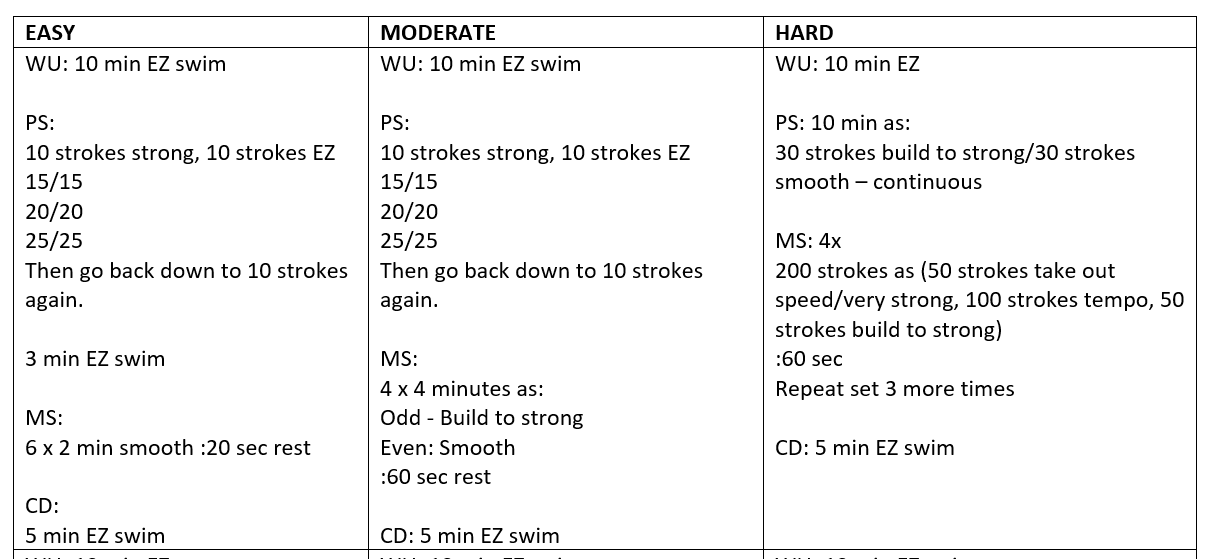
30 workouts for open water and tethered swimming

Trimarni


Do you have access to open water but find yourself bored and exhausted with continuous swimming?Do you need a bit of workout inspiration for your new at-home pool set-up while your local pool is closed?

To help you get more out of your swim training, I have 30 mentally-engaging swim workouts that are sure to help you build and maintain your swim fitness strength, endurance, skills and power.

What’s included in the swim training plan? 

15 stationary swim workouts (~30-45 minutes per workout)

  • Requires the use of a tether/resistance band and some type of pool.
  • Workouts are broken into 3 categories (5 workouts each): easy, moderate and hard based on intensity/volume.
  • Workouts cater to all fitness levels.
  • Sent via email as a document (PDF).
To learn more about our experience buying an above ground pool and swimming with a tether, check out this blog post.

15 open water swim workouts (~45-60 minutes per workout)
  • Requires the use of a body of water (max continuous swimming is ~10 minutes)
  • Workouts are broken into 3 categories (5 workouts each): easy, moderate and hard based on intensity/volume.
  • Workouts cater to all fitness levels.
  • Sent via email as a document (PDF).

Add on:
If you need motivation, inspiration and accountability with your strength training regime, you can add-on our strength training template, which includes 20 different strength/core/plank/swim dryland workout routines (videos performed by Marni). Minimal equipment required (hand weights, stretch cord, resistance band, stability ball, soup cans).

To learn more about the training plan, click HERE.

TriWeek: Swimming Tips

Trimarni


It's National Triathlon Week!

National Triathlon Week is an initiative created by USA Triathlon to celebrate multisport and all its constituency groups. "National Triathlon Week is a celebration of not only triathletes, but all members of the multisport community, including officials, coaches, race directors, families and friends of triathletes and more."

On behalf of Triweek, I'll be sharing some information on each sport (swim, bike, run) to help you make the most of your triathlon training journey. If you are new to the sport (or thinking about training for a triathlon), I hope you find this information helpful.

                                                 -------------------------------------------------


Without a doubt, a pool offers a very controlled, safe and consistent swimming environment.

Add in 1000+ athletes in the open water and you have a very different situation compared to pool swimming.


As a triathlete, you must remember that your swim training should be preparing you for open water swimming. You are not a competitive swimmer - you are a triathlete. Your race day swim will last between 10 minutes to 2 hours (depending on the distance) and when you are finished swimming, you need to have the energy to bike and run (knowing that as the race continues, you'll be experiencing more fatigue). Because of the unpredictable and uncomfortable nature of open water swimming, it's important to equip yourself with the proper technique and fitness that will help you swim efficiently and confidently on race day.  

  1. Improve your body posture in the water. If you did not grow up as a swimmer, you likely struggle to "hold" yourself in the water. In other words, it takes a great amount of extra energy just to position your body in the water so that you don't sink. Unlike land sports, where gravity helps you hold your posture, in the water, you are not familiar with your body weight. Once you are in the water, you weigh about 10% of what you do on land. It’s no surprise that when you are in the water, you expend a lot of extra energy in your legs (kicking) to help you stay afloat. Because of poor body posture, there's a good chance that you are dragging yourself through the water, making swimming extremely exhausting. As an example, think about how easy it feels to swim when you have on your buoyancy shorts, a wetsuit or a pull buoy. The buoy or buoyancy garment is helping you achieve good posture in the water. But remove the added buoyancy and you lose that good posture in the water and swimming suddenly feels more difficult This has less to do with your swimming fitness and more to do with your swimming posture. 
  2. Tautness - When you look at a "fast" swimmer, they are usually stiff and firm. Most triathlon swimmers are soft and floppy in the water. Tautness in your core and torso is what helps you swim more efficiently in the water, helping you conserve energy. Once you learn how to swim with a “stiff” or taut body, it will be easier to achieve good posture in the water, helping you swim faster (less drag) with less energy expended.
  3. Improve your body alignment - When you swim, proper alignment helps you swim through the water with the least amount of resistance possible. Without good alignment, errors occur in your stroke. If your body is anything but aligned (ex. noodly, scissor kicking, crossing your arms over the midline of the body), you create an excessive amount of drag and you must expend more energy than needed to move through the water. It's important to avoid excessive movements that are preventing you from staying in a straight line. 
TRIATHLON POOL TOOLS

As it relates to your swimming fitness and technique, the greatest benefit you'll receive is through the use of pool tools. Many newbie triathletes try to master perfect swim technique, similar to a competitive pool swimmer. However, gliding, rolling and a slow arm cadence will not help you in the open water. 

Swimming tools are not crutches (or cheating). Every tool has a purpose and each tool is designed to help you improve your body position, tautness and alignment in the water for more efficient open water, triathlon specific swimming. I've been swimming competitively for over 20 years and I use the same pool tools as Karel, who has only been swimming since 2012.
Whereas you may not feel the benefit of using the pool tool immediately, the goal of using the tool is to help you swim better without the tool. In open water, you have no walls to rest on, no black line to follow and you have to navigate yourself through waves, chop and current, as well as hundreds of other swimming bodies. Your pool tools will help you become a better triathlon swimmer. 
  • Ankle strap - The ankle strap/band/lock is an effective method to force you to be “taut” in the water. By eliminating the use of your legs, requiring you to keep a more taught/stiff body with your core, you are forced to use your upper body to move you through the water without the use of your lower body. If you have poor body position in the water and struggle to keep a taut body position, you will likely find it impossible (and exhausting) to swim with the strap as you feel like your feet are dragging on the pool bottom. With time, by using the ankle strap (and a small buoy or buoyancy shorts for a helpful lift), your body position and tautness will improve.  The ankle strap will also minimize excessive hip rotation. A higher cadence and stronger catch will also increase your propulsion through the water – which is the most efficient way to swim as a triathlete (propulsion should not come from kicking!). 
  • Pull buoy - To help with your body position, a pull buoy is a tool, not a crutch. Therefore, anytime you swim with the buoy, you want to feel how the buoy is lifting your body in the water. As you swim with the buoy, you’ll find it easier to keep your head, hips and feet in a straight line and your legs and hips will not swing from side to side with every stroke. The buoy is also a tool to "rest" your legs while requiring you to use more of your upper body (which is what you need for more efficient open water swimming).  Let the buoy be an aid to developing better form in the pool and don’t hesitate to use the buoy when you feel tired in the water, when form suffers. Keep the buoy between your thighs. Another way to give your body a lift without restricting your legs is through buoyancy shorts. 
  • Snorkel – A snorkel is a training tool that helps you focus on technique without the disruption of moving your head. The snorkel also allows you to focus on all of the components of your stroke without needing to turn your head to breath. Many stroke flaws, like scissor kicking, crossing your hands in front of the body and swinging hips occur when you turn your head to breath. The snorkel allows you to correct specific flaws while also building fitness in the water.  I suggest to use a nose clip if you feel like you are suffocating with just the snorkel. If you normally do flip turns, you can do an open turn with the snorkel, if needed. 
  • Paddles – Paddles offer a strength component to swimming. They should not be viewed as a way to swim faster. You want to think of the paddle as an extension of your forearm position. We have our athletes use three different types of paddles for each provides a different tool for the job to help with your arm mechanics and catch.  For example, the FINIS agility paddles do not have a strap, which forces you to have a palm positive hand position to correct incorrect technique when your hand enters the water and pulls through the stroke. Paddles should be small (the size of your hand) and should be used wisely as poor form with a paddle can cause shoulder issues. 
  • Fins – Sure, you may feel super fast with fins but when used properly, they are designed to help you with fluency. Fins help you move through the water with a rhythm, providing less work for your lower body as you focus on your upper body mechanics.  Do not overkick when using fins. And to avoid cramping, you need to kick from your hips and not from your knees, feet or calves. Think of the fins as an extension of your legs, with the kick coming from your hips. Fins will also help you work on ankle flexibility. Fins can help you learn how to drive your kick from your hips and not from the knee. Fins are also helpful when performing drills (ex. single arm drills).  Kicking is important but it doesn’t propel you forward as an open water swimmer/triathlete. Save your legs for the land! If you cramp with fins, this may be a sign that you tense your calf or feet muscles when you kick. Also if you run before you swim, you are more likely to cramp. Make sure to warm-up your ankles and feet before you swim and be sure to relax your feet, calves and legs when you kick lightly in the water.  

Triathlon swimming take-away tips: 
  • Swim frequently (3-5 times per week) and consistently throughout the entire year. Stay accountable to your swim training. 
  • Be patient. Swimming is a technique driven sport. It's takes a lot of practice. 
  • When you are tired from running and biking, you'll feel it the most in the pool. Don't get frustrated when you form feels off. 
  • Incorporate swim "bricks" where you swim and run or swim and then bike to get yourself use to transferring from the horizontal swim position to being more upright. 
  • Make every swim workout purposeful - with a specific warm-up, pre-set and main set to get the most out of your time in the pool. Avoid non-stop, continuous swimming "workouts" as you'll only teach yourself how to swim with poor form due to fatigue. 
  • Stay present, focused and dedicated to each swim session. You need a clear pathway so you know where you are going with your swim training.
  • Your swim training should first focus on your body position. Next comes the strength/propulsion component. Then comes specificity to prepare you mentally and physically for the open water. Focus less on gaining speed or trying to achieve a certain distance for each swim but instead, focus on swimming efficiently and effectively so that you can become swimfit for the open water. 


Swim training - to fuel or not to fuel?

Trimarni


During our 3.5 day train-cation in Clermont, Florida we were spoiled by swimming in NTC pool - perfect water temp, lots of open swim lanes, surrounded by swimmers/triathletes and most importantly, swimming outside! Because the pool is my happy place, I was super happy to see so much swimming on my training plan. In four swims (over 5 days), I completed 17,600 yards of following the black line and I never stopped smiling.

Two of our workouts went by extremely fast, even though they were 4000+ yards. Not always do Karel and I have the same swim workouts (or on the same days) but for camp we swam the same sets but had different cycles for the main set. Here were my two favorite swim sessions from camp:

Tuesday (4000 yards)
WU: 800 choice

Pre-set:
100 drill
3 x 50's (kick/swim)
2 x 75's open turns
100 choice
4 x 25's build
3 x 50's head up free
2 x 75's kick/swim/kick
100 choice

MS: All with paddles
18 x 100's as:
#1: on 1:20 (cycle)
#2: 1:30
#3-4: 1:20
#5: 1:30
#6-8: 1:20
#9: 1:30
#10-13: 1:20
#14: 1:30
#15-18: 1:25

CD as needed

Wednesday (5000 yards)
WU: 600 w/ buoy

MS:
9 x 100's on 1:30 @80% effort
4 x 200's w/ paddles on 2:50
7 x 100's on 1:30 @90% effort
400 w/ buoy
5 x 100's swim on 1:30 @95% effort
2 x 200's w/ paddles on 2:50
3 x 100's swim on 1:30 @best effort
200 buoy

Post set:
200 EZ

----------------------------
Many triathletes and swimmers feel that fueling/hydrating during a workout isn't necessary for if you can't do it during a race/meet, why do it in training? The point of training is to change your physiology in order to maximize your athletic performance/fitness while also preparing for the race day demands. With this, it's critically important to stay consistent (and healthy), so we often do things in training that we don't do in races in order to help build strength, endurance and speed, while also improving skills and technique. Sport nutrition and nutrient timing are two important ways to help the adaption response to training. 

When I swam in High School and in College, I would rarely sip on water on deck when I swam. There were mornings when I would swim a long workout on an empty stomach and I never had a precise fueling strategy for a swim meet. While I did OK during this time in my life, I wish I knew then what I knew now, as I feel I could have adapted a lot better to swim training, while also reducing my frequent issues with muscle soreness in my back, while also feeling rundown and exhausted. 

Although my swim workouts are not as long (or intense) as when I swam in college, I still typically swim 4-5 times per week an around 60-75 minutes per swim. Although I don't consider them as exhausting as some of my run and bike sessions, I still make the effort to always eat before my workouts and use sport nutrition during my workouts. Rather than going into the specifics of how to fuel for swim training sessions (you can find detailed info about fueling your workouts in my book Essential Sports Nutrition), I'd like to share a bit about the physiology of swimming and how proper fueling can help you better adapt to your swim training, especially if you are triathlete. 

-------------------------
Swimming is a strength, technical and endurance sport. In addition to the difficulty of dealing with your displaced body in water, there's a lot of resistance (or drag) when you swim. As you push against water to move forward, water pushes back to slow you down. A huge part of swim training is optimizing technique in order to forcefully thrust (or propel) yourself forward while reducing drag and optimizing buoyancy and alignment. Although technique work is important, it's only in the face of fatigue that good technique will give you a big performance boost. If your form falls apart when you get tired, your propulsive force will greatly decline and you'll become more inefficient and exhausted. Thus, an overvalued component of swimming (especially for triathletes) is being strong in the water. Simply swimming back and forth, for x-yards, is an ineffective use of your time as it relates to making significant performance improvements. You must train your different energy systems (swimming at different speeds), while keeping great technique.

Although swimming may be exhausting to many and easy for some, it should still be viewed as a strength-endurance sport. This means your training should include a mix of high-intensity efforts (to tap into the phosphagen system and anaerobic glycolysis) and endurance or lower-intensity training to improve efficacy of swimming technique while improving your aerobic pathway (VO2 max, max oxygen consumption).

Understanding the physiological demands of swim training (and outcome goals for each session) is important because as it relates to sport nutrition, you'll quickly realize that with swimming, glycogen stores in the muscles can easily become depleted. This will compromises your ability to keep good technique under fatigue and will affect your propulsive strength capacities. Consequently, this decreases the training adaption that you could be making through your swim training. Sure, you are checking off the workout but it doesn't count if you aren't making significant performance gains. By understanding the demands of your sport, you can better identify the factors that will affect your ability to adapt. Certainly nutritional strategies can help optimize your swimming performance. 

While any athlete can "get by" for a workout or two in an energy deficit state, long-term periods of being in a poor energy balance can affect hormones, metabolism, strength and power, while increasing the risk of injury, burn out and sickness. Beginning a training session with low carbohydrate availability (especially if you trained the night before an early morning workout or you are restricting carbohydrates in your diet), can increase metabolic stress during your swim workout. Again, yes you may be able to complete the workout, but without proper fueling, the stress response increases. It's also worth mentioning that when engaging in high intensity training sessions, adequate carbohydrate intake/stores can improve the health of the immune system - meaning less risk for sickness. Lastly, even though you may not feel it, you still have hydration needs while swimming. The higher the water temperature (or the warmer you feel in the water), the higher your sweat rate. Starting your sessions well hydrated and hydrating throughout your training session (often with a sport drink containing carbohydrate and sodium) can help optimizing hydration while maintaining blood glucose levels. Because most triathletes are not overly fond of swim training, a significant drop in blood glucose can turn your mood sour and raise RPE - making it easy to cut your workout short (or dislike swimming all together). 

Getting your nutrition right is key for athletic success. Don't compromise your performance and health by being extremely dedicated to your training plan and apathetic to your diet and fueling regime. 

Weekly (swim) training recap

Marni Sumbal, MS, RD


I love to swim but there's something so special about swimming in the Kona ocean. While you always see brightly colored fishes swimming happily around you, it's not uncommon to see a pod of dolphins or a cute little dog on a boat, waiting for salty kisses. Oh the things you see in the bright blue waters of Kona.

After IMWI, I was itching to race again. I am actually still wanting to do another race (half Iroman) but my options are limited due to our upcoming travels and other events. Earlier this year, I signed up for my 3rd Hincapie Gran Fondo here in Greenville, SC which will officially conclude my 2018 "racing" season. However, I still have one more event approaching - the 2.4 mile Hoa'la training swim on the Ironman World Championship swim course. While a fun event for everyone who participates, it's still a tough event in the unpredictable ocean, along with a couple hundred other fit and fast athletes.

Because I am not yet ready to stop training (mentally or physically), I am maintaining my fitness with some intense run workouts along with joining Karel for a few of his IM Kona prep rides. I made sure to take good care of myself post IMWI and to be honest, this was the fastest and best that I have recovered from an Ironman. I am looking forward to a deserved off-season in early November (when Karel takes his off-season) but for now, I'm continuing to enjoy training at a much higher intensity than when I was training for the Ironman.

Karel has given me some tough swim workouts this week so I thought I'd share a few of the main sets with you. These are PPF and Tower26-inspired swims. Karel and I typically swim the same workout but lately we have had different workouts.

Total distance this week: 18,100 yards (My typical swim days are M, Tu, Wed, Fri, Sun).

Workout #1: 
MS: (all with 10 sec rest)
100 EZ, 100 fast, 100 EZ (with buoy), 100 at Ironman (IM) effort
100 EZ, 100 fast, 100 EZ (buoy), 200 at IM effort

100 EZ, 100 fast, 100 EZ (buoy), 300 at IM effort
100 EZ, 100 fast, 100 EZ (buoy), 400 at IM effort
100 EZ, 100 fast, 100 EZ (buoy), 500 at IM effort
100 EZ, 100 fast, 100 EZ (buoy), 600 at IM effort

Workout #2
MS 2x's:
300 strong endurance
30 sec rest
6 x 50's fast w/ 10 sec rest
6 x 25's very fast w/ 10 sec rest
300 pull (buoy/paddles)

Workout #3

MS 3x's:
2 x 50's fast w/ a deck-up after each 50 (quickly get up out of the pool, touch the wall and get back into the water) w/ 10 sec rest
400 build to strong
6 x 50's w/ buoy and paddles w/ 10 sec rest

Do you get gassy after swimming?

Marni Sumbal, MS, RD


GI issues are very common among athletes - specifically endurance athletes in the sports of running, cycling and triathlon. Don't let the happy post-workout smiles on social media fool you for a good number of athletes experience unwelcomed intestinal problems during exercise.

The most common (and annoying) GI complaints include:
  • Belching
  • Nausea
  • Heartburn
  • Gas
  • Abdominal cramping
  • Loose stools
  • Abdominal pain
  • Diarrhea 
  • Vomiting
  • Side stiches
There are several common reasons for GI issues such as dehydration (thus why athletes complain of many more GI issues in the summer months versus winter), high fiber/fat foods and using NSAIDs such as ibuprofen.  Although runners more frequently experience GI issues compared to other athletes, in my latest Triathlete magazine article (July 2018, pg. 62), I discussed some of the reasons why swimmers/triathletes may get gassy after swimming and how to minimize this unpleasant post-swim issue. 


Ironman-ish swim workout

Marni Sumbal, MS, RD


The pool is my happy place. I don't always feel great in the water but I am always happy to be in the water. Lately, my swimming has felt strong and speedy. Sometimes I find myself in a swimming slump and I just feel horrible in the water for weeks at a time. I typically swim 4-5 times per week - 4 days during the week and typically once on the weekend on Sunday late afternoon. When I am feeling good, I treasure those swims and the workouts that I get to do when I am feeling ON.

Yesterday was one of those days. I had a great swim workout and despite feeling a bit tired near the end (with heavy arms), I was focused the entire time, enjoyed the entire set and managed to do a great job executing the workout. Again, this doesn't always happen so when I feel good, I make sure to take note of these workouts and put them in my memory bank to refer back to come race day (just in case any doubts pop into my head - which they usually do as it's normal to have those pre-race worries and what ifs).

Here's the swim workout from Tues morning:

Warm-up:
500 EZ swim (last 50 backstroke)
200 kick with fins (on my back alternating free/fly by 50)

Pre-set: 2x's:
2 x 25s max w/ paddles
50 EZ
50 max w/ paddles
2 x 25's EZ
(rest 10 sec)
This is a great set, above, to do on race week to get the engine going) 

Main set
8 x 200's w/ 30 sec rest
8 x 100's w/ 20 sec rest
8 x 50's w/ 10 sec rest

All as: 
2 x 70%
2 x 80%
2 x 90%
2 x very strong

Cool down:
100 w/ buoy
50 breastroke/backstroke

The key to this set is to focus on execution which means not going out too hard and to be able to keep good rhythm and form even when tired as the set progresses. It's also important to stick to the rest breaks. I didn't take any extra rest between each part of the main set. I sipped on 1 scoop EFS during in 20 ounce water during the swi (finished the entire bottle during my swim)

Here's the data from my swim (I usually don't swim with a watch but I wanted to capture my splits from this workout):
4100 yards (57:41 swim time, 1:10 total time in the pool)
8 x 200's as:
3:01
2:56
2:51
2:47
2:42
2:40
2:37
2:35

8 x 100's as:
1:26
1:24
1:22
1:21
1:18
1:17
1:16
1:15

8 x 50's as (as you can see, I don't get much faster the shorter the distance :)
:42
:41
:39.92
:39.46
:38.9
:38.3
:37.1
:36.72


Benefits of pool toys for triathletes

Marni Sumbal, MS, RD


Benefits of Pool Toys
Most age-group triathletes come into the sport with little to no swimming experience. Because swimming is very skill specific, most triathletes lack the proper body position, alignment and posture to swim efficiently for continuous efforts. Poor swimming technique often brings added stress and unnecessary energy expended, which may cause frustration, anxiety and exhaustion while swim training. Because every triathlete should be swim-fit in an effort to feel confident at the start of a triathlon, the use of pool toys may help improve swimming mechanics which can also help to boost swim fitness. 


  1. Pull Buoy - A pull buoy is a tool – not a crutch. A buoy provides assistance to help you hold horizontal alignment while also giving you buoyancy. When you swim with a buoy, pay close attention to what your body feels like with the added "lift". Let the buoy be an aid to teach you how to hold a more efficient body position without dragging your legs behind you.

     
  2. Ankle strap - The ankle strap (also called an ankle band or ankle lock) is an effective tool to force you to be more “taut” in the water. By eliminating the kick from your freestyle stroke,you are forced to use your upper body, instead of your legs, to propel you forward in the water (the more efficient way to swim). The ankle strap also teaches you how to catch and hold on to more water as you push the water behind you. The ankle strap will minimize excessive hip rotation and will force you to swim with a higher cadence, which is important for open water swimming. Although the ankle strap may feel like torture at first, it quickly alerts you to poor swimming technique. If you struggle swimming 25 yards with only the ankle strap, start by using a buoy between your thighs (not ankles) or use the ankle strap combined with buoyancy shorts. Overtime, try to eliminate the added buoyancy and only use the ankle strap.

     
  3. Paddles - Paddles are an added strength component to swimming so be mindful that paddle work is tough/exhausting and your paddles should not be much larger than your hand. You want to think of the paddle as an extension of your forearm position. Paddles like the Finis Agility Paddles help promote an early catch and early vertical forearm position. Because agility paddles do not have a strap, this requires a palm positive hand position to correct incorrect technique when your hand enters the water and pulls through the stroke.  Paddles should be used wisely as poor form with a paddle can cause shoulder issues (or may exhaust you). Paddles are designed to help you increase pulling intensity and load but they can also help you improve your catch, forcing you to maintain a high elbow position under the water, throughout your entire pull phase. If you are feeling sore in your shoulder socket while using paddles, you are not using the correct muscles or your paddle is too large.

     
  4. Fins - Sure, you may feel super-fast when you use fins but they are designed to help with swimming fluency in the water - not to help you become a better kicker. Fins for kick sets can help with ankle flexibility while teaching you how to kick from your hips and not from your feet/knees. Fins also help you move smoothly through the water when focusing on upper body technique. When you use fins, don’t overemphasize kicking. Save your legs for the land!  Fins can also teach you how to kick with plantar flexion (pointed toes instead of breaking with your feet and pointing your toes to the ground). We recommend the TYR cross blade fins - rigid on the sides with flexibility at the end of the fins. 

     
  5. Snorkel - A snorkel is a training tool that helps you focus on your technique without the disruption of turning your head to breathe. Because many stroke flaws happen when you are tired or have inefficient breathing patterns, by using the snorkel, you eliminate the breathing part of your stroke and you are no longer interrupted every few strokes (or every other stroke) to catch a breath. Without the continuous head rotation from breathing, you can create good motor patterns regarding the symmetry of your stroke, alignment and body position. The snorkel also helps with body and head position and alignment. For good head position in the water, you should be looking at the bottom of the pool but slightly in front of you. Eyes should look in the direction you are moving. Your hands should be dropping in the channel between the midline and shoulder line of the body. If you struggle with the snorkel, suggest to invest in a nose clip to use with the snorkel. 
To continue your triathlon swimming education, suggest to subscribe/listen to the Tower 26 Be Race Ready podcast. 

Scottsdale, Arizona Train-Cation - Day 4

Marni Sumbal, MS, RD


Some swim workouts are better with company. A swim partner keeps you accountable to getting to the pool to start your workout and to stay in the pool to finish your workout. 

For our last workout of our train-cation, we had a mega swim workout provided by Tower 26.

My body was still feeling pretty tired from the bike ride on Wednesday but I shifted my mindset from "I'm too tired" to "you can do it!"

Here's the swim workout......

500 warm-up
4 x 50's kick with snorkel and board w/ 10 sec rest

Pre set:
400 swim w/ fins and snorkel

MS: 10 x 350's with 40 seconds rest as
#1-4: 70, 75, 80, 85%.
#5-7: 85% (same effort as #4)
#8-9: 70%
#10: Best effort

CD: 100 EZ
Total: 4600 yards

Scottsdale, AZ Train-Cation - Day 2

Marni Sumbal, MS, RD


Before I talk about our last workout of the day, let's start with the first workout of the day.....

Day two of our mini train-cation started with an outdoor swim.......
My happy place. My comfort zone. My favorite sport!

After my mental struggles on the bike yesterday, I was so excited to start Tuesday with a 75-minute, 4350 yard swim workout (prescribed by Tower 26). I had never done this workout before and really enjoyed it.

WU: 500
Pre set: 5 x 200's with snorkel and fins with 20 sec rest as
200 swim
150 swim, 50 kick with board (head down in water stretching arms out while holding the edge of the board)
100 swim, 100  kick
50 swim, 150 kick
200 kick

MS:
500 at 70% w/ 1 min rest
2 x 250's at 75% w/ 40 sec rest
4 x 125's at 80% w/ 30 sec rest
7 x 75's at 85% w/ 20 sec rest
25 EZ

Post set:
500 smooth with snorkel, buoy, ankle strap

12 x 25's at 95% on 40 sec interval

50 EZ

After the swim, we changed and headed to the gym for a 50-minute strength circuit focusing on full body, with a lot of hamstring/core/back work. It was intense!

After the workout, time to EAT! I may just need to do another blog on all of our delicious eats because we have been enjoying some yummy meals filled with fresh ingredients! Today we ate at Mojo Morning Joint, which was amazing after our morning workout. I had the skinny frittata and Karel had the Mojo Burrito and the Rise and Shine smoothie. Oh - and I also got a mini cinnamon roll because......I love cinnamon rolls!

After our eats, we rested for about 90 minutes (Karel took a short nap and I got caught up on emails since I am not a napper) and it was time for our 2nd workout of the day - a trail run!


There's something so therapeutic about running on trails - out in nature and free from the world. Although this trail required a lot of ankle and hip strength to run over all of the rocks (there was a bit of walking to safely navigate my way over some piles of rocks), I felt really strong running on the trails. Plus, it was a heck of a workout! Emily tackled the trails like a champ which just shows me that trail running requires a lot of time to build strong tendons and ligaments to tolerate the twisty, turner nature of running off the flat road. I can't tell you how many times I rolled my ankle on the run today but thankfully, no inflammation or sprain (or falls!).

Fun fact about the cactus...

It can take 10 years for a saguaro cactus to reach 1 inch in height. By 70 years of age, a saguaro cactus can reach 6 and a half feet tall, and will finally start to produce their first flowers. By 95-100 years in age, a saguaro cactus can reach a height of 15-16 feet, and could start to produce its first arm.


Thanks to the fun fact, every time I see a cactus here, I try to figure out how old it is. How old do you think this cactus is?

Well, day two of our mini training camp is a wrap and now it's time to eat some yummy pizza from Picazzo's (and leftovers) and fuel up for our big workout tomorrow!

Weekend recap: Training

Marni Sumbal, MS, RD


It's hard to believe that we will be racing in about 8 weeks at the conclusion of our Clermont training camp. We have been putting in some good work training indoors over the past few weeks due to the cooler temps and rainy days but with the weekend forecast looking good, we gathered up the crew for a Saturday long ride. Exploring Greenville on two wheels was on the training agenda and we took full advantage of our nicer weather! 


But first, a Friday swim workout for me and Karel to leave the arms heavy all day. 


MS: 30 x 100's at 85% on 1:28 cycle. 
Whew...that was a long swim requiring a lot of focus and energy! 
Karel swam with his buoyancy shorts (which have helped him out a lot with his swimming development) and paddles so he was much faster than me. He did his 100's on a 1:26 cycle! 

As for the rest of Friday, after working all day, I had my teeth cleaned at the dentist (yay for healthy teeth and gums!), stopped at the grocery to stock up the pantry and fridge for a weekend full of cooking and baking (recipes and food pics to come in the next blog!) and then took Campy for a long 1+ hour walk as I was tired of sitting all day. 


The weather was absolutely beautiful (70's and sunny) and it was just a perfect evening to be outside. Around 5pm, Campy and I walked to my mom's house and then we walked around her neighborhood before returning home. Karel had a RETUL fit on Friday afternoon + a private bike skills session to follow so he was rather tired from being on his feet and riding all afternoon so he had an early dinner and then relaxed in the evening while finishing up some work on the computer. Campy and I returned home from our walk and then I ate dinner before getting started with some cooking and baking (yum) for the next hour, before going to bed around 10pm. 


Thankfully, my no-rain dance worked and the rain that was planned for Saturday morning didn't happen so we had dry roads and cloudy skies instead for our 8:30am roll out. After spending the last two weekends inside for long trainer rides, it felt so good to be on the tri bike outside (and in great company with Trimarnis Bryan, Karel, Thomas and Al). 


Our plan was to ride to and up/down Caesar's head mountain, which was a great idea until the fog became too unsafe for us to continue riding to the top. Karel was leading the way and made the call that we needed to stop for safety reasons (even with lights on bikes). We stopped about 2 miles from the top, which was still 20 minutes of climbing and a fun descend to the bottom. 


The fog made for some pretty neat scenery while climbing and all around, it was just a great morning to be on my bike. 


After 3 hours and 45 minutes of riding (a little over 5000 feet of climbing), we made it back to Trimarni HQ's for a quick gear change to get ready for our brick run. Once again, the brick runs have been on the treadmill for the past two weekends so it was nice to pound the pavement with the guys for 25 minutes. 

After the brick, it was time to refuel with a recovery drink and some of my yummy treats that I made on Friday evening. Campy didn't want to miss out on the eating fun so he joined us in the garage, just in case anything tasty "accidentally" dropped on the ground. 


After resting for an hour on the couch, it was time to get some work done on the computer and then get to more cooking. We invited my mom over for dinner so she brought the main dish (stuffed shells with tofu) and I made the side dish which was a Moroccan lentil dish. And for dessert, chocolate cookies! Don't worry, I'll share the recipes and food pics tomorrow but to make your mouth water, you can head over to my Facebook page to check out the pictures. 

Karel and I were pretty tired on Saturday evening so we made it until about 9:30pm and then it was time to get ready for bed. No surprise, Campy was pooped from his exhausting day. 

Sunday was absolutely great for running. Just like Saturday, not too hot, not too cold. It felt so nice to be outside for 1 hour and 48 minutes of running. My run workout started off with a little hip/glute activation in our home-gym and then some outside dynamic stretching and then a 5 minute power walk to get the blood flowing. As for the rest of the run, it was a conversational pace run, where I incorporated 30 sec walk breaks every mile to reduce the overall training stress and included a stronger effort up any hills. Of course, where I live there are no shortage of hills so I had about 1000+ feet of stronger efforts. Surprisingly, my legs felt rather good throughout the entire run and I was able to keep good form. I stayed well hydrated with my Nathan hydration belt and refilled as needed throughout my run at water fountains. It was great to see so many people outside enjoying the nice weather!


Campy happily joined me for a post run walk as Karel was still out running (he warmed up with a 30 minute trainer bike before his 90 minute run). Karel rested for a little bit (and refueled) before an afternoon RETUL fit and I had some work to do on the computer before getting in one last swim workout (2250 yards) in the late afternoon to wrap up another great week of training. 

It was a successful, busy, yummy and active weekend of training and I could not be more thankful to my body for keeping me in good health so that I can live such an active lifestyle. 


Life skills learned from sport

Marni Sumbal, MS, RD


Tonight I will be speaking at Furman University to a small group of exercise science students for career night.
I will share my 11-year extensive educational journey and how it got me to where I am today. I will also share some of my real world experiences and tips of owning your own business (and lessons learned along the way). 


It wasn’t too long ago when I was listening to experts discuss various professions in the fields of nutrition, exercise, health and fitness.

I always found career night to be a valuable opportunity to learn about interesting and sometimes not so interesting careers. 


My hope is to inspire the students to continue their education and to explore the many job opportunities out there. It's a great feeling to make a living from doing something that you love. 

My best advice to the students is not to stress about finding the perfect career. Let it find you. There is no right or wrong path to finding your dream job. Whatever you eventually end up doing in life for work, always stay true to yourself and do what you love.
If you pursue your passion, you will always be motivated to work.


On the topic of careers, I realize how important education/schooling is when searching for a job but to be honest, I developed many life/job skills from being a lifelong athlete.

  
Although my education has always been a high priority in my life, sport has given me many useful skills that I constantly apply to my work life. 


Skills gained from sport:


-Self-discipline and dedication
-No short cuts
-Patience
-Hard work ethic
-Learn from mistakes
-Healthy and active lifestyle
-Confidence
-Team work 

-Time management
-Setting goals
-Being a leader and teammate 
-Learning from others
-Sacrifices and priorities 
-Dealing with pressure and stress
-Constructive criticism 
-Focus and concentration 
-It’s not always about being the best

IM Kona '16: Day 9

Marni Sumbal, MS, RD


Starting a Kona blog with little to no clothes on can only mean one thing.....


It's Thursday of race week!


Which means it's time for the 2016 Ironman Underpants Run!!


While this Kona spectacle has turned into a looked-forward-to event among, well, everyone on the island, there is actually a story behind the Kona Underpants Run. 


My day started early as I biked to the Clif Bar base house at 5:50 to arrive by 6:10am to lead the Clif Bar media group (and my contact Lisa from Clif Bar) for a 4 mile from to town. The miles went by fast and before we knew it, we were in town just in time for me to take off some clothes to join my Trimarni teammies. 


The walk to the official start of the undie run (behind the King K hotel) is filled with laughs as the streets are filled with lots of well designed (and some, not so much) underwear "costumes". 


Even the doggies came out to participate. 


The UPR (underpants run) is a mix of enjoying running around with little clothes on, taking pictures and checking out what other athletes are (not) wearing. 


The actual "run" is about 1.5 miles (if that) and is a mix of jogging, walking and running. 


And a lot of picture taking. 


Trimarni athlete Justine designed our Splish Trimarni suits (which I absolutely love) and Karel ordered his jean-inspired speedo from Shinesty


Ali'i drive has never looked so good. 


Thank you Justine's hubby Eric for these great pics!


After the run, it was time to cool off in the ocean for a swim to the coffee boat. The media girls (and a few others) from Clif Bar wanted to experience the fun of swimming to the Clif Bar coffee boat so I lead the group out to the boat (about 500 yards out). I was really proud of a few of the girls who had never swam in open water before!


While I just love swimming, this swim was extra special as we not only saw dolphins but the dolphins put on a show for us with lots of twists and flips. It was totally unreal and so hard to describe but it will go down as one of my top moments in life that I never want to forget. Thank you dolphins!


And if swimming with dolphins wasn't enough, I received some puppy kisses in the ocean. 


I love swimming but it's even better when you can get a little love from a furry friend. Thanks A.J. for making my day!


After the run/swim, it was finally time to head back to the Clif Bar base camp house for breakfast. 


Talk about a delish breakfast!


But then again, I'm not surprised at the goodness of our breakfast meal as Clif Bar takes pride in real, locally sourced, food.


These Acai bowls were amazing!

After breakfast, we were introduced to a few new Clif Bar products (coming out in 2017 - stay tuned!) and then I gave a nutrition talk at the Base Camp house regarding the diets of Ironman athletes, how Ironman athletes fuel before, during and after the race (and training) and a few tricks/tips of Ironman athletes. The media girls asked some great questions. 

Around 12:30pm, it was time for me to bike back to my condo to get a few things done before heading off at 3:30pm (on our bikes) to the PPF house for a pre-race talk by Matt Dixon. 


Matt gives the best pre-race talks, always filled with great advice. 


After the meeting, Karel and I biked down the hill to the Clif Bar base camp house for a lovely dinner with the Clif Bar family (including Gary Erickson and his wife Kit - the creator of Clif Bar)


Karel only stayed for a short time before heading back to our condo (on his bike) to attend the athlete banquet with Trimarni athlete Leigh Ann. Karel also stayed for the 8pm mandatory athlete briefing. 


When I finally returned home from a full day of activities around 8:30pm, I had a chance to unload my box and bag of goodies from Clif Bar, including a lot of items from ROKA, Under Armour, Hoka, Zoot and Garmin.

Thank you Clif Bar for being more than a company that makes "products".

You make great tasting food, made with organic ingredients, to fuel active lifestyles.

You care about the planet.
You care about people.
You care about farmers.
You care about food.
You care about athletes.

My 5th IM Kona, as a first time non-participating athlete, has been a special one thanks to being here with my Clif Bar family. 

IM Kona '16: Day 8

Marni Sumbal, MS, RD


The town of Kailua Kona is getting crazy. Crazy busy that is.
There is so much going on all day every day, that it's hard to not be overly busy all day. 


On Wednesday morning, we started the day with a 7am swim at the pier. 


No surprise, it was packed. 


Every where you look, there is signage and booths. 


We met up with the PPF crew for a quick talk by Matt regarding sighting (hint: don't sight just for buoys, sight on landmarks by your turn buoys and by the finish to help keep you on course) and then we were off into the water for a 25-30 minute swim w/ a few efforts. 


Justine and I did our efforts together (with a stop at the Clif Bar coffee boat for a refreshment mid swim) which included 6 x 3 min strong efforts w/ rest as needed in between. 


After the swim, we quickly changed into our cycling gear for a ride. 


Karel joined us for just the warm-up and then he was off. Leigh Ann and Justine both included 3 x 6 min build efforts w/ 4 min EZ in between for a 75 minute ride.
I rode along for the company. 


Gotta be on the look out for Paparazzi! 


They are everywhere!


Even on the side of the road on the Queen K hwy. 


Since we didn't ride too far past the airport, the winds stayed relatively calm for all three intervals. 


Karel had to make sure he took his obligatory lava field photos with his bike.


We finished the ride just before 10am which meant a quick shower and smoothie (I'm loving adding papaya to my whey and milk smoothies - so creamy!) before heading to the expo. 


Clif Bar asked me to take part in the nutrition expo panel at 11am to talk about the on course sport nutrition products for the IM athletes, specific to Clif Bar. 


I was joined on stage by Gatorade, Base Performance and Hot Shot.


Karel came to the expo soon after I started the talk so it was nice to see him in the audience. By 11:30am, we were done so it was time to finally check out the IM Kona expo. 


Karel is loving all of the bike stuff in Kona. It's hard to stump Karel with a bike question as he knows everything and anything about bikes because he is always learning, researching and staying up-to-date with all things bikes. 


We had a few hours of downtime before it was time to get on our bikes and head to the Clif Bar BBQ. So much to do! 


It's easy to bump into familiar faces in Kona. Hello Colleen! 


It was so great to hang out with some familiar faces and to get some IM Kona advice (for our first timers Justine and Leigh Ann) from Linsey Corbin and Sarah Piampiano. 


We enjoyed some salted watermelon non-alcoholic drinks to keep us cool while noshing on some fresh fruit. 


We are rooting for Clif Bar CEO Kevin who will be racing his first IM World Championship on Saturday (2nd Ironman). It's pretty cool to see a CEO do an IM but I think this just speaks about the lifestyle of the Clif Bar employees in that this company breaths and lives physical activity. 


I was super happy to connect with my friend/Clif Bar contact Lisa, who will be keeping me busy on Thursday with some Clif Bar activities. 


After the BBQ, it was time to relax after a long day of well, having a lot of fun.

I want to send a huge shout out to Boco Gear for hooking us up with the full line of the 2016 Kona limited edition hats.

You can make your purchase for a stylish, functional and comfortable hat HERE.

The next blog post will feature the famous underpants run!


IM Kona '16: Day 7

Marni Sumbal, MS, RD


IM Kona race week is nuts.
Until you are here in Kona to experience the craziness in which athletes from all over the world take-over Ali'i drive, it's really hard to describe what it is like here in Kona during this week.
Seeing that triathletes are extremely passionate about swim/bike/run and ALL gear and products related to the sport, this island feeds any triathlon addiction and you simply feel "normal" all week as you are surrounded by thousands of other like-minded individuals. 

I say all of this as a 4x Ironman World Championship finisher but also as a first time spectator.
I'm overwhelmed by all the stuff going on and I'm not even racing! :)

There's really no other way to describe this week as it's filled with so many to-do's.....funny enough, many of which have nothing to do with race day! There is no much hype going on with the Ironman World Championship and it's so easy to be busy all day, every day.

Our athletes are sticking to their training while still making a little time to experience everything going on here in Kona.

On Tuesday morning, we planned a 40-45 minute run at the energy lab for Justine and Leigh Ann to see the 4 miles that they will cover from mile 16-20 of the marathon run of the Ironman but first we made a stop at the Levelen house for sweat testing.
I have always wanted to get a sweat test for more concrete analysis of how much fluid and electrolytes I (and my athletes) loose during training. I have had great success in working with athletes and adjusting their sodium and fluids based on things like urination, weight loss, etc. but this takes away the guessing. Oddly enough, my athletes and Karel were almost spot-on with replacing their electrolytes per my recommendations of how much salt I have them add to their drinks.

Certainly, here in Kona, fluid loss is extreme so most athletes will drink at least 1/2 - 1 full bottle of water per hour in addition to a bottle of sport nutrition.


I'm hoping to incorporate sweat testing into my nutrition services where I can use a system to test my athletes so stay tuned.
Thank you Levelen for introducing us to a great system of dialing in sport nutrition to optimize performance!


The method of sweat testing:
-Get naked and weigh yourself
-Weigh all bottles that you will use during training (and fluids)
-Put on the patch to collect sweat (fluids and electrolytes)
-Go workout
-Weigh yourself for fluids lost
-Remove patch, get it analyzed
-Get your results
-Adjust your nutrition protocol as needed


My results below.


After we left Levelen, we drove to the energy lab (6 miles from Palani drive) and we parked at the parking lot at the end of the main road of the energy lab). 


It was nearing 8:30am and it was warm and a little windy. Certainly not extreme conditions for the "natural energy" portion of the island.


After a dynamic warm-up, we went off for our run workout:
10 min EZ jog
Stretch it out
MS: 3 x 6 min build to strong effort w/ 4 min EZ jog/walk in between
CD
Total 45 minutes


The energy lab has a slight net decline for about a mile off Queen K (which occurs at mile 16 of the IM run course) and then it veers to the right to finish up the out section of the energy lab. Special needs is at mile 18. Then it's a slight incline back up to mile 20 to exit the energy lab for the last 6 miles of the IM run course on the Queen K, to Palani and back into town to the finish. 


It's been very special to share this all with my athletes (and Karel) as everything is so new to Justine and Leigh Ann so we are trying to give them every tip and trick and suggestion for the best race performance, execution and experience possible. 


Leigh Ann's athlete (she is also a coach) Mike ran with Karel - two speedsters!


After a hot and sweaty run, it was time to return back to Levelen to turn in our sweat samples. 


After we returned back to our condo (Kona Plaza) we walked to the pier for Justine and Leigh Ann to see the main stage (start/finish area) of the IM World Championship for the first time. 


With SO many triathletes everywhere, it's hard not to bump into familiar faces. It was great to see Trimarni campers Alex and Angie who are here in Kona to spectate. 


Since this was the first time for our athletes to be in the ocean, we let them play around for a 15-20 minute "splash" to see the fishes and to experience the beauty of swimming in the Kona ocean. 


Yay pink.....


After getting some food into our bellies, I accompanied Karel to registration until I was no longer allowed to cross the line "Athletes only". 


In the mean time, I snapped some pics. 


Official!!! 


Karel is now officially an IM World Championship participant for the 2nd year in a row. 


Around 5pm, it was time for the Parade of Nations where we watched athletes from all over the world walk down Ali'i drive. 


Go CZECH! :) 


Mike Reilly cheering on the athletes


GO USA!


For dinner, we made edamame and plain pasta w/ veggies which was delicious.
It was a long day so we were asleep by 9:30pm in order to get a good night of rest before another exciting day in Kona.