We’d love to hear from you.

We welcome your thoughts, experiences, comments, suggestions, questions or personal stories. If you don't hear from us right away, please note that your email is very important to us. We will do our best to respond with 24 hours.


Greenville, SC

Trimarni is place where athletes and fitness enthusiasts receive motivation, inspiration, education, counseling and coaching in the areas of nutrition, fitness, health, sport nutrition, training and life.

We emphasize a real food diet and our coaching philosophy is simple: Train hard, recover harder. No junk miles but instead, respect for your amazing body. Every time you move your body you do so with a purpose. Our services are designed with your goals in mind so that you can live an active and healthy, balanced lifestyle.

Blog

2019 Clermont Train-Cation Recap

Trimarni


For the past few years, Karel and I have dedicated a few days in the month of February to a personal "training camp." We ran this idea by our coaches and they supplied us with our workouts for 3.5 days of training in warm and sunny Clermont, Florida. We are very familiar with Clermont as it was the first place where we held a training camp back in 2013. Since then, we have held five camps in Clermont, Florida. Also, when we lived in Clearwater and then Jacksonville, Karel and I would annually participate in the Clermont Horrible Hundred bike event in November.

Clermont is a great place for triathletes. The NTC (National Training Center) has an incredible facility with a huge outdoor pool that would make even the most anti-swimmer triathlete want to swim. The one-day rate is a little pricey ($15/person) but it's worth it when you get to swim outdoors and be surrounded by other like-minded individuals (there's no shortage of triathletes in the area, no matter when you go to Clermont).


There are countless routes for cycling. Since we were last in Clermont (in 2017), there have been so many new developments, roads and cycling trails. Although we consider Greenville, SC super bike friendly, it's incredible how many cycling-friendly paths there are in the area. We also feel safe on the road, mostly because the drivers are accustomed to sharing the roads with cyclists/triathletes. We have been fairly lucky with this trip as the weather was perfectly HOT when we arrived on Sunday evening. Although Wed was rainy and chilly, we were lucky to get two warm days to start our train-cation. It's been a nice change from our weather in Greenville (which is not that bad compared to way up north!). And in case you were wondering, Clermont is hilly!! Although we are searching out more "flat" terrain while we are here, we are getting plenty of ups and downs to remind us of home. 


As for running, there's the notorious Clay Trail that is a rolling hill trail covered in orangish clay. It's very popular among visitors and locals. We were planning to run on it on Thurs but due to weather, we had to swap Wed/Thurs workouts. While there are plenty of paved trails for running, we enjoy running by the Waterfront Lake - which is home to a series of triathlon events from March until October.

Tomorrow we will conclude our training camp with one last big workout. Here's the run down so far...

Monday AM:
4300 yard swim
2:46 ride

Monday PM:
50 minute run

Tuesday AM:
3:49 ride
(Karel had a 25 min run off the bike)

Tuesday PM:
4000 yard swim (with a 40 min break before the main set due to lightening)

Wednesday AM:
5000 yard swim
1 hour run for me, 50 min run for Karel

Wednesday PM:
30 minute run

Thursday AM (still to come!)
5 hour ride
20 min brick run

With a lot of training to pack into 3.5 days, nutrition plays a huge role in our training - all year long.  Consistency is key for us as we love the process of training, but we also care greatly about our health. In my opinion, nothing says "healthy" when you think about the stress that we put our body under when we are training for 3-5 hours a day so it's very important for us (and for all athletes) to consider the role of the daily diet and sport nutrition to help the body perform well and adapt to this intentional overload of training stress.

While I always put a lot of thought and effort into how we eat and fuel, it never feels too overwhelming for me. With a background in exercise science (Bachelor degree) and exercise physiology (Master degree), I find that sport nutrition comes quite simple for me. Because I know what's going on on a physiological level, it's much easier for me to know how to eat, fuel and hydrate on a daily basis. 

I prepped a lot of food before we traveled to Clermont so that we could easily put together a balanced meal in a hurry, without needing to think about meal planning (or waiting for food). Rather than making complete meals, I made a bunch of different foods such as rice, quinoa, boiled potatoes, sauteed veggies, tempeh, tofu and chicken. I also brought along some staples like honey, syrup, PB and oatmeal, as well as some "fun" foods like Oreas and pita chips (however, the later two haven't been consumed very much). Karel and I are all about real food to make up the majority of our diet but as endurance athletes, there is room for the "fun" foods. We never worry about eating "too much" and we also don't focus on body image when we train (or throughout the day). Food is our fuel and nourishment and we don't ever restrict ourselves (that includes fueling before and during workouts). 

Although I am all about real food, there's a time and a place for sport nutrition - specifically powders and bars. I'm grateful for the sport nutrition companies out there who have well-formulated products with safe and effective ingredients. When I search for a quality sport nutrition product, I look for the carbohydrates, electrolytes and formulation to ensure that it's well made and also that it can be easily digested and absorbed. I am not a fan of "boosters" and additives in sport nutrition products so to me, sport nutrition needs to be simple - give the body what it needs and nothing more. If the body needs something more (ex. BCAAs, protein, fat, etc.), get it from an extra source and not from your primary sport drink. By supplying the body with what it needs during a workout (with the right type of product and amount), the body can perform at its best and the stress response decreases (with less risk for injury, burnout and sickness). This is how the body can best stay "healthy" through intense and high volume training. In my opinion, sport nutrition products are not unhealthy - they keep the body in good health! That is - if you use them properly.

Throughout this camp, I've not consumed any energy drinks or caffeinated products outside of my one cup of coffee in the morning. The energy that I need comes from my daily diet and from the fuel and hydration that I consume during training (and after training). 


Karel and I don't get to train like this very often. Even with the Ironman World Championship as our priority race this season (in October), this will likely be our only personal training camp of the year. The rest of the season will include a lot of private and group training camps for athletes and we will squeeze in our own training when it makes sense. As part of this mini train-cation, I wanted to use social media to show you how we train, fuel and eat. It's not extreme, sexy or complicated. Yes, it does require a lot of planning, understanding and effort, but I feel it's an obligation to my body to take care of it. 


It's not uncommon for endurance athletes to want to change how they look and to experience strong feelings before, during and after workouts to be lighter, leaner or stronger. This often leads to overexercising and underfueling. However, there is also a large group of athletes who don't think this way but just lack an understanding of how to fuel and eat to support the training load. Regardless of the group that you fit into, haphazard fueling and eating can result in health issues and a performance decline.

As it relates to the former group, rather than fueling for consistent training, great health and a stronger body, athletes sabotage great workouts by not eating properly. The body becomes weaker and more fragile as the goal switches from being strong, fit and healthy to train more and to eat less.

There are far too many nutrition "experts" who are encouraging athletes to avoid carbs and sport nutrition and even to fast for 8-24 hours at a time. Because of this, athletes are scared and confused about food. This thinking is absolutely wrong!!!


The outcomes of an underfueled/undernourished body are not advantageous. I could not image training in an underfueled, undernourished state. Workouts are hard enough as they are, even when I'm well fueled! 

If you have been told to not fuel before, during or after a workout OR you feel you are chronically undernourished OR you are occasionally severely restricting your food/sport nutrition intake, you may be putting your body at an increased risk for injury, burnout and illness. 

Please be kind to your body. Take care of it and give your body the fuel and nourishment that it deserves. In return you'll be rewarded with great health, consistent training and an improved quality of life. 

Will your current diet fail you?

Marni Sumbal, MS, RD


When it comes to sports success, diet is a big piece of the puzzle that many athletes struggle to appreciate and master. Around this time of the year, when the temps are moderate to cold, overall training load is low and the training stress is not extremely high, it's easy to get away with haphazard fueling methods and inconsistent eating habits. However, as training intensity and volume increase (especially with the added stressor of heat), the previous style of eating that you thought was working for you, may soon present major issues for your health and performance.

Karel and I are currently in Clermont, Florida for a mini train-cation. 3.5 days of a training overload in a different environment. While we can't completely check out of our daily work responsibilities, there's the understanding that we are here to train and to absorb as much training stress as we can.

With this comes a huge responsibility to our bodies to make sure we are fueling and hydrating well (it's hot here!) before, during and after every training session. Any major slip-up and we could compromise our health and performance. Similar to training in our home-environment, our goal of training is always to make a positive return on our training investments. With this comes attention and awareness of what and how we are eating.

An athlete who is dehydrated, glycogen-depleted, deficient in nutrients, sleep deprived and stressed will not perform at his/her best. Whether it's intentional (rigid dieting) or unintentional (poor planning/lack of understanding), it's not uncommon for athletes to suffer from hormonal imbalance, anemia, stress fractures, loss of strength and power, GI issues, fatigue, moodiness, lack of appetite (or overeating), low motivation and an overall decline in performance due to not meeting energy, fluid and electrolyte needs. In other words, as your training changes, your diet needs to change as well. The greater the training stress, the more emphasis you need to put on what, how much and when you are eating.

While some of the symptoms of improper fueling and inadequate nutrition will not show up until health and performance is already compromised, pay attention to the following that may indicate that your current diet is no longer meeting your training demands:
  • Feeling dizzy, lightheaded, weak or "fuzzy" when training (or during the day)
  • Headaches
  • Nausea
  • GI issues - bloating, gas, loose stools, constipation 
  • A significant decline in strength, power, speed and stamina
  • Trouble sleeping (falling asleep or staying asleep)
  • Lack of appetite
  • A significant change in your appetite
  • Unintentional weight loss, specifically a quick amount of weight loss in a short amount of time
  • Unintentional weight gain, specifically around the midsection
  • Prolonged recovery, abnormal muscle soreness, chronic joint aches
  • Heavy reliance on anti-inflammatory meds
  • Increased reliance on caffeine to "survive" the day and workouts
  • Decrease in self-esteem, mood and confidence
  • Suppressed immune system - more frequent sickness or more time needed to recover from sickness
  • Chronically feeling dehydrated, change in urination habits
  • Increased injuries
  • Loss of enthusiasm for the sport
  • Irritability, trouble concentrating 
Although disordered eating and rigid dieting are often the cause of not meeting the energy and hydration demands of training, most athletes lack the knowledge and appreciation for the amount of fuel, calories, nutrients and fluids that are needed to support sport specific training.

To reduce the risk of a health or performance setback this season, reach out to a sport RD (CSSD) who can optimize your diet and provide fueling strategies for before, during and after training to help you reach athletic excellence without compromising your health and well-being.

Don't just be dedicated to training. You can train as hard as you want to, but without good nutrition and fueling, you'll never reach your full potential.

Pumpkin Pecan Maple Oatmeal

Marni Sumbal, MS, RD


Deep into winter, it's time to spice-up your plain bowl of oatmeal with this delicious recipe filled with pumpkin, pecans and maple syrup. 

 Pumpkin Pecan Maple Oatmeal
By Joey Mock, RD, LD, CLT

Ingredients

  • 1 cup old-fashioned rolled oats
  • 1 ¾ cups soy, almond, or low fat cow's milk
  • ¼ cup canned pure pumpkin
  • ½ teaspoon vanilla extract
  • ½ teaspoon ground cinnamon
  • ¼ teaspoon ground nutmeg
  • 2 Tablespoons chopped pecans
  • Pure maple syrup, to taste


Preparation
  1. Combine oats and milk in a small saucepan over medium heat.
  2. Bring to a boil stirring occasionally. Reduce heat and simmer, continuing to stir, about 4 minutes.
  3. Stir in pumpkin, vanilla, cinnamon and nutmeg. Continue to simmer about 1 minute until heated through.
  4. Top with pecans and a drizzle of maple syrup and serve immediately.
  5. Enjoy!
Adapted from: Damn Delicious Pumpkin Pie Oatmeal recipe


Hydration and Performance

Marni Sumbal, MS, RD


The first step to optimizing performance is mastering your daily hydration needs to maintain proper body functions. Fluids are critical to optimal health. They replenish what has been lost through normal physiological processes, such as respiration, sweating and urination. To optimize cardiovascular and thermoregulatory functions, it's important to subscribe to a comprehensive fluid-replacement program. Identify the best beverages to consume and plan your fluid intake - frequency and volume - around and during exercise. 


To help simplify this confusing topic, I highly suggest to listen to the Purple Patch Fitness Podcast with Andy Blow from Precision Hydration.  Matt and Andy go into the specifics of hydration and why athletes should pay more attention to hydration needs on a daily basis and during training. 


If you are like most athletes and desire specific guidelines and strategies for optimizing hydration intake, I feel you'll really find my book Essential Sports Nutrition practical and useful. Within the book, I provide several sport specific strategies on how to hydrate (and fuel) for better results.

I start the book by discussing fluid and electrolytes and how to identify dehydration (and overhydration) symptoms. I then discussing fluid balance - specifically fluid loss and fluid intake. With so many different types of fluids -from coffee and tea to sport drinks - I discuss several different types of drinks and the pros and cons. Within part two of the book, I spend three chapters discussing how to best hydrate (and fuel) before exercise, during and after exercise, on rest days and during competition. Respective to every type of workout or competition scenario, I give specific guidelines to help you fine-tune your hydration and fueling strategies. 

To fully understand and apply sport nutrition concepts, it's important to have a great understanding of exercise science, exercise physiology and sport nutrition. I feel Andy and Matt did an exceptional job dissecting this complicated topic and I hope my book can serve as a comprehensive - yet easy-to-read guide - to help you optimize your performance and maintain optimal health.

If you already have my book, THANK YOU! Because most online consumers are influenced by reviews when purchasing a product, after you read my book, it would be great if you could leave a review on Amazon. Click HERE and scroll down to Review this product. 

In pursuit of race weight

Marni Sumbal, MS, RD


With January behind us, there's a good chance that you are getting a bit more serious with your training and diet. Motivation is high, all with hopes that this will be the season when you reach your BIG performance goals.

With an extreme drive to succeed, you may be looking for the many ways that you can optimize performance.

Body composition has and will always play a role in performance. Many athletes are on a never-ending pursuit to achieve the perfect weight for race day. However, being lighter isn't always better.

I've touched on this topic many times in the past but I don't think it can be discussed too much. In a media-driven world, body image has become an obsession among athletes - particularly how you compare your body image to the body image that you see on others. In today's "visual" society, it's not hard to compare how you look to other people. This may cause you to question your looks and lose confidence in your abilities. With this comes a strong desire to look for ways to "fix" yourself - often in hopes of becoming a better athlete (or to "look" more like an athlete).

Whereas you would think that athletes would be obsessed with eating "enough" to perform consistently well in training in an effort to become strong, fit and healthy enough to tolerate the demands of racing, athletes are often anxiously worried about eating "too much". However, lighter isn't always better.

Sadly, for many athletes, the attempt of reaching "race weight" becomes detrimental to health and performance. When an athlete is trying to train for an endurance event while attempting to lose weight/lean-up, it can be rather difficult to adapt to training and recover properly from workouts. This is why far too many athletes fail to improve performance when attempting to intentionally reach "race weight" and often become sick, injured or burnt out. And for those who are able to change body composition from increasing the training load and restricting calories, it's rare to see an athlete become a better athlete in the long-term. Overtime, they become the opposite - weak and fragile. In other words, just because you reach race weight, this doesn't mean you have achieved the fitness level necessary to perform to your physical, emotional and mental capabilities on race day.

I'm a firm believer that if you fuel and nourish your body properly throughout the year, your body can adapt to every phase of training and you'll arrive to your races with a fit, strong and healthy body. This idea of unintentional weight loss means not trying to proactively lose weight through restricting calories, watching every morsel of food that goes into your body, eliminating carbs (or food groups) and performing fasted training sessions. Understanding the changing demands of your training as you progress throughout the year, your nutrition should also change. There are going to be times when you need more calories and carbohydrates to support the energy demands of your training. If you restrict calories and carbohydrates, you'll eat too little to support your overall training load and your body will become compromised. Then there are times when you are burning a mix of carbohydrates and fat and overall energy expenditure is rather low. This doesn't mean that you should avoid carbohydrates and follow a low calorie diet but instead, you need to be mindful of what and how you are eating.

By matching your nutrient intake to the demands of training, you can maintain the quality of your training so you can optimize performance for race day. As you improve your sport-specific fitness through consistent training, your body will adapt by oxidizing fuel more efficiently. Naturally, your body composition will change - without extreme measures. Remember, sport isn't about body image. It's about performance. Every athlete has an optional body weight that allows for optimal performance. How you need to look to perform at your best may differ than how you think you need to look.

The Ventum makeover

Marni Sumbal, MS, RD


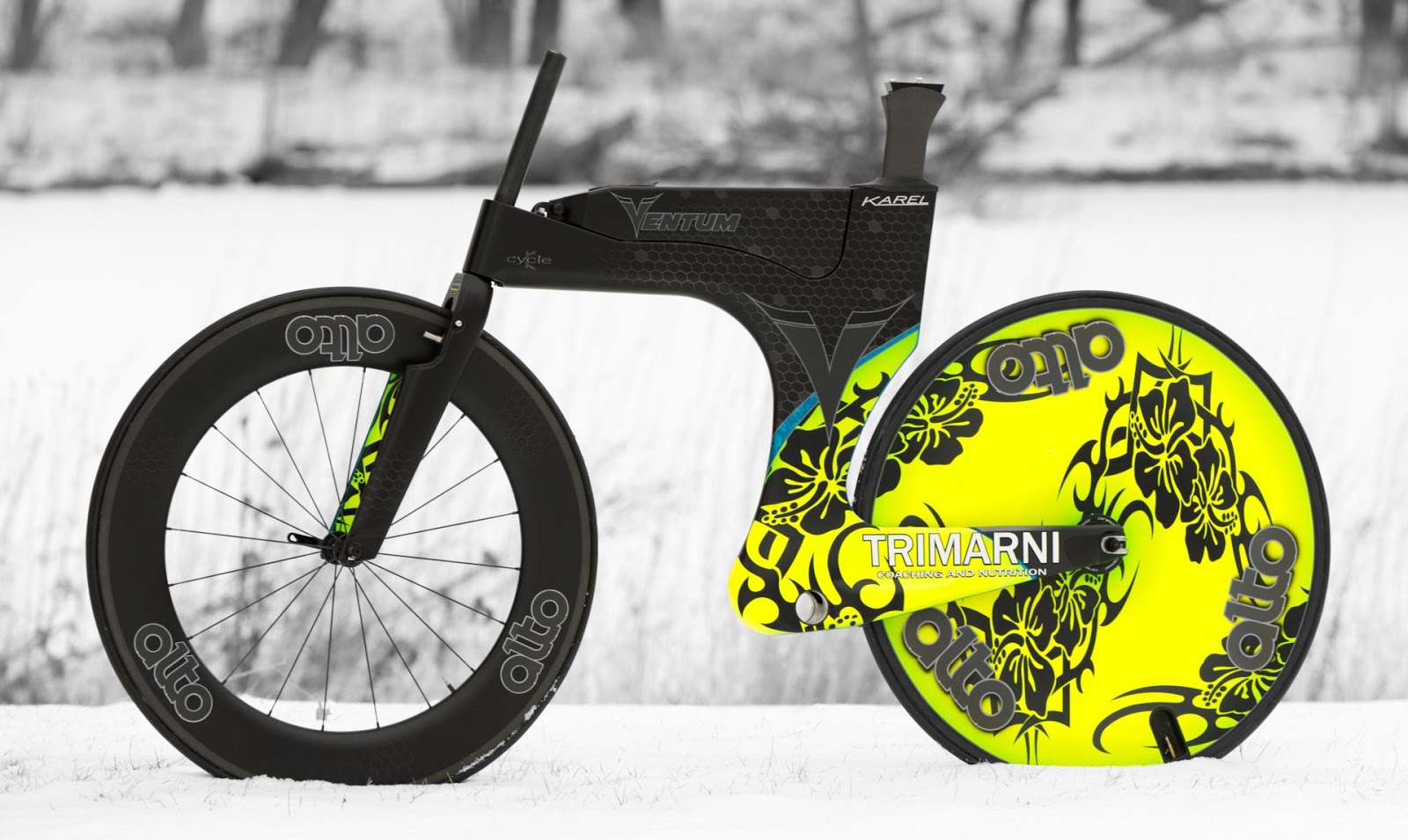
When Karel learned about the custom paint work of Mike Furtek of Kcycle Design in early 2018, he couldn't pass up the opportunity of a receiving a complimentary custom paint job on his Ventum. Karel's bike was flashy and certainly stood out in a crowd.

With a new season approaching, Karel wanted a makeover on his bike. Something a bit more his style - black. This time around, Karel paid for the paint (a special and very specific type of paint) and let Mike go to work, creating another incredible design. Once again, Mike created a masterpiece and a one-of-a-kind bike. The pictures don't really capture the details of the deep shiny black paint. Mike did an incredible job hand painting this bike.

Karel also has a new handlebar setup by 51 Speedshop, along with his Dash Cycles aero combo, Alto Cycling wheels and new 4iiii dual-side powermeter.

Saturday was Karel's first time since November (IMFL) outside on his Ventum and he was riding happy for all 3.5 hours. Having a hand painted bike is certainly a luxury but seeing that bikes are kinda like art, it's only fitting that Karel has a bike that looks like an expensive painting. Karel is over the moon excited about his Ventum makeover. 


Happiness destination syndrome

Trimarni


Do you suffer from happiness destination syndrome?

  • You struggle to commit to something just in case something better comes your way. 
  • You believe that when you reach your goal, you'll be happy. 
  • You are always rushed and in a hurry. 
  • You can't let yourself slow down. 
  • You are always anxious and overwhelmed about what's next on your to-do list. 
  • You never let yourself relax. 
  • You are constantly counting down the days until ___. 
  • You want to live in the future instead of accepting where you are now. 
  • You are always thinking about the next big thing in your life. 
  • You'll feel more at ease when you get ____ done. 
  • Your mind is always wandering. 

If you suffer from this type of destination thinking, you may believe that success is a destination - and only in the future is when or where you can be happy. Life quickly passes by as all of your focus is somewhere else - in the future.

Think about how you go about your week. Are you constantly on the go, wishing for the weekend or waiting for the summer in an effort to be happy? Have you convinced yourself that you can only be happy when you reach a certain fitness level or body composition?

Happiness is not a destination or an outcome. You must enjoy the day - not just survive the day.

There's a lot of great stuff happening in your life right now. Nothing is promised in the future. If you are constantly thinking that happiness is somewhere else, you're going to miss out on many great moments, experiences and opportunities.  More so, there's no point of arrival. By constantly being in pursuit of some type of future happiness or success, you are going to find yourself constantly dissatisfied.

Learn to live in the moment and with purpose. Instead of thinking about the end result, focus on the process. Stop rushing through life as quick as possible with the belief that somewhere in time, you'll enjoy your life more than you do right now.

Slow Cooker Whiskey Barbecue Beef

Trimarni


Slow Cooker Whiskey Barbecue Beef
By Joey Mock, RD, LD, CLT

Are you ready for the Big Game? If you are a football fan, you may be planning to watch the Rams take on the Patriots in the Super Bowl. With any good Super Bowl viewing party (whether it’s for the game, commercials, or half time show), good food is a must. This Slow Cooker Whiskey Barbecue Beef makes a tasty option for your party that won’t require a lot of cooking and cleaning up during the game. Prep everything in the morning and let the slow cooker do the rest of the work (well, most of it). Serve on your favorite rolls/buns or tortillas.

Ingredients

For the Whiskey Barbecue Sauce: (can be made ahead of time and refrigerated if desired-yields about 2 ½ cups so you will have leftovers to use on chicken or wherever you enjoy barbecue sauce)

½ medium onion, finely chopped
4 cloves garlic, minced
¾ cup bourbon whiskey (blended Canadian whiskey works great too)
½ teaspoon ground black pepper
1 teaspoon salt
2 cups ketchup
¼ cup tomato paste (from an ~6 ounce can-reserve the remainder of the can for the beef)
⅓ cup apple cider vinegar
1 Tablespoon paprika
3 dashes cayenne pepper (can use more if you like a little more heat)
¼ cup Worcestershire sauce
½ cup packed brown sugar
⅓ teaspoon hot sauce, or to taste

For the Beef:
1 small yellow onion, finely chopped
~2 pound top round (London broil) roast, with visible fat trimmed off
Kosher salt and freshly ground black pepper to taste
1 Tablespoon canola oil
2 Tablespoons minced garlic
1 teaspoon paprika
1-14 ounce container reduced sodium beef broth
2 cups water
Tomato paste, remainder of the ~6 ounce can of tomato paste from making barbecue sauce


Preparation
  1. To make the barbecue sauce, in a large skillet over medium heat, combine the onion, garlic, and whiskey. Simmer for about 10 minutes until onion is translucent. 
  2. Mix in the remaining ingredients. 
  3. Bring to a boil and then reduce heat to medium-low and simmer for about 20 minutes. Remove from pan, cool, and refrigerate until ready to use.
  4. Place chopped onion in slow cooker.
  5. Salt and pepper both sides of beef. Heat canola oil in large skillet and sear all sides of beef roast. Transfer beef to slow cooker.
  6. Add minced garlic, paprika, beef broth, water, and tomato paste to slow cooker and stir until all are combined.
  7. Cook on low for about 6-7 hours until done.
  8. Remove roast from slow cooker and shred meat.
  9. Remove liquid from slow cooker straining off and reserving onions and then reserving liquid.
  10. Add shredded beef, strained onions, and ~1 ½ cups of the Whiskey Barbecue sauce back to slow cooker. Use reserved liquid to gradually add back to slow cooker, stirring between additions, until desired consistency is reached (you will only use a small amount of the liquid until the beef/barbecue mixture is moist but not too liquidy).
  11. Cook on low for about 30 minutes until heated through. 
  12. Serve on your favorite rolls/buns or tortillas and enjoy!

Athletes - be careful of trending diets

Trimarni


It seems like fasting is all the rage these days. Although not a new concept for athletes (fasted workouts have been studied by researchers for several decades), not eating has grown in popularity over the years as a way to enhance and optimize fat burning and to promote weight loss. There's also the claim that fasted training can improve athletic performance in endurance athletes - although according to consistent research, that doesn't appear to be the case.

One of the major reasons for a massive shift in how athletes eat is an overwhelming obsession with energy, performance and body image. Athletes are also hungry for direction, guidance and quick fixes.

In addition to fasted training and intermittent fasting, there is a wide spectrum of diet ideologies these days - ketogenic, vegan, clean eating, Gluten free and Paleo to name a few. What's interesting is the culture around these diets and their "communities."

The dieting behaviors embraced by followers is worth discussing for eating ideologies is very cult-like. It's almost as if athletes are joining a movement and you are either in or you are out. Behind every diet is a number of extremely passionate individuals. The more rules, the greater the devotion among followers. Advocates of certain diets (or styles of eating) can often get very defensive when methods are questioned. Sadly, within every diet is a lot of unhealthy and unethical information. Question your dedicated followers and you'll quickly be attacked.

Interestingly, those who are successful with a diet often become more credible when it comes to offering advice. It's almost as if those who can succeed the best are given higher authority to promote the diet. Sadly, this is almost always independent of nutrition background. Often, those who lose the most weight, can fast the longest or perform the best on a certain diet quickly become an expert and chief advocate of the diet. As a very important reminder, what works for one person doesn't give that person a right to give advice on nutrition.

As a professional in this field (with a license to prescribe dietary advice), I find it important to not be tied to one diet belief. While there are healthy eating components that everyone should follow, dietary choices and patterns can differ. There's no one-size-fits-all approach to eating - especially when it comes to health, weight loss, body composition or performance. Genetics, metabolism, culture, emotions, economics and health status all influence eating patterns and should be concerned when personalizing a diet that is sustainable and health and performance promoting.

If you are following a diet hot topic and its working for you - that's wonderful. But if you are questioning if you should be doing fasted workouts, putting your body into ketosis, going vegan or giving up sugar, dairy and grains, be mindful that diet does play a role in health and performance but food is not the answer to every health and performance concern. There's great power in food but food isn't the be all end all. Your diet needs to be flexible and shouldn't take over your life. If you experience shame, guilt, anxiety or stress because you can't be perfect with your diet, you are falling into a dietary trap that isn't right for you or your body.

Diet hot topics will never go away - especially when athletes are eager to find the "next best thing" to help improve performance or body composition. Athletes are overwhelmed by choice so it makes sense that athletes will seek a style of eating that has strict rules and a diet "leader" to reduce confusion. As a human being, you have a responsibility to your body and that means not believing everything that you hear. There's a lot of bad (and sometimes dangerous) advice out there - especially on the internet, in forums, on Youtube and from podcasts. When you are vulnerable for a health change (or performance boost), it can be difficult to decipher good from bad advice.

It's important to take charge of your health and find ways that work for you to help you reach your performance goals. That being said, be cautious with online diet communities, forums and podcasts as the advice you receive may be counterproductive to your health and performance goals.

If you have a health or performance concern or question, consult with a knowledgeable and credible professional, such as a Board Certified Sport Dietitian.

Information overload: 10 Tips for Triathletes

Trimarni


When starting a new athletic journey or wanting to live a healthier, more active life, it's normal to try to find as much information as possible on a given topic. Information overload is common in today's society. Although it's easy to get information from the internet, it can easily prevent athletes and fitness enthusiasts from taking action or making sensible decisions due to too much information to consume. And more so, so much of the information available provides conflicting advice.

Given all the advice, tips, hacks and plans that are available, many people fail to start (or stay in) a sport, exercise regime or a more healthy style of eating because they are afraid of doing something wrong. For example, the simple task of finding the right pair of running shoes, warm-up routine, swim goggles or pre-workout snack can feel overwhelming.

Most of the time, the best way to minimize information overload is to focus on the most simple path to get you started, keep you healthy and to maintain consistency. There's no one-size-fits all when it comes to what will work (or not work) for your health, training and fitness journey.  While it's great to learn, always listen to your body and figure out what works best for you.

As part of our event "Triathlon Night," each expert had an opportunity to share their top tip related to their area of expertise. I wanted to share a few simple, practical and realistic tips that I heard from the experts in our Greenville community:
  1. Don't expect or look for quick fixes. 
  2. Never neglect sleep. This is where growth happens. 
  3. Don't diet. Eat right and give your body what it needs to perform. 
  4. Don't neglect your mental and physical health while training for a triathlon. 
  5. Keep up with prehab. Regular massage therapist or PT work should be part of your regime. Don't wait until you are injured to start treating your body. 
  6. Make time for strength training - especially core strength. A strong body performs well.
  7. Work on your breathing and movement patterns - many triathletes don't know how to breath properly or to move efficiently. 
  8. Keep the sport fun. If you start to feel overwhelmed, take a step back and remember why you started. 
  9. Don't be afraid to ask for help. Invest into a team of experts to keep you on your path. 
  10. Your bike fit and shoe choice should be unique to your body - not based on what other athletes are using. 

Triathlon Night - helping to grow the sport

Trimarni


In late December I told Karel that I wanted to put on an event to help grow the sport of triathlon in our Greenville community. It was a large undertaking but at the conclusion of the event last night, I feel like it was a great success. We had over 100 people attend from all over the area. The focus of the event was to put all types of triathlon experts and resources together in one room, combined with new, future and experience triathletes. All in an effort to help new, future and experienced triathletes get more out of their personal triathlon journey.

Although I've only been in the sport for a little over twelve years, I've seen a lot of changes over the years. Triathlon is a fast growing sport - in 2017 there were ~4 million participants in triathlons in the U.S! However, triathletes make up a very small community compared to runners. Because the sport of triathlon is still evolving, there's a lot of confusion with the best practices for training, nutrition, racing and how to incorporate a 3-sport activity into an already busy and stressful life.

This lead me to the purpose of this event. With so many barriers to entry and misguided and extreme practices, it's hard for many people to get into the sport....and stay in the sport. Triathlon is an expensive and time-consuming sport but if you equip yourself with the right people, you'll find yourself getting the most out of your triathlon journey - without sacrificing your relationships, health or bank account. Triathlon is a motivating, inspiring and fun sport but far too often it can become all-encompassing, health destroying and viewed as a chore. I don't believe that the later has to happen if the right experts are in your corner.

After earning my Masters in Exercise Physiology, I become a triathlon coach. Although I've been a coach since I started the sport, my knowledge in the sport has grown tremendously over the past few years. While Karel and I have a lot of coaching experience, never would we say that we know it all. We are constantly learning by making the effort to surround ourselves with experts who know a lot more than we do (and have much more experience than we do). Through these experts and resources, our athletes can become better athletes and we can coach them better. Whether it's a proper bike fit, massage, sport dietitian or physical therapist, every triathlete can benefit from being part of a team of experts. This team can help to reduce the risk for setbacks, can instruct on the most appropriate gear and equipment to fit your budget and can treat you like an individual so that you can get the most out of your triathlon journey.

To help grow the sport of triathlon, it's starts within the community. But within every community, cliques can easily develop. One expert feels threatened by another expert and the athlete is forced to take sides. While this may never change, I do feel that within each community, we need a more inclusive feel of experts - especially by coaches. By focusing on what you are good at, not going against your philosophy and what you believe in and being open to new ideas, thoughts, methods, be proud to welcome people who have great educational and real life experience in an specific area that you don't excel in. This is all in an effort to help your athletes excel. When we start on the community level, it's easier to grow the sport on a more global scale.

To ensure that this event was inclusive, I welcomed any and every local "expert" to the event. This event was free of ego, judgement and cliques as we had several "experts" of the same area in the room. Every expert had the opportunity to introduce themselves, share a little about their business or specialty area and provide info on how athletes can contact the individual. This event was great for newbie and future triathletes as well as for the experienced athletes and experts.

I love this sport now as much as when I started back in 2005-2006. It's my hope that we can get more people in the sport of triathlon and keep them in the sport for many more years to come. It all starts with every athlete having an all-start team of experts.
A huge thank you to those who attended the event. Thank you Randy for opening the Carolina Triathlon store to us for over 2 hours on a Sunday evening. And wow - the raffle prizes were incredible! Thank you to the following companies for donating to the event. 
  • Katouff Supplements
  • Run In 
  • Xterra
  • Sam Smith
  • Katie Malone
  • Brad McKay
  • Joylynn Simmons
  • Set Up Events
  • Zealious
  • Clif Bar
  • Time to Tri
  • USAT
  • Mg12
  • Veronica's Health Crunch
  • Kelly Vanleeuwen 
  • Frigid Cryo
  • Carolina Triathlon


Menstruation and body image

Trimarni


I consider myself an expert on menstruation.......as it relates to my body. I've had a regular (naturally produced) menstrual cycle for over 13 years. Each month, my menstrual cycle is a reminder of my healthy body and mind. Even in peak Ironman training, I still have a normal cycle. However, this doesn't mean that it's a fun time of the month. For almost two weeks out of every month, I suffer - mentally and physically. As a fellow female athlete, can you relate?

For females, menstruation is a normal monthly occurrence for a good 30-35 years of life. For female athletes, training and racing can be positively and negatively affected by your cycle - every female is different. An excellent read on this topic is ROAR by Dr. Stacy Sims. Although menstruation is often shunned by the media, it is gaining more attention by athletes, researchers and coaches. However, a topic that is not heavily discussed is the way your body image changes during your period.

Menstruation causes many physical and mental changes, specifically during the luteal phase (the second half of your cycle phase). Research shows that anxiety and negative body-image related thoughts are highest during this phase. In other words, females are more unsatisfied with how they look (appearance and body image) in this high hormone phase, often perceiving the body to be larger than it really is and feeling less attractive than normal. Despite research showing that body size remains the same, there's a strong association between body dissatisfaction and the menstrual cycle.

As I've discussed in previous posts, body image is a tough topic for athletes for its influenced by many factors. With so many mixed messages about what's the "ideal" image, how attractive or comfortable you feel about your body can be a constant work in progress. Emotionally, it can be tough to deal with all these messages, especially when there are dramatic changes in your hormones in the 10-14 days before your cycle. For this reason, it's important that female athletes become aware of the physiological changes that occur in the body throughout the menstrual cycle. The more self-awareness you have, the easier it is to take care of your body - especially when your hormones are making you feel miserable about the way that you look.

Here are a few side effects of menstruation that may affect your body image.
  • Constipation
  • Loose stools
  • Bloating
  • Diarrhea 
  • Swollen or tender breasts
  • Night sweats
  • Gassy
  • Lethargy
  • Feeling tired
  • Mood swings
  • Depression
  • Appetite changes
  • Food cravings
  • Trouble concentrating 
Body image and restrictive eating/dieting often coincide. For when you are dissatisfied with your appearance, you may conclude that losing weight will make you feel better about yourself and your body image. Self-esteem, anxiety and depression can also be problems of being dissatisfied with your body image. For many, to help combat uncomfortable physical and psychological feelings, next comes restrictive eating, overexercising and patterns of disordered eating.

By recognizing that these issues (above) are normal, my hope is that you will avoid extreme dietary changes in attempt to try to change the way that you look and feel and instead, have more compassion for your body during this time of the month.

I can attest that it's no fun to deal with the side effects of menstruation...month after month after month. Especially when trying to train consistently - often in tight/revealing clothing. That is why I feel it's very important to recognize how your feelings about your body change in the week (or days) before you start your menstrual cycle and to remind yourself that what you are experiencing is due to a change of hormones - because you are healthy. If you find yourself being more critical of your body during this time of the month, often noticing more physical changes with your body, use this time to become more in-tune with your body so that you can give it what it needs, what it matters the most.

Greenville News Run Downtown 5K Race Recap

Trimarni

Picture: Beth Molzer

Back in November, Karel and I were discussing a few running races with our coach to use for training purposes. During this chat, Karel realized that he has never ran a 5K before! Back in 2006, Karel joined me for the Tampa Bay Times 10K Turkey Trot - which he quickly flew by me within the first mile and finished in a blazing time of 39:45. This was back when Karel was bike racing and didn't really care for running as he loved riding/racing his bike.. To prepare for the Turkey Trot, Karel only ran 4 times before the race, in the weeks prior - starting at 20 minutes and working his way up in time (and speed) to the 10K distance.

Fast forward 13 years, an older (I mean wiser) Karel decided to sign up for his first 5K race. There was no special training (or tapering) for this race but instead, this was a workout where Karel was told to run as hard as he could to get his heart rate up as high as possible. His "workout" on race day also included running 25 minutes before the run and another 25 minutes after. Karel was looking forward to his first 5K as he loves to push hard and be in a race environment.

The morning started a little before 6am when we both got up to start the day. In typical fashion (nothing changes on the weekend), we both got a little work done on the computer before getting ready for our "workout" for the day.

Karel started his warm-up at our house with some mobility work and a ~16 minute jog on the treadmill to get his system going so he could go to the bathroom before he left the house. This also included a few pick-ups. Around 7:15, Karel drove the 8 miles down the road to downtown Greenville for the race, which started at 9am (we picked up Karel's bib number/shirt on Friday so he didn't have to deal with lines on race morning).

After Karel left, I started my workout with a 15 minute spin on the trainer (which I do before all my runs - something new I've started per my coaches advice) and then out on the road for my run workout. I had a 65 minute run (no intervals) which worked perfect for me to run from our house to downtown Greenville, via the Swamp Rabbit Trail. A 5K is not something that suits me (or my physiology) but I still wanted to see Karel race (and be in the race environment). I timed it perfectly so that I arrived to the race start just a few minutes before 9am to give Karel a smile and a wave.

The weather was perfect (in the low 40's) with light rain (drizzle). There was a big crowd for the 41st anniversary of this event. We have an incredible running community in Greenville so Karel knew that there would be some fast feet ahead of him. With no set pacing strategy, Karel focused first on his breathing and form and then gave it all he could. The course was rolling with very little flat (no surprise here in Greenville), which suited Karel. The only hard part was the fast downhill running. After the race, Karel finished his "workout" by running on the Swamp Rabbit Trail to the bakery. I met him there (I drove Karel's car from downtown) and we enjoyed a coffee and croissant before heading to Furman for a swim workout. Karel loosened out with an easy and short swim (I had a different swim workout) and he finished off with strength training right after the swim. Although a lot to pack into race day, the purpose was to get in the workouts before the soreness sets in.

Karel is happy with his performance and at the age of 42.5 yrs, he's happy that he can still chase around the "kids" in running races.

Per Karel's Garmin watch:
Mile 1: 5:32
Mile 2: 5:24
Mile 3: 5:31

Official race time: 17:08, 10th overall, 2nd male masters.

Here's a video recap of Karel's first 5K.

2019 Trimarni Kits - ORDER NOW

Trimarni


The Trimarni store is now open!!
We are thrilled to officially announce that the Trimarni team will be sporting Castelli apparel in 2019....and so can you!

Engineered for top-level racing, Castelli is dedicated to making the fastest clothing in the world for triathletes and cyclists by using the most advanced fabric technologies available. We are confident that you will love the reasonably priced, comfortable and functional kit items.

And because we can't have you sporting an old design on a new kit, our designer has revamped our 2018 kit design to make sure that you look GOOD and stand out in a crowd of triathletes.
As in years past, the black kit is for the males and females can choose between the black or pink kit items.

We can't wait to see you training and racing in your Trimarni Castelli kits.
2019 is going to be AMAZING!

To access the Trimarni page:
1) Click on this link.

2) Sign up on the bottom of the page. This grants you access to the Trimarni team page of kit items.
3) Start shopping.

If needed, here's a size chart. From our experience of trying on the various kit items, the pieces run true to size.

The store will only remain open until Monday January 28th.
This is your only chance to place an order so don't miss out on this one-time opportunity to purchase your Trimarni training and race day gear for 2019. 

A $15 shipping charge will be added to your order and Castelli will directly ship to you. Once the store is closed, please allow 6-8 weeks for production and shipping.

Anyone can place an order (friends, family, training partners, etc.). This page is open to the public. 

Thanks for your Trimarni support!


Building your team of experts

Trimarni


When browsing a popular forum page not too long ago, I came across a thread of an athlete looking for nutrition assistance. One of the comments had me thinking about the overwhelming number of experts that an athlete can choose from when it comes to assistance with health, body composition, mental skills, fitness and performance. This certainly extends to doctors, physical therapists, massage therapists, strength coaches, etc.

I believe that there's someone out there for everyone BUT you do have to do your due diligence. What is it that you need from your professional and does she/he have a similar belief structure as your own? 

Today, it's easy to turn to the internet and social media for health advice but the WWW isn't the best place to get information as it relates to your personal situation.

As it relates to finding the best "expert" to assist in your health, performance and/or body composition goals, here are a few of my tips:

  1. Credentials - Today, anyone can claim to be an expert. Use your basic knowledge to determine if your expert has credibility to call him/herself an expert. Does this person have the appropriate education/schooling to diagnose and treat you? You can also look for advanced credentialing such as CSSD (Board Certified Specialist in Sport Dietetics) to demonstrate specialized experience, knowledge, skill and expertise in a certain area.
  2. Experience - It goes without saying that you should be searching for an expert who has expert experience in the area that you need help with. In some fields, lots of experience may be more beneficial than having lots of credentials. If you are an athlete, your expert should be experienced in your sport. Just because someone has formal education to call him/herself an expert, this doesn't mean that he/she should professionally counsel you. While she/he may have textbook, laboratory or internet knowledge, it's also good to have real life experience.

  3. Avoid black or white thinking - When you reach out to an expert, you should be able to ask questions without judgement or fear.  An expert should have time for you - treating you like an individual, listening to your background and always considering options and different problem-solving strategies. Rigid thinking and not listening means an inability to change the mind. But with humans, we are all different. Flexible thinking and personalized advice is important in the counseling process as it relates to long-term success.
  4. Philosophy - I feel a business or personal philosophy is extremely beneficial when it comes to finding our expert. Instead of reaching out to someone who is popular, you should understand and align with his/her methods and philosophy. Ask around for recommendations and referrals from athletes who have worked with your potential expert to ensure that you find the right person for your needs. Pay attention to contradictions in advice, extreme methods or affiliations to "sell" you a product. Take some time to understand the set of beliefs and principles from your future expert to ensure that he/she practices what he/she preaches. Above all, a philosophy outlines the values that are important to that person/business. If you don't connect with his/her philosophy, there's a good chance that your expert is not the right fit for you (even if he/she worked fabulously well for your friend/teammate and has a large social media following).
  5. Don't look for a quick fix - As with any professional, it's important to find someone who is properly trained and offers sensible, realistic, sound advice. Don't choose your  expert from his/her social media following/presence or a promise that he/she can quickly cure/fix your issues. Ask questions before you commit. With so many self-made experts, it's difficult to recognize who is trustworthy or not. Be mindful that a change in behavior/health is never a quick fix. Don't expect immediate, rapid or dramatic changes when starting on a new journey. If your expert promises that you will be an overnight success or there's a quick fix for your problem, be warned that something is too good to be true.
  6. Take your time - Just like with any field, finding the right professional for your needs may take time. Instead of googling for free advice, start the process of finding the expert who can help you answer your questions and give you appropriate advice that will help you reach your goals/needs. And it's ok to have multiple experts in the same field! 
A big thank you to the experts that are part of my team!
  • Erin Carson - Strength Coach
  • Gloria Petruzelli - Sport Psychology
  • Chris Johnson - PT
  • Scott Kaylor - PT
  • Dr. Casses - Doctor
  • Kelly Vanleeuwen - Massage Therapist 
  • Kristen Johnston - My swimming partner 
  • Campy Sumbal - Recovery coach ;) 
  • Karel Sumbal - Life-long teammate 
  • Our new coaches!! (More on this soon)

Sport Nutrition Myth or Fact??

Trimarni


You can get dehydrated in the cold or when swimming. FACT
When exercising in cold environments, respiratory water loss increases because of the low humidity and increased ventilation rate. Additionally, under all your clothing keeping you warm, it’s possible for sweat rates to exceed 33 ounces per hour. When swimming, if internal body temperature exceeds the sweat threshold, you will sweat (even if you don’t feel it because you are already wet). You may also find yourself needing to urinate more often when swimming due to the increase in plasma volume that occurs during immersion from high pressure baroreceptors. This may increase risk for dehydration. Make sure to stay up with your hydration intake in cold weather and while swimming by bringing a water bottle with you (or a sport drink when appropriate). 


Caffeine causes dehydration. MYTH
Athletes have been cautioned to avoid caffeine (ex. coffee) before and after exercise due to association with dehydration or electrolyte balance. There’s no strong, consistent evidence that caffeine is a diuretic and should be avoided before/after exercise. However, caffeine does come with adverse effects, such as an increase in blood pressure at rest and during exercise, an increase in heart rate, GI issue and insomnia. Caffeine may enhance performance due to its role in stimulating the central nervous system to reduce mental and physical fatigue in some individuals. Caffeine is considered safe at recommended doses (2-6mg/kg/bw). 


To prevent a cramp, consume lots of salt. MYTH
Cramps are a common phenomenon affecting athletes and non-athletes (ex. night cramps). Normally, muscles voluntarily contract and relax to encourage purposeful movement, physical activity and posture. When a muscle or group of fibers contracts involuntarily, it goes into a spasm. A forceful and sustained spasm causes a muscle to cramp. A muscle cramp can be painful and may last from a few seconds to fifteen or more minutes. Eventually, the muscle will relax and resume its normal state of functioning. Although cramps can occur anywhere, they typically occur in the lower extremities, such as the feet, calves and quads.
Although the primary cause of a muscle cramp is unsolved, overuse, fatigue and dehydration are frequent culprits. However, recent research is demonstrating that hyperexcitability of the nerves that stimulate a muscle may contribute to exercise-induced cramping. Anti-cramp products, such as HotShot, claim to reduce the longevity or incidence of cramping by stimulating sensory neurons in the mouth and esophagus to send impulses to the spinal cord, which then overpower and inhibit repetitive signals coming in and out of the cramped muscle. Before you begin to add more salt to your diet (or to your sport drinks), make sure you are warming up properly, building into stronger/intense efforts and pacing yourself to help delay fatigue. For triathletes, there's greater risk for cramping in the feet/calves when you swim after a run due to exhausted lower leg muscles. 


Coconut water is a healthy sport drink-alternative. MYTH
Coconut water is derived from the fluid inside a coconut. An 8-ounce portion of unsweetened coconut water contains about 50 calories, 55mg of sodium, 11g of carbs, 9g of sugars and 460mg of potassium. Although coconut water contains calcium, phosphorus and magnesium (electrolytes found in sweat), sodium and chloride are the major electrolytes because they reside in the extracellular fluid. Compared to a sugar-rich hydration beverage, coconut water is a safe and natural alternative to help meet hydration needs during low intensity, short-duration exercise. However, to sustain moderate to high-intensity exercise for longer than 90-minutes, the body depends on ingested carbohydrates and sodium – both of which lack in appropriate amounts in coconut water.  Additionally, if you are paying extra for coconut water to increase your daily potassium intake, look no further than the produce aisle – a large potato contains 1553 mg of potassium! If you enjoy the taste of coconut water over plain water, choose it for light activity. But to prevent dehydration, replace lost electrolytes and provide the muscles with carbohydrates, a well-formulated sport drink is encouraged. In all other situations, plain water should be your go-to hydration beverage. 

Triathlon Night Event

Trimarni


Calling all new, future and current triathletes in and around the Greenville area!!!


To kick-off 2019, we invite you to show support for our amazing Greenville triathlon community by attending "Triathlon Night" at Carolina Triathlon.

When: January 27th, 2018
Time: 5:30-7:30pm
Where: 123 Welborn Street Suite 102
Greenville, SC 29601

We look forward to the opportunity to connect you with other triathletes in and around the Greenville area who also love the swimbikerun lifestyle.

If you are new to the area or new to triathlon or you just love triathlon, come meet several of the local "experts" who work with triathletes (Coaches, PTs, Massage Therapists, Strength Coaches, Race Directors, Store owners, etc.).

After a meet and greet, we will have a Q&A with the local triathlon coaches and professionals for you to ask questions. Every coach/professional is welcomed to provide information about his/her services and sell gear/services.

Light snacks and drinks will be provided. We will conclude the evening with raffle prizes!
A big thank you to the following companies/people who are donating raffle prizes for the event:
Run In - $50 gift card
Sam Smith - Strength Class gift certificate
Katie Malone - Underwater video swim analysis
ROKA - 5 x $50 gift cards
Set Up Events - 2 free race entries 
zealios - Skin and body care package
CLIF Bar - Assortment of Clif energy granola
TeamKattouf Coaching - supplement package
Veronica's Health Crunch - 4 bags of crunch
Mg12 - The Power of Magnesium - Basket of Mg12 sport products
Ironman - Time to Tri bag of must-have triathlon goodies


Any questions, contact Marni via Trimarnicoach.com (contact page).

We look forward to seeing you there!

For more info: Click HERE.

Recipe: Sweet Potato Protein Pancakes

Trimarni


Athletes love pancakes! Therefore, I knew that I needed a pancake recipe in my book Essential Sports Nutrition. However, I didn't want just a simple pancake recipe. When I make pancakes, I typically keep it super simple (basic ingredients) or I use a box of Kodiak cakes (which also works great for traveling) but I wanted something a bit more nutritionally complete to help meet the needs of an active individual.

Joey mentioned to me about her sweet potato pancake recipe that included cottage cheese. At first I was skeptical.....I love cottage cheese but in pancakes??? But these pancakes came out amazingly well! Satisfying, protein-packed and a perfect option for an on-the-go snack or for breakfast. Enjoy!

Sweet Potato Protein Pancakes
Yield 10 (4 1/2 inch pancakes)
Prep: 15 minutes
Cook: 15 minutes

Ingredients
  • 2 sweet potatoes
  • 1 cup gluten-free rolled oats
  • 1 cup 2% cottage cheese (my favorite brand is Daisy Brand)
  • 2 large eggs
  • 4 large egg whites
  • 1 tsp baking powder
  • 1 tsp vanilla extract 
  • 1/4 tsp ground cinnamon
  • 1/4 tsp ground nutmeg
  • Nonstick cooking spray
  • Maple Syrup - for serving (optional)

Directions
  1. Pierce the potatoes five or six times with a form and microwave for 5-8 minutes, rotating halfway through. 
  2. Place the oats in a food processor and grind until they make a fine oat flour. Transfer to a large bowl and set aside. 
  3. Place the cottage cheese in the food processor and process until smooth. Add to the bowl with the oats and stir well. 
  4. Scoop the sweet potato flesh into the food processor and process until smooth. Add to the bowl with the oats and cottage cheese and stir well. 
  5. Add the eggs, egg whites, baking powder, vanilla, cinnamon and nutmeg to the cottage cheese mixture and stir well. If you prefer a thinner pancake, add a little water to achieve your desired consistency. 
  6. Heat a skillet or griddle over medium heat and spray with nonstick cooking spray. 
  7. Using a 1/2 cup measuring cup, portion the batter onto the skillet or griddle. Cook the pancakes until bubbles form and begin to burst in the center, about 4 minutes. Flip with a spatula and cook until done, 3-4 minutes. 
  8. Serve with maple syrup (if desired). 
Nutrition facts
Per serving (2 pancakes)
Calories: 192
Total fat: 4g
Saturated fat: 1g
Total Carbs: 25g
Fiber: 3g
Protein: 13g
Sodium: 333mg

Don't forget the small things

Trimarni


It's a common occurrence. The injured athlete is dedicated to physical therapy in order to get back to training and once the athlete is "healed," daily rehab exercises are pushed aside. Little does the athlete consider that these rehab exercises are now beneficial as prehab exercises - to reduce the risk of a future injury (or re-injury).

With this being my 13th consecutive season of endurance triathlon training and racing, I won't lie - I've made my fair share of mistakes and very stubborn decisions during my early years. Triathlon has been an incredible hobby for me because it's taught me a lot about patience, hard work, time management and structure.

In today's society, epic workouts and big results are easily highlighted. We often see the highlight reel instead of the behind the scene moments. This often leaves us feeling like results are easy to achieve so long as you work hard.

As I train for my 15th (IM Canada) and 16th Ironman (Ironman World Championship) this summer, I am no longer constantly chasing longer, harder or faster. Sure, I'd love to cover the 140.6 mile distance in a faster time but the way to do is not necessarily through harder or longer training. With such a great aerobic base under my belt, I need to put my focus/energy into areas that will make a significant difference in how my body adapts to training. Therefore, what I do between training sessions matters a lot for it's the small things that continue to help me improve. The daily mobility work, strength training, good sleep, proper fueling/nutrition and mental skills are contributing to big picture goals. I'm confident that through these little things, the big things will eventually fall into place.

Here are a few small things that I'm focusing on right now to help me consistently train and better adapt to training. Although they don't take much time or energy, they are easy to dismiss if not a daily priority.
  • ~5 minutes a day of mobility work on my back/hips and neck/shoulders
  • 3-4 sessions a week of strength training (full body)
  • Daily glute/pelvis exercises to help with my running
  • ~3-5 minutes of warming up before I start a cardio session
  • Making sure I stay well-hydrated on a daily basis
  • Making sure I eat "enough" on a daily basis and support my training sessions appropriately with proper fueling/sport nutrition before/during/after workouts. 
  • Spending a few minutes to clear my mind before my workouts to help me stay present and attentive. 
  • Getting off the computer/phone at least 90 minutes before bed. 
What small things are helping you in your personal athletic journey? 

Recipe: Peanut Butter Pretzel Balls

Trimarni


While it's extremely important to think about what you eat before, during and after exercise, as well as on rest days, most athletes fail to plan ahead or question what and how much to eat. When you fall short on your meal planning and nutrient timing, you also fail to ensure that you are delivering the nutrients that your body needs to help you perform (and recover) at your best. When writing my book Essential Sports Nutrition, it was important to me that all recipes were nutritionally balanced and delicious. As an athlete myself, I want my recipes to come together quickly and to include easy-to-find ingredients.

To help you out, here are a few recipe ideas from my book to help with your meal planning:
Breakfast - Blueberry Stuffed French Toast


Lunch - Southwestern Salad


Afternoon snack - Carrot Cake Muffins

Dinner - Maple-Dijon-Glazed Salmon 

 
                                           Dinner - Sesame-Honey Tempeh with Wild Rice


Peanut Butter Pretzel Balls
Pg. 146 in 
Essential Sports Nutrition

Yield: 24 balls
Prep: 15 minutes

Ingredients
2 cups bite-size pretzels
3/4 cup creamy peanut butter
2 1/2 tbsp honey
1/2 tsp ground cinnamon


Directions
  1. Put the pretzels in a resealable plastic bag. Crush with a rolling pin until finely crushed but not too powdery. 
  2. In a medium bowl, stir together the peanut butter, honey, and cinnamon. Stir in the crushed pretzels until well combined. 
  3. Use a tablespoon to scoop the mixture and roll into 24 balls. Transfer to a parchment paper-lined baking sheet. 
  4. Freeze on the baking sheet for 10 minutes to set. 
Nutrition facts 
Per serving (1 ball):
Calories: 67
Saturated fat: 1g
Total fat: 4g
Protein: 2g
Total Carbs: 6g
Fiber: 1g
Sodium: 63g