We’d love to hear from you.

We welcome your thoughts, experiences, comments, suggestions, questions or personal stories. If you don't hear from us right away, please note that your email is very important to us. We will do our best to respond with 24 hours.


Greenville, SC

Trimarni is place where athletes and fitness enthusiasts receive motivation, inspiration, education, counseling and coaching in the areas of nutrition, fitness, health, sport nutrition, training and life.

We emphasize a real food diet and our coaching philosophy is simple: Train hard, recover harder. No junk miles but instead, respect for your amazing body. Every time you move your body you do so with a purpose. Our services are designed with your goals in mind so that you can live an active and healthy, balanced lifestyle.

Blog

Filtering by Tag: Nutrition tip

Weight loss without dieting

Trimarni

One of the most common New Year resolution is weight loss (or changing body composition). If you are feeling dissatisfied with your body, wanting to improve your health or feeling tempted to lose weight fast, you may be thinking that a diet, calorie restriction or extreme exercise is the solution.

A desire to lose weight coupled with body dissatisfaction can easily turn unhealthy and dangerous. It's easy to take a diet too far. It's not uncommon for people to make extreme changes - like not eating grains, dairy, sugars and processed foods - severely restricting calories and nutrients all in the name of weight loss. A "diet" may offer quick fixes and a black and white method of dictating what you can and can not eat, but the truth is that these methods are extreme and impossible to maintain in the long term. Plus, they teach you nothing about changing your lifestyle habits which is how long lasting weight loss is achieved.

You can take a pill, injection, supplement, purchase a meal replacement kit, fast for 8-12 hours or follow a fad diet but if your weight loss method isn't sustainable, the weight loss you achieved will not last. Furthermore, with many extreme weight loss methods, there may be long term risks associated. It's easy to think that weight loss will happen easily from eating less and exercising more but maintaining a healthy weight means making sustainable habit changes. 

Here are some practical tips to help you eat healthier without the constraints of dieting:

1. Embrace whole foods

  • Fruits and Vegetables - make sure your plate shows color variety
  • Whole Grains and potatoes - choose brown rice, quinoa, oats, and potatoes.
  • Lean Proteins - incorporate beans, lentils, fish, chicken and tofu.
2. Eat slowly and mindfully
  • Take your time to savor each bite.
  • Look forward to something at every meal.
  • Limit distractions while eating (ex. avoid eating in front of the TV, while reading, scrolling social media, in the car, etc.)
  • Pay attention to your hunger and satisfaction cues.

3. Stay Hydrated

  • Carry a water bottle with you as a reminder to drink. 
  • Add a slice of citrus fruit, a splash of fruit juice, cucumber or mint to add flavor to plain water.
4. Adopt a positive relationship with food
  • Avoiding Labeling Foods as "Good" or "Bad" as this can lead to guilt and unhealthy eating habits.
  • Focusing on eating for fuel, nourishment and joy. Think about how foods make you feel and how they fuel your body.
  • Induldge responsibly to prevent feelings of deprivation and the tendency to overeat.
5. Plan and Prepare Meals and Snacks
  • Set aside time once or twice a week to prepare meals and snacks.
  • Create a grocery list to help with meal planning (and to avoid impulse buys).
  • Don't go more than a few hours without eating. 


Is breakfast the most important meal of the day?

Trimarni


The Importance of Breakfast

Where are my breakfast lovers at? 🙋‍♂️🙋🏽‍♀️🙋🏼

As the name suggests, breakfast (or the first meal after you wake in the morning) breaks the fasting period that occurred throughout the night. 

Despite the many benefits of starting your day with a nutritious meal, I've heard many convincing reasons for skipping breakfast: 

  • Not feeling hungry
  • Not having time
  • Wanting more sleep 
  • Can't tolerate food first thing in the morning
  • Desire to lose weight
  • The rest of the family skips breakfast 
  • Having nothing to prepare
  • Poor appetite 
  • Having nothing to eat 
  • Having no one to prepare breakfast

There's been a considerable amount of research to try to answer the question "Is breakfast the most important meal of the day?" and while the results are mixed, there are many noticeable benefits for starting your day with a meal. 

  • Eating regular meals and snacks - starting with breakfast - allows for more opportunities throughout the day to provide your body the nutrients and energy it needs to optimally function. You are also giving your brain a boost.
  • For better productivity, concentration and focus, it's important to feed your body and brain when you wake up in the morning. Because the brain uses glycogen (stored carbohydrates) when you sleep, trying to thrive throughout the morning can be difficult when blood sugar is dropping. 
  • For better satiety and more stable energy throughout the morning, it's important to combine a bit of fat and protein with carbohydrates. For example, instead of having a bowl of cereal (primarily carbs with a little protein), have yogurt topped with nuts, granola and fruit for a well-balanced meal to keep you satisfied throughout the morning. 
  • Low energy, sugary cravings, moodiness, cognitive impairment, sleepiness and overeating, alongside lightheadedness, dizziness and poor concentration may occur the body doesn't receive the energy it needs in the early morning hours of the day. Plus, you are more likely to snack or graze throughout the day when you fall short on your morning calorie needs. 

Breakfast does not have to be a fancy meal. Your food options can be made quickly and consumed on the go. And for anyone who has yet to appreciate traditional breakfast foods like oatmeal or eggs, you'll be happy to hear that breakfast can be whatever you want it to be. 

To create a well-balanced breakfast, aim for the following range of macronutrients:
  • Carbohydrates (~50 - 80g)
  • Fat (~15 - 20g)
  • Protein (~20 - 30g)
If you lack creative breakfast ideas, here are a few suggestions:
  • Pita or wrap stuffed with scrambled eggs, veggies, leafy greens, salsa, guacamole and cheese. Serve with orange slices.
  • French toast w/ yogurt, nuts and fruit.
  • Burrito/wrap with beef, tofu or eggs, lettuce, tomato, onion, mushroom, guacamole, salsa, cheese and a dollop of sour cream.
  • Naan breakfast pizza
  • Oatmeal w/ nuts/seeds and berries and a glass of milk or yogurt.
  • Apple with spoonful of nut butter on a slice of toast. Served with yogurt or cottage cheese.
  • Waffles topped with fruit, cottage cheese and seeds. 
  • Rice w/ lean meat (or Boca vegetarian crumbles) and veggies topped with cheese. 
  • French bread, pita or wrap w/ marinara sauce + cheese and your choice of protein on top.
  • Cottage cheese or yogurt with fruit, goji berries, cacao nibs, nuts and granola.
  • Grilled tempeh + wrap/pita or bread + slice of cheese, lettuce. Fruit on the side.
  • Yogurt topped with granola, honey, nuts, seeds and fruit.
  • Lettuce wraps filled with lean protein, veggies, cheese and avocado. Served with a side of rice/whole grains.
  • Smoothie made with protein powder, fruit, milk and spinach/kale. Served with bread or waffle and a spoonful of nut butter on top.
  • Homemade muffin with butter on top and hardboiled eggs on the side.
  • Bagel with egg, cheese, lettuce and veggies.
  • Pita bread with hummus, veggies, lettuce and egg or lean meat. Served with fruit.
    And if you need help deciding what to meal prep, Joey has 5 delicious and easy breakfast recipes that you can choose from. Check them out HERE!

    Nutrition tips to optimize your evening workout

    Trimarni


    Do you want to take your health and performance to the next level?

    Say hello to NUTRIENT TIMING⏰.

    Nutrient timing can be the link that takes you from a good athlete to a great athlete. It can also help with better quality training sessions and reducing the risk for injury and illness.

    Nutrient timing refers to the intentional manipulation of nutrients at specific times in and around exercise in an effort to achieve a specific outcome (ex. performance, health, body composition).

    Although the definition is simple, the application can get complicated when you factor in workout type, duration, frequency, timing, intensity, purpose and time of the day.

    When it comes to nutrient timing, evening workouts can be tough to nail. Knowing what, how much and when to eat before and after the workout can be tricky as you have to be extra intentional with making sure you time your nutrition appropriately before or after the workout.

    The upside of an evening workout is that (if timed well) you already have two meals, a good amount of hydration and at least one or two snacks in your fuel tank, which means you get to start your workout with much more energy than you would for an early morning workout (although many athletes think they perform better during morning workouts vs. evening workouts).

    Here are a few nutrition tips to take into consideration when planning your evening workout.


    Nutritional Considerations for Evening Workouts

    Trimarni


    I love our Tuesday night workout.

    Karel and I leave our house at 4:40pm and ride to Donaldson. This takes us around 75-minutes to cover 17.5 miles. To get to the group ride, we bike mostly on the Swamp Rabbit trail with a few miles on the road and two short sections on gravel. I love the start of the ride because it serves as a great warm-up before we meet the Spinners A-Group at 6pm. Plus, it's so much better than sitting in the car for 40-minutes to drive to the group ride. There are several others (probably 10-20) that ride to and from the group ride, which makes it fun to chat before and after the ride. 

    The A-ride includes a police escort (everyone chips-in $5) for safety as the group of 50+ riders loops around the "Perimeter." We do 5 loops which comes to around 37 miles. The ride is around 90 minutes depending on the speed of the group. The ride is fast and it requires so much focus. There are a lot of surges as the riders in front try to breakaway and then the group tries to chase. I love the dynamics of group riding, even though it makes me work oh-so-hard. I made 4 loops two weeks ago and last week I made all 5 loops. Yesterday was the hardest - the group averaged 25 mph and there were so many attacks, surges, chases and single-file lines. I was the lone female in the group as my fellow female cyclists recently raced in Knoxville. I have no idea how I was able to hang on. I was thankful for a few guys (and Karel) who were helping me (barely) stay with the group. I always finish the ride exhausted and satisfied and yesterday was no exception. I refused to give up last night, which meant pulling every ounce of energy out of my body to not get dropped. 

    After the ride, we bike home (making a quick stop at the gas station to refill our bottles), which is around 14 miles and it takes us just under an hour. The sun is setting and the trail is quiet and peaceful. We often see deer and bunnies along the trail. 

    In total, Karel and I get in almost 70 miles in around 3 hours and 40 minutes and arrive home before 9pm. It's my favorite workout for a few reasons: I get to socialize, I'm on my road bike and I'm outside. Oh and I get in an awesome workout!


    The only downside to this evening ride is that we get home late. This makes it hard to get in a good meal and a good night of sleep. Knowing that many athletes workout in the evening, here are a few nutrition considerations for late-day workouts. 

    Recovery nutrition 
    A workout is only beneficial if you can recover from it. Make sure to get in some type of snack or meal within 30-minutes of completing your workout. Aim for low fat and low fiber foods and prioritize carbohydrates and protein. To help you make good nutritional decisions in your post workout meal, I suggest to have food prepared and ready for when you get home so that you don't find yourself going for what is most convenient. Plan ahead so that a meal is ready. This will also make it easier for you to eat as soon as you get home - which means more time to digest the meal before bed. Although rehydration is very important, make sure to not overdo it on liquids as you'll find yourself making frequent trips to the bathroom throughout the night. Avoid finishing the workout dehydrated - the better you fuel/hydrate during the workout, the easier you'll recover. 

    Loss of appetite
    Whereas you'd think that you'd be starving by the time you finish a late day workout, many athletes struggle to eat after a workout. But go into a workout starving and you may find yourself overeating as soon as you finish the session. If you lack an appetite, optimize liquid calories which will tackle three things at once - carbohydrates, fluids and electrolytes. One of my go-to drinks is a glass of Orange Juice with a pinch of salt and then a whey smoothie w/ fruit and milk. Most breakfast meal options work well for a late night easy-to-digest meal. To avoid feeling starving during the workout, don't forget to have a small snack before the workout (if working out late, you may need an afternoon snack and then another pre-workout snack). You may also want to have a carb-rich snack for the drive home if you are unable to eat within 30 minutes after your workout. 

    Balanced diet
    It's not ideal to refuel from a hard workout with a large leafy and cruciferous salad at 9pm. Instead, you'll optimize recovery (and promote better digestion) with carbohydrates and protein - low fiber and low fat. Because your post workout meal may not look "healthy" the key to optimizing daily nutrition is to compliment that dinner meal by filling in nutritional gaps earlier in the day. Ideally, breakfast or lunch should be your "plant-rich" meal to ensure that you are getting in a few servings of vegetables, along with high-fiber grains, quality protein and healthy fats. So long as you aren't working out within 4 hours from lunch, you should be able to easily digest a wholesome meal at lunch without risking GI issues during your evening workout. However, if you are prone to Gi issues in the evening, I suggest to opt for cooked/baked veggies over raw and to avoid cruciferous veggies. 

    Sport Nutrition
    You may not think that you need to fuel during your evening workout but the better you support yourself nutritionally, the easier you'll recover and the better you'll sleep after the workout. If you finish the workout depleted and dehydrated, you may find yourself sleeping poorly, struggling with recovery and putting yourself at risk for sickness. Make sure to have a snack in the 45-90 minutes before the workout and use sport nutrition (ex. sport drink) during the workout. Because the brain requires glucose when you sleep, if your liver glycogen stores are low after your workout and you are dehydrated, you'll find it difficult to get a good night of sleep (and you may find yourself starving at 1am).

    Sleep
    Speaking of sleep, when your body temperature is elevated, your body is working to digest a meal, adrenaline is elevated and your body is nervous and endocrine system is overly excited, you may find yourself awake in bed, tossing and turning - despite being exhausted. Because the harder and longer the workout, the more trouble you may have getting a restful night of sleep, try to cool yourself down as soon as you finish your workout. Douse yourself with cold water or an ice pack if you are feeling hot. You may even try a cold shower. Don't rely on caffeine to give you "energy" so consuming a stimulant to help you start or get through a workout may make insomnia even worse. You may feel tired but after a good warm-up, you'll find yourself alert and ready to go. Avoid caffeine before/during the workout (as well as alcohol). The next day, reduce the temptation to rely on a stimulant to help you power through the day. Although you may feel tired, avoiding caffeine during the afternoon and resisting the urge to take a nap the next day can ensure a good night of sleep the evening after your restless night of sleep - which should help you get back on a good sleep cycle. 

    6 Fixes for Sport Nutrition Sabotage

    Trimarni


    Self-sabotage has a simple definition - making choices that undermine your own goals and values.

    As a dedicated athlete, as it relates to nutrition, you may be making choices that directly conflict with your commitment to training - this is self-sabotage.

    For example, are you guilty of any of the following?

    ❓Intentionally undereating before a workout in order to "save" calories.
    ❓Forgetting to fuel before an afternoon workout, only to cut the workout short because of low energy/fatigue/hunger.
    ❓Saving calories to validate consuming sport nutrition products during the workout.
    ❓Intentionally underfueling during a workout in order to indulge post-workout.
    ❓Restricting food in order to lose weight.
    ❓Skimping on recovery nutrition because you are pressed for time or not hungry.

    Whether your self-sabotaging behaviors are intentional or unintentional, everybody engages in self-sabotage at some time. If done occasionally - such as indulging in a big meal or forgetting your sport drink during a workout - the consequences may be minor.

    But for some athletes, self-sabotaging behaviors become a chronic pattern negatively affecting training, health and life.

    To stop your self-sabotaging behavior(s), take some time to understand why you are doing what you are doing and to determine a more constructive way to fix the underlying problem.

    When you understand the need that your self-sabotaging behavior is filling, you can learn alternative behaviors to fill that need. As an example, if you are afraid to fuel adequately (consume enough calories) during your workouts because you are unhappy with your body composition/image, recognize that this belief is not serving you well. While intentionally restricting fuel/calories is your choice method to help you feel control over your diet and body composition, this behavior has negative consequences to your performance and health (and body composition.

    Do you self-sabotage?


    National Nutrition Month - Don't diet, personalize your plate.

    Trimarni


    It's National Nutrition Month!

    The theme this year is Personalize Your Plate. 

    We are all unique with different bodies, goals, fitness levels, backgrounds and tastes. There is no one-size-fits-all approach to nutrition and health.

    When your diet is varied – without restriction – it’s much easier to meet energy needs and to supply your body with adequate vitamins, minerals and macronutrients to support your health and performance goals.

    Eating should always remain a source of pleasure, not panic.
    Eating should never be extreme or all-consuming.

    Don't diet. Personalize your plate.

    The fact that there are thousands of diets out there, promoting different tips and tricks, should be enough to tell you that no one diet works. The diet industry loves to profit from exploiting your expectations and insecurities as they damage your relationship with food.

    No food is the enemy.

    Every food serves a purpose – from nourishment and fuel to fulfilling hunger, making memories and celebrating. Any style of eating that promotes restrictive or extreme eating is the opposite of health-promoting . Give yourself freedom and flexibility with your food choices. While it’s ok to have a preferred style of eating, being spontaneous with your food choices during unique circumstances allows you to remain present and in the moment. This is especially true in sport. Deviating from a planned or preferred meal doesn’t make you a bad athlete.

    Enjoying a pastry with your family at a local bakery or eating popcorn at the movies with your friends is not reflection of poor health, cheating on your diet or showing lack of self-control. It’s a normal part of being human. 

    Trust your body around food - it is much smarter than you give it credit for.

    How will you personalize your plate? 

    Busting 6 eating disorder myths

    Trimarni


    “The goal of National Eating Disorders Awareness Week is to shine the spotlight on eating disorders by educating the public, spreading a message of hope, and putting lifesaving resources into the hands of those in need.”

    According to the the Alliance for Eating Disorder Awareness, 29 million Americans will experience a clinically significant eating disorder during their lifetime. Yet, only one-third of people with eating disorders will ever receive treatment. Eating Disorders Awareness Week was developed to reduce the stigma, raise awareness and provide better access to support for those suffering from an eating disorder.

    In a field where marginalized communities continue to be underrepresented, it's important to welcome conversations on raising awareness, challenging systemic biases, and sharing stories from all backgrounds and experiences (NEDA).

    If you or a loved one is currently struggling with an eating disorder, it’s important to know that you are not alone. Know that a life of full recovery is possible. It's worth the effort to create a life worth living.


    Before you start a 30-day challenge, read this!

    Trimarni


    A 30-day challenge is a great way to implement new healthy habits into your lifestyle, push yourself through fears or to try something different. Hey, it's only 30-days....what's the worst that could happen?

    Although time-bound challenges can be effective for behavior modifications, many people fail to reach the finish line. Here are a few things to keep in mind before you jump on the 30-day challenge bandwagon:

    👍PROS: Changing habits is hard. With it comes great pressure and self-doubt as you think about committing to "forever." In the big picture of the year, 30-days is a period just long enough for you to experiment with what works and what doesn't work. You can begin to understand how the change affects you emotionally, physically, socially and spiritually. A challenge allows you to open your mind to new possibilities or a new ways of doing things and gives you confidence and a sense of accomplishment. Plus, it can put you well on your way to making something an actual habit.

    👎CONS: A fixed-time challenge can be a great way to kickstart a new activity but it takes more than 30-days to ingrain a new habit. You can't rush the process in 30-days. While you may be motivated to reach a goal, there's no quick fix to long-term problems. More so, many challenges are oriented toward short-term results and not effective for long-term changes. It's not uncommon at the end of those 30 days for people to give up and return to previous habits (or worse habits due to frustration or relief that the challenge is complete). The outcome often becomes about reaching a goal or finishing the challenge, rather than on changing behaviors to maintain the change in a sustainable way.

    Because you can't turn life into a series of 30-day challenges, it's important to make changes because they are important to you. A habit is a learned automatic response. To form a new habit - or to break a bad one - you must make the commitment to change, initiate the new behavior and continue to work at it until it becomes part of who you are and how you live. A challenge should align with your values and should be realistic for your lifestyle - in other words, it should make your life easier or less stressful, not cause you distress. Avoid the all or nothing, pass or fail mentality and approach the challenge with good intentions.

    As featured in the latest Trimarni newsletter, here are a few challenge ideas to implement into your routine for the next 30-days:
    • Everyday, write down one thing you are grateful for.
    • Engage in some type of movement for 30-minutes everyday (can be split up into segments).
    • Drink at least 8-ounces of water every time you eat (meals and snacks).
    • Consume 1 cup of fruits and 1 cup of vegetables every day.
    • Meditate for 5 minutes every day.
    • Eat breakfast every morning (within 2 hours of waking).
    • Commit to a random act of kindness everyday.
    • Floss your teeth every day.
    • Take a photo of something that makes you happy everyday.
    • Pay for everything with cash for the next 30-days. At the end of each day, put all loose change (or $1 bills) in the charge to use as an emergency fund.
    • Declutter (or organize) your house by one location (or drawer/shelf) everyday for the next 30-days.
    • Do something that makes you happy for 20-minutes everyday.
    • Get up ten minutes earlier every morning.
    • Limit non-business related social media usage to no more than 30-minutes a day.

    The perfect diet - does it exist?

    Trimarni


    If you are on a quest to change your body composition or boost your health, you may find yourself overwhelmed by all the different dietary approaches. 

    Traditionally, the word "diet" describes how you eat. However, over time it has evolved to mean "restriction" or "elimination" - often in attempt to lose weight. 

    To help you out, I want you know that the perfect diet doesn't exist. There is no one "best" diet that works for every person around the world. Every human being is different - different genes, lifestyle habits, nutritional needs, emotions, activity regimes.....and so much more. 

    While there are several universal nutrition principles that have consistently shown to improve health, reduce risk for disease, maximize longevity and to help with weight maintenance, I'd like to offer a different way of thinking about food. In other words, if you are on a quest to improve your health or change your body composition, there's much more to the diet formula than searching for the pieces of a perfect diet. 
    • Your diet should not only keep you alive, but it should help you thrive. 
    • Consume the highest-quality (nutrient density) of food that you can afford within your budget. Consider it an investment in your health. 
    • Your diet should supply your body with a wide variety of nutrients to support all body processes. 
    • Your diet should be financially feasible. 
    • Your diet is consistently evolving. Work on a good, better, best system. 
    • Prioritize food that comes naturally from the Mother Earth. 
    • Your diet should be sustainable, flexible and enjoyable. 
    • Your diet should have a positive environmental impact. 
    • Eat for your activity level. 
    • Your diet should leave you satisfied. 
    • Your diet should not be socially isolating. 
    • Changing your diet won't fix body image issues. 
    • Achieving a specific look, number on the scale or size of clothing from your dietary choices will not ensure long-time happiness. 
    Diet rules, lists and labels are used to control your eating. They tell you exactly what you should and shouldn’t eat in order to lose weight, improve health or change body composition. The diet rules make you believe that if you follow the “good” food list and avoid the “off-limit” foods, you will achieve certain results. (This doesn’t apply to medical, ethical and religious reasons for avoiding certain foods or food groups).

    Extremes and absolutes are never healthy. Strict and restrictive eating can run and ruin your life, health and emotional well-being. Often times, it can create disordered eating patterns.

    If you don’t diet, you can never cheat, break, mess up, feel guilty, fall off the wagon or have a bad day of eating.
    Your eating choices belong to you. If you choose to reduce, minimize or avoid certain foods for ethical, medical, religious, health or personal reasons, your diet should remain simple, flexible, varied and nourishing. 

    Your personalized style of eating is constantly evolving. 

    Keep it practical, enjoyable and sustainable. 

    It’s not a fad, it doesn’t require meticulous calculations, there are no strict rules, and it should never cause guilt, stress or worry.

    Warm weather training and appetite loss

    Trimarni


    A hearty bowl of stew in the winter and a refreshingly cold bowl of fruit in the summer.
    Have you noticed how your appetite changes based on the season?

    This change is partly as a result of the body needing less calories to function at an optimal body temperature - less energy is needed to maintain homeostasis. Even though in the heat, the body slows down a bit to try to conserve energy to not overheat, if you are an athlete who trains high volume/intensity and you only listen to your appetite to direct you when to (or not to) eat, your loss of appetite can result in a massive energy deficit. While you may think that this energy deficit will help with weight loss/body composition changes, training in an extreme energy deficiency affects normal body functioning, which can affect metabolism, immunity, heart health, bone health, menstruation, endocrine health, recovery, muscle strength and power and mood changes.

    Another reason for a loss of appetite in the heat relates to the act of digesting food generates heat. If your body temp is high, your body will suppress the appetite in an effort to reduce the work load until your body temp returns to normal. This is not a good thing when you are in need of nutrition post workout to replenish and repair.

    In hot weather, you may have noticed that you are more likely to desire fluids over solid food or maybe you have no appetite for anything. In these scenarios, a cold smoothie or pre-made recovery beverage is often the gold star post-workout drink so that you can drink your calories (and sodium) instead of chewing them. Be careful not to overhydrate on plain water, especially when you've lost a considerable amount of sodium in your sweat.
    Tip: If making your own smoothie, follow this order of ingredients to make the perfect consistency smoothie: Liquids, soft foods, powders, frozen foods, then sticky ingredients.

    A few other tips to help stimulate your appetite post workout - cool yourself as quick as possible -either with ice packs or cooling towels or in a cold shower. You should notice that when your body temp returns to normal, the appetite quickly increases. Post workout, start your recovery with liquids and light foods (easy to digest) instead of not eating or attempting to eat a heavy meal. Aim for small snacks and meals throughout the day. If you are experiencing a strong headache or nausea after your workout, in addition to loss of appetite, this is likely a sign of dehydration and that your workout hydration strategies are inadequate.

    Just because you don't have a subjective desire appetite to eat, this doesn't mean that your body is not in need of calories. To repay your body, who worked extremely hard to help you complete a given workout, figure out the best foods/drinks and strategies to refuel, rehydrate and recover after your hot-weather workouts. In this scenario, not eating because you don't feel hungry can be damaging to your performance and health. 

    Nutrition advice - what's true or false?

    Trimarni

    People are hungry for nutrition information but how do you know if you are being fed the truth?

    There's a lot of conflicting advice when it comes to nutrition as the media is quick to report every nutrition study that comes out. Believe it or not, there was a time in the not-to-long past when research studies were read by scientists and collectively, only the most useful information, from the most useful studies, would make it into the newspapers.

    While it's great to take your personal health into your own hands by making your own nutrition decisions, being too reliant on every nutrition "fact" can lead to information overload. With so much nutrition information on Facebook/Instagram/Twitter, websites, TV, magazines, radio, advertisements, friends and family, it's easy to feel confused and conflicted.

    Accurate nutrition information is science-based, peer reviewed and can be replicated. Nutrition fraud is information that is not supported by science or is missing important details and information.

    Because it can be rather difficult to recognize the difference between reputable and fraudulent nutrition advice, be aware of these red flags when reading the newest article, diet book, tip or advertisement (this information is collected from the Food and Nutrition Science Alliance).
    1. Recommendations that promise a quick fix.
    2. Dire warnings of danger from a single product or regimen.
    3. Claims that sound too good to be true.
    4. Simplistic conclusions drawn from a complex study.
    5. Recommendations based on a single study.
    6. Dramatic statements that are refuted by reputable scientific organizations.
    7. Lists of “good” and “bad” foods.
    8. “Spinning” information from another product to match the producer’s claims.
    9. Stating that research is “currently underway,” indicating that there is no current research.
    10. Non-science based testimonials supporting the product, often from celebrities or highly satisfied customers.
    Sadly, with limited enforcement of laws and regulations on dietary supplements, research studies that go public before being published in a scientific journal, research with conflicting interests, and far too many individuals identifying themselves as "nutrition experts," fraudulent nutrition will never end.

    To better recognize reliable nutrition advice from media sources, follow these tips:
    • Look for credible websites ending in .edu, .gov, or .org. Websites ending in .com (commercial) or .net (networks) should be read with caution. Be careful of clicking on the first few websites that appear after your google search. Many of which are not from reputable websites. 
    • Look for credible qualifications when reading nutrition advice/tips, especially online and in books and in magazine articles. RD, DTR, LD or PhD (in a nutrition related field) represent comprehensive and formal education in the field of nutrition or dietetics. 
    • Don't believe everything you see/hear on TV. Be critical and look for research to support claims. 
    • If you are promised immediate, quick or guaranteed results, it's too good to be true. Words like miracle, special or break-through are designed to appeal to your emotions and are not scientific terms. 

    Will your current diet fail you?

    Marni Sumbal, MS, RD


    When it comes to sports success, diet is a big piece of the puzzle that many athletes struggle to appreciate and master. Around this time of the year, when the temps are moderate to cold, overall training load is low and the training stress is not extremely high, it's easy to get away with haphazard fueling methods and inconsistent eating habits. However, as training intensity and volume increase (especially with the added stressor of heat), the previous style of eating that you thought was working for you, may soon present major issues for your health and performance.

    Karel and I are currently in Clermont, Florida for a mini train-cation. 3.5 days of a training overload in a different environment. While we can't completely check out of our daily work responsibilities, there's the understanding that we are here to train and to absorb as much training stress as we can.

    With this comes a huge responsibility to our bodies to make sure we are fueling and hydrating well (it's hot here!) before, during and after every training session. Any major slip-up and we could compromise our health and performance. Similar to training in our home-environment, our goal of training is always to make a positive return on our training investments. With this comes attention and awareness of what and how we are eating.

    An athlete who is dehydrated, glycogen-depleted, deficient in nutrients, sleep deprived and stressed will not perform at his/her best. Whether it's intentional (rigid dieting) or unintentional (poor planning/lack of understanding), it's not uncommon for athletes to suffer from hormonal imbalance, anemia, stress fractures, loss of strength and power, GI issues, fatigue, moodiness, lack of appetite (or overeating), low motivation and an overall decline in performance due to not meeting energy, fluid and electrolyte needs. In other words, as your training changes, your diet needs to change as well. The greater the training stress, the more emphasis you need to put on what, how much and when you are eating.

    While some of the symptoms of improper fueling and inadequate nutrition will not show up until health and performance is already compromised, pay attention to the following that may indicate that your current diet is no longer meeting your training demands:
    • Feeling dizzy, lightheaded, weak or "fuzzy" when training (or during the day)
    • Headaches
    • Nausea
    • GI issues - bloating, gas, loose stools, constipation 
    • A significant decline in strength, power, speed and stamina
    • Trouble sleeping (falling asleep or staying asleep)
    • Lack of appetite
    • A significant change in your appetite
    • Unintentional weight loss, specifically a quick amount of weight loss in a short amount of time
    • Unintentional weight gain, specifically around the midsection
    • Prolonged recovery, abnormal muscle soreness, chronic joint aches
    • Heavy reliance on anti-inflammatory meds
    • Increased reliance on caffeine to "survive" the day and workouts
    • Decrease in self-esteem, mood and confidence
    • Suppressed immune system - more frequent sickness or more time needed to recover from sickness
    • Chronically feeling dehydrated, change in urination habits
    • Increased injuries
    • Loss of enthusiasm for the sport
    • Irritability, trouble concentrating 
    Although disordered eating and rigid dieting are often the cause of not meeting the energy and hydration demands of training, most athletes lack the knowledge and appreciation for the amount of fuel, calories, nutrients and fluids that are needed to support sport specific training.

    To reduce the risk of a health or performance setback this season, reach out to a sport RD (CSSD) who can optimize your diet and provide fueling strategies for before, during and after training to help you reach athletic excellence without compromising your health and well-being.

    Don't just be dedicated to training. You can train as hard as you want to, but without good nutrition and fueling, you'll never reach your full potential.

    Prevent that embarrassing race day nutrition disaster

    Marni Sumbal, MS, RD


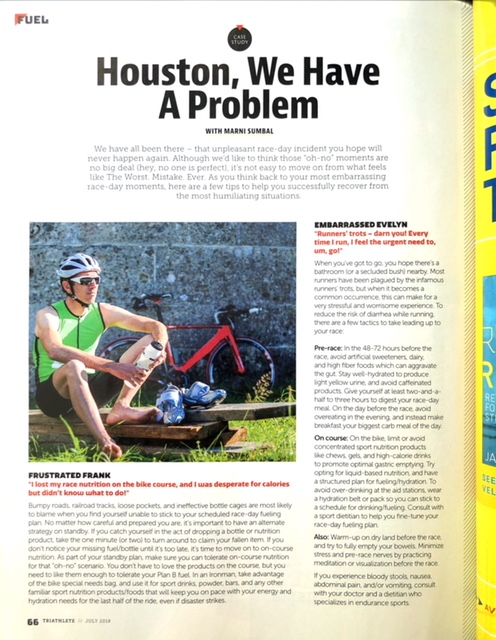
    We have all been there - that unpleasant race-day incident that you hope will never happen again. Although we'd like to think those "oh-no" moments are no big deal (hey, no one is perfect), it's not easy to move on from the Worst. Mistake. Ever. As you think back to your most embarrassing race-day moments, check out a few of my nutrition tips in my recent Triathlete Magazine article (July 2018, pg 66), to help you successfully recover from the most humiliating situations. 

    Nutritional needs for the older female athlete

    Marni Sumbal, MS, RD


    Meet my nutrition athlete Christine. She is in the 70-74 year age group and she recently placed 1st in her age group at Ironman Lake Placid, in a time of 16:16.37. She was the oldest female finisher of the day and earned a slot to IM Kona (she declined the slot in order to focus on IM 70.3 WC).


    Meet my nutrition athlete Stacey. She recently earned a spot to IM Kona at Ironman Switzerland by placing 3rd in the 55-59 age group in a time of 13:07.58.

    These two inspiring ladies are among several older female athletes that I have the honor to work with on nutrition, along with several Trimarni coaching athletes who race in a 50+ age group category. Although it's easy to classify age based on when you were born (chronological age), these ladies, among many other female athletes, are showing us that sport can play a positive role in the aging process and that age is just a number. What can you do with your body at your age?

    Although aging may negatively affect the physiology of the body relating to athletic performance, now more than ever, more older female adults are pursuing a sport as a way to exercise. Whether it's to improve health, maintain fitness, socialize or to stay competitive, consistent physical activity can offset some of the negative effects of aging, all while improving self confidence, psychological well-being, mood and reducing risk for disease.

    Most athletes will experience a decrease in max power, max oxygen consumption, muscle strength, bone mass and flexibility/range of motion throughout the aging progress. While the statement of "use it or lose it" works for many, the aging body is not immune to illness, injury or other health setbacks which may prevent the older female athlete from maintaining a consistent exercise regime. Although there are many normal consequences of aging, a lifelong habit of exercise can certainly slow the aging process and improve quality of life.

    As it relates to the nutritional needs for the older female athlete, we need to pay close attention to energy expenditure vs energy intake, macro and micronutrient needs and fluid intake, as well as the physiological changes that are occurring in the aging body as the diet and training will need to be tailored to each older female athlete.

    However, I feel it's important to address a few of the other nutritional needs that should be discussed with the older female athlete to maximize performance all while keeping the body in good health. 
    • Food and drug interactions - The older female athlete my require the use of medications due to a chronic or temporary health condition. When determining the dietary needs and fueling regimes of the older female athlete, consider that diuretics (ex. blood pressure medications) may cause urinary losses of sodium, potassium and magnesium and NSAIDs may cause iron losses and kidney issues. Banned substances and other medications should be discussed with the older female athlete in order to optimize health without side effects (and fair play in sport).
    • Fluid needs - The older female athlete has less body water than the younger athlete. Thirst sensation decrease and the older kidney can not concentrate urine as well, which means more water is needed to remove waste. Less sweat is produced, especially if adequate hydration is not available. This brings challenges to dialing in sport nutrition needs during training/racing, especially in hot or humid conditions.
    • Daily diet - There are many reasons why an older female athlete may struggle to eat a well-balanced diet on a daily basis. Reasons may include, decreased appetite, caretaker responsibilities, increase fullness, eating alone, wanting to eat out in order to socialize, inability to purchase healthy food options, food aversions, digestion issues and constipation. It is important to take the time getting to know your athlete, so that you treat her as an individual and tailor the diet to her lifestyle and health needs.
    • Nutrient timing - Maximizing performance through the timing of nutrition is critical for all athletes. Seeing that the aging body may not respond to training stressors as well as the younger body, it is important to structure the daily diet so that nutrition is always consumed before and after workouts in order to reduce the stress response of exercise and to delay fatigue, while helping the body keep good form and focus. Additionally, the timing of nutrition (protein post workout) can help with tissue rejuvination which can help the older female athlete, who is at risk of losing bone/muscle throughout training. It is important to take a lot of time with the older female athlete, working on the daily diet and timing nutrition with training, as the foundation of great performances start with the daily diet.
    • Sport nutrition - The older female athlete requires carbohydrates, fluids and electrolytes similar to the younger athlete. Sport nutrition education is important when working with the older athlete as proper application of sport nutrition products will help with digestion and absorption, to delay fatigue and to optimize metabolic needs during training/racing. Depending on the sport and duration of the older female athlete, different sport nutrition products/strategies should be applied. Many older female athletes overconsume nutrition products during training in order to "get through" workouts and underconsume adequate energy (and nutrient dense foods) in the daily diet. It is critical to help the older female athlete structure her daily diet in a way that supports the current training load, prior to working on the application of sport nutrition.
    • Body image concerns - The older female athlete may suffer from body image concerns, similar to her younger counterparts. Therefore, it is important to de-emphasize weight and body composition, such as "you would perform better if you were leaner/lighter." It is important to promote healthy eating behaviors to the older female athlete as her focus should not only be on performance but also on disease prevention. The older female athlete should feel comfortable talking about her body image, food and weight concerns with a coach and sport RD, thus trust is extremely important.. Health and well-being should always be ahead of athletic performance. Because many older female athletes come from a era of fat-free foods and dieting, it is important to discuss the health consequences of disordered eating behaviors when applicable, even among the older adult population. Eating disorders affect females of all ages and there is no age discrimination for body image concerns. Many female athletes do not grow out of their struggles with food and the body. 
    For the older female athlete, be mindful that the body becomes less resilient with age. There are more GI, cardiac, bone and muscle effects of training with an older body. Therefore, proper nutrition and fueling/hydration are critical to the body's ability to withstand training stressors, while keeping the body in good health.

    Although sport participation provides general physical activity, it is also provides an opportunity to travel, make friends and to interact with like-minded individuals, of all ages. Competition is not just for young athletes. Sure, you may not be in your 20's but there's a good chance that you are now moving a lot faster than the people who you grew up with.


    "Aging in not lost youth but a new stage of opportunity and strength."

    Confused by nutrition??? Here's why.....

    Marni Sumbal, MS, RD


    Nutrition plays a very important role in health and performance. But I don't have to tell you what you already know.

    You are well aware that if your body doesn't get the nutrients/energy that it needs, your risk of illness, injury and sickness increases as your body struggles to adapt to intentional training and life stressors. With proper nutrition, you are rewarded with performance gains and a strong, healthy and fit body. 

    As a Board Certified Sport Dietitian, I have an important role as it relates to the performances by athletes. For countless reasons, many athletes are invested into improving "nutrition" with the help of a sport dietitian. At the most basic level, improving nutrition will lead to better strength, resilience, endurance and recovery but nutrition also plays an important contributing role in the development, management and prevention of mental health problems as well as in achieving and sustaining a healthy body composition. 

    Thanks to social media, we now communicate, share information, connect with people, receive news, promote products/brands and debate topics much differently than in the past. With so much nutrition information available to the public, nutrition overload leads to confusion and misleading information.
    This reminds me of the telephone game where you hear from one person "American's are eating more processed carbs than ever before" and a few people later, the message reads "carbs are bad, avoid gluten."

    We live in a society that is obsessed with healthy eating yet many people admit that it is very difficult to live a healthy lifestyle. With so many health and diet products, books, articles, TV shows, experts and meal plans, it can be difficult to tell the difference between false, half-truth and practical nutrition advice.

    It's unfortunate but far too many individuals are being taken advantage of by so-called "experts" that sell you a strategy or product to encourage you to buy into a life changing weight loss or performance method. Science and research is often twisted and fabricated to make you believe that you are getting the best advice from a trusted authority on nutrition. Many uneducated experts know that you are vulnerable and desperate for a change and recognize that you lack the knowledge to identify truth from quackery.

    I take my job very seriously as I care about the health and performance of my athlete. Over the years, I have learned that many athletes are just straight-up confused by nutrition. This confusion may lead to disordered eating, health issues or an unhealthy relationship with food. This needs to change. My best advice is to reach out to the real experts on nutrition - a Registered Dietitian specializing in YOUR needs (ex. weight loss, performance, sport nutrition, health issues, etc.)

    Why are so many athletes confused by nutrition? Here's why.....
    1. You are being taken advantage of by unqualified "experts" with little to no formal nutrition education. 
    2. Food and the physiology of the body is very complex. 
    3. Genetics and the environment play a role in the interaction of food and body composition. 
    4. Nutrition science continues to evolve.  
    5. You believe everything that you read on the internet/TV. 
    6. You live by a good food/bad food list to gain control over your diet. 
    7. You want big results with little effort. 
    8. You are easily distracted/sabotaged. 
    9. You blame nutrition for everything - trouble sleeping, digestive issues, stress, etc. 
    10. The food/diet industry thrives off confusion and fads/trends. 
    11. You go to the extreme when making diet changes and this causes you to "fail" with your nutrition methods. 
    12. You follow a restrictive diet or 30-day plan to lose weight/clean up the diet but you never learn to change your lifestyle. 
    13. Your lifestyle does not support healthy eating. 
    14. You focus too much on your body image than health. 
    15. You let yourself get too busy, rushed, stressed, overwhelmed and exhausted and healthy eating becomes an afterthought. 
    16. You are letting personal stories/experiences from someone else guide your individual nutrition journey. 
    17. The media poorly communicates nutrition information. 
    18. You sift through mixed nutrition messages on a daily basis and jump from one nutrition plan to the next.
    19. Research studies have a great chance of getting published (and be talked about) if they demonstrate positive results. Research studies are often funded by food/supplement manufactures to promote products. 
    20. You are surrounded by tempting food that is socially welcoming, convenient, processed and calorically dense. 
    21. Everyone is different but you follow mainstream nutrition advice. 
    22. You are easily influenced by food trends. 
    23. You believe opinions and not science. 
    24. You don't rely on trustworthy resources but instead seek free or sexy-marketed advice.
    25. You don't like to cook, meal prep or eat healthy food. You want a quick fix. 
    26. Diets are cult-like - you are either in or you are out. 
    27. You see nutrition as black or white instead of keeping an open mind and being flexible with your thoughts. 
    28. You eat based on fear, guilt, anxiety, uncertainty and doubt. 
    29. Nutrition is not one-size-fits all. 
    30. You blame willpower and discipline instead of focusing on small changes. 
    31. You want quick results right now. 
    32. Nutrition is not something that you can "track" or "measure" and experience quick, long-lasting results. 
    33. The nutrition industry has failed to establish reliable experts and information and instead, anyone can be a called a nutrition 'expert'. 
    34. In the field of nutrition, it's very difficult and expensive to produce research studies that offer meaningful and applicable results. 
    35. You categorize food as good or bad and this creates a dysfunctional relationship with food. 
    36. You only believe nutrition advice when it is backed by a research study. 
    37. It's easier to be motivated to eat a certain way in order to treat a current issue than to stay motivated to eat a certain way for a long time in order to prevent a future issue. 
    38. Nutrition is an emotional and personal subject. 
    39. It's very difficult to isolate nutrition/food from other factors that affect your health/body composition/performance. 
    40. You rely too much on tips, tools, gadgets, trackers and apps than learning the basics of mindful and intuitive eating. 
    41. What you eat doesn't affect your health right away. 
    42. No one controls nutrition advice/information that you read/hear. 
    43. Nutrition is one of the very few fields that you can become an expert in, if you are passionate about it, you have a success story or you have helped other people achieve results. 
    44. People won't stop talking about nutrition/food and it can be difficult to stay on your path. 
    45. Everyone has an opinion, thought, story. 
    46. Our food industry has changed and factories are becoming more important than farmers. 
    47. Basic, effective nutrition advice has remained the same for decades but the media, food industry and experts want you to believe otherwise. 

    Top 10 Nutrition tips for athletes - link to video and recap

    Marni Sumbal, MS, RD


    The human body is an amazing machine. In our daily life, we only use a very small part of our true physical capabilities. 

    But as athletes, unlike our daily life, our training is a big stressor on our body.

    Understanding that training for an athletic event places such a high demand on the cardio, respiratory muscular, immune and other organ systems, it’s important to recognize that preparing your body for an athletic event is so much more than just checking off workouts.

    I am sure I don't have to tell you this but your athletic success depends on proper nutrition. 


    Last night, I had the opportunity to give a presentation at Run In on my Top 10 nutrition tips for athletes.  

    Before getting into the talk, it is important that I tell you a little about myself and why I am so passionate about nutrition and sport nutrition. 

    As a Board Certified Sport Dietitian with a MS in Exercise Physiology, I have dedicated much of my educational career to studying the human body and how food, or nutrition, affects physiology. I love learning about the science behind training and nutrition.

    But, I am also an endurance triathlete. For the past 11 years, I have pushed my body to great physical and mental limits by completing 11 Ironman distance triathlons, including 4 Ironman World Championships and I have place overall female amateur at several half IM distance events. 


    As a motivated, disciplined, competitive and goal-driven endurance triathlete, you can say that my activity routine is quite punishing and what I do with my body is very extreme. More important than any personal best, podium placement, overall win or World Championship qualification is my health. This hobby is a choice and seeing that you may also choose to do something similar with your body, it is important to remember that your ability to perform well with your body is dependent on good health.

    I invite you to listen to my 1-hour presentation which discusses the following topics:

    1. How to organize youd diet as an athlete
    2. Incorporating whole grains into your diet
    3. Daily hydration needs
    4. Natural anti-inflammatory foods
    5. Incorporating more vegetables into the diet
    6. Easy to digest pre-workout snacks
    7. How to master post-workout nutrition
    8. Tips and tricks for dialing in sport nutrition and hydration during workouts 
    9. How to make your own energy bar out of real food
    10. Why it is important to create a healthy relationship with food and the body
    I selected these ten topics because I felt they were important to discuss at this time of the year. There is a lot of misinformation and unsafe dietary advice regarding nutrition for athletes and unfortunately, many athletes get sick, injured or burnout because they lack the require energy and nutrients to adapt to training stress.

    As a nutrition expert who is qualified to give nutrition advice to athletes, I feel it is important to stress that I encourage a mostly real food based diet with absolutely no off-limit foods, I believe in the use of sport nutrition products during training and never do I prescribe “magic bullets”, quick fixes, make claims for fad diets or encourage rigid and extreme styles of eating and fueling. 


    When I work with athletes, health, well-being, longevity and enjoyment for sport are most important to me because I want you to keep your body in amazing health AND perform amazingly well with your body on race day, and for many more years to come. 

    I hope that you find my tips practical, easy to implement and effective for your upcoming training and racing journey.

    Any questions, don't hesitate to send me an email via the contact form on my website. 


    Get back on track with healthy eating

    Marni Sumbal, MS, RD


    What does "healthy food" mean to you? 

    To me, healthy food is included in a varied, nutrient dense diet which keeps my body functioning well. 

    But in a world where unhealthy food is so available, it can be difficult to define and follow through with healthy eating. 

    Busy schedules, misinformation, poor planning and low motivation can make healthy eating extremely challenging. 


    Here are a few tips on how you can get back on track with healthy eating. 

    -Stop the dieting and food rules. Restriction and deprivation doesn't work as it's not a sustainable style of eating. 

    -Plan and prep ahead. When you are prepared, you make better food choices. Plus, by learning how to be a great meal/snack planner, you will create long-lasting "go-to" strategies for maintaining healthy eating habits even during your most busy, stressful and exhausting times in life. 

    -Don't make your meals too complicated. Keep healthy eating simple and eat to feel satisfied and energized. 

    -Eat with a purpose beyond weight/body composition. Learn to eat mindfully. You deserve to eat enough food to honor your biological hunger but you also deserve to eat food that you enjoy. Eating should be pleasurable experience. You should love your diet. Healthy eating is so much more than just eating to look a certain way but instead, eating to do amazing things with your body. Define your eating purpose behind every meal and snack in your diet. 

    -Create one new "healthy eating" goal each week and don't set a new goal until your previous goal becomes a habit. For example, your goal can be to eat breakfast every morning, to bring an afternoon snack to work everyday, to have a recovery snack after every workout, to drink more water, to cook dinner at home two nights per week or to more vegetables at lunch. The idea behind a healthy eating goal is to create new strategies for change. If you have a goal of making dinner, you must figure out how you will make this happen. Stop the saying and start the doing. The only way you can sustain healthy eating is by creating a new lifestyle. 

    -Leave space in your busy day for meal planning, prep and cooking. If you tell yourself that you do not have time to eat healthy, you need to adjust your priorities. Healthy eating may feel overwhelming if it is not yet a priority in your life. You can use a food delivery meal prep service or search through cookbooks for inspiration, but in order to eat healthy, healthy food needs to be available. By prepping and planning ahead, you will find yourself eating food that you love and feeling great about the foods that you put inside your body. 

    Understand your appetite

    Marni Sumbal, MS, RD


    Do you struggle with your appetite?

    While it is important to create a diet that meets your training, health, metabolic and daily needs, many athletes struggle with their appetite - not fully understanding, respecting or acknowledging hunger and satisfaction cues. 

    Whereas some athletes eat mindlessly out of emotions, boredom or stress, use food as a reward or overeat for fear of not having enough energy for a workout, other athletes have a disconnect with the body and will many times go too long without eating, ignore hunger cues or undereat due to fear of feeling too full or uncomfortable.

    If you feel hungry all the time, feel that you are constantly eating or grazing or feel that you have no or little appetite and food simply doesn't interest you, something needs to change.

    It's time to better understand and fix your appetite.

    As an athlete, food is your fuel. Therefore, it is important to recognize that you need to eat a lot more than the sedentary individual. However, what, when and how much you eat is important.

    Recognizing that it is normal to feel more hungry on certain days of the week when it's reflective of higher intensity or longer workouts, it is also normal for athletes to lose the appetite after a strenuous, long or intense workouts.

    Because of this, it's understandable that athletes will often struggle to honor hunger in a smart, proactive, performance-enhancing and healthy way.

    The athlete who has no appetite after a workout misses a prime opportunity to rehydrate, refuel and recover from a workout. Whereas the athlete who eats all day, may feel too full or uncomfortable before a workout and may restrict sport nutrition or the intake of any additional nutrition while training and this can make it difficult to understand if energy needs are being met properly before, during and after workouts.

    It is important that you learn how to create an eating style that works for your body, your life and your needs.
    No diet fad will do this for you.
    You have to take the necessary time to understand your body, your appetite and your hunger.

    Use the next few weeks to understand your appetite. Learn to create meals that will not only keep your body energized and well-nourished but will also satisfy your biological hunger so you feel comfortably full and satiated. 


    On Tuesday evening, Karel and I did a group ride on our tri bikes which started at 6pm and we followed the 1:40 hr ride with a 15 min run. This was a very hard workout for me and even though we didn't finish our workout until close to 8pm, I didn't have much of an appetite due to the intensity and warmer weather. However, I started with liquid nutrition (2 scoops Clif Recovery protein + water) first as I knew that would be easiest to digest. Then on the way home (25-30 minute drive) I had a banana and a few dates that I brought with me.
    When we got home, it was close to 9pm by the time we cleaned up from the workout and our bedtime is around 10pm. To ensure easy digestion, I made the most delicious sandwich with rosemary bread, melted Swiss cheese, arugula, hummus and smashed avocado with a glass of 1% Organic cow's milk.
    It was a delicious dinner.
    Even though I understood that I didn't have much of an appetite, I knew that after a hard workout, eating nothing is not performance enhancing.
    The recovery drink + sandwich did the trick and I was able to wake up Wednesday morning with my normal appetite to eat something before my Wed am workout (I always, 100% of the time, eat before I workout).

    Daily diet or fueling manipulation?

    Marni Sumbal, MS, RD


    Through this approach, your body composition will change because you are able to perform well and maintain a realistic and sustainable style of eating. 
    Are you an athlete looking to change body composition and improve your performance as you train for an upcoming event?
    Consider this: 
    Manipulating your eating before, during and after workouts in an effort to enhance the adaptive response to training will only provide a marginal performance and body composition improvement if your daily diet is not well-balanced, well-timed and consistent.

    It's remarkable how the body performs and changes when emphasis is placed on the daily diet as a vehicle of nourishment and when workouts are supported with food as a vehicle of energy.

    Far too many athletes choose sport nutrition restriction over daily diet manipulation whereas the later can significantly help to change your body composition without compromising energy when you ask your body to perform and adapt to intentional training stress.

    Meeting your daily nutrient and energy needs in the daily diet ensures maximal adaptation to your training because you have met your foundation nutritional needs which will help allow you to perform (and recover from) a variety of workouts - from easy to moderate to intense and from short to longer to very long.

    Once you place emphasis on your daily eating (which it will change throughout your season), you'll find that your body systems, hormones and metabolism work better. Your body ultimately works for you as an athlete, not against you. Thus, rather than trying to outperform a poorly planned diet by restricting nutrition around and during workouts (this statement in itself makes absolutely no sense but athletes continue to believe that this is the "best" approach to improving performance and to assist in weight loss) you'll find it much easier to optimize, adjust and personalize your fueling regime before, during and after workouts to meet your performance goals after you have taken the time to establish a healthy foundational diet.

    If you know (or think) that your daily diet needs some tweaking, consider the straight-forward approach of creating a well-balanced, well-timed and consistent eating plan rather than simply not eating around and during your workouts with the hope that food elimination or restriction will make you a stronger, healthier and fitter high-intensity or endurance athlete. 

    Ultimately, if performance and body composition changes are the ultimate goals of your nutritional changes, you'll find that when you create a foundation diet to support your current training load, your workouts become easier to accomplish, you can go longer or harder with better focus, form and motivation and you can maintain a great sense of enjoyment when you train (which leads toward more training consistency and longevity in your sport).


    And ironically, with this approach, there's a better chance of unintentionally changing your body composition without intentionally trying, while maintaining a great healthy relationship with food and the body AND feeling fulfilled and happy in your sport of choice.

    Me time: Nutrition

    Marni Sumbal, MS, RD


    You work hard. You take care of other people. You are always busy.

    What about yourself?
    Where's your ME time?

    Sometimes it is not even about making or finding time.
    It can be hard to even think about yourself when you are exhausted from everyday, life to-do's.

    Are you still carrying along the same excuses that you have been telling yourself week after week, month after month, year after year.
    Too busy to shop, too busy to cook, too busy to meal prep, too busy to eat. 

    I bet if you had more time, you would find a way to fill that time in with more stuff that would keep you "too busy".

    When it comes to your health, nothing could be more important than making time to nourish your body throughout the day. From the moment you get up to when you lay down to sleep, you should not find yourself pushing your meals and snacks to the side just because you are too busy, too tired, too exhausted or too ______ (insert your typical reason to not make your nutrition/diet a priority).

    Although there are times when a call runs over, a meeting gets postponed and something comes up and I find myself with no or little time to eat lunch or a planned snack, I don't like how this makes me feel. Not only have I not made time for myself but I can't do my work properly because I am hungry and I need nourishment and energy. 

    Meal time is a special time for me.
    I like to step away from what I am doing (work) and think about nothing more than what is going inside my body. I like to yum when I eat.
    Meal time is my reboot.
    No matter what time of the day, I feel even better after I eat, than before because the food that I put into my body serves a greater purpose than just being calories, fat, carbs and protein. 
    Meal time is so important to me that I plan it into my day. Just like a phone call with an athlete, my workout or the time needed to write a training plan or an article....there is time to eat. 

    Here are a few tips to make sure you are making time to nourish and fuel your body:

    1. Set aside time in your day when you will eat. Allow as much time as possible so that you are not rushed. Try to make this time behind a table with minimal distractions, rather than behind a wheel or computer screen.

    2. Plan ahead. If healthy options are not available, you can't eat healthy. And if you are starved, rushed or hangry, you are not going to plan, cook or eat what you know you should be eating. Planning and food prep may take time but in the big picture, it really does save you time. Waiting for food, driving somewhere to eat (or pick up food) or cooking/chopping one or two items at a time, is time consuming (and sometimes costly).  Plan your meals and your snacks ahead of time and know that things will come up, so try to plan for those oh-no moments too.

    3. Create an eating schedule that works for you. We all know that life changes and it is nearly impossible to eat at the same time every day. But if you find yourself getting biologically hungry at certain times of the day, do something about it - EAT. Figure out the best times in your day that work for you to eat your meal(s) and snacks. Don't be a clock watcher when it comes to eating. Odds are if you skip a snack or push back a meal, you will likely overeat later in the day.

    4. Give yourself a little extra time in your day to plan for a better tomorrow. Any time you make a change, you need time to adjust to the change. It may seem like packing your lunch the night before work may seem tedious and time consuming but overtime, you will knock it out in less than 5 minutes. Create a good food environment to help you out and consider a few life hacks to make meal prep less overwhelming. 

    5. Inspire others. It's very common that people feel guilty or embarrassed when they have ME time. As if it is selfish to take care of yourself. I'm not sure why people feel this way because you can't be good at taking care of others (or doing your job well at work or at home) if you let your own health decline. Be a role model for others. If anything, impress yourself. Without being pushy or lecturing, use your actions to show others that making time for yourself is actually making yourself a better person.