We’d love to hear from you.

We welcome your thoughts, experiences, comments, suggestions, questions or personal stories. If you don't hear from us right away, please note that your email is very important to us. We will do our best to respond with 24 hours.


Greenville, SC

Trimarni is place where athletes and fitness enthusiasts receive motivation, inspiration, education, counseling and coaching in the areas of nutrition, fitness, health, sport nutrition, training and life.

We emphasize a real food diet and our coaching philosophy is simple: Train hard, recover harder. No junk miles but instead, respect for your amazing body. Every time you move your body you do so with a purpose. Our services are designed with your goals in mind so that you can live an active and healthy, balanced lifestyle.

Blog

2021 Trimarni 3-day spring training camp recap

Trimarni


After eight years and 14+ group triathlon camps, we have learned the importance of having a plan B. Whether it's for rain, snow, a cancelled reservation or some other type of unforeseen circumstance, we have learned that things will not always go as planned. Over the years, we have been rather creative with our plan B scenarios. At our group camp in Clermont, FL last year (just before the pandemic took over), we came up with a long bike/run workout for our 20 campers, in place of our scheduled Olympic distance race that got cancelled at the last minute. In April 2019, rain forced us to change up our planned triathlon practice workout for the last day of camp. Instead, our campers had a great group run workout followed by a swim at Furman (with some fun relays). In March of 2018, weather turned our long ride into a morning indoor workout of strength and relays - let's just say that our campers may have enjoyed it a bit too much as there were so many laughs. After the workout, the weather cleared and we were able to get in a chilly afternoon bike followed by a run. I still think back to our very first camp - back when we had no idea what we were doing - and it rained on the first morning of camp. We quickly had to adjust from a swim/bike workout to a swim/run workout.

This camp was no different in that we had to adjust our plans and go with the next best option for a memorable, safe and challenging workout on the first day of camp. 

Here is how the camp experience went for our four campers. 
And a bit of a side note: We have always offered two camps per year for athletes, with both being large group camps of at least 12-20 athletes. However, due to COVID, we have reduced the size of our past few camps to no more than 6 athletes. While we love the big group camps, we have really enjoyed the personalized approach to these smaller camps. Things run much more smoothly and there is more time to work with each camper. Although we won't be getting rid of our bigger group camps, we do feel that smaller camps have their place and can be very valuable for athletes. 


DAY 1 (Wednesday)
  • 8:30-9:30am: 1 hour swim (~2500 yards)
  • 11am - 1pm: 2-hour indoor workout (Bike/Run/Bike/Run/Bike/Run) - ~60 minutes of cycling (with warm-up) and ~45 minutes of running. 


Day 1 of the Trimarni Greenville 3-day mini camp looked to be a washout but thankfully, a last minute request for the workout rooms at the Aquatic Center was granted and we were able to put together a great workout for our group. We split the athletes into two groups (2 each) so that two athletes would be on the bikes at a time and two athletes would be on the treadmill. Then they would switch. So two athletes did B/R/B/R/B/R and the other two started with running first. I coached the run workouts in the treadmill room and Karel coached the bike workouts in the exercise room. 

After our scheduled 1-hour swim at the Westside Aquatic Center, our campers had a short break before a 2-hour Bike/Run/Bike/Run/Bike/Run workout. There was a specific focus for each bike and each run workout, which worked out to be ~15 minutes of each discipline (x 3) for a great 45 minutes worth of biking and 45 minutes of running. As for the rest of the day, we encouraged our campers to rest as we had two big days planned on Thurs and Friday. Our campers will be nicely exhausted.


DAY 2
  • 8:30-9:30am: 1 hour swim workout (~2700 yards)
  • 10:30-12pm: ~80 min run workout (~800 feet elevation gain w/ 3 x 3 min hill repeaters)
  • 2:30-5pm: 2.5 hour bike workout (~3600 feet elevation gain w/ 3 x 2.5 mile climbs up Paris Mountain. First round normal cadence, second round heavy gear, third round high cadence). 


We started the day with a 1-hour swim workout. With only four campers, we were able to keep everyone on a similar cycle and also provide individual feedback. After a quick break, it was time for a run workout.
The theme today was STRENGTH. We all met at the Trailblazer parking lot for the run workout. 
After a warmup run (which included a run up the hill that we would be using for the main set), the pre set was 3 rounds of 15, 30, 45 sec hill sprints for neuromuscular firing. Then it was time for the main set. The main set was 3 rounds of 3 min strong run uphill followed by an easy jog down. The focus was to run strong up the hill and then when the hill crested, to maintain that effort over the top of the hill and on to the flat road. We finished the run off with a best easy pace effort. After the 90-min run workout, the campers had a 2 hour break before the last workout of the day.

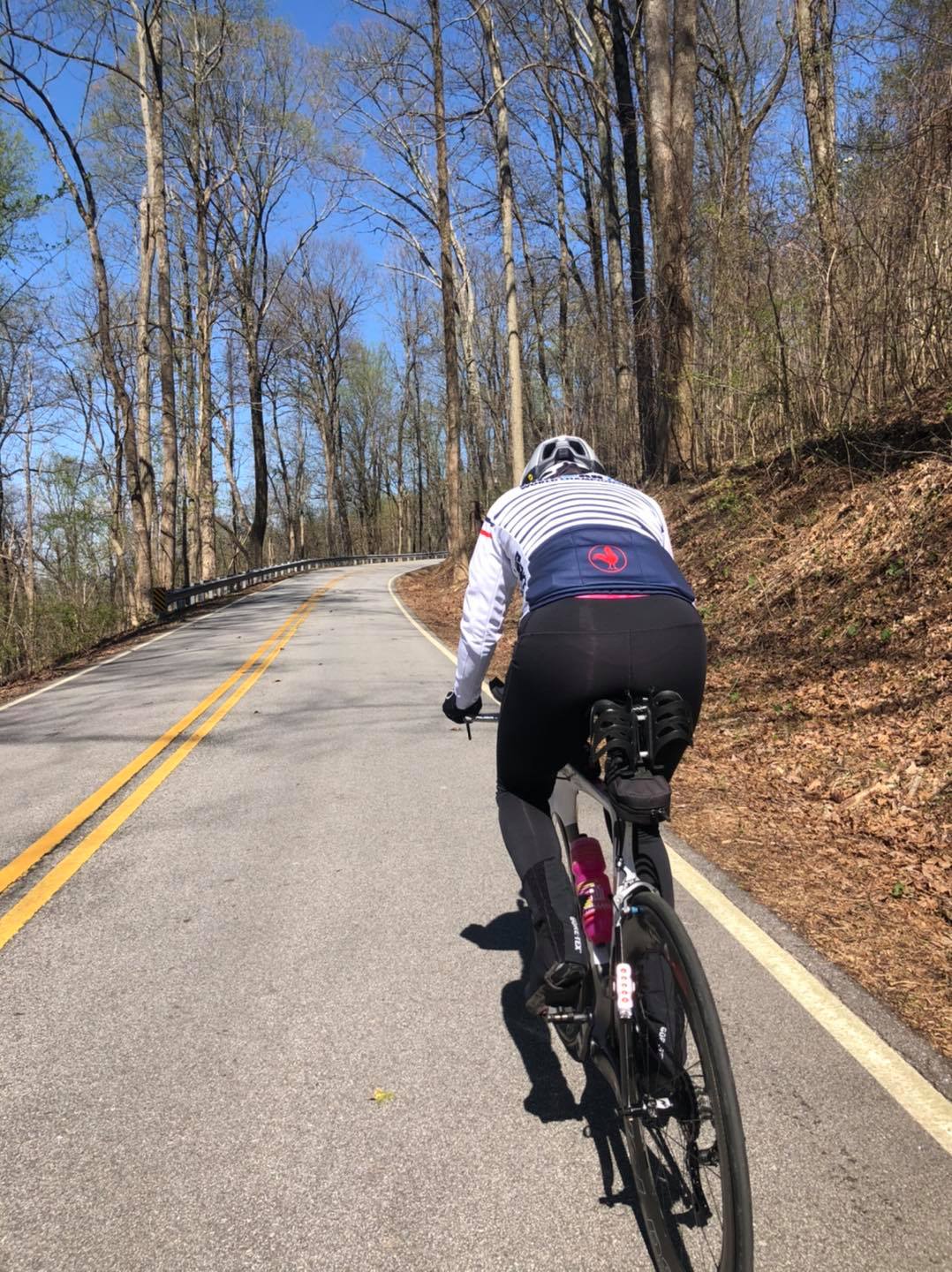
It was a windy and chilly afternoon but our campers embraced the conditions for their last workout of the day, a ~2.5 hour ride. We warmed up on the country roads before we made our way to Paris Mountain. The main set was 3x up Paris Mountain. Each 2.2 mile climbs up Paris Mountain took around ~18-20 min but each climb had a specific focus: #1: normal cadence. #2: heavy gear. #3: high RPM. Then descend down. Not only did we have an opportunity to spend time with each athlete on the climb but we could also help the athletes with their descending skills. Our friend Alvi also took part in the run and bike workout to help us out. 

After five hours of training today, our campers were nicely tired for their last day of camp.


DAY 3
  • 8:30-9:30am: 1 hour swim workout (~3000 yards)
  • 11:45am - 2:45pm: 3 hour bike workout (~2400 feet elevation gain w/ a ~5.2 mile TT)
  • 3pm - 4:15pm: 75 minute (3 x 2.5 mile loop) run (~500 feet elevation gain)


We started the morning with another 1-hour swim at the Westside Aquatic Center. Typically we only do two back to back swim workouts (with a third swim in the open water for our summer camp) but this time around we had three swims, one each day in the morning. The athletes made a lot of improvements after three consecutive days in the water.

After a 2 hour break, we bundled up for a chilly and windy 3-hour bike. It was really cold to start but our athletes didn't complain. We met at Trailblazer parking lot again and made our way to the Swamp Rabbit Trail before getting on the country roads. Thankfully the weather warmed up to 50 degrees after a super cold start at 40 degrees. We slowly warmed up as we made our way near Jones Gap - thankfully there were plenty of hills to climb and the sun was shinning. Once we arrive to our "loop", we did a recon of the 5.5 mile loop and then the main set was a 5.5 mile time trial on the beautiful course filled with all types of terrain. Our athletes did amazing on the course, showcasing their improved terrain management skills as well as their resilience and endurance after two hard days of training. 

Immediately after the bike....the finale! The last workout of camp was back to the course where we did the hill repeaters on Thursday. The workout was simple - 3 x loops (~2.5 mile per loop) for ~70-min run. With a big hill and lots of wind to tackle with each loop, our campers worked through a lot of emotions and physical struggles during the first loop and found their groove on loop 2 and 3. Let's just say that everyone finished feeling accomplished and satisfied. 

We ended the camp with a pizza party (Pizza from D'Alles) and had a great time laughing, sharing stories and chatting with our athletes before saying good bye. 

There were a lot of hills to climb and weather to negotiate during this camp but our athletes showed tremendous grit, strength and resilience. The conditions were tough and they never complained.
Great athletes and amazing humans!

Total stats over 3 days: 
Swimming: 3 hours, ~8200 yards
Biking: 6.5 hours, ~6000 feet elevation gain
Running: ~3.5 hours, ~1300 feet elevation gain
Total: 13 hours of training

And a big thank you to the companies who supported our training camp!
Run In
Infinit Nutrition
Mg12
PR Lotion 
Breakthrough nutrition 

Weekly training update (no crashes!!!)

Trimarni


After we returned home from an eventful gravel ride, I spent the rest of Sunday licking my wounds (not figuratively). Although I discovered a small crack in my helmet, I'm thankful that I didn't have any issues with my head or neck. My arm, leg, knee and hand were uncomfortable due to the scratches and wounds but otherwise, I was grateful and thankful that nothing worse happened during my crash. Even my bike was ok! 

After the impactful crash, I knew my body needed a lot of sleep to start the recovery process so I went to bed earlier and tried to sleep as much as possible. After a somewhat productive Monday, the beautiful weather was begging me to get outside. Karel joined me for an easy spin on our road bikes and my good friend Kristen also joined us. We saw our friend Thomas on the trail and he joined us as well. It was great fun to ride together on the Swamp Rabbit Trail from Traveler's Rest to downtown Greenville. 


After we arrived downtown, Karel was ready for some ice cream so we stopped for a quick "recovery snack" at Blueberry Frog. After healing my wounds with the sweet treat, we biked back home for an easy conversational ride. It felt really good to be riding a bike again. 

As for my body, I started to heal pretty quickly. The human body is amazing. But I had a pretty deep gash in my forearm by my elbow. To ensure that it healed without complications, I stayed out of the pool all week. I really wanted to swim on Friday but I figured it would be good to give it a full week to heal. This also was good for my chest as my first crash left me with some pain in my right chest area, which had then moved to the outside of my rib cage on both sides. Thankfully, the pain becomes less with movement (running feels the best) and with each day, I was able to breath a lot better. As I sit and type this, it still hurts a bit to cough, sneeze and take in a really deep breath but overall its getting much better and my skin is healing well. 

Because I was unable to swim this week, I focused on what I could do - bike, run and strength. I also supplemented my swimming for stretch cords, straight arm planks (I can't put pressure on my forearms just yet) and core work. As for the rest of my training, I am really happy with the workouts that I was able to accomplish this week. 

Monday - 1:52/25.6 mile easy social spin
Tues - AM: 1:23 treadmill run w/ 8 x 4 min tempo w/ 2 min EZ walk/stop/jog between
PM: 1:27 bike (2700 feet of elevation gain) - 3 x 2.13 mile climbs up Paris mountain (#1 normal             cadence, #2 heavy gear, #3 high rpm) w/ recovery descend between. Karel joined me for this. 
Wednesday - AM: 1:49 trainer bike (with 8 x 6 min at 86% FTP w/ 3 min EZ between) followed by a 35 min hilly run. 
Thursday - AM: 1:10 smooth endurance run. PM: 1:15 anaerobic interval bike workout (trainer)
Friday - AM Strength. PM 2:36 steady ride on road bike (beautiful warm day, rode by myself). 
Saturday - "Repeatable" workout. 2:02 trainer bike (a set of 6 and 8 minute strong sustainable effort intervals w/ 2-3 min EZ between followed by 4 x 3 min ascending intervals). Followed by a 11.3 mile run. 
Sunday - Smooth and EZ 1:09 mile run. 


I was really proud of my body and I found myself working through a lot of planned fatigue. 

A little bit about the Saturday "repeatable" workout....
While it’s fun to do a workout for the first time or to build off a previous session, there’s a lot to gain from completing a familiar workout. And while the training leading up to the workout may change, there’s so much to gain from a session that you get to complete more than once.

Saturday was the second opportunity to work through the mental and physical challenges of this 3.5 hour workout.

Endurance sport is much more than chasing paces and watts, collecting miles and building endurance. It’s so much more than reaching a race weight. Sure, preparation requires building fitness but and endurance sport requires building mental toughness.

The capacity to endure physical discomfort and self-doubt. To make good decisions under extreme fatigue. To learn how to cope with discomfort by dissociating the mind from the body. To stay hopeful and positive when faced with adversity.

This repeatable workout isn’t so much about metrics but developing mental skills to help me overcome the physical, emotional, nutritional, psychological and environmental obstacles that will test me on race day.

When it comes to preventing burnout and maintaining joy for sport, I encourage you to seek personal growth in ways that aren’t necessarily measured by metrics.


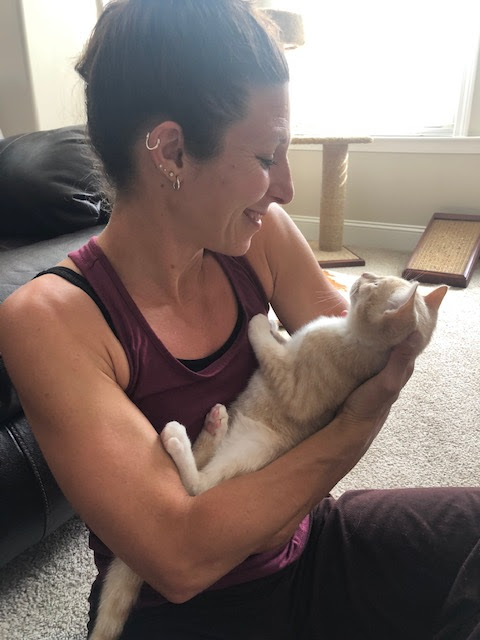
As for Sunday after my morning run, I organized the kitchen in the afternoon and then went to visit a close friend who just got a kitten after her 10-year old cat passed away. 


Karel was in Saluda, SC playing gravel bikes with our friend Alvi at the Saluda Roubaix race. Here's Karel's detailed race report via text (not G rated).......


Karel ended up 1st in the 40+ (Masters) category and 5th overall. After he arrived home in the evening, we watched the first Formula one race in Bahrain and then went to bed in excitement for our first group camp of 2021 on Wednesday! 

Does every workout require a recovery drink?

Trimarni


A smoothie can be a perfect recovery beverage. 

This blended (or shaken) beverage can be a good source of carbs, protein, electrolytes and fluids, and makes for a well-tolerated snack when fatigue, exhaustion, and dehydration linger post-workout.

But does every workout require a protein-packed smoothie?

❌Skip the engineered foods and expensive shakes and make yourself a nutritious well-balanced meal if:

👉You only exercise once a day and have long recovery periods between two workouts.
👉Your workout is neither intense or high volume.
👉You can eat a meal within 45 minutes of the workout.

✅Certain situations justify a recovery drink before a real meal. Go for the post-workout smoothie if:

👉There are less than eight hours between two workouts.
👉Your workout is high intensity or high volume.
👉Muscle damage has occurred (ex. plyometrics or weight-bearing activity).
👉You can’t eat a meal within 45 min of your workout.
👉Your workout included eccentric movements (downhill running, strength training).

Because your daily energy and carbohydrate needs are higher on intense or high volume training days, don’t be concerned about the extra calories affecting your body composition goals. Take advantage of this window of opportunity to recover, refuel and rehydrate to get stronger, faster and fitter.

If making your own smoothie, follow this order of ingredients for the perfect concoction:
🥄Liquids
🥄Soft foods
🥄Powders
🥄Frozen foods
🥄Sticky ingredients

Do you need a daily supplement?

Trimarni


"The term 'dietary supplement' describes a broad and diverse category of products that you eat or drink to support good health and supplement the diet. Dietary supplements are not medicines, nor should they be considered a substitute for food." -From the Quality Supplements website.

Dietary supplement ingredients can be one or a combination of any of the following:
  • Vitamin
  • Mineral
  • Herb or other botanical
  • Amino acid (the individual building blocks of a protein)
  • Concentrate, metabolite, constituent, or extract
Although some herbal and mineral compounds have been used for hundreds of years to treat health conditions, current dietary supplement manufacturers are not legally allowed to say their products cure, treat or prevent disease. Supplement makers are allowed to claim that products support health or contribute to well-being.

Congress does not regulate dietary supplements the same way it regulates medicine. Except for new dietary ingredients, dietary supplement manufacturers do not need to prove to the U.S. Food and Drug Administration (FDA) that a product is safe or effective before selling the product to the public. And, unlike medicines - which are required to meet USP standards to help ensure product consistency across multiple manufacturers - USP standards are voluntary for dietary supplements.

Dietary supplements are widely available in health food stores, drug stores, grocery stores, fitness centers and online. They come in many forms such as 2-piece capsules, soft gels, tablets, bottles of liquid, powders and chews/gummies.

Supplements are not in the same category as sport nutrition products (ex. sport drinks, bars, gels and chews). Sport nutrition products are formulated in a way to optimize performance and health by providing the body with nutrients (ex. carbohydrates, sodium, fluids), in a precise formulation, that are used by the body during activity. They are backed by science/research to demonstrate a performance benefit if used correctly. Because not all sport nutrition products are created equal, prioritize simple ingredients in the nutrition profile (carbs/sugars/electrolytes).

So when it comes to supplements, why do fitness enthusiast and athletes take them?
  • To boost performance.
  • To improve health.
  • To gain the competitive edge.
  • For medical reasons.
  • Because it's trendy (ex. endorsed by a professional athlete).
  • Because a coach said so.
  • Because an article said so.
  • To overcome a nutrient deficiency.
Occurring in many different forms, like tablets, liquids, powders, bars, creams, injections and capsules, commonly sought-after vitamin and mineral supplements include iron, B12, probiotics, creatine, beet juice, Ashwagandha, Rhodiola rosea, vitamin D, calcium, multivitamins and antioxidants like vitamin C, E and Q10.

Because most supplements are poorly regulated and contain multiple ingredients, many supplements can be problematic to your health and performance. Because supplements are not well-regulated, it can be difficult to know (or to predict) the efficacy and safety of your desired product. As an example, consuming high-dose antioxidant supplements (vitamin C, E) may prevent important training adaptations from happening - such as creating new muscle mitochondria, muscle growth and improving insulin sensitivity.

Supplementing in certain situations may be necessary, especially if you fall into any of the following categories:
  • Dieting/intentional undereating
  • Vegan/Vegetarian
  • Lactose intolerant
  • Food allergies
  • Crohn's or Celiac disease
  • Limited sunshine
  • Extended periods of traveling
  • Considering pregnancy/pregnant
  • Elderly
  • Peri/post/menopause
  • Nutrient deficiency determined by a blood test (ex. iron, vit D, vit B12)

If you are currently using or considering a supplement, here are a few tips:

☑️Choose your supplements wisely. Do your research. Only take what is most necessary for your health. 

☑️Review your supplement on Supplement411 for banned substances (or being high risk).

☑️Look for the NSF certified for sport mark.

☑️Ask yourself "what are the benefits and risks to taking the supplement?"

☑️ Choose nationally recognized, reputable brands.

☑️ Make sure you consume the recommended/appropriate amount by reading the label.

☑️Test don't guess. Get your blood tested to determine the right individual nutrient (and how much you need) for a true nutrient deficiency. Stay tuned - I'm working with a new blood testing company!

☑️When a specifically identified nutrient hole exists in your diet (from a blood test) and food won’t fill the gap, choose an individual vitamin and mineral supplement to ensure you are consuming exactly what you need - nothing more, nothing less. In other words, if you are deficient in iron, seek out an iron supplement and not a MVI.

☑️Consult with a Board Certified Sport Dietitian to review your diet and medical/health history/status. Many foods/supplements have interactions where certain foods should be avoided when consuming a specific supplement.

As a reminder, it’s best to first try to obtain your vitamins and minerals from food – just like Mother nature intended you to eat.

Effects of dehydration on a body in motion

Trimarni


Although water has no caloric value, it’s the most essential nutrient required in your diet on a daily basis. Your body is made of water. It’s part of your blood, brain, heart, lungs and bones. As it relates to exercise, water maintains blood volume, reduces the risk of heat stress, regulates body temperature and is involved in muscle contractions.

To optimize your hydration status, you must be an active participant in your hydration regime by consuming adequate fluids and electrolytes on a daily basis - as well as before, during and after exercise. Leaving hydration to chance or ignoring dehydration symptoms can be hazardous to health and performance.

Sadly, once you are dehydrated, you can't 'make-up' for fluids lost.


Going into a workout dehydrated and/or not replenishing fluids and electrolytes lost during exercise can cause great strain on your cardiovascular system. As dehydration reduces plasma volume, blood becomes thicker and retains more sodium. This makes blood harder to circulate through your body. To compensate, your heart beats faster, which increases heart rate and blood pressure. Central venous pressure decreases which reduces the amount of blood returning to the heart. Less blood entering the heart decreases the amount of blood leaving the heart. An increase in core temperature leads to an increased rate of glycogen breakdown (carbs stored in the muscles), which causes an intracellular increase in acids. As lactic acid is produced, pH decreases causing skeletal muscle fatigue. Dehydration may also increase levels of the stress hormone cortisol - which reduces testosterone levels and impacts muscle growth.

Keeping your body well-hydrated on a daily basis - as well as before/during/after exercise helps your heart pump blood more easily, protects your body from heat stress and allows oxygen to reach your muscles to help the muscles work efficiently.

To learn more about mastering or fine-tuning your hydration needs during exercise, check out my book Essential Sports Nutrition. Not only do I discuss how to best hydrate before, during and after workouts and races but I also provide many guidelines on how to best fuel your incredible body in motion in training and on event day. 


Embarrassed by failure

Trimarni


I feel like a failure. 

After tackling some pretty extreme conditions during my first few gravel rides - snow, ice, mud, water - along with completing a 72 mile group gravel ride with a group of fast and skillful guys and then a 104 mile muddy gravel event, I am embarrassed to say that I've now crashed twice on my gravel bike...in the past 8 days.

Last Saturday was an unfortunate accident where I hit a deep hole during the Sumter Forest Gravel race and with the impact, my handlebars flipped forward, which caused me to lose control. I was able to "softly" land on my left side with only a small road rash on my hip and knee. However, upon the impact of my chest on the bike frame when hitting the hole, I must have bruised my ribs in my right chest. The road rash healed nicely after a few days but I was still experiencing uncomfortable pain in my chest while swimming. Although I had tenderness in my chest while biking (less while running), working out always made it feel better and it remained somewhat tolerable for the hours post exercise. 


Nonetheless, I was excited to get back on my gravel bike this past weekend. Although I was extra cautious, I didn't find myself riding with fear or worry. I was just being careful and keeping my distance from Karel and Alvi so that I could see what was ahead of me. Around 27 miles and just under 2 hours into our 67 mile gravel ride in Greenwood, SC. I found myself on the ground again. But this time the crash was much worse as it wasn't a soft landing. Thankfully, my helmet saved my head and I didn't break any bones. I hit a big rock on a flat gravel road. There are no excuses here. I just didn't see it. Again, an unfortunate accident. This crash was more dramatic as I felt myself sliding on the gravel. It knocked the wind out of me. Karel quickly turned around as he heard me scream when I hit the rock. He held my hand as I laid on the ground shaking until I was able to regain control over my breathing. Although I was pretty banged up, my bike was ok and after a few minutes of collecting myself, I got back on the bike and we rode back to the car - another 23 miles and 90+ minutes of riding. My arm and left hip (the same hip that I crashed on last weekend) was burning from the road rash, but I was more embarrassed than anything. 

I didn't want to write about this accident. I take full responsibility for my mistakes. I crashed twice because I didn't see what was right in front of me. I am embarrassed and to be honest, I feel like I am failing at gravel riding. I can't help but compare myself to others and wonder if I should just give up. 

I've experienced plenty of setbacks, obstacles and challenges in my life. Sometimes the right answer is to give up. Sometimes you need to pivot.  

But imagine if every person who failed the first few times just gave up. 

Thomas Edison - "I have not failed. I've just found 10,000 ways that won't work."
Albert Einstein - “I have tried 99 times and have failed, but on the 100th time came success.”


Although I hold many "expert" titles after my name (exercise physiologist, board certified sport dietitian, author, Ironman female amateur champion, mom of Campy), I never shy away from vulnerability. For many, vulnerability can be seen as a weakness. Vulnerability doesn't mesh well with wanting to come across as strong, perfect and right. But I am not afraid to talk about how I'm feeling, being honest with others and admitting my setbacks and mistakes. 

Let's face it, there's a certain amount of risk in putting yourself out there. The reality is that I have had a few struggles in the past two weeks. It's unlikely that anyone is envious of my gravel journey. But I refuse to paint a rosy picture that my gravel biking journey has gone smoothly. Like in life, we all go through hardships, failure, disappointment, pain and heartache. It only makes sense to share the difficult times along with the successful, happy times. 

Social media is a great place to be inspired and to connect with other like-minded individuals.

Unfortunately, we live in a world where many people have unrealistic expectations of what they should look like, what they need to achieve and unrealistic standards to live up to. If you have found yourself stuck in the comparison trap, I am here to say that not everyone is winning at life. 

Yes, picture perfect moments do exist but they exist amid a reel of behind-the-scene moments. 

Often those embarrassing moments don't get documented or captured.  
Here I am. Vulnerable, real and raw. Being honest and open about my life. 
And right now, I'm certainly in the rocky stage of my relationship with gravel riding. 


How to find the right "expert"

Trimarni


Getting and giving advice over the internet is risky. It's also incredibly easy. 

The problem with receiving advice from a stranger is that this person is not responsible for what happens next. For example, what if the nutrition advice you receive negatively affects your health? What if the training advice you receive causes an injury? 

There are a lot of self-proclaimed, unqualified "experts" out there. And even if a person sounds reputable, advice targeted to the masses doesn't mean that advice is right for you. 

You can't receive safe, realistic, practical advice from an expert without giving that expert a detailed assessment of your health, fitness and your past history. More so, just because one expert experienced success in weight loss, diet, health, athletics or career, this doesn't mean that what worked for him/her will work for you. Also, tips dished out by "experts" can be heavily skewed to fit an agenda, such as selling a service or product or boosting popularity (or followers on social media). I assure you that there will always be a research study and success story to support any kind of agenda. You don't have to believe everything you hear. If it sounds too good to be true, it probably is.

With so many experts out there, here are some ways to help you select the right expert for your needs:

  • Your expert has formal education, credentials, competence, experience and a good reputation. An easy-to-obtain certification doesn't qualify someone as an expert. 
  • You believe in his/her philosophy. When you have insight on how an expert approaches situations and how he/she helps others, you will gain trust in this individual because you have similar views. It's important to understand his/her methodologies. If you don't have a similar belief system as your expert, it's not the right expert for you. 
  • You feel you are listened to, respected and not judged by your expert. You feel like you are treated like an individual.
  • Your expert has a specialty area and is a qualified expert in a specific field (based on formal education and years of experience).
  • Your expert is actively involved in learning with continuing education. She/he admits to not knowing everything and has references for other "experts" that may be more qualified for a specific diagnosis/problem.
  • Your expert has patience for you and does not rush your journey. She/he doesn't have a quick fix or a one-size-fits-all method. Despite having knowledge, education and being extremely popular, experts are not magicians. Most issues or problems require ongoing support, accountability and assistance.
  • Your expert gives you his/her full attention, provides a supportive, caring and positive environment and does not ignore or dismiss your questions or concerns. Your expert values a team approach when working together.
  • Your expert challenges you and provides a safe approach to help you to step outside your comfort zone. She/he doesn't tell you exactly what you want to hear or give you false promises. She/he also welcomes feedback, questions and concerns.
  • Your expert maintains your confidentiality.
  • Your expert doesn't change his/her approach based on what is "in" or trendy. While it's important for your expert to keep an open-mind to new research, trends and strategies, an expert should not change his/her beliefs every time a new fad becomes heavily popular.

As you search for the best expert(s) to help you with your personal needs, keep in mind that the same expert that works for your friend, training partner or family member may not be the right expert for you. By using the above criteria, you can figure out exactly what you need and are looking for in an expert - keeping in mind that not every problem has a clear, simple, straight-forward or easy solution.

Overcome your fear of trying something new

Trimarni

 
Photo: @Supercycling

In life, we are often given the opportunity to try something new or to do something for the first time. 

It's easy to stay in your comfort zone. Or you can face the fear and step out of it. 

Trying something new typically means that there is a chance for failure. 

It's hard, risky and scary to take the leap and to try something new. You may look silly or embarrass yourself. You may have to ask questions. You will feel unsure of yourself. You may feel vulnerable. 

Two months ago I rode a gravel bike for the first time. Last weekend I participated in my first gravel race. Oddly enough, I have found myself looking forward to each riding opportunity as I get to learn new skills. And this came as a surprise to me because my history of bike riding has been filled with a lot of fear any time I was forced to step (or ride) outside of my comfort zone. 

After participating in endurance triathlon for over 14 years, it's has been a really long time since I have done something for the first time. Gravel riding has been a refresher to feel like a beginner again. 

Saying no to trying something new keeps you safe as you avoid any possibility of embarrassment, stress, shame, anxiety or failure.  

Saying yes to trying something new but wanting to master it immediately can set you up for failure and frustration. 

Trying something new is a learning process. You are going to make mistakes. Learning something new is how you grow. It's how you explore your abilities and capabilities. Yes, it can be stressful, fear inducing, humbling and humiliating but when you let go of fear, you can learn to love the challenge of trying something for the first time. 

When was the last time you launched yourself into a new experience?

Don't be afraid to get out of your comfort zone. 

There is a world of opportunities out there. 
Are you ready to take the leap?


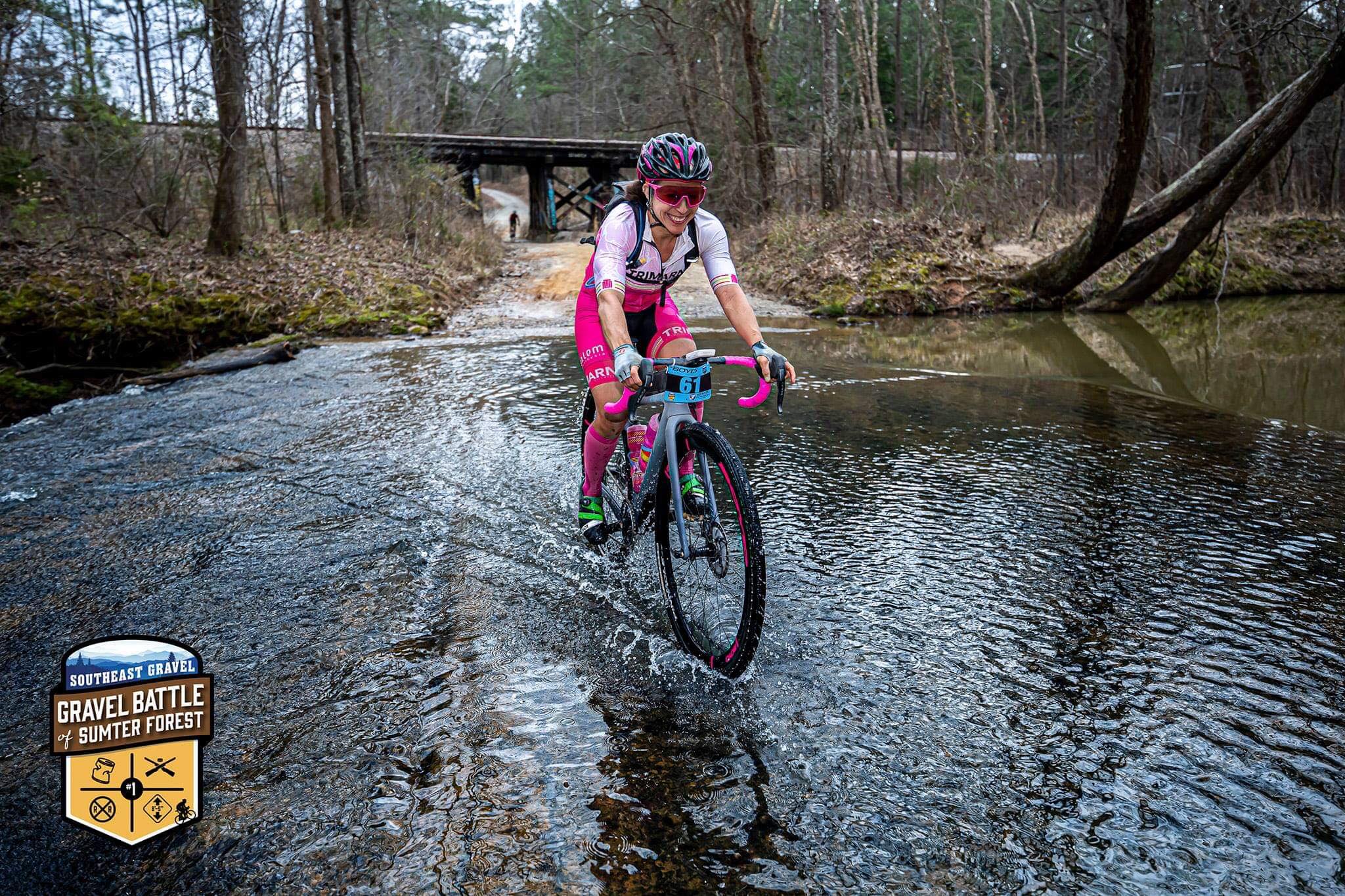
Gravel Battle of Sumter Forest - Race Recap

Trimarni


After two opportunities pre-riding the Battle of Sumter Forest race course, I felt comfortable with course itself as it was a good mix of gravel and road. You do a few miles of gravel and then a few miles of road - rinse and repeat for 72 miles. Although there are a few technical areas (and a river crossing, a few steep hills and a tight rocky turn), I felt like my current gravel-biking abilities were suitable for this event.

Taking things waaayy back to my very first gravel ride....it was not too long ago - January 19th, 2021. I can count with my fingers of all of the times I've rode on off-road since then (total newbie here - only about ten times). It wasn't until a few weeks ago that Karel decided it was time to retire my makeshift Ventum NS1 gravel bike (and return it back to my road bike - which is what it was designed to be) and purchase a real gravel bike frame. After sourcing all of the parts from all over the US, I took my 'real' gravel bike (Cervelo Aspero - size 48) out on Tuesday for it's maiden voyage in Dupont Forest. I had to get used to the new shifting set-up and we made a few adjustments to my position on the bike (saddle) but after a sketchy start (a fresh layer of loose gravel was distributed on the ground just as we started riding), I started to feel more comfortable on my new gravel bike. 


While I am no pro, I registered myself in the pro category of women - This would only impact the results as we had a mass start (all pro men, pro women and anyone riding the long course). But I felt a tremendous amount of nerves going into the event. There was a lot of hype about the pro women field as there were so many incredibly strong and talented road and off-road cyclists registered. With equal pay for both the men and women (which is not typical in many cycling events), this brought more pro women to the event. Plus, Ben and Boyd of Southeast gravel are just plain awesome so their presence alone brings along good people who love bikes. 

We woke up around 5:30am, packed up the car and headed to the race venue (~51 miles away) around 7am (with a quick Campy drop-off at my mom's house). When we arrived to the race venue around 7:45am, you could feel the energy. With nearly 400 cyclists registered for either the long or short course, there was a lot of energy in the air that people were itching to race. I think more than the race itself, an event brings a community together - a community of like-minded individuals who love to ride bikes. It was great to see some familiar faces and to see so many people who just love to ride off road. It was great to see so many female riders there as well. 


After warming up on the last few miles of the race course, which included riding through a corn field, onto gravel and then a pitchy climb to the finish (an area that we hadn't ridden before because it's on an active shooting range), we gathered at the race start of the Clinton House Plantation around 8:45am for a few last minute words by Ben. 

When the event started, it felt like any other bike race. It was fast, a bit chaotic as everyone got organized into a tight pack and you could feel the excitement and nervous energy. Because there were several pro women racing teams (and individual) riders, I had hoped to stay close to them but I was not as skillful moving through the field on the road. I tried to move up when I could but I was just trying to stay safe. Karel made it look so easy as he slithered his way through the field, near the front of the pack. 

Photo: Southeast Gravel

Although the first few miles were fast, I'm used to that from bike events. But what I didn't expect was the intensity of the group when we hit the first section of gravel (around mile 6). The pace didn't slow down - if anything, it got faster. Because this was all very new to me, I had no idea what to expect. When I reached the gravel section, it was so dusty that I could barely see anything. This freaked me out a bit and I found myself slowing down to stay safe. Karel later told me (after the race) that he had hoped that I would be safe and not try to race it as he had no idea that it would be so fast and packed to start the race. As a reference, Karel was near the front and for the first 6 mile section of gravel, his group average 23.9 mph! His HR was in the mid 160's and pretty much stayed there for the rest of the race. For the next 50 miles, Karel's group averaged 21.5 mph! Karel got dropped from a few groups but also found himself yo-yo-ing his way back on. Because of Karel's bike racing (and lifetime of riding) experience, this gravel race felt much like a road race for him. There was a crash on the gravel sometime in the first 10 miles but I think everyone that crashed there finished. 

As for me, once the field started to disintegrate, I jumped onto a smaller group of guys. This felt much more manageable for me - although I was still a bit uncomfortable with the intensity on the gravel. Once we reached the first road section, I felt much better as I was able to stay on the wheel ahead of me. The first section went by fast (looking back, I was averaging 21 mph). Although I felt like I was the last female in the pack and everyone was way ahead of me, it got a bit of a boost when another group came up and there were a few pro ladies in that group. I found myself a bit nervous as the roads seemed to have a bit more loose gravel than what I was used to on this course so I had to be extra careful and attentive on the hillier sections, especially when there's holes, sand and rocks to dodge - all while riding in a group. 

Once I went past the railroad crossing (which occurred after a downhill), I was just riding along (famous last words) until I found myself rolling into a deep hole (more like a crater) on a pavement-like crossing. The hole caught me by surprise and it was too late for me to do anything as I don't have the skills to bunny hop holes yet and my reaction times are a work-in-progress. When my front wheel hit the hole at 21 mph, the force of my body weight on the handlebars caused them to rotate forward. Thankfully, the hoods on my handlebars allow for great gripping. My body slipped forward as my hands stayed on the handlebars so I was trying to navigate my bike while laying on the top tube with handlebars (and brakes) near the front wheel. I did the best I could to try to keep my bike upright but after a lot of swerving, I finally hit the deck. 

I was really shook up from the fall and I had cut my left hip and knee. Thankfully, it wasn't worse. 
After collecting myself and getting up, I tried to adjust my handlebars but they were pretty stuck in that downward position. I managed to put them back up by pressing all my weight on the drops of the bars. I inspected the bike, texted Karel what happened (knowing that he probably wouldn't see the text until the finish) and then got back on my bike. 

At this point, I had a bunch of thoughts going through my head. Quitting, taking the shorter route, never riding gravel again. All of these negative thoughts crept in my head - I'm not good enough, what an embarrassment for me to be out here, I am not having fun I just want to go home, etc. For the next ten miles, I really fought through some negative thoughts and emotions. When I entered the turn off for the short course, I decided to continue what I started. I still found myself with low morale but when George Hincapie and his son Enzo came rolling by with two other guys, I jumped on their train and found myself feeling better (hey, this is pretty cool to ride with our local cycling legend). Thankfully, when I jumped on, we were about to head on a long pavement section which was perfect to get a nice pull (and not work on my own) but also to help me get through my funk. I stayed with George's group for several miles until Enzo had a flat - so I kept rolling. There were a few other groups here and there to hang with so I felt like I was never alone until the last section of the race. 

Since I had two bottles on my bike of sport nutrition along with a Camelback of 1.5L of sport drink, I didn't need to make any stops. After the river crossing and the technical and challenging segment that followed, I made a quick stop to text Karel where I was as I had failed to tell him that I was ok and I was continuing on (I probably shouldn't have left the text as "I crashed and my handlebars aren't working"). 

The last gravel segment was a bit lonely but I was actually relieved to just ride by myself. I was still fighting some emotions as I rode the last 8 miles of gravel by myself. Two riders came up behind me on the pavement section and it was nice to have some company for the last few miles. Once I hit the cornfield and knew I was just a few minutes away from the finish, I was so relieved to see Karel. 


Karel had a lot of fun but he said it was crazy - his first gravel race felt more like a road race. Karel finished 3rd in his AG (40-49) and missed the first spot by just a few seconds as he was outsprinted. Karel had nothing left as he cramped near the end. I finished 17th pro and 23rd overall female. I didn't feel like I was racing after my crash but I never gave up. When I felt safe, I pushed it and I continued to stay focused and do my best with each gravel section. 


When I finished, I was relieved to be back at our car to assess my wounds. They looked a lot worse than they really were so after cleaning them up, it wasn't anything too serious - just some road rash. I've seen a lot worse - especially from Karel's crit bike racing days. My right pec was (and still is) really sore and makes it hard to take in a deep breath, cough, sniff, laugh or move my body quickly. 

It took me a bit of time to sort through all of the emotions that I felt over the past 72 miles. Rather than making excuses or saying something silly that I would later regret, I just stayed quite to work through my thoughts. Karel was very supportive and kind and knew exactly what to say. 


After being around the other riders and hearing so many post race stories, I started to feel a bit more accomplished of my completion of my first gravel race. 


I think we all like to stay in a place of comfort. For any stretch of the comfort zone brings worry, doubt and fear. It can be scary to try something new. Perhaps it's a lack of skills, not having the right gear or equipment or being afraid of the unknown - all valid reasons to be a bit tentative to try something for the first time. But I do believe that we often keep ourselves in a place of safety for fear of comparison, not meeting self expectations or bruising our ego. Being a beginner at something is hard, especially when you see other people who make something look so effortless, simple and easy. Being a beginner means knowing that you have a long road ahead of you, filled with a lot of work, trying, failing and practicing. It can be hard to be a beginner when you believe success only comes to those who are fast. 

Although it's uncomfortable in many ways - physically, mentally and emotionally - I own my beginners status. 

I look forward to the unpaved road ahead of me and what obstacles I will overcome with each day that I refuse to give up. 

Race results
Marni - 4:01
Karel - 3:16

Happy RD Day to the trusted experts

Trimarni


To be sure you are always getting accurate, credible and safe nutrition advice, your go-to expert should always be a Registered Dietitian.

From the media to magazines to articles and books, nutrition advice is everywhere. Unfortunately, not everyone is a credible nutrition expert.

Becoming a Registered Dietitian is a time-consuming, challenging process that involves obtaining the proper education and experience through approved, accredited programs.

After completing coursework approved by the Accreditation Council for Education in Nutrition and Dietetics, the next step is to apply to an accredited dietetic internship. Dietetic internships are extremely competitive and immediate acceptance is not easy (~50% acceptance rate). Internships are usually unpaid, and require tuition. Upon acceptance, 1200 hours of supervised practice in the areas of community nutrition, food service and clinical nutrition must be fulfilled before being eligible to sit for the Registered Dietitian exam. The last step to earning the Registered Dietician (RD) credential is passing the RD exam. Once you pass the exam, you have earned the national RD credential. You are then eligible for state-issued licensure.

Because nutrition is a popular (and passionate) topic, offering nutritional advice requires no education or professional training. In other words, there are countless unqualified individuals giving nutrition advice - often charging for services, selling products and unethically diagnosing and treating health and medical conditions. Just because someone achieved significant weight loss, overcame an eating disorder or achieved athletic success by changing his/her diet, this does not allow this person to help you with your nutritional needs and struggles. No matter the circumstance(s), always research the credentials of your nutrition source to determine if they are a true professional.

Happy RD day to all those who went the extra mile, climbed the mountain and refused to take the easy path in route to becoming a qualified nutrition expert.

Why you need to stop complimenting appearance or body image.

Trimarni


We hear it all the time.

If an athlete weighs less or changes body composition, performance will improve.

We must stop assuming that an image is correlated with performance, health and mental well-being.

When I work with athletes (coaching or nutrition), I always consider the possible outcomes of my advice. I do this through getting to know my athletes as much as possible. I listen to my athletes to understand where they are at in their individual journey and their current relationship with food and the body. I explore every outlet possible to help an athlete improve performance and to get the most out of their body, without placing the focus on body size, shape or image. 

Many times, athletes will come to me with a weight loss goal and without targeting weight loss, performance improves because we addressed behaviors - not a body image. 

While a coach or nutrition expert may mean well by telling an athlete to lose weight or change body composition for a health or performance boost, this language can do more harm than good. Words matter in our appearance-obsessed society. 

Because most athletes do not seek out professional guidance and support when starting a weight loss or body composition journey, there is no one to prevent the use of extreme weight loss methods, to reduce misinformation and to question against unhealthy dietary practices that can sabotage performance and health.

By complimenting someone on qualities and characteristics that are not based on appearance, this helps the person develop the sense that who they are matters — not what they look like. 


Recap - 2.5 day private training camp

Trimarni


One of our favorite aspects of our coaching business is private and group training camps. We love the interaction with athletes. We get to help athletes work through mental and physical barriers in a safe way (with a watchful eye) as well as giving athletes a beautiful playground to show off their strengths. It's been a while since our last private camp and I completely forgot how mentally and physically exhausting and incredibly rewarding these camps are. Now that we got a taste of it, we are looking forward to our next (and first "mini" group) camp of 2021 on the 31st. 


Since Karel and I have been seeking adventures on our road and gravel bikes, we decided to dust off the tri bikes from the garage. Although we both have a tri bike set-up on our trainers, we haven't rode our Ventum tri bikes outside since the Xtreme Tri in November. It was a bit awkward at first (especially with the howling wind) but with each mile, we felt more comfortable in the aero position. We did a recon of the route that we would be doing on day 2 of the private training camp as Karel had never seen those roads before (I discovered it with one of the GVL WBL group rides but Karel was doing a group gravel ride that day). It's incredible that after nearly seven years in Greenville, we are still finding new bike friendly, beautiful routes to ride on!

On Friday morning, I joined our master group for a "fun" 33 x 100 main set. It actually went by rather quickly. Karel did an EC Fit strength session at home and then met me at the aquatic center. 


We reserved a lane for our campers/athletes Jodi and Kelly from 9-10am on Fri and 7-8am on Saturday at the Westside Aquatic Center. Since Jodi and Kelly have different swim abilities, Karel worked with Kelly (adult onset swimmer) and I worked with Jodi (grew up swimming). We focused on technique as well as putting skills into action with a main set. 


On Friday, we headed out to one of our go-to routes for cycling. It's a route that we use when we want to do an EZ spin but also shake out the legs with a few punchy and rolling hills. It's also a great route for working one-on-one with athletes because we can work on a lot of bike handling skills. We did a few loops of a ~3 mile course and I worked with Jodi on her skills and Karel worked with Kelly. Then we finished the ride with applying those skills to the rest of the route. After the ride, I took the ladies for a 20-minute run on our rolling neighborhood terrain. Both of the ladies did a great job on the first day of camp. 


After a good night of rest for us all, Jodi and Kelly met at us at the aquatic center for another swim and then after they got some food and cleaned up at their Airbnb, they met us at our place for our endurance ride. The ride included a recon of the ~5 mile loop that we then had them do for a "time trial" - giving a strong steady effort. This loop is by Jones Gap and has a bit of everything - a steady climb, a downhill, and a long stretch of road with gentle curves that you can stay in the aerobars. It was a cold morning to start but we all warmed up quickly (and overdressed!). After the ride, we went for another 20-minute run. We did the same route as Friday as I wanted the ladies to feel the difference of running with a bit more fatigue in the legs compared to the day prior. They both did great and we finished off another great day of training with a recovery smoothie that I made in our home. 

Because the ladies had a 5ish drive home on Sunday, we needed to start the workouts early on Sunday. But because it was rather cold to start the morning, we decided on an interval trainer workout (~45 minutes) in Karel's fit studio. While it was a great workout for them to warm their legs up, it also provided great value to us as we give a lot of very specific trainer workouts and this gave Karel an opportunity to make sure Jodi and Kelly were executing the workouts correctly while on the trainer.


While they were biking indoors, I went outside for an EZ run to warm myself up before we all ran together for an endurance run. The sun was shining and the weather was perfect for our 1-hour run filled with hills and mountain views. 


After wrapping up the weekend with an espresso and some snacks, the ladies hit the road for their long drive back home. Thanks Jodi and Kelly for taking time out of your busy family, life, work schedule to spend time with us in Greenville! 


Cultivating empathy in a divisive world

Trimarni


In a divisive world, people are very passionate in their beliefs and opinions. This is only heightened on social media where anyone can express opinions without censorship, restraint or legal penalty.

When a topic is polarized by different views, thoughts or opinions, you may find yourself in one of two situations - you either full heartedly agree or disagree.

While it may be hard to accept that a friend or family member has a different opinion to you, the ability to understand and to be understood in a world of conflicts is extremely important. Every person in this world has a unique context which helps inform and shape the way he/she sees the world and behaves in it. As much as you want people to understand where you are coming from (and your point of view), you must be willing to do the same for others.

To enter a space of conflict or lack of understanding, here are a few tips:
  • Accept differences. People come from different backgrounds and are brought up and taught to believe in different viewpoints.
  • Don't be mean. Even if you disagree with an issue, don't be rude, hurtful or overly dismissive.
  • Respect an opinion. We all come from different backgrounds, upbringings and cultures. Even if you don't agree with someone's opinion, you can agree to disagree. In other words, agree with their right to have an opinion.
  • Be curious. A thought, feeling or point of view doesn't have to be right or wrong. No argument or opinion should be black-and-white.
  • Look at the facts. When trying to understand the other side, look at what behaviors, beliefs or situations are facts - not feelings.
  • Emotions are important. Anytime there is a disagreement or argument, there are bound to be emotions and personal experiences attached. There will always be some type of emotional context when expressing an opinion.
  • Don't overlook the context of the situation. People are influenced by their personal history and experiences. Always consider the context of the person or situation. Even if what you consider to be a "fact," we all differ in the interpretation of the "facts" - especially if someone had first-hand experience with an issue or had an experience which was emotionally-difficult. 
The next time you find yourself in a conflict of opinion, have some empathy. "Help me understand where you are coming from" doesn't mean that you agree with the person. It means you want to fully understand the person and their opinion.

Remember that everyone you meet is afraid of something, loves something and has lost something.
-Jackson Brown
--------------------------------------------
For more education, inspiration and motivation - and to check out a delicious cherry couscous salad recipe - subscribe to our free weekly newsletter delivered to your inbox once a week on Wednesday. 

National Nutrition Month - Don't diet, personalize your plate.

Trimarni


It's National Nutrition Month!

The theme this year is Personalize Your Plate. 

We are all unique with different bodies, goals, fitness levels, backgrounds and tastes. There is no one-size-fits-all approach to nutrition and health.

When your diet is varied – without restriction – it’s much easier to meet energy needs and to supply your body with adequate vitamins, minerals and macronutrients to support your health and performance goals.

Eating should always remain a source of pleasure, not panic.
Eating should never be extreme or all-consuming.

Don't diet. Personalize your plate.

The fact that there are thousands of diets out there, promoting different tips and tricks, should be enough to tell you that no one diet works. The diet industry loves to profit from exploiting your expectations and insecurities as they damage your relationship with food.

No food is the enemy.

Every food serves a purpose – from nourishment and fuel to fulfilling hunger, making memories and celebrating. Any style of eating that promotes restrictive or extreme eating is the opposite of health-promoting . Give yourself freedom and flexibility with your food choices. While it’s ok to have a preferred style of eating, being spontaneous with your food choices during unique circumstances allows you to remain present and in the moment. This is especially true in sport. Deviating from a planned or preferred meal doesn’t make you a bad athlete.

Enjoying a pastry with your family at a local bakery or eating popcorn at the movies with your friends is not reflection of poor health, cheating on your diet or showing lack of self-control. It’s a normal part of being human. 

Trust your body around food - it is much smarter than you give it credit for.

How will you personalize your plate? 

End of Feb weekly training recap

Trimarni

I recovered pretty well after the Thomasville Clay (err....mud)100-mile classic. For the 48 hours after the event, I was really tired. The feeling was very familiar as it was like the lethargy/empty feeling that I am familiar with after an Ironman. Thankfully I wasn't too sore. This is one of the (many) great things about cycling (compared to running) in that you can do epic adventures and not destroy your tendons, ligaments and muscle tissue, which means quicker to return back to training. 


With three absolutely beautiful and warm days this week, I felt my mood lifting and the fatigue from the event subsided just in time for me to take my bike and run workouts outside. After a tough morning swim workout on Tues, I joined my new friend Alexi (who is a professional cyclist) and her boyfriend for her afternoon bike workout. The main set was two rounds of 3 x 2 min high power, high cadence efforts up Paris Mountain w/ 5 min EZ recovery between each two minute effort and ~10-15 min EZ between the rounds - ouch, that burned!. We also rode together on Thursday for an endurance ride. I was pretty toasted after the Thurs morning masters swim so the endurance ride in the mountains was just perfect for the soul. Wednesday I "only" had an interval run with 6 x 0.5 mile tempo effort loops w/ 2.5 min EZ between. 

My swims have been tough and I really struggled on Thursday. I acknowledged that I was tired and just focused on my form. Friday is my favorite swim day as it's a 7am swim and my only planned structured workout for the day. It's nice to have the entire day to recover before the weekend.  The main set on Friday was 20 x 100's w/ 1 EZ and 3 strong on 1:30. I was really struggling with my catch in the water so I used my FINIS agility paddles for the set. Although I felt like I was running out of energy in the middle, I managed to squeeze in a 1:10 for the final strong (I think that's more mental than anything when you know you are finished and can really leave it all out there). 


I was really looking forward to this weekend because a friend from my hometown of Lexington, KY was in town for the Greenville Half marathon. Oh to be excited to see someone and to look forward to a get-together. 

Karel went for a swim on Saturday morning and I went out for my long run. My plan was 1:45-2 hours and without looking at my time, I ended up with right at 13 miles and 1 hour and 47 minutes. I rarely look at my watch when I run (mostly for time) so I just let my leg lead the way and I did a nice out and back run with a few last minute turns on the way back (I was feeling good so I decided to add in a little more than I originally planned). My run felt good and it was a cloudy and cool morning - perfect for the running race that was happening. 


After my friend Shannon finished her race (with a PR of 1:38), we made plans to meet at the Greenville Zoo. This was our first time visiting our local zoo after nearly 7 years of living in Greenville. But we timed it right as we got to see the new baby giraffe. Shannon's little girls loved the animals at the zoo (and all of the adults loved the animals too!) After our zoo trip we made a quick stop at Run In to get a few things and then it was time to head home. It felt so unfamiliar but good to actually have a plan and someone to meet up with. 

On Sunday we drove near the Sumter National Forest in Clinton, SC to do a recon of the Southeast Gravel race that is happening on March 13th. We actually pre-rode the course a few weeks ago for my first group gravel ride. It was a perfect day for riding and to my surprise, I overdressed! Our friend Alvi joined us for the ride and I would call this a happy ride. We rode 57 miles of the course in 3 hours and 32 minutes with ~3200 feet of elevation gain. It was nice to see the course again and to ride on the very quiet roads. After the run we did a quick 3 mile brick (out and back) on the gravel to finish off the week/weekend. 


My body has been really tired this past week so it was nice to have a good meal in the evening, give some love to the furry kids and get to bed early for a full eleven hours of sleep on Sunday night - oh did I need it! 


Time is flying by - how is it already March??


Busting 6 eating disorder myths

Trimarni


“The goal of National Eating Disorders Awareness Week is to shine the spotlight on eating disorders by educating the public, spreading a message of hope, and putting lifesaving resources into the hands of those in need.”

According to the the Alliance for Eating Disorder Awareness, 29 million Americans will experience a clinically significant eating disorder during their lifetime. Yet, only one-third of people with eating disorders will ever receive treatment. Eating Disorders Awareness Week was developed to reduce the stigma, raise awareness and provide better access to support for those suffering from an eating disorder.

In a field where marginalized communities continue to be underrepresented, it's important to welcome conversations on raising awareness, challenging systemic biases, and sharing stories from all backgrounds and experiences (NEDA).

If you or a loved one is currently struggling with an eating disorder, it’s important to know that you are not alone. Know that a life of full recovery is possible. It's worth the effort to create a life worth living.


2021 Thomasville Clay Road Classic - 104-miles of mud, clay, water and sand.

Trimarni


**If you'd like to skip the race recap and view a video from the event, JOM from The Gravel Cyclist did a great video recap from the event. Scroll to the bottom to see the footage.**

Around 12pm Thursday, we left for our 6-hour drive down south to Thomasville GA. It was a rainy day for a long road trip but it’s been several months since we had a true “race-cation” road trip so it was somewhat enjoyable to know that we were traveling for an actual event. 

We made good time and arrived to our Airbnb shortly just after 6pm. I was happy to have booked an affordably priced 2-bedroom house just a 1/2 -mile from the race venue but I had no idea how cute of a house we would be staying in. The house had historic bone-structure with a few recent updates. It was one of the best Airbnb stays that I’ve booked, which made for a super comfortable stay.


After a good night sleep on Thursday, we took our time on Friday morning to catch up on work and emails. We ventured outside around 11am to ride the first ~10 miles of the course (out and back). We ended up with around 18 miles (in about 82 miles) and a whole lot of mud and water on our bikes. After several days of rain, the packed clay roads had been filled with water which turned the roads into a muddy mess. I couldn’t help but laugh at myself when I fell into the mud as I attempted to go from a muddy groove up to a muddier section. I’ve only been riding off-road on my gravel bike just a handful of times (4 rides + 1 technical skills session) so every ride is a learning opportunity. I’m still getting a feel of what different textures feel like under my wheel and how to handle my bike through those conditions. Karel is a great teacher. Not only does he instruct me what to do but I also watch him and learn from his exceptional bike-handling skills.


 After our ride we biked to the Hubs and Hops bike shop to check out the store and to pick up our packets. While this was technically an event (we paid for it, received an event t-shirt and a bib number), the Thomasville Clay Classic was a self-supported, see-ya-when-you-get-back type of ride. The event host/organizer was very nice and it was to hear that the event brought in over 200 participants to this small charming town of Thomasville.


Since I brought all of our food for our stay, we didn’t have to do any grocery shopping or eating out. Although we did visit the local bagel shop (Empire Bagels) for 6 delicious bagels. Our assistant coach and long time friend Joe arrived to our place around 2:30pm.

We went to bed around 7:30pm and feel asleep just before 9am. I wasn’t nervous for this event but instead, excited to embrace the challenge of riding 100 miles on the clay roads of Thomasville.


The alarm woke us up around 5:30am. With all of our gear prepped the night before, all we had to do was eat, gear-up and do some foam rolling to move some blood for the chilly start (~low 30-degrees when we left the house around 6:45am). With the sun just rising, we had just enough light to bike our way to the shop for the start of the event.

There were only ~10 of us doing the 102-mile version (there may have been a few others who started later in the morning). We all started together after the event organizer gave us a pre-course talk and a morning prayer. We started the ride just a few minutes after 7am.


The first few miles of the ride were on the road and then we hit the clay trail. Three guys broke away right from the beginning and then there was me, Joe and Karel. And for the next 60-ish miles, we didn’t see any other riders. Although this was a race, there was no timing or competition to race against. We didn’t ride easy but instead, rode a steady strong effort to try to complete the course as “quick” as possible – also taking into consideration that this would be a long ride with a lot of challenges to overcome.


I didn’t feel the best for the first two hours. My hands were cold and my body was not awake. It typically takes me about 60 minutes to feel good on the bike when I start a ride but for this ride, I was struggling for the first 2 hours. At one point, I asked Karel to look at my bike because I couldn’t understand why I was going so slow and why it was so hard to ride. He told me that this was all normal and that it was hard for him as well. Realizing that this was only my 5th gravel ride, I quickly changed my perspective as I was approaching this ride in the wrong way. I didn’t think the ride would be easy but I had no idea that it would be this hard. It wasn’t that I wasn’t having fun but I didn’t have the right attitude. Once I changed my mindset, I started to ride a bit stronger and better. Because I had the course map on my computer screen, I had no idea what mile were at (there were no course markings) or how long we had been riding. And I didn’t want to know. 

I really enjoyed seeing my map and knowing that our next turn would be in x-miles. It was fun to approach each segment and to feel accomplished after that segment ended. Sometimes a segment would end after a super rough 5-6 miles of rough, bumpy and slow terrain, only to turn onto another 8-9 mile segment of road of even more difficult terrain.


We crossed a few water crossings, which is still a bit nerve-wracking for me as each time I enter the water on my bike I have no idea what to expect. Karel always reminds – keep pedaling, don’t stop pedaling. Nothing good happens when you stop pedaling. There was one water crossing where the road was under water and Karel and Joe decided to ride through it. I like to watch and learn when I see a technical or uneasy section so I stopped far out from the water to watch how Karel and Joe rode through the water. It wasn’t until Karel’s lower leg was nearly covered in water that I realized that this was way too deep for me so I walked my bike around the water on the grass. It was a laughable moment by us all.

Normally the roads are ideal for gravel biking but we have learned that after a rain storm, they become rather difficult for riding. We would be riding along feeling a good rhythm and then we would hit a section of bumps which would knock you around as you tried to dodge the big holes but you would still have to ride over the bumps (which felt like speed bumps). There were very few “nice” sections that were “easy” but plenty of sections of sand and mud which made us feel like our brakes were squeezed tight, we had a parachute behind us and you were riding with a flat tire. Oh, and it was windy too! It’s just the strangest feeling to be riding and then hit these sticky and slow sections and you have to produce a lot of power and a high cadence to keep the momentum going. The roads were fun at times but super exhausting. I’d say that about 85-90 miles of the ride was off-road and only about 15ish miles of pavement. We were always happy when we did hit pavement because it was such a nice change to be able to ride so easy and cover the miles a bit quicker. And then, back to the hard work again.


It was incredible to see how many roads were suitable for gravel riding. We had very few cars pass us (maybe 5?) on the clay roads which was great for feeling safe. The only downside of gravel riding is the lack of stops for refilling bottles so we planned our stop for the end of the loop at mile 70 (we passed the store at mile 20 so we knew where we would stop at the end of the loop).

As we were getting close to finishing the loop, we made a turn and saw our local friend Boyd Johnson (of Boyd wheels) riding in the opposite direction – toward us. He was in the front of the ride with the two other guys so we were surprised to see him. He told us that the road was under water and it was really deep (which deep for them meant really really deep for me). He said there was a way around it which would give us a few extra miles but would keep us from being really wet. We all decided that we would take the extra miles on the road to bypass the road under water.


After our store stop for some needed water to refill our bottles (we brought sport drink power to refill and had plenty of snacks for throughout the ride) and a coke, it was time to hit the road again for the last 30-ish miles. At this point, Karel found his rhythm, I was feeling strong and Joe had hit his low moment. We knew that we would all be affected differently by this ride and that we would each have our moments. Karel, however, never hit a low moment and contributed it to taking in more calories than he would in an Ironman on the bike. As we were nearing the last 20 miles, Karel was in the front and then out of sight. Boyd and gotten his energy back after the store stop and Joe was still struggling. We thought we would see Karel at the next turn but he was not there.
 
We rode to the next turn and no Karel. I called and texted Karel but no reply. I was very worried about him and of course, thought the worse – that he had bonked and he was laying in a ditch in the mud half asleep. Joe helped me stay calm as I was super worried about Karel. Part of me knew that he was just fine but I guess when you are exhausted your mind thinks silly things. Karel finally called me and told me that he was feeling good and just kept riding because he didn’t want to lose his rhythm. I was a bit upset at him for not letting me know this as I would have been fine with it but instead, I was worried. Karel’s exhausted brain convinced him that he thought I’d figure it out. Oh Karel - he always keeps me on my toes. 😊


Near the end we had one last creek crossing which I managed to get through successfully, despite the water coming up to my knees. It’s the weirdest feeling pedaling a bike through the water! But this was a nice one as you could see the bottom of the creek and the rocks didn’t get bumpy until the end. And then there was one last super muddy section that forced me off my bike as my legs were just so tired that I didn’t have the power (or willpower) to get through that deep mud.


Joe kept me laughing as he was struggling and anytime he needed to unclip to navigate through a technical section, he decided to just lean over and fall to the ground. He called them his “micronaps” and said it felt really good just to lay down. I was belly laughing at him as he fell twice and both times he could have easily unclipped but in the moment, the easiest thing was just to fall over.

As we made our way on the pavement for the last 2 miles of the event, I was so relieved to be on a smooth road. It was actually a bummer that we didn’t ride on the pavement more often during this ride as the Thomasville and surrounding area roads were super smooth! I finally saw Karel (who had finished about 10 minutes ahead of us) and he rode to the finish of the event with me. There was no official start/finish line but instead, we biked right to the bike racks to hose off our incredibly dirty bikes.

It felt so good to finish the ride. Surprisingly, the ride didn’t feel like 104 miles or just under 7 hours of riding. It was a challenge and an adventure and it was really exhausting. But it was also a huge accomplishment to ride 104 miles on such difficult off-road conditions. At least we had a beautiful sunny day and got to enjoy great scenery with each mile.


After we cleaned off our bikes, we received our post-ride meal of vegetarian stew topped with cheese, sour cream and frittos and a side salad and bread. Oh it was sooo good. During the ride I had 4 bottles of sport drink, 2 bars (Clif PB and chocolate filled bar and a Picky bar), a handful of chews (Skratch and Honey Stinger) and some coke.

After the ride, there was live music and the amphitheater park was filled with local people. There weren’t many cyclists at the finish when we arrived but we did see a few dozen riders out during the last 15 miles. I think most of the riders started around 9am and were riding the shorter versions (25, 50 and 70 miles). There were also options to shorten the ride by taking some of the main roads instead of the clay roads. Like I said before, it was an unofficial, self supported event. Although we had hoped for a bit more socializing before, during and after the event, we still feel like this trip was well worth it. 


 We made it back to our rental house around 4:00pm and it felt so good to get out of my cold wet socks and into the warm shower. I was so exhausted after I cleaned up that I barely managed to eat some type of dinner (quinoa vegetable microwave mix with tofu that I brought from home) before collapsing in bed. Wow – I had no idea how hard that would be! It felt like I had just done an Ironman but without the deep aching soreness that comes from running. 

I never grew up a cyclist and really didn’t improve my bike handling skills until we moved to Greenville. Although I still have a lot of skills to learn for gravel riding, it makes me excited to know that I can continue to improve and seek out more adventures on two wheels. Running can be really hard on my body and I just can’t push and test myself when I run like I can when I swim and bike. If I try to push myself running, I get injured so I have to be cautious and careful. Swimming and biking are safe sports for me to feel challenged and to test my limits and abilities. I look forward to more adventures where the focus is on the experience and not on the end result. Don’t get me wrong - I love racing and I love competition. And I LOVE triathlon. But sharing these adventures with Karel – out in nature - makes me so happy. And this type of happiness doesn’t involve a finish line or race results and I'm ok with that. 

Early Season Sport Nutrition Tips

Trimarni

For several decades, extensive scientific research has focused on what and when to eat before, during, and immediately after exercise to enhance the adaptive response to exercise.

For example, prolonged exercise depletes muscle glycogen storage and breaks down muscle tissue, which increases the risk for fatigue and immunosuppression (greater risk for sickness). Consuming carbohydrates and protein within ~30-minutes after a workout can help you build muscle, store energy, and minimize tissue damage. Unfortunately, nutrient timing is a confusing nutrition topic because most strategies conflict with the “healthy” nutrition advice given by experts regarding weight loss and management. As an example, a fitness enthusiast may be told to restrict dietary carbohydrates around exercise to lower insulin levels. This can help with fat loss. However, insulin is a powerful anabolic hormone and with the help of carbs, it plays a vital role in transporting amino acids, fatty acids or glucose from the blood stream into cells.

Although sport nutrition advice may appear “unhealthy,” implementing smart fueling practices around and during your workouts is critical for your health and performance. It can reduce the risk for sickness, fatigue and injury so you can achieve faster results, improving strength, speed or endurance, while staying consistent with exercise.

To help master nutrient timing, here's a simple nutrient timing worksheet that I created. 


Simply fill it out the day before your upcoming workout(s) to plan out your pre, during and post workout nutrition. To save paper, you can laminate it and complete on a day-to-day basis with a dry-erase marker. 

ACCESS THE WORKSHEET HERE.

Is fat burning undermining your performance?

Trimarni

The media loves to make nutrition simple. Workout fasted and you burn more fat. If only it was this simple. 

When it comes to the physiology of the body during exercise, nutrition is a complex topic. Researchers are still studying the different effects of nutrients, nutrient timing and supplements on exercise and exercise performance. This isn't to say that fat burning doesn't work (it does!) but it's not as simple as not eating carbohydrates before and during a workout. 

There's a lot of debate about fasted training, training low, LCHF diets, keto and low carb. Unfortunately, with no middle ground, athletes tend to direct their energy and attention to what's most trendy and popular and for the past few years, carbohydrates have received a bad reputation from the media. 

I am a proponent of carbohydrates in the diet. I feel strongly for nutrient timing (eating before/after workouts) and I believe that the use of sport nutrition is critical in optimizing health and performance for endurance athletes. But this doesn't mean that I prescribe eating all the carbohydrates, anytime and of any kind. But I am also a proponent of fat, protein, vitamins, minerals and water. In other words, fueling for sport performance is not black or white. If you sit on either end of the spectrum you could be sabotaging your performance and compromising your health. 

I'd like to start off with some not so breaking news that often gets overlooked when it comes to fat burning. 

  • Through endurance training, you will increase fat oxidation by upregulating the enzymes of the fat oxidation pathways, increasing mitochondrial mass, increasing oxygen update and improving economy of movement. 
  • To become a better athlete (ex. faster, stronger, more powerful), your physiology needs to change. While some individuals may experience a performance boost because of an improvement in health, the diet or body composition, a race weight means nothing if you haven't done the work to significantly change your physiology and to arrive to the race in an optimal state of mental and physical health. 
  • Don't underestimate the importance of the relationship between your lactate threshold, economy of movement and VO2max. Having a lean or muscular body or performing workouts in a fasted state does not ensure that you are economic and able to quickly oxidize carbohydrates (without GI distress) to optimize performance. 
  • Carbohydrates are the primary fuel produce ATP (energy). But you also need to keep up with your hydration (water and sodium) needs in the face of sweat losses induced by intensity, duration and the environment. 
  • Don't rush the process. To truly change your physiology for performance, you have to continue to stress your body in different ways. Otherwise it gets comfortable and you no longer receive an adaptation. High intensity efforts and strength/power training are just as important as easy sessions, endurance sessions and recovery. And don't neglect skill and technique work. All of that training is for nothing if you can't hold good form under fatigue. 
  • You have to fuel and hydrate on race day. There's no beating the system here. If you want to perform (and have some fun doing so), you need to take in carbohydrates, sodium and fluids - in proper amounts, frequently and consistently during your long distance event. And to figure out the best fueling and hydration strategy, you have to develop confidence (and the ability to digest/absorb nutrition) through training. More so, consuming carbohydrates teaches your body how to store and utilize carbohydrates more efficiently which will reduce the risk for GI issues on race day (while promoting more efficient use of carbs to delay fatigue).
If the majority of well-designed research clearly shows that the strategies to become a better fat burner does not show a direct correlation with improving athletic performance. So it's worth asking the question.....are you undermining your health and performance by restricting carbohydrates, performing fasted workouts and trying to complete workouts in an underfueled state?

For many athletes, the strategies applied to become a better fat burner for metabolic efficiency or to burn more fat to change body composition are nothing more than a form of underfueling - which means you are not eating enough to get the results that you desire. Yet scenarios play out all the time as athletes try to apply the weight loss methods for the non-athlete population, assuming that eating less carbs = fat burning and weight loss.

Sadly, far too many athletes are using endurance training as compensation or punishment in order to look a certain way or to justify eating patterns. You don't need to ride your bike for 3 hours in a fasted state just to "earn" a bagel. And you don't need to punish your body with a high intensity workout just because you ate a cookie. 

The methods that you are using to become a better fat burner (or to lose weight) are likely not working. I know this because I see it time and time again. Not eating adequate carbohydrates in the diet, not timing nutrition with training, not utilizing sport nutrition properly and having an unhealthy relationship with food (alongside body dissatisfaction) turns training into a method for weight loss, but it doesn't work. You are simply undermining your training, sabotaging your health and these methods have the exact opposite effect on your body composition than you are trying to achieve.

As a result, health is compromised, fitness improvements are slow to achieve (if at all) and all that training, time, energy, money and effort is for nothing come race day because the body is undernourished and overtrained. 

Fat burning is catchy, trendy and enticing. And some methods may work for improving performance in the short-term. But the long-term repercussions of not feeding your active body enough food and nutrients are concerning - from a weakened immune system, bone loss and nutrient deficiencies to gut issues, damaged endocrine, hormonal and metabolic health and psychological issues. 

With so much great research and science demonstrating a positive relationship with carbohydrates and performance, are your methods for weight loss and metabolic efficiency negatively impacting your health, performance and body composition?

Let's look into some of the reasons why fat burning is not all that it's cracked up to be. 


If this blog was helpful for you, please share, especially with your fat-burning obsessed training partners. 


It's race week - we're going off-road!

Trimarni


Since December 5th, we have been extremely lucky with our weekend weather. We have been able to ride outside every Saturday morning for the past two months. Although a few of those rides were rather cold, drizzly and windy, the weather seemed to always be in our favor. 

This past weekend was a different story. On Saturday morning, it was cold and rainy. Although the trainer is always available for a weather-controlled indoor ride, I craved a change in the routine. Maybe it was meant to be. 

Instead of staring at the wall for a few hours, I decided to start my workout with 30 minutes of mobility and strength (with EC Fit On Demand) and then headed out in the light cold rain for a run on my favorite long run loop. Although I wasn't quiet sure how to dress, I found myself comfortable and happy running in the light cold rain. I listened to two triathlon podcast interviews during my run and found delight in dodging the puddles and feeling the wind in different directions as I made my way out and back on the undulating 11.5-mile loop. To keep with the theme of the weekend (changing things up), I repeated the route on Sunday for two 11.5 mile runs in 48 hours. My legs responded really well to the 2nd run and with a different shoe choice on Sunday (NB Fuelcell) versus Saturday (NB Fresh Foam), I ran much more efficiently on Sunday with a slightly faster pace and an average HR of around 8 beats less on Sunday. I'd call that a successful weekend of quality training! 

Karel and I are really excited for this weekend as we will be participating in our first race of 2021! I came across the Thomasville Clay Road Classic after searching for gravel rides in and around our area. I had just finished my first gravel ride with Karel and was instantly hooked. After showing the event page with Karel, it was an easy decision to register for the 100-mile distance. This will be our first ever gravel "race." Our assistant coach Joe will be joining us and we know of a few other people who will be participating. One of my favorite things about racing is seeing familiar faces. 

I've been asked by a few people if I am giving up triathlon racing for bike racing. My answer is always a quick no. I love the sport of triathlon - especially long distance triathlon training and racing. I love swimming, I love biking and I like running (love/hate relationship with it). But during these uncertain and unpredictable times, I find it really important to explore different racing opportunities - which means using my triathlon fitness for different racing experiences. 

Although I love swimming, biking and running, I really enjoy racing. Although it's incredibly uncomfortable at times and sometimes brings worry, frustration, anxiety and distress, race day is worth getting excited for. I love the community feel of a race, being around other like-minded individuals and escaping the stressors of life for a day (or a few hours) in order to do something that brings you excitement and joy. Competition (or participating in an event) also teaches you a lot of great lessons that you can apply to life. Every race is seen as a driving force and a form of motivation for continued improvement. 

Sport is all about what you make of it. It's all-too-easy to stay in a comfort zone and opt for what's familiar, convenient or comfortable. But with the added weight on our shoulders of whether or not a future race will happen, I believe it's really important to seek out and take advantage of the opportunities that are available to you right now. While it's important not to abandon your structured training for your future events and to also keep yourself safe during this pandemic, it can be a wonderful thing for your mind to change up the normal workout routine and to try new things. 

When looking for a race, consider your current level of fitness and skills and search for something that would slightly stretch your comfort zone. Also consider your safety as it relates to your health. Any race/event that you choose should be something that makes you nervously excited. 

Don't be afraid to step outside of what's familiar to do something that your future self will thank you for. 


Although a systematic training plan will have a certain amount of monotony to produce physiological adaptations, it’s necessary to occasionally break the monotony. Changing up the routine allows you to stay emotionally and mentally engaged. Otherwise, always going through the same motions can increase the risk of boredom and burnout.

Change the sport, change the scenery, change the route, change the isolation, change the need for familiar and comfortable. 

Don’t fear change.
Embrace it.