We’d love to hear from you.

We welcome your thoughts, experiences, comments, suggestions, questions or personal stories. If you don't hear from us right away, please note that your email is very important to us. We will do our best to respond with 24 hours.


Greenville, SC

Trimarni is place where athletes and fitness enthusiasts receive motivation, inspiration, education, counseling and coaching in the areas of nutrition, fitness, health, sport nutrition, training and life.

We emphasize a real food diet and our coaching philosophy is simple: Train hard, recover harder. No junk miles but instead, respect for your amazing body. Every time you move your body you do so with a purpose. Our services are designed with your goals in mind so that you can live an active and healthy, balanced lifestyle.

Blog

A quick self-care trip to Lexington, KY

Trimarni


I took Campy on a weekend road trip to my old Kentucky home. If you are new to my blog (thank you for finding me), I was born May 31st, 1982 and I spent the first 22 years of my life in Lexington, KY before moving down south for graduate school.

I get awfully sentimental over people and places. No matter if the experience was positive or negative, if it shared some meaningful time in my life, I have trouble letting go.

Like many of you, I'm still on a rollercoaster of emotions. I've been on the same ride since around mid March. I recogniz that I have a lot to be thankful for during these times and I realize it's a privilege to feel grateful for so much - health, career, home, family, love. But sometimes I can't get out of my own head and this leaves me stressed, overwhelmed, anxious and confused. Let's just say that unless I have a lot on my daily plate to keep me insanely busy, my mental gymnastics will spiral into overdrive.

Another fun fact about myself - I am stimulus hungry. My brain needs a lot of stimulation. They say opposites attract and this couldn't be more true for me and Karel. Karel gets his energy from being alone. He tolerates people in small groups and in small doses. Thankfully, he also tolerates me ;)

As for myself, I get my energy from being with and around people. Being alone or alone with my own thoughts is incredibly difficult and brings me great stress and anxiety.  I receive a lot of happiness from the outside world and I am constantly trying to cultivate interesting activities and seeking out companionship to give my brain the stimulation that it needs.

Our current global health situation has been incredibly hard for us all. You are not immune to the stress and distress that is affecting your community, nation or the world in which you live. The things that brought us joy and freedom have been temporarily removed and we are learning to embrace a new normal as we welcome certain people and things back into our life.

Feeling so overwhelmed with my thoughts and emotions, I needed to gift myself some me time. Even tough my extrovert personality loves being with and around others (something that I miss dearly, especially with the cancellation of all of my races this summer), I seek opportunities that allow me to collect my thoughts.

Travel is my way of "me time." Since most of my travel is for personal reasons (racing), it's something that I greatly look forward to as it makes me feel happy and alive. Travel serves as a recharge to my brain and I always feel more energized (not drained) than when I left.

Earlier last week, I decided to book a quick trip to Lexington, KY. A short weekend away, just me and Campy. Oddly enough, Campy is a great travel partner as he never makes me feel alone. Plus, I love making memories with my 12.5 year old furry BFF. I safely reconnected with people, places and things that I hadn't experienced in a long time. With such a positive, nostalgic view of my past, I tried to keep myself busy as I ran, walked and drove myself around my old Kentucky home. When I found myself bored and tired of my own company, I knew it was time to head back to Greenville, SC.

Here are a few pics from my trip:


On Friday morning, I did an hour workout in my makeshift pool and hit the road around 10:30am for my 5 hour drive up north to Lexington, KY.


While I listened to podcasts, my co-pilot was great company. 


We didn't stop throughout the drive so Campy slept the entire trip. So much cuteness. 


Exploring an unusually quiet downtown Lexington, KY.

Saturday morning long run (10.3 miles/1:22) on the Legacy Trailhead. 

I started my run from my Airbnb in downtown Lex (on E. Maxwell street) and made my way through downtown side streets to the trail. 

I ran a similar route on Sunday (8.6 miles/1:11). 

Both runs included sight-seeing and picture taking. And a lot of humidity!

It was fun to run around downtown. 

And see new and familiar sights. 

And so fun to run on flat pavement and not hills! 


Transy! Where I went to undergrad and earned a bachelor degree in Exercise Physiology and minor in Psychology. 

Triangle Park in downtown. 


Visiting my high school friend Shannon (who's a nurse) and her horses on her farm. 


Campy was on his best behavior. Just a few tough barks to the horses in the barn. 

What a peaceful backyard!


During my last trip to Lex, I visited my old house where I spent all of my teenage life. For this trip, I wanted to visit the house where I was born at in 1982. My parents were the original owners of the house and it was the first house they purchased. I drove past the house and with the owners in the front yard, I asked if I could take a picture of the house. After talking to the owners (who were incredibly nice and have lived in the house for 30 years - the 3rd owners of the house), they kindly invited me inside for a socially distant tour. Because I couldn't remember a lot about the house, I decided to Facetime my mom who gave me a memory-filled tour inside the house.

My mom loved sharing stories to the owners about the house. There were so many original things in the house - like the toilets and cabinents! And they even had a piano in the same place where I learned to play piano. 

I had so many memories in this backyard! 


 Funny thing - the house felt SO much bigger when I was little! This was the basement (with the original wall finishings) where I played a lot with my dad. I remembered it to be SO big but in reality, it was just a small finished basement room.
Finishing our morning walk outside my Airbnb. I learned this is a Poplar tree - which has very distinctive leaves. As it name suggests, it's a popular utility wood.

One last long walk around downtown Lexington. 

Someone is SO tired from the trip and all of his memory-filled adventures. 


How to plan a healthy summer picnic (+ recipe)

Trimarni


With warmer weather in your near future (fingers crossed), you may be looking to enjoy a meal or two outside. Whether it's a family backyard cookout or a picnic with a friend at the local park, here are a few tips to keep your picnic meal nutritious and safe.
  1. If you plan to be outside for several hours, choose foods that won't melt or spoil easily. Good options include raw or cooked firm vegetables, chopped fruit, cooked grains, cold pasta salad, beans, popcorn, pretzels, hummus and trail mix. 
  2. Consider going meatless with plant proteins that hold up well in hot conditions. Options include beans, lentils, tofu or tempeh. You can mix into a beautiful salad or your go-to grain dishes. 
  3. For a savory-sweet dessert, consider cheese alongside dried and fresh fruit.
  4. Don't forget to hydrate. To limit individual plastic water bottles, have everyone at your picnic bring/carry their own reusable insulated water bottle. 
  5. When grilling, consider heart-healthy options like fish, lean meat, veggie burgers, and a range of veggies. A marinade may reduce the production of carcinogens and adds great flavor to your dish due to all the herbs and spices. 
  6. Be sure to wash hands before serving or eating food and bring hand sanitizer to use before and after eating, handling pets, changing baby diapers or using the bathroom. 
  7. Perishable foods - like dairy, mayo, eggs or meat - should not be left in room temperature for more than two hours (one hour if the temperature is higher than 90 degrees F). Make sure you have plenty of ice if using a cooler. 
  8. Minimize waste by bringing disposable paperware and utensils. Products made of glass, bamboo, cloth, cermaic or stainless steel are environmentally friendly and can be washed and reused.
"Dinner and a movie, forget that, I’d rather have a picnic and a waterfall."
– Amanda Grace
 --------------------------------------------------

Mediterranean Orzo Pasta Salad

By Joey Mock, RD, LD, CLT

This Mediterranean Orzo Pasta Salad makes a deliciously refreshing side for your picnic in the park or backyard cookout. Leftovers will make a perfect addition to a lunch on-the-go or to enjoy as a satisfying afternoon snack.


Ingredients

For the vinaigrette:

  • 2 tablespoons red wine vinegar
  • 2 tablespoons freshly squeezed lemon juice (about 1/2 medium lemon)
  • 1 clove garlic, minced
  • ½ teaspoon dried oregano
  • ¼ teaspoon kosher salt
  • ¼ teaspoon freshly ground black pepper
  • ½ cup olive oil
For the pasta salad:
  • 3 cups cooked orzo, cooled
  • 1 large tomato, seeded and chopped
  • 1 cucumber, peeled, seeded, and chopped
  • ¼ cup black olives, quartered
  • 2 Tablespoons fresh parsley, chopped
  • ½ cup feta cheese, crumbled
  • ¼ teaspoon dried oregano
  • ½ teaspoon dried minced onions
  • Couple of dashes black pepper
  • Dash dried thyme
  • 1 teaspoon freshly squeezed lemon juice
Preparation
  1. In a 16-ounce mason jar, combine all ingredients for the vinaigrette. Seal the jar with a lid and shake vigorously until combined.
  2. In a large bowl, combine pasta, tomato, cucumber, black olives, parsley, feta cheese, oregano, minced onions, black pepper, thyme, and lemon juice and toss.
  3. Give the vinaigrette another good shake and pour up to 6 tablespoons of the vinaigrette over the pasta salad and toss to evenly distribute.
  4. Refrigerate until ready to serve.
  5. Enjoy!
For more tips and recipes, subscribe to our free weekly newsletter - delivered to your inbox every Wednesday morning.  SUBSCRIBE HERE

How to thrive during a difficult time

Trimarni

We are all going through a very difficult time in our life. It's ok to feel your emotions. But in these challenging times, maintaining a positive and resilient mindset is very important.

To help with this, remember that everything ends. Whether it’s good or bad, nothing lasts forever. You've overcome challenges before.

Think about the setbacks/obstacles that you’ve successfully overcome in your life. When you do this, it acts as a reminder of your ability to handle challenging situations and to succeed. It boosts your sense of self-confidence and it eliminates the sense of helplessness. This attitude shift is needed to motivate you to not give up and to successfully rise above the situation.

As part of our weekly "Motivational Monday" post on our private team Facebook page, I recently asked the Trimarni team members to share their best advice/tips on how to thrive through a difficult time.

Here are some of their incredibly insightful responses:
  • Injury: “Try to remember it will always be there. You can’t ever lose that part of yourself. Once an athlete, always an athlete. Get knocked down, get back up, rinse and repeat. You need to be patient with yourself though. Lots of love and grace.”
  • Stay Involved!! 2 years ago I was in a cycling accident and could not workout for 3 months due to a concussion. But I would still meet my running friends and I would walk while they ran. I went to OWS’s and acted as a spotter for our lifeguards and I volunteered at many races. By staying involved I had a reason to get up in the morning and I still got to spend time with my friends while I recovered.
  • Listen to the coaches, period. They know the path to where you hope to go.
  • I've been very lucky in general but did have a six month period very recently where I kept getting sick- immunity was down, prob due in part to undereating. My advice is keep seeking the answers, you know your body better than anyone and what is normal for you and what is not - find the people who truly care and are relentless in helping you get better.
  • Be persistent and patient. When I tore my meniscus in 2017 I had a hard time finding an ortho doctor that looked at and took into consideration what I did and not look just at my age to decide the course of treatment. To tell me I could probably run a mile or two and ride 5-10 miles wasn't acceptable - why get my stuff dirty for that! Once I found the right doctor - as an older athlete - I had to learn to be patient and to listen to my body and my doctor. I don't tend to be patient and as a former nurse I don't tend to do what I'm told but I learned and it paid off. I also found that my occasional 'pity' party made my resolve to rehab only stronger.
  • Working with Trimarni the last 7 years has been amazing. I have completed 6 Ironman's and 20 half Ironman's with multiple podium finishes and I was able to race in three world championships. In that time I have not had any major setbacks. Yes, I have had my share of ups and downs and I do love a good long off season (HA!). Even if I do get comments in training peaks like… "can you do something this week"... LOL!
    During this new phase in my life I have had to really step back. I can't CRUSH workouts the way I use to, or mentally push myself to a breaking point to discover I am not broken, my body is not in a place to race and I keep reminding myself that I am in a season, a wonderful different season. I keep cheering for myself even when I have to walk more. When my watts are in the toilet, I tell myself to just keep pedaling and enjoy the journey. A race is not in sight for me right now and even though the racer in me is missing the adrenaline rush, the cheer of the crowd, chasing down my opponents and those finish line feels. I keep reminding myself. THAT I AM STILL A RACER! That drive inside of me is not gone. To stay consistent, stay happy and listen to my body and “Listen to my coaches”. I know there is another finish line out there for me. I just have to be patient. True champions aren’t made in the light but in the dark when no one is watching. Slowly pounding away at your craft. BE YOUR OWN CHEERLEADER.
  • Find ways to stay involved in your sport(s) - volunteering, strength training, mobility training of non-affected areas, read about races/training, put some of your training energy into a new hobby (yoga, art), work on the mental side of training, explore new recipes for fueling. Consult experts about your recovery.
  • Know that everyone is different. The loss of doing something you love whether temporary or long term will cause various emotional reactions at various times. Acknowledge it, accept it and know this too will pass (much like when you race). This past year and a half has been an emotional and physical roller coaster for me, but I have to keep reminding myself that no matter what stage I am in, I have the tools to overcome this. Just like a race, there will be doubts, nerves, ups and downs, questioning and times when I want to quit. But I don’t. Instead I keep putting one foot in front of the other, and sometimes there are pity parties, but always one foot in front of the other. And instead of always looking at the big picture I take it mile by mile or day by day. What can I do today that will make me happy, healthy and feel like an athlete (no matter how small an activity or movement). For me it really often is the small things that make all the difference. And now more than ever, being thankful for my health and what my body can do verse what I think it should do.

Why you need to be challenged

Trimarni


As an athlete, you are constantly put into scenarios where you are challenged. Sometimes you will thrive and other times you will struggle. This isn't just on race day, but in training as well. When you experience a challenge, your level of perserverance, mental fortitude, grit and determination will be tested.

Whether a tough main set, a virtual race or a block of epic workouts, now more than ever before, it's important to find creative ways to satisfy your competitive drive.  With a strong desire to conquer the challenge that lies ahead, you will find yourself filled with nervous, positive energy - just like you would experience on race day.

As for your emotions, if you feel threatened or discouraged by a challenge, your confidence will be affected. And where does that dislike of a challenge come from? Likely from a fear of  failure. When you consider or accept a new challenge, you are also faced with the possibility of failure. Rather than seeing the opportunity in the situation, your mind may feel with thoughts on what it would be like to fail or not meet your expectations.

Gift yourself a workout challenge. You deserve to feel excitement, inspiration, courage and healthy nerves, even during stressful and difficult times. Instead of avoiding a challenge due to fear of failure, focus on what you will gain by putting yourself through a personal challenge. During a physical challenge, it's not about pass or fail. It's about having fun and seeing the challenge as something exciting, new and enriching.

As you learn to become motivated by athletic challenges, you will develop a positive reaction to difficult, uncomfortable and new scenarios. Instead of viewing challenges with fear and self-doubt, learn to rise to the challenge. By doing this in training, you'll be better prepared for the challenges that you will face on race day.

You have two ways of viewing a challenge. One is: "this is going to be so hard, there's no way I can perform well today." The other is: "I'm excited to see what I can do." Clearly, one thought is a threat (or self-doubt in abilities) and the other is viewed as a welcoming experience.

The more you can test your limits and capabilities, the more you can learn about yourself.

New challenges are opportunities to discover your incredible capabilities, strengths and areas of improvement.

How will you challenge yourself?

What defines a healthy diet?

Trimarni

Food is fuel and nourishment. Your diet should include food that you enjoy. Eating should never cause anxiety, worry, guilt or frustration. Unfortunately, that isn’t always the case. Every individual comes to the table with a unique food history - which shouldn’t be ignored when creating a personal nutrition plan. For example, an athlete may understand the importance of nourishing the body with proper nutrition, but when having to negotiate a packed work schedule and the diet needs/likes/dislikes of your family and/or spouse, it may be difficult to make nutritious choices that help you meet your body composition and performance goals. And in our weight and image-obsessed culture, trying to match energy intake to energy output may be tricky if you have a complicated relationship with body image. But for you to remain in good health, the daily diet is key. This means taking the time to learn about the nutrients that your body needs to function properly, and having a practical game-plan of how to turn this knowledge into action.

Proper nutrition is essential for all bodies. Whether you exercise for 30-minutes a day a few days a week or train for 15+ hours a week, your diet is the only vehicle that delivers nutrients to your body. These nutrients are required to support your overall health, supply your body with essential nutrients, reduce risk for disease, maintain a healthy body composition and power you through your busy work day A nutritious diet that supports your daily activity level will keep your body functioning at its best.

Because not all calories are created equal, learn to see food differently. It's the composition of your diet that helps you meet your nutritional needs - not individual foods or macronutrients.

Don't neglect proper eating until a setback occurs. Through education and a smart action plan, you can optimize health, delay fatigue, change body composition in a healthy way and consistently improve athletic performance.

The three macronutrients – carbohydrates, protein and fat – are required in relatively large amounts. Carbohydrates, like fruit, bread, potatoes and vegetables, are used as an immediate source of energy or stored in your muscles (glycogen) as a quick fuel source during intense and long training sessions. The liver both stores and produces glucose (digested carbs) for your brain and to stabilize circulating blood sugar levels. Protein, such as chicken, fish, milk or tofu, is not a preferred energy source during exercise but when broken down into amino acids (building blocks of protein), your body can use this nutrient to maintain, build and repair tissues. Fat is a slow, but long-lasting, source of energy. Foods like olive oil, nut butter, seeds and avocado are needed to support cellular growth, protect organs and support your hormonal health. Fat is also important for hormonal health and to keep you satisfied. Plus, fat tastest good! Micronutrients, like iron, B12, calcium and magnesium, are equally as important but are consumed in much smaller quantities. Although specific nutrients play a beneficial role in your health and performance, it’s the synergy of nutrients that greatly affect your well-being, recovery, sleep, mood, body composition and fitness.

Healthy eating doesn’t have to be overly complicated. It’s not about strict rules, eliminating food groups, counting calories or depriving yourself of foods that you love to eat. Improving the nutritional quality of your diet doesn’t have to be all or nothing. You don’t have to be perfect and you don’t have to change everything all at once. Like your love of physical activity or sport, think of your diet as something that you want to stick with for the rest of your life. Make small changes to keep you satisfied, energized and fueled, without feeling deprived. Prioritize nutrient-dense, real food, packed with vitamins and minerals. When cutting back on nutrient empty foods like chips, candies or soda, don’t view these foods as “off limit” – this will only heighten cravings and make you feel like a failure if giving in to temptation. A healthy diet is supported with a nutritious foundation but includes "extra" foods for enjoyment. As with most things in life, don’t make healthy eating complicated. 

Karel's Solo Ironman Distance Race Recap

Trimarni


So last Saturday Karel did a thing. He completed his first ever solo Ironman distance triathlon. No volunteers. No spectators. No aid stations. No race medal. No official race times. Just Karel and his mind for 140.6 miles.

While this is not something that we recommend to try on your own, we hope that during this time of stress, worry, anxiety and sadness (being an athlete doesn't make you immune to emotions) you can get some inspiration, motivation and laughs from this incredibly challenging, mentally difficult and somewhat crazy feat.

Here's the play by play as well as the final recap.

Race Morning
Pre Swim


Pre Bike


During Bike


Pre Run


Run


Finish line!!

Nonofficial, official results


OFFICAL RACE REPORT


Tips for safe and fun cycling

Trimarni


The current pandemic has led to drastic changes in the bike industry. Bike sales are booming. Suddenly, riding a bike has become a fun way to phsyically distance while enjoying the great outdoors. More so, for many people around the world, the bike is a convenient (and necessary), sustainable, cost-effective and reliable mode of transportation.

While accidents on the bike do happen and some roads are just not safe for biking, your safety and enjoyment on the road can be improved with a few tips:
  1. Master your cycling skills - While you can improve your fitness on the trainer, a stationary bike trainer does not allow you to identify and master your cycling skills like you can when you are riding in the elements and on all types of terrain. Learn how to change your gears, sit on the bike properly, stand up and adjust your position, grab your bottle (for hydration), break quickly, maneuver your bike in tight spaces, react smartly, descend, corner, stop/start on any terrain and ride confidently on your bike.
  2. Invest in the right gear - This goes beyond the obvious of getting a professional bike fit from a very experienced fitter if you are riding your bike for more than leisure. Your helmet, sunglasses, shoes and clothing should be very comfortable. If you don't feel comfortable in your gear, you are not going to be comfortable riding your bike for many miles. Visit your local bike store for bike-friendly gear and clothing.
  3. Obey the rules of the road - While we all want drivers to obey the rules of the road, cyclists should do the same. Learn the rules of the road in your community.
  4. Be remembered - If you are riding on the open road (not on a bike path/trail), you want every car to remember you as the "nice" cyclist - not the one who stuck out your middle finger, yelled at the car or disobeyed the rules of the road. Create a good image for the entire cycling community.
  5. Don't be a hypocrite - It's easy for a cyclist to complain about distracted drivers. But sadly, people who bike are also guilty of being distracted while riding. Whenever you are behind two wheels (not on two wheels), take the same actions as you'd like others to do while in the car.
  6. Be alert - It's important to be alert to your surroundings. Always look what's slightly in front of you, paying attention to cars, dogs, squirrels, branches, potholes and any other distractions. Plan your routes accordingly to minimize riding in unsafe areas. If you like to listen to music, do so on a safe trail (free of cars) and keep the volume low so you can hear people around you.
  7. Keep your bike tuned-up - A clean and well-tuned bike is a happy bike. A proper tune-up doesn't mean simply cleaning the chain and wiping off the grease, dirt and sweat. To ensure safety while riding, make sure the bike is fully rideable at all times (bolts, bearings, wheels, brakes, tires, cleats, pedals, cables, etc.). Your bike should always be in proper riding condition and if not, don't ride outside. Your local bike shop can teach you how to best maintain your bike.
  8. Have fun! - It would be a shame if the only time you are allowed to ride a bike outside is when you are a kid and only in the neighborhood with your parents watching. While a stationary bike trainer is an effective tool for specific bike training and for riding your bike at any time of the day, no matter the outside weather conditions, riding a bike outside is fun. Let's keep riding fun. It's easy on the body as it is non-weight bearing and it allows you to be impressed in nature. Riding a bike is freedom in the great outdoors.
  9. Be the change you want to see - If you aren't happy with your current cycling community, safety or riding conditions, get involved with your community.
“Ride as much or as little, as long or as short as you feel. But ride.”
– Eddy Merckx

SUBSCRIBE TO OUR FREE NEWSLETTER HERE

How body image affects mental health

Trimarni


In honor of mental health awareness month, it's important to discuss body image. Body image is how you think and feel about your body.

I want to stress that body image issues affect men and women, athletes AND people of all ages – especially adults. Consistent exposure to “the perfect body image” can make you dislike your appearance, look, weight, size and shape. The message that “leaner is faster” or “thinner is better” or “strong is the new sexy” is everywhere, and especially for athletes, ongoing exposure to this “socially defined ideal body” message can increase body dissatisfaction, which can lead to dieting, disordered eating and may eventually cause an eating disorder. We also have a problem with weight stigma in our society, which is the discrimination or stereotyping based on a person’s weight. Additionally, if you constantly strive to meet very high expectations for yourself, you may find yourself in self-defeating cycle of dissatisfaction when failing to meet high expectations and lofty goals. This sense of frustration and disappointment can drive towards control, which often turns into dysfunctional eating and obsessive exercise behaviors.

With all this being said, it’s not surprising that so many people in our society have developed such a negative relationship with food and the body. Increased body dissatisfaction has been linked to increased likelihood of depressive symptoms, psychological distress, disordered eating and eating disorders. On the other hand, positive body image has been linked to better overall wellbeing, mental health and quality of life.

We live in an interesting time where it has become socially acceptable not to eat. In other words, it's not uncommon for an athlete to restrict calories and from the perspective of others, it's accepted, encouraged or advised. Some athletes are afraid to eat "bad" foods while others are afraid to eat "too much." There are tricks, rules and games that athletes play as it relates to food - all in an effort to keep, obtain or achieve a different look or weight. Athletes are fasting, eliminating food groups, strategically choosing the training sessions that deserve fuel and hydration and avoiding/reducing carb and calorie intake and sometimes it's applauded as a way of taking control over health, being dedicated to sport or having a passion for healthy living. To me, it looks like a miserable way to live but to others, it's become viewed as the necessary thing to do for performance, health and body composition. I'm shocked to see how many endurance triathletes will train for hours at a time, only to eat a few hundred calories in the name of attempting to become more "metabolically efficient."

To the outsider, certain athletes may look fit, lean, strong, healthy and happy but it's very easy to hide behind a photo on social media. With an overvalued belief that a lower body weight will improve performance, it's not surprising to hear that so many athletes suffer from eating disorders and mental health issues.

Our society has a very dysfunctional relationship with food and body weight/image but things only get worse when it affects athletes - who place tremendous stress on the body through training. A super strict, rigid and controlled way of eating often comes at a huge emotional and physical cost. Dieting and disordering eating require a lot of focus, which means using a lot of mental space for food-related decisions. Ultimately, this increases the risk for mental health problems.

Because athletes can easily hide under the umbrella of being very dedicated to healthy eating and extreme exercise because they are training for an athletic event, it's important to ask yourself if your current eating habits are enhancing your training, health and lifestyle?

Changing your diet and/or exercise regime in an attempt to achieve an "idealistic" body type fights against your current biology and places you at risk for physical and mental health, hormonal and performance issues. There are healthy ways to change your body composition for health or performance but the methods of your strategies should optimize health and performance - not destroy your physical and mental health. What may start as an innocent attempt to lean-up or to lose a few pounds, can easily spiral out of control, undermining health, training, recovery, performance and mental well-being

Regardless of your fitness level, I'm here to tell you that it's ok to not have a body that fits into your sport specific body "ideal." Every athlete has his/her own optimal training and performance weight where the body and mind function at its best. This body type and mental state is achieved by consistent training, nutritious eating and proper fueling and hydration. Acknowledge your strengths beyond the physical, for you are so much more than just a look. Care for your mental and physical health. Eating is not cheating. Meeting daily nutritional needs and supporting training sessions with proper sport nutrition is a necessary component of athletic success - and it keeps sport fun and health-promoting.

As a mental health advocate, I want to send a message of hope and support. Mental illnesses often come with the stigmatized belief that those who struggle with depression, substance abuse, anxiety or disordered eating are weak and fragile. You may feel shame and embarrassment for having to struggle with mental health issues. Seeking help is a sign of strength, not a weakness. Because mental health issues affect how you feel, think and behave, don’t be afraid to ask for help. You can be successful, courageous, inspiring and badass all while getting treatment for a mental health issue. There's no shame in strengthening your mental health. With appropriate care, you can go on to live a meaningful, productive and rewarding life. Carrying for your mental health is just as important as taking good care of yourself physically. Be kind to one another and most of all, be kind to yourself.

30 workouts for open water and tethered swimming

Trimarni


Do you have access to open water but find yourself bored and exhausted with continuous swimming?Do you need a bit of workout inspiration for your new at-home pool set-up while your local pool is closed?

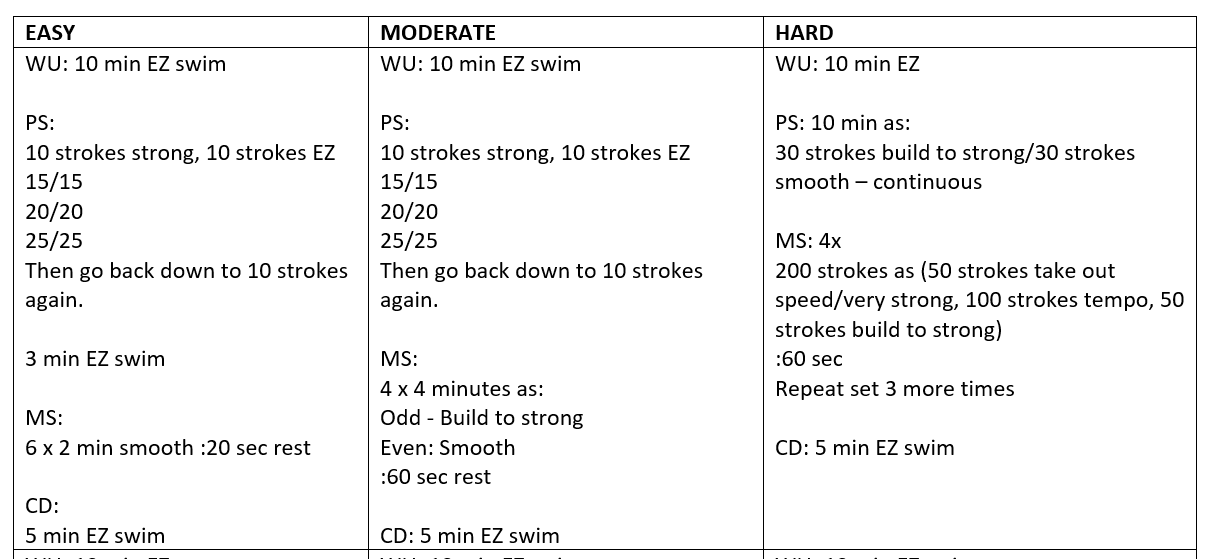
To help you get more out of your swim training, I have 30 mentally-engaging swim workouts that are sure to help you build and maintain your swim fitness strength, endurance, skills and power.

What’s included in the swim training plan? 

15 stationary swim workouts (~30-45 minutes per workout)

  • Requires the use of a tether/resistance band and some type of pool.
  • Workouts are broken into 3 categories (5 workouts each): easy, moderate and hard based on intensity/volume.
  • Workouts cater to all fitness levels.
  • Sent via email as a document (PDF).
To learn more about our experience buying an above ground pool and swimming with a tether, check out this blog post.

15 open water swim workouts (~45-60 minutes per workout)
  • Requires the use of a body of water (max continuous swimming is ~10 minutes)
  • Workouts are broken into 3 categories (5 workouts each): easy, moderate and hard based on intensity/volume.
  • Workouts cater to all fitness levels.
  • Sent via email as a document (PDF).

Add on:
If you need motivation, inspiration and accountability with your strength training regime, you can add-on our strength training template, which includes 20 different strength/core/plank/swim dryland workout routines (videos performed by Marni). Minimal equipment required (hand weights, stretch cord, resistance band, stability ball, soup cans).

To learn more about the training plan, click HERE.

How to fuel for a training camp (or train-cation)

Trimarni

Disclaimer: Neither Campy nor I encourage the consumption of alcohol during a training camp.
Truth be told - I don't never drink alcohol. 

Although your racing may be on hold, your training shouldn't stop. More so, you should still feel the need to fuel your inner athlete...which means incorporating big training days, personal challenges or a heavy training week into your training regime.

Better fueling and hydration strategies before/during/after workouts give you better performances and improved health. It’s that simple. With races postponed, there's no better time than now to start (or to continue) designing and fine-tuning your personalized hydration and fueling plan. Event day is not the time to try the latest sport bar or to invent a new homemade sport drink. Instead, use your big training days and personal challenges (ex. virtual or mock races) to figure out the best sport nutrition strategy for your needs.

While the nutrition you consume during workouts is extremely important, your body performs at its best when you put energy into your daily diet. In other words, well-timed daily and exercise hydration practices will help reduce the risk of dehydration and heat illness, minimize early fatigue, improve central nervous functioning, optimize cardiovascular, digestive and thermoregulatory functioning, enhance recovery, protect the immune system, maintain energy levels throughout the day and make for a more enjoyable training session.

To learn more about what and when to eat before and after a training camp, here are four detailed blogs from Kathleen at Eat Love Triathlon (our Trimarni camp chef) who did a wonderful job explaining the meals and snacks that we consumed throughout camp (and why)....not to mention an incredible job keeping us well fueled and nourished!

Camp Day 1
Camp Day 2

Eat to Thrive: Improve your relationship with food

Trimarni


Sport and daily nutrition consulting is much more than learning what and when to eat. Much of my consulting services are dedicated to helping athletes overcome an unhealthy relationship with food and the body. By improving your relationship with your body, you can actually improve your relationship with food, which will ultimately enhance your athletic performance. When you can thank your body (instead of bashing it), respect your body (instead of starving or overexercising it) and appreciate your body (instead of wishing you looked differently), you can make better nutrition choices to optimize health and performance.

In a past article I wrote for March 2015 issue of Triathlete Magazine, I discussed the topic of achieving a performance breakthrough by changing current eating behaviors and body image thoughts. In the article, I'll help you recognize if your body image concerns are steering your relationship with food in an unhealthy direction - and how to address them.

If you are currently struggling with your relationship with food and the body, now is a great time to reach out to a Board Certified Sport Dietitian for help. Don't wait until a performance or health setback occurs. A qualified nutrition expert (RD) can take away the guessing so that you can learn how to nourish and fuel your body for optimal health and performance.

To read the article: Eat To Thrive

Nutrient timing for athletes: Pre-workout fueling

Trimarni


For several decades, extensive scientific research has focused on the topic of nutrient timing: what and when to eat before, during, and immediately after exercise to enhance the adaptive response to change physiology.

For example, prolonged exercise depletes muscle glycogen storage and breaks down muscle tissue, which increases the risk for fatigue and immunosuppression. But, by consuming carbohydrates and protein within 30 minutes after a workout, you can build muscle, store energy, and minimize tissue damage. 

Unfortunately, nutrient timing is a confusing nutrition topic because many strategies conflict with the “healthy” nutrition advice given by experts regarding weight loss and health. For example, an athlete may have heard to restrict carbohydrates before a workout to induce higher fat oxidation – or in other words, to promote fat loss. However, insulin – which is released by the pancreas when carbohydrates are consumed – is one of the body's most anabolic muscle-building hormones. It prompts cells to absorb sugar from the blood to use for immediate energy or storage in the muscles and liver and plays a vital role in transporting amino acids, fatty acids or glucose from the blood stream into cells. Additionally, many of the foods that athletes are encouraged to consume before training may be viewed as nutrient-poor.

Although sport nutrition advice may sometimes appear or sound “unhealthy”, implementing smart fueling practices around and during your workouts is critical for your health and performance. The practice of nutrient timing can help reduce the risk for sickness, fatigue and injury so that athletes can achieve faster results, improving strength, speed or endurance, while staying consistent with training. 

Here are a few tips on how you can incorporate nutrient timing into your training regime:

PRE WORKOUT MEAL IDEAS AND TIMING


PRE WORKOUT CARB SNACK IDEAS (~20-30 min pre workout)


PRE WORKOUT TIPS


One topic I’d like to briefly discuss – which I am sure you’ve heard about or tried out – is training in a fasted state. This nutrition intervention (unlike fed training) is designed to enhance fat burning. Sure, some athletes train on an empty stomach due to lack of time or a dislike of training with the feeling of food in the stomach but a good amount of research shows that exercising in a low carbohydrate or fasted state can induce higher fat oxidation compared to eating before a workout – which will promote higher fat burning.

While training with low carbohydrate storage amounts, also known as “training low,” may favor fat metabolism, there’s little scientific proof that this strategy directly leads to performance enhancements on event day. In other words, even if you do lose weight, lean-up or become more metabolically efficient, there's no guarantee that you will become a better athlete (aka perform better) on event race. I often remind athletes that there’s no point in having a lean body if you can’t do anything with it on event day.

It’s difficult to know if this type of dietary manipulation alone directly assists in weight loss or improved performance. Factors such as overeating, grazing throughout the day, poor sleep and workout intensity can potentially nullify the fat-burning effects occurring during a fasted training session. While some athletes may experience a favorable change in body composition or a short-term noticeable performance boost, not every athlete will respond in the same manner. 

Common side effects of training low include fatigue, hunger, sickness, nausea, dehydration, lightheadedness, low motivation and poor recovery. If you are struggling to eat before a workout – for whatever reason – it’s recommend to work with a sport dietitian to develop a strategic plan as to the best time to consume carbohydrates around workouts to maximize the training response.

Remember - the ability to compete high-quality training sessions, day after day, provides the best scenario to boost fitness, prepare for competition and to change body composition. Fasting before a workout may interfere with the ability to train long or hard on a consistent basis. 

Our Experience Buying an Above Ground Pool

Trimarni


After seeing several recent "above ground swimming pool" pictures and videos circulating around social media, it didn't take long for us to get one of our own. And now that we have it installed, I am not sure why we did not think of this idea earlier. Not only are we able to maintain a feel of swimming during a time of pool closures but I have a feeling this pool will come in handy after those long, hot summer workouts.

If you are looking for a way to maintain your swim fitness when pools are closed or you need a convenient swimming option for when you are crunched for time, here are my tips (based on our recent experience) for purchasing and installing an above ground pool.


What pool did we purchase? 
Bestway Power Steel 16' x 10' x 42" Oval Frame Swimming Pool Set with Pump, Ladder and Cover. I selected this pool based on internet pool reviews. I wanted a rectangle pool (to feel more like a swimming pool and using less water than circular) and one that was big but not massive. The depth of 42" was perfect - not too deep but certainly not too shallow. Because we plan to use this pool for more than one season, I choose a steel frame for durability.

What was the cost of the pool?
$515 (+ shipping)

How long did it take to receive the pool after ordered? 
We originally ordered the pool in early April from Amazon. However, that order was cancelled a few days later because the shipper cold not pick up the item due to Covid-19 restrictions (it was not an "essential" item). We then ordered the pool from Walmart.com. The pool was delivered in about 10 days.


What came with the pool? 
Ladder, cover, pool and pump.

What steps were needed before assembling the pool? 
Karel did everything from getting the ground ready to assembling the pool. Because we wanted the pool on the side of our house where the yard slightly slopes down, Karel has to even the surface of the ground. He removed the sod and dug to create a smooth base level for the pool. He purchased some gardening/digging tools for this process. He also purchased and used a long 2 x 4 piece of wood to put a level on to help with leveling the ground. Lastly, he purchased an outdoor green "carpet" to use as a smooth/sturdy base on top of the soil. He also added a few flat pieces of wood under the pool legs to help spread the weight load so it wouldn't dig into the softer ground (the ground is pretty sturdy but soft in terms of the heavy pool).

How long did it take to assemble the pool? 
According to Karel, the assembly itself was pretty quick. Around 90 minutes.

How long did it take to fill the pool with water? 
About two days (not filling overnight). We used a garden hose to fill the pool.

How do we keep the pool clean? 
We are still learning but we purchased bromine tabs to put into a floating dispenser w/ thermometer and a testing kit. We still need to purchase a net for cleaning and a few more things to control and adjust the pH level. We have been covering the pool every evening to prevent debris (leaves) from getting into the pool.


How do you swim with resistance? 
We purchased the TYR aquatic resistance band (currently out of stock) and connected it to a shepard hook that we planted into the ground at the end of the pool (our friend/athlete Alvaro gave us the shepard hook - painted it pink and modified it for us to hold the resistance band).


Total cost of everything we invested into the pool?
~$750

How often are we swimming in the pool? 
We've only had the pool for a week and we've completed three ~45-60 min swim workouts in the pool in the past seven days. Normally we would swim (in a real pool) 5-6 times per week with our triathlon training. The water is still a little chilly (~64 degrees) so we are wearing a wetsuit when we swim. The first swim I used my booties as the water was really cold from just filling it up. I have a feeling once the water warms up over 70 degrees, we will include more frequent short swims. We used the first swim to just get comfortable to swimming with the tether (it's not like normal pool swimming) and now we are completing actual swim "workouts" that we have created for swimming with the tether.  We use a snorkel when we swim as it can get choppy and this helps with body alignment and to keep us from getting dizzy from the waves that are created from swimming in place. We are lucky to have safe access to a lake for swimming (~45 minutes away) so we are swimming open water once a week (we also do a workout in the open water instead of continuous swimming).

Any other tips? 
Our pool is close to our house and the length of the cord from the pump to the eletrical socket is long enough for us to plug in for daily filtering. We run the filter for a few hours during the day when we swim. The pump doesn't need to run all day. We ran it in the first 24 hrs after setting up the pool (and adding chemicals to the pool. In learning from others, we suggest to attach the tether cords above the pool - not at the same level of the pool (the pool frame). It works better for swimming when the cord is tight and elevated. If Karel would have done this again, he would try to make the base (ground soil) a bit more sturdy. Because of our ground is sloped, he had to dig quite a bit on one side but the other side was still a bit soft. Next time he will dig deeper and use crushed gravel to put an extra layer on the top of the soil, before placing the carpet over it and assembling the pool. As of now, and because of the recent heavy rain, one side of the pool is sinking into the soil about an inch. The pool is extremly heavy when it is filled with water.


Does Campy like to swim? 
Nope! :)

Here are a few videos that I did explaining more about the pool and our swim workouts:


If you have any other questions, feel free to send us an email. Happy swimming! 

Almond Butter Tart Cherry Energy Balls

Trimarni


These no bake energy balls (recipe by Joey Mock RD, LD, CLT) make a delicious, quick, and convenient snack while serving as a healthier alternative to other heavily processed, convenience snack foods or bars. They are also easy to make and can be a fun and productive activity to do with your kids while they are homebound. They store well, so go ahead and make a double batch. Freeze extras in an airtight container with wax paper between rows. Get your ingredients together and start rolling!


Ingredients
  • 1¼ cup old-fashioned oats
  • 3 tablespoons unsweetened dried shredded coconut
  • ½ cup sliced almonds, chopped
  • 1 scoop (about 2 Tablespoons) whey protein powder
  • ½ cup honey
  • ½ cup dried tart cherries, chopped
  • ½ cup natural almond butter (or peanut butter if you prefer)

Preparation
  1. In a medium bowl, combine the oats, coconut, almonds, and protein powder. Stir until well distributed.
  2. Add the honey, cherries, and almond butter and stir all ingredients until well distributed.
  3. Place mixing bowl into the refrigerator for about 20 to 25 minutes.
  4. Roll into rounded balls and place on wax paper. Refrigerate or freeze balls in an airtight container when done.
  5. Enjoy!


Happy Earth Day!

Trimarni


We are lucky to have fresh air to breath, fresh food to eat and access to clean drinking water. It’s easy to get caught up in our daily struggles, life stressors and challenges, and to assume that someone else will handle the issues in the world. But as members of society, we can all make a difference and any amount of change and action, no matter how big or small, will have a positive impact on the world. Our Earth is amazing and we must not take it for granted.

In honor of Earth Day, here are a few tips to implement into your life as you do your part to take care of Mother Earth. You don't have to do them all (or do any of them all the time), but by doing your best every day, you are doing your part.

  1. Go digital! Save paper and send an email. There is nothing wrong with a nice hand-written letter but pay bills online, stay organized on the computer and avoid printing unnecessary information that will quickly end up in the trash. 
  2. Plan a clean-up day in your local community. Pick up trash, plant trees or start a flower garden.
  3. Grow your own vegetables and fruits, herbs and spices or support the local farmers by shopping local.
  4. Turn off the TV, water and lights when not in use. 
  5. Protect water quality. Don't dump used oil, paint, coolants or other chemicals into the ground, storm drains or garage drains. 
  6. Eliminate or cut back on plastic bottle usage. Go to your nearest small business sport store and invest in a quality, reusable BPA-free drinking bottle.
  7. Produce less waste with your paper towels, tissues, toilet paper and paper napkins by conserving to what you actually need at one time (it's easy to overuse). Consider using washable cloths for spills and kitchen clean-up.
  8. Bring your own reusable bags when you grocery shop and recycle bags whenever possible. 
  9. Buy products in bulk or with minimal packaging materials. Re-use and recycle as much as possible. Purchase and use reusable produce bags and storage bags. 
  10. Open the window shades and enjoy natural light. Don't turn on the lights or crank down the AC if you don't need it. 
  11. Carpool, walk, use your bike and be strategic with your outings when you run errands to minimize driving. Many people live within 2 miles of somewhere that they are driving to. If you can safely walk or bike, leave your car at home.
  12. Don't water your sidewalk. Be mindful of your sprinkler system, especially if it just rained or is about to rain. Conserve water in and outside the home.
  13. Learn about composting and mulching. These natural fertilizers will improve your garden soil’s fertility and will help to retain soil moisture. Use natural lawn products - friendly for you, your pets and the environment.
  14. Plants trees to benefit local communities, increase habitat for species, and combat climate change.
  15. Did you know that toilets are the most common source of household water use? A leaking toilet can waste more than 150 gallons per day! You may not see or hear water running, but routinely check to make sure your toilet doesn't have a silent leak.
  16. Drive smart. Avoid waiting in long drive-through lines - turn your car off and go in. Minimize use of air conditioning if you can. Get regular engine tune-ups, and don’t ignore "check engine" or "service engine soon" lights. Fill your gas tank during cooler evening hours to cut down on evaporation. 
  17. Use less stuff. Become a DIY-er. There are many ways to reduce waste in your home. Share magazines and newspapers with a friend, neighbors, a nursing home, hospital or library or leave in a gym. Donate used goods such as clothing, furniture and toys to a thrift shop, day care center, charity or second-hand store instead of throwing them out. Consider what you can make at home instead of purchasing online. 
  18. Conserve energy in your kitchen. Use the right size pot or pan on the stove for the item you’re cooking. When your oven is done pre-heating, be sure to use it. Cover pots and pans when cooking if possible. Make sure to clean the refrigerator coils and switch the refrigerator to its power-miser setting. 
  19. If you only use a few dishes day, wash your dishes and only use the dishwasher when it is full. Your dishwasher uses the same amount of water whether it’s full or just partially full of dishes, so make the most of it. When doing laundry, save energy and use cold water for wash and try to wash full loads. Air dry your clothes. 
  20. Did you know that one female cat and her offspring can produce 420,000 kittens in 7 years? Or that one female dog and her offspring can produce 67,000 puppies in 6 years? Every year, between 8 and 10 million dogs and cats enter U.S. shelters. Low cost spaying or neutering is a solution to pet overpopulation and is available at most shelters. If you can provide a loving home, attention and give exercise to a pet, go find a rescue animal to call your own or to foster.

"One individual cannot possibly make a difference alone. It is individual efforts, collectively, that makes a noticeable difference—all the difference in the world." 
~Dr. Jane Goodall


Diet culture and body image

Trimarni


In the midst of a global health crisis, now is a perfect time to make health and nutrition a priority. But in our body-image obsessed culture - supported by a multibillion-dollar industry that profits from body dissatisfaction, the idealized body image, dieting and fear of fat, this can be incredibly difficult as there's nothing healthy about our diet culture. Sadly, weight loss and body image are still a priority for many in a global health crisis.

The diet culture is constantly reminding you that you are not good enough at your current weight and being a bit thinner or more toned will improve your health and happiness.

If self-isolation and stay-at-home orders are becoming a real challenge in managing your mental health as it relates to your body image, consider that no amount of dieting or extreme exercise will make this pandemic less scary or will improve your mental well-being. Restriction, purging, bingeing, obsession, rigidity or "clean eating" only provide a false sense of control and temporary numbing of emotions in the otherwise out-of-control world that we are currently living in.

If you’re struggling with food or body image at this time, I want you to know that you’re not alone. Because the diet culture is alive and well during this pandemic, here are some important reminders to help you get through this chapter in your life:
  • It's ok to feel your emotions - As a culture, we are taught to avoid unpleasant emotions. This often leads to finding ways to temporarily escape from these uncomfortable feelings - often relying on alcohol, drugs, restricting food, binging on food, staying busy, or self-harming as coping mechanisms. With so much going on, you have every right to experience a range of emotions. There are many new obstacles and circumstances to navigate. If you are having a difficult time, what you are feeling is completely valid. An integral component of being able to cope with emotions is the practice of self-compassion. Stay kind, grateful and compassionate to your body.
  • Life is not pass or fail - Perfectionism is never helpful. Perfect is the enemy of the good. Instead of aiming for perfect, focus on making something "good enough". Do the best you can with what you have. Not every meal is going to be perfectly balanced. Sometimes your snacks will be just ok. Your diet may ebb and flow based on your energy, mood and what you can find at the store (or in your kitchen). This ok. Stay flexible with your food choices knowing that the most important thing right now is keeping yourself nourished as best as you can.
  • Set boundaries - The intense media coverage, overwhelming tips by fitness influencers and conflicting messages on social media can increase feelings of anxiety and depression. When you feel overwhelmed, down or anxious, it can be extremely difficult to take action and do things that positively help to improve your mood and thinking. Set boundaries for yourself so that you do, read and see things that help to lift your mood.
  • Talk it out - You do not have to face your feelings alone. Talk to someone you trust about your concerns or reach out to a health professional. 

Emotionally fulfilling workouts

Trimarni


As a life-long athlete, I crave competition. I love showing up to a race with the desire to give my best and leave it all out on the race course. But with the temporary removal of "race day" competitions for the uknown future, I continue to seek opportunities to release my competitive spirit. Some workouts are intense. I find myself smiling (or perhaps it's a cringe) through the pain of a challenging workout that leaves me drenched in sweat and completely drained and empty. These workouts are so hard and the suffering is so intense that it actually cleanses my soul. It's a sick type of pleasure that feeds my inner athlete.

Having said that, the passion I feel for the sport of triathlon and being part of this incredible triathlon community provides a sense of belonging, purpose, opportunity for growth and pursuit of victory - all without an actual race day start and finish line. Fortunantly, within every workout, I can still give myself a proverbial start and finish line.

My intense training sessions are now supported by workouts that bring me peace, calm and joy. The feeling of being alive, free, healthy and safe - without feeling pressure to "perform." I feel a sense of accomplishment simply by keeping my heart rate low, stopping to smell the roses (or talk with farm animals), marveling at the beauty of the mountains and releasing the stress of what's happening in the world by staying completely present to the current moment.

While it may look as if I sometimes lose perspective on what it means to be an athlete (I probably stop to take pictures of nature and say hi to animals far too often), it's actually the opposite.

What we (athletes) are going through right now is really hard. It’s challenging in ways that we could not have planned for. We are all struggling with fear, anxiety, changing moods (ups and downs) and worry. This isn’t easy. This is hard. Really really hard. Not one of us - you, me or anyone out there - is expected to have all the answers as to how you are supposed to feel, function and act during this time.

While it's good to feed your body and mind with challenging workouts, a key ingredient to thrive during this time of uncertainty is to commit yourself to several weekly emotionally fulfilling workouts. These workouts help give life rich meaning, soulful purpose and ecstatic joy. Whereas you may be used to thinking of workouts as something that must be endured and not enjoyed, now is the time to make workotus pleasurable, soul-fulfilling and emotionally satisfying.

If you are struggling with how to train during a time of cancelled races and living with a pendulum of emotions, I encourage you to include workouts into your weekly training that can serve as a healthy way to unload stress, process deep emotions and emerge more balanced and self-aware. Look at your surroundings, stop when it feels right (without guilt or self-judgement) and be creative with your use of "me time." It's ok (and necessary) to continue to push your physical limits but make space in your training for these necessary emotionally fulfilling training sessions.

Eating healthy while working from home

Trimarni


For those who are used to working in an office, it can be a big struggle to transition to a "work from home" environment. With so many interruptions, the biggest WFH (work-from-home) distraction is........you guessed it.....the refrigerator.

As it relates to nutrition, when you work in an office away from home, there's the need to plan ahead as to what, when and where you will be eat. While this lifestyle skill is still a work in progress for many, bringing your lunch (and snacks) to work helps you control what you are eating.

At home, you may find yourself mindlessly snacking or forgetting to eat all together. To help you eat healthy while working from home, here are a few tips:

  • Meal prep - Even when your office is (now) in your home, meal prep is a must. Making a meal from scratch - and when you are hungry - can take up a lot of time, cause you to lose momentum during a work project/emails and force you to resort to quick and not-so-nutritous options. With a bit more flexibility with your meals, prep food in advance so that you either have your lunch meal ready to go or you have stuff to throw together for a balanced meal. Don't forget to plan for and prep nutritious and satisfying snacks to keep you from grazing on processed food throughout the afternoon.
  • Set a schedule - Set your day like any other day - plan your workout, breakfast, when you will stop to eat lunch and a few small recharge breaks. While it's good to stick to a schedule, understand that things may not always go as planned and sometimes you have to adjust your schedule. Approach each day with an open mind and flexibility. But most of all, have a plan.
  • Eat away from your desk/office - Having a total break from work can help you clear your mind and refocus. It also allows you to eat more mindfully. Resist the temptation to keep working as you eat in order to save time. Give your day structure by stepping away from the computer/desk in order to eat.
  • Stay hydrated - With less distractions and a bathroom nearby, you may find yourself overly hydrated on caffeine. Limit yourself to only a cup or two between 9-11am and be sure to keep a water bottle nearby - filled with water to keep yourself well-hydrated throughout the day. The bottle of water can also help you avoid unncessary snacking when you aren't truly in need of food.
  • Do a check-in - It's important to snack between meals but not overdo it when you find yourself bored, emotional or stressed. Before you grab an unplanned snack, check in with yourself. Are you eating because you are biologically hungry and need to eat to satsify hunger or because you are bored, lonely or stressed?
  • Journal - With a temporary new normal, don't be so hard on yourself. During the first few weeks of working from home, keep track of your mood, hunger signals, energy levels and productivity. See if you can notice any patterns related to your food choices. Give yourself permission to learn from each day, without feeling like your eating habits are pass or fail.
"It is not the strongest of the species that survives, nor the most intelligent. It is the one that is most adaptable to change.”
-Charles Darwin

For more nutrition, lifestyle and exercise tips, as well as delicious and nutritious recipes, subscribe to the Trimarni weekly Newsletter HERE

20-minute dryland "swim" circuit

Trimarni


I've been swimming competitively since the age of ~10 years old. For the past 27.5 years, I've never been away from a pool (or a swim workout) but for more than a few weeks. During these unprecedented times, I am longing for the day when I can drive to the pool for a swim workout. But until then, I am trying to maintain my swim strength, endurance and power with dryland workouts. Although it's far from the joy and calm that I feel when I am in the water, it's better than nothing.

If you need some inspiration and motivation for a "swim" dryland workout, here's a video that I did last week with the Trimarni team (on our private Facebook team page). If you like this video and would like more, check out our new 6-week maintenance training plan which includes videos (like this one below) for strength, planks and swim dryland, along with a variety of structured bike and run workouts. To learn more about the training plan, click HERE.


Training: the new normal

Trimarni


It's a little strange thinking that our first long-distance race of the season was supposed to happen this coming weekend (IM 70.3 Florida). Although I'm bummed that most of my racing season has been postponed until 2021, I am not giving up on triathlon training.

Keeping focused on long-term goals is important during this time of uncertainty. However, I'm struggling with my long-term racing goals. I've achieved so much in the sport of triathlon over the past 14 years and I feel content with all that I have accomplished. While I would still like to achieve a few big stretch goals, I am not sure what I am chasing in the sport of triathlon. Despite the uncertainty, I am still very dedicated to my training because training doesn't serve as just fitness-gaining or race readiness for me but it's how I can connect with nature, calm my mind, take care of my body and relieve stress. Plus, I love the feeling of conquering a challenging workout.

When I train, I often find myself thinking "I should be doing this" which is not the best mindset during this time of unpredictability. If you are struggling with your training motivation during this time of postponed races and questionable future race goals, here are a few tips:

  • Dedicate at least three training sessions a week to structured workouts - with specificity, intent, purpose and intervals. Consider keeping these sessions indoors to keep them in a controlled, safe environment. 
  • Dedicate the rest of your training sessions to be without structure. This doesn't mean that they are not important or don't have a purpose but use these as rejuvinating workouts to refreshen the mind, body and soul. If possible, I suggest to take these sessions outside and to enjoy yourself out in nature. If you can't get outside, make these sessions fun when you train indoors.
  • Training should not be "race specific" right now - you'll only burn yourself out if you are putting too much pressure on yourself by trying to hit certain paces, watts or achieving a certain amount of miles. Think about this time as foundation (or base) building but with a bit more intensity/specificity than what you would do in the winter. 
  • Keep your long sessions only moderately long. Whereas you may be use to "going long" right now in the season (or building your mileage/duration), you don't want to burn yourself out - mentally and physically. Again, you don't need to be training like you have a race approaching in the next 4-6 weeks. 
  • Embrace the grind.  Being an athlete is hard. Training is hard. Life is hard. As with anything in life, there are ups and downs and some days are easier than others. Understand that public health crisis or not, not every day is going to be smooth sailing. 
  • Keep it fun. Even if you are social distancing, find ways to train with others. Invite a friend for a virtual training session, sign up for a virtual challenge, purchase a new training plan or set a personal challenge for yourself. It's ok if your normal training looks a bit different right now. 
  • While it's important to be kind and gentle with your emotions, motivation and mindset right now, it's also important to take care of your health. Daily exercise is a must - training is not. Even when you don't feel like training, it's worth the effort to make yourself move. Take a walk, do yoga, dance or go for an easy spin on your bike. 
  • If you feel like your world has been turned upside down, you may have made some extreme (unhealthy) changes in your nutrition, sleep and overall lifestyle. Try to keep yourself on a normal routine for sleep, eating and training. When you are skimping on sleep, eating poorly and pushing back your workouts until you find some motivation and energy, you'll find yourself wasting the day away. Take good care of yourself so that you can stay in good health.