When you mention the word endurance athlete, I think most people would instantly think "long" workouts. As that would be expected if you are training for a "long" event. In my multisport world, Ironman and Marathon are the two big endurance events but I would also like to include anything over 2 hours, such as a half marathon or olympic distance triathlon for many.
When it comes to building endurance, there are many approaches as to the best way to improve the cardio, muscular and respiratory systems as well as building confidence for the big, long day. But before we jump ahead as to the best way to build endurance, I think I must point out the best way to train for any event.....
Forget about what your training partners are doing, what you read in a magazine or what a friend of a friend told you to do to improve fitness. The general and most basic approach to training involves periodization. If you do the same thing over and over, expect the same result. However, infrequent workouts bring infrequent results. Consistency is key as you continually stress the body.
That is, the most appropriate way for you to appropriately adapt to a sequence of training is in a way in which your body is overloaded to adapt to training stress but not at the cost of injury, burnout and fatigue. In order for this periodization principle to be executed properly, athletes must recognize that there must be a healthy balance between training and recovery so that you peak at the right time and training intensity/volume is specific to training and racing goals. In other words - there is no "best" way to train but instead the right way for your body to consistently (key word) progress with training....and still function as a normal human-being in life.
Structurally, your body must be flexible, strong and biomechanically "healthy" to move with proper form and skill and metabolically, your body must be able to provide energy to meet the demands of training.
For many athletes, the motivation is there but the body doesn't always perform. For others, the mind and body struggle to maintain energy as training progresses. I find that most athletes have about 3-4 "great" weeks in their system when they start a new training plan or start training for a race. Thus, this is where many adaptations quickly take place. However, athletes are known to be a bit inpatient and instead of progress continuing to be made after 3-4 weeks, athletes begin to plateau with fitness (and often, struggle with body composition issues) and recovery is delayed, motivation dwindles and goals are forgotten (or the opposite - the athlete continues to push with a body that is not responding appropriately to training stress).
In order to maintain optimal health as you see/feel yourself progress with your athletic training, it is important that you recognize that the best performances by athletes are done with individualized training. Therefore, how your body responds to training stress may be different from your training buddies. You can follow a similar training plan but your approach - the duration, frequency and intensity - may be different. Thus, it is important to recognize that throughout many cycles of "epic workouts" and finishing workouts you never thought you could start along with resting and recovering the body when it needed to rejuvenate, this is where the magic happens. It is not one or two great long workouts (or "yay, glad that is over") but instead, many orchestrated workouts that allow you to recover and then peak at the right time and eventually, race at your full potential on race day.
When it comes to endurance training, there are many approaches to improve running endurance.
For example, I have many of my athletes doing different styles of run training depending on how they adapt to training stress as well as their primary goals for race day.
A few different strategies for improving running endurance:
-mid week "long" runs
-long runs off a short bike warm-up
-mile repeaters during a long run
-fast intervals, a few times per week
-two a day runs, once or twice a week instead of a long run
-run/walk workouts
-plyometrics/hip strength
-cross training
-track workouts
-group runs
-hill workouts
As you can see, there is no right or best way to improve running endurance and despite what your training buddies may tell you, those long runs, weekend after weekend can be very damaging and non-productive.
Rather than blogging about the physiology of the body (I sure do love that stuff!) , I will keep things simple so that you can have a few take aways from this blog to figure out the best way to improve our running endurance.
- The primary prescription for building endurance is based on training frequency, training duration and training intensity.
-Research has shown that running twice per week may produce similar changes in VO2 max as training 5 days per week. However, if training intensity is low, you will need more frequent workouts to increase aerobic capacity.
-Depending on your workout intensity, this will determine your workout duration. If your intensity is above lactic threshold, the duration should be kept short due to fatigue.
-Although an increase in intensity will likely shorten the duration of activity, keep in mind that if training intensity is kept low, a greater frequency of training may be needed to elicit the desired physiological adaptations to enhance endurance performance.
Confused? To maximize aerobic capacity, whatever workout you are doing should create an overload on the physiological processes of the body in order to result in adaptation. This is where it is up to you, as the athlete, to consider the risk-to-benefit relationship that exists when training for an endurance event. Increasing the duration of training too quickly may increase risk for overtraining and injury. Increasing the intensity too quickly or too hard, may cause premature fatigue. Not increasing the duration or intensity may have you wondering why you aren't making progress with your fitness.
When an athlete builds endurance, several things are taking place in the body to adapt to stress:
-Increase in cardiac output
-Increase in stroke volume
-Increase in blood volume and hemoglobin concentration
-Increase in blood flow to exercising muscles
-Decrease in resting heart rate and blood pressure
-Increase in mitochondrial size and number
-Increase in oxidative enzymes
-Increase in capillary density
-Increase in reliance on stored fat as an energy source
-Possible increase in myoglobin content
-Increase in VO2 max
-Rise in toleration of lactic threshold
-Improved ratings of perceived exertion
-Improve metabolic efficiency
-Improved mental strength
Out of all those adaptations that take place as we work on building endurance, there is no guarantee that running 20+ mile runs before a marathon will help you out on race day or running 3 hours as you train for IM will ensure that you will have a strong run off the bike.
It is without saying that you body must learn to tolerate stress if you are training for a long distance event and you have a lot to work on when it comes to training your body and mind but it important to consider the many types of workouts (ex. intervals,repeaters, tempo runs, hills, fartleks, short/easy runs, cross training, longer runs, brick workouts) that contribute to an increase in endurance. Many times, athletes forget that each workout stacks on the other to build endurance.
And most importantly, if your body is not physically ready to adapt to stress, it is important that you strengthen your body prior to pushing your body. Weak muscles do not respond well to weight-bearing activity for weak muscles bring poor form. The same is true with slacking on nutrition and how it affects your form, mind and recovery during a long run.... trying to progress too quickly with an endurance running routine will only bring haphazard results.
As I continue to blog about my 6th Ironman journey, I enjoy sharing my workouts with others but also with the hopes that I can inspire you to train in a way that allows for consistent success as you have fun with your training. Yes - there are hard workouts and the body will not like you at times but never should you feel as if training takes over your life and never should you stop liking training, especially when you paid money to train for an event.
Sunday's brick - My workout:
2 hour bike + 2 hour run2 hour bike - 1st hour warm-up (as I progress with IM training, I often need longer warm-ups to get my body excited to train). 2nd hour w/ Karel on his wheel - nice and steady at a little faster than my IM pace (power).
2 hour run - solo
Run 1 mile, walk 10-12 seconds in between each mile. Per my mental coach
Gloria, I am only allowed to focus on one thing at a time. When I am biking, I can not think about the run off the bike. When I am running, I can't think about how many miles I have left. It's amazing how much I can think about within a mile - it is a great way for me to stay focused and in the moment.
13.15 miles
Total time: 1:52
Average pace (including walk breaks) 8:32
(I refilled my bottles at mile 7 and mile 10, 2 minute break each time. Goal was to hold around 8:20 pace)
Mile 1: 8:19
Mile 2: 8:23
Mile 3: 8:17
Mile 4: 8:21
Mile 5: 8:19
Mile 6: 8:17
Mile 7: 8:13
Mile 8: 8:23
Mile 9: 8:28
Mile 10: 8:31
Mile 11: 8:21
Mile 12: 8:19 (I cut a deal with myself as miles 10-12 were getting really hard - it was very hot and I was running into the wind and my body was tired but still I was holding good form. The deal was if I could run sub 8:20 on mile 12, I could go "easy" on the last mile...done!)
Mile 13: 9:02
(my walk breaks ended up ranging from 10-22 seconds which I walked every mile from 1-13, from my Garmin which still gave me a consistent 8:32 pace and a body that recovers quickly so that I can have another consistent week of quality training)
Sunday's brick - Karel's workout
10 mile group run + 3 hour bike + 6 mile run
Another style of training based on Karel's goals and his fitness and how he adapts to training. The first 10 miles were a comfortable pace for Karel, between 7-7:30 min/miles for most of it (don't hold me to that though :) which he did with a group of runners at 6:30am at the beach. He then went for a 3 hour ride (I sat on his wheel for 1 hour of it) which was a nice steady ride at his IM pace. The 6 miles off the bike were by feel and Karel said he ended up feeling better on the 2nd run than the first run.
Two different approaches to the "long" run and both of us finished our 2nd big week of IM training. We are both feeling great and we have been recovering really well from our workouts..just enough stress to adapt but not too much that we feel lingering fatigue or injuries.
Of course, having good nutrition during the day and proper sport nutrition helps but we can't blame everything on nutrition. Train smart, train hard and recover harder.

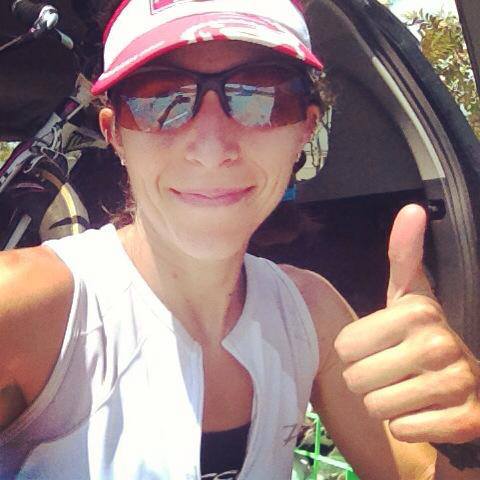
6 more weeks.....thumbs up for fun, consistent training :)