We’d love to hear from you.

We welcome your thoughts, experiences, comments, suggestions, questions or personal stories. If you don't hear from us right away, please note that your email is very important to us. We will do our best to respond with 24 hours.


Greenville, SC

Trimarni is place where athletes and fitness enthusiasts receive motivation, inspiration, education, counseling and coaching in the areas of nutrition, fitness, health, sport nutrition, training and life.

We emphasize a real food diet and our coaching philosophy is simple: Train hard, recover harder. No junk miles but instead, respect for your amazing body. Every time you move your body you do so with a purpose. Our services are designed with your goals in mind so that you can live an active and healthy, balanced lifestyle.

Blog

Filtering by Tag: interview

RAAM interview with Katie Aguilar

Trimarni


Name: Katie Aguilar
Age: 48F
Profession: Engineer
Where do you live? Atlanta, GA


1. What is RAAM and why did you want to participate in the event?

RAAM is Race Across America. It’s an annual race where participants race solo, or in teams of 2, 4, or 8 from Oceanside, CA to Atlantic City, NJ. It’s over 3000 miles of continuous riding, climbs 175,000+ feet, crosses 13 states and must be completed within 12 days (for solo riders) and 9 days (for teams). 

I have been interested in RAAM since my friend Dani Overbaugh participated in 2013. I love watching the event unfold. This year I was given the opportunity to be on a team and I couldn't turn it down. It seemed like a terrific test for me to test perceived boundaries. It seemed so exciting and challenging.
To me, RAAM was an incredible opportunity to see what I could do while racing daily, with short breaks between riders. I've never done an event like this before and I wasn't sure if I could handle the extreme nature of the event. 


2. What is your fitness/athletic background (as well as top successes in sport)?


I joke and say I’m an adult-onset athlete. I didn’t find endurance sports, or any sport really, until my mid to late 30s. I started with Team In Training. On the inaugural GA Ironteam, the coaches told me I was consistent, and should consider aiming for the Ironman World Championship in Kona, Hawaii (IMWC). This started a 7-year journey of gradually working my way up, finding my race, learning to trust my body and nutrition, and figuring how to embrace the discomfort. In 2017 - lucky IM #7 - I earned my first IMWC qualification. I’ve finished 17 Ironman races, including four Ironman World Championship finishes. I’ve also finished many 70.3 races and accepted my slot to two 70.3 World Championship races. I was the first female in the MidAtlantic 12-hour race in 2018, completing 246 miles.


3. Can you give an overview of the specifics/details of your participation in the event? 

We started in Oceanside, CA. and the clock stops when you cross the official finish near a stadium in Atlantic City, JN. Each team starts at a set time. Our team started at 12:13 pm Pacific Coast time. We started together as a group and then I set off for the first 21 miles, unsupported. For the rest of the race, you have a car near you at all times. Night time the car is 'direct follow' and day time is 'leap frog' support. 

Our team had an RV, 2 mini vans, and a support crew of 12 people. In each of the 2 mini vans (and RV) we had a driver and navigator. The support crew members were on 16 hour shifts with 8 hours to sleep/rest. My husband Carlos spent his time driving the RV, so I got to see him before and after each shift. We also had a house person who is a team member dedicated to preparing the food we (racers and crew) ate between sessions and preparing the crew snacks for while they were on shift.

Each member of the team was on allocated time intervals for riding. Our team had a schedule of each member riding for four hours and then four hours rest. On the four hours riding, I would do about 30 minutes of riding, or I was being shuttled ahead of my counterpart Dani while she rode. We’d exchange riders about every 30 minutes except in special situations such as climbs, a long descend, or extreme weather (ex. in Kansas it was extremely windy).

Dani and I rode 11 pm-3 am, 7 am-11 am, and 3 pm-7 pm eastern time for almost 7 days. All shifts were based on the Eastern time zone so the times were not changing as we progressed across the country. My other teammates Vicki and Caz did the 30/30 plan on the other four hour blocks.

In all, I rode about 120 miles a day, give or take. In total, I rode around 750 miles. We all rode about the same.


4. What was your overall fueling/hydration plan? Did you have a specific strategy for each ride?

I actually reached out to Marni because I didn’t know where to start with how to fuel for this type of stage event. In the past, I struggled with stopping in long rides because I’d bonk and for the short efforts of 30 minutes riding with a 30 minute break, I knew I needed to figure out how to fuel. Marni and I met and worked on some details and then I practiced, experimented, and found a regime that worked for me.

My coach gave me several sessions where I was able to experiment with fueling in similar scenarios to what I'd experience at RAAM. Marni and I worked together over several months and we first tried fluid calories only and then started to add more solid food while bringing down the liquid calories. We figured out that my goal was around 80 g of carbs per hour. We found that a ratio of 40% of my carbs from food and 60% of my carbs from fluid.  If I’d change anything, I’d use a timer to help with my timing of nutrition. Not only did I fuel on the bike but I also continued to fuel in the shuttle during my 30 min off, as if I was still riding throughout the 4 hour riding block.

After day 3 I started using ketones, per Marni’s suggestion, to help me think clearly and focus with the sleep deprivation and fatigue. I made an error early on and combined ketone with the caffeine at first which made me feel very strange so I learned not to make that mistake again. This was my only real nutrition issue throughout all 7 days. 

I also focused on what I ate between sessions. Marni and I had worked on how to best recharg my body in 4 hours so I was ready to ride again once it was my turn. At the start of my 4-hour off shift, I would eat something prepared by our house person. I also ate something before each session My go-tos were bagels, peanut butter and honey before a new session, and Ensure, fruit, and yogurt right after. I only drank caffeine before my 11 pm shift.


5. How did the logistics work on a team?


Our crew shifted from van to van and then to the RV and then rest. We all had assigned beds in the RV so there was no time lost between transitions. This means, when riding, I had 3 different crews: one for each time block. I enjoyed each crew and each offered what I needed at that time. 11pm-3am was Sarah and Zane. Sarah was pragmatic and wanted to be ready with time to spare. She was wonderful.

7-11a.m. was Zane and Colin. They made me feel relaxed so that I didn't have to worry about things out of my control. Colin was one of our 2 mechanics, and he got what I needed to be able to race and he was able to always figure things out. He fixed our tire that was slowly going flat after day 2. H checked our bikes, and would quick maintenance to prevent any issues. And he showed me what he did when we were waiting. I knew it’d all be fine, no matter what. And when parking the vans/RVs seemed difficult, Colin was able to direct us to some amazing spots (or get us out). He also made a big honk when a dog came out after me in Nevada, MS to safely scare it away. 

3pm-7 p.m. was Bobby and our crew chief William. I loved it when William would write on the window, tracking us. And Bobby would get my bike ready for me to ride in minimal time.

I also relied on the other crew members for timing when exchanging. Countless times Jason would motion to me to start riding so Dani and I could pass and have an efficient exchange.


6. What was your favorite state/route to ride?


I am not sure I had a favorite state but I had a favorite time to ride. I always felt my best and loved riding the 11 pm-3 am shift. It was always so quiet and all I had to do was focus and ride. Also, it was when Mother Nature showed her splendor: a strawberry moon, the Milky Way, amazing stars. The weather was cool and comfortable. Although, on the first night we had some winds which surprised me. And one time we passed sand dunes which caused sand to swirl around me. Again: Mother Nature was just full of surprises. Especially at night. I loved it.


7. What was the most difficult state/route to ride?

Kansas was a big challenge. The wind started picking up on our 7-11 am shift and I was riding my TT bike. For our 3-7 pm shift, the wind got stronger and I had to ride my road bike as the cross winds would have pushed me off my TT bike. Dani was able to ride her TT bike. We adjusted to 15 minute shifts so we could refuel between sessions because I was not taking my hands off the handle bars. Dani saw that and made the call to shorten our intervals. My hands and butt were planted hard on the bike. It was where I pedaled my hardest to keep momentum against the wind. And despite the crazy wind, I loved it. I was scared at times, pushing my comfort zone but I was able to do it. It was amazing.

For me, the 3-7 pm shift felt hard. It could have been the heat. 

8. Were you able to sleep between stages?

We had an RV that shuttled us to the next exchange and where the riders stayed for their 4 hours off. We stayed in the back bedroom on the bed with curtains drawn so we could sleep. RVs are not really made for sleeping while in motion. William warned me when I got in the car after my first ride that I’d awake at some point, flying and weightless. I did. Dani and I would lay back there laughing because we were getting bounced around. My husband drove the most and I told him it felt like we were barreling down the highway at 100 mph. Or doing donuts in a parking lot. He said he was lucky to get to 50 mph, and averaged around 45mph. And no donuts. After the first two days (and past the mountains), they were able to stop the RV for longer periods of time so we could get a little more restful sleep.

I managed to sleep 1.5-2 hours between blocks. So about 4.5-6 hrs per day. This was enough for me as I never felt sleep deprived.

There was a lot to do when you got in the RV: change, eat, get organized, and then sleep. And quickly the crew was waking you up to prepare you for your next shift. I did manage to shower about once per day. But it was a quick, chilly shower in the RV.
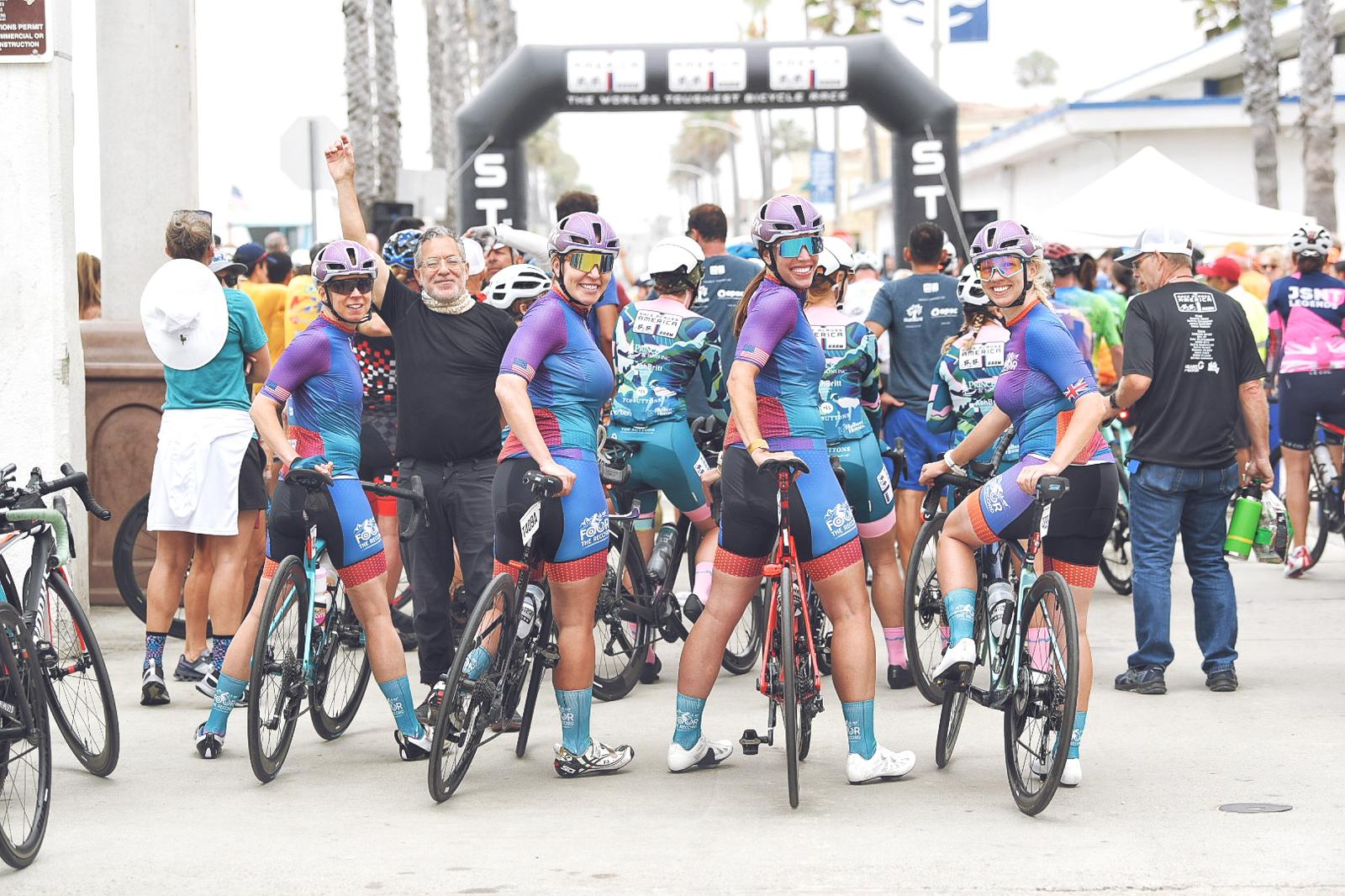

9. Besides fitness and endurance, what qualities/characteristics does one need to participate in an event like RAAM?


Our team of four ranged in personality and organizational skills. We each had various “important" things. But all four of us are goal-oriented, competitive athletes. To do RAAM, you have to want to challenge yourself mentally and physically in an endurance event that lasts several days. Which isn’t for everyone. Some people excel at short, hard and fast efforts/events. RAAM was interesting in that it was shorter efforts over a prolonged duration. My effort was around half ironman effort in my interval shifts. I loved asking my body to give, and then I would ask it for more.  You need to have the time to train and participate in a 7+ day event.

A supportive family/group of friends isn’t a quality, but it's a huge help. The training (and event) required a lot of time on the bike, not to mention travel to ride, maintaining your bike, prepping (nutrition), etc. Friends showing up for even parts of a training ride was priceless. I appreciated every friend that joined me for a couple of hours.

A supportive spouse or significant other is important. Carlos, my husband, was very supportive (enabling? 😁). He’d wait for me when I had long rides, followed me for night rides, and also joined our crew, and drove one of the mini vans from Atlanta to Oceanside. He made this all possible for me.

To do RAAM you will pull in a lot of favors as it takes a lot of resources: financial, crew, and equipment (even if you have been riding a long time). You will have to ask for help. It can be hard, but it was amazing to see how many people wanted to help out.


10. How did your team place? Would you do it again?


We were one of 2 all female quartets. We finished first in our division. Our goal was to beat the RAAM record of 19.27 mph set by Quattra Bavariae in 2017. We missed it at 18.7 mph. However, we did go through the epic certifications of crew to get the Guinness record for a four female team to cross America. No record existed. So, pending certification, we did achieve setting a standard and a Guinness record. I would love to see another all female team take inspiration and break both records.

I would do this event again in a heartbeat as a 2 or 4 person team. I’d love to try a 2 person team. I loved everything about it..the training and racing. I loved being on a team. It was my first time on a team where we worked for a single goal. We were four racers but we really were a team of 16. And it was an incredible experience.

Own Your Athlete Body - protect yourself from harm.

Trimarni


Due to the pressures within the sport environment, such as coaches, teammates, competitors, uniforms and judges, every athlete is at risk for developing unhealthy eating practices to lose weight or to change body size/shape in order to become more competitive and to meet societal and sport-related physique ideals. 

But not all athletes struggle.
Why is it that some athletes refuse to diet or conform to an idealized body image but others end up in a dangerous place of disordered eating and extreme exercise?

  • Advice from coaches - Many coaches connect the ability to change body composition to that of hard work, discipline and commitment to sport. Coaches (and onlookers) will often applaud athletes who can reduce body fat to exceptionally low levels. How many times have you heard an athlete, coach or commentator say that an athlete looks race ready by referencing body size, shape or appearance? Comments made by coaches, social media, body shaming, fat talk, attributing poor performances on weight, and low self-esteem can initiate or intensify underlying body image concerns. It's not uncommon that many athletes (and coaches) believe that body weight is determining factor of athletic success. Even worse, many coaches attribute a poor athletic performance to weight. A coach who has an underlying obsession with weight will only intensify an athlete’s body image concerns. 

  • Body dissatisfaction - How often do you “size up” your competition based on a look of exceptional fitness?  Considering that body dissatisfaction is normalized in our society, it’s not surprising to learn that one of the main contributors to dieting, disordered eating or an eating disorder is body dissatisfaction. Body dissatisfaction (or poor body image) refers to unhappiness with the shape, size or weight of one’s body or appearance. Interestingly, negative thoughts about one’s body tend to develop (and strengthen) from body comparison. Have you ever noticed how easy it is to establish your level of body dissatisfaction based on how your body shape/size compares to that of another athlete? 

  • Pursuing a race weight - The idea behind a “race weight” mentality stems from a belief that your body will perform the best at a certain weight. More often than not, this weight is often less than your healthy, set point weight. A low body weight (or body fat percentage) is perceived as a biomechanical advantage. This belief leads many athletes to work diligently hard to achieve a physical body type to fit sport instead of letting the body develop and improve as a result of sport. In other words, instead of letting your body unintentionally change from the effects of proper nutrition to support consistent training, you are led to believe that with some hard work (aka dieting), you can override genes, hormones, age, fitness level and other physiological mechanisms to achieve an arbitrary number on the scale that will guarantee peak performance. In a race for leanness, many athletes succumb to unhealthy and extreme weight loss behaviors. As a result, in the attempt to improve performance, performance and health are sabotaged. 

  • Deep in diet culture - No matter who you are, diet culture wants you to feel like you have complete control over your body image. Happiness and feeling good about yourself is not something that you need to earn by achieving a specific body weight, size or shape through dieting. Food should never be conditional. Diet culture is trying to compromise one of your most special relationships – the one that you have with your body and food. Dieting is a form of starvation. Whether it’s overexercising, undereating or a combination of both, you are in a losing fight against your biology. When you are underfed, undernourished or underfueled, your brain will obsess over food until you “give in.” Your body is extremely smart. Whether you like it or not, your body has powerful biological mechanisms which are triggered when your body does not receive the energy it needs from food. You may feel like you are addicted to certain foods but this is your body’s way of driving you to eat the calories that it needs to function. The pattern of weight loss and weight gain from dieting is called weight cycling. This constant yo-yo dieting is in and of itself an independent risk factor for cardiovascular disease, insulin resistance, inflammation and high blood pressure. This cycle is more harmful to your mental and physical health than maintaining a higher, but stable, body weight. There’s nothing wrong with adopting new behaviors to improve your health, performance or well-being. If anything, it’s encouraged! But health is not synonymous with size. Peak performance is built from changing your physiology, not your weight. Regardless of the incentive, intentional undereating (especially when you are very active) is hazardous to your well-being. It can’t be stated enough but anytime you are engaged in some form of intentional food restriction (often for the sake of shrinking your body or maintaining a fantasy body), you are buying into diet culture which is packed with false promises and unrealistic claims. Pursuing a restrictive style of eating will keep you on a roller coaster of mental, emotional and health struggles as you become more out of touch with your hunger and satisfaction cues.
It's no secrete that many athletes struggle with body image. But what about elite and professional athletes....do they deal with the same issues?
→Are Olympians afraid of becoming too muscular?
→Do they feel pressure from coaches to lose weight?
→Do they worry about weight?
→Do they have days when they don't feel good in their own skin?
→What about nutrition - do Olympians follow a strict diet plan?

Many athletes struggle with eating enough to support the energy demands of training and wanting to look a certain way. When the pressure is so great to achieve a specific body composition, it's not uncommon for restrictive or extreme eating strategies to compromise physical health, mental well-being and athletic performance.

It's not about the look of your body but what you can do with your body.

I hope you can take some time out of your day to listen to this raw, enlightening and educational discussion with Katie Zaferes. As a female athlete at the top level of her sport, she discusses how she fuels and eats for performance, how she deals with body image dissatisfaction as well as her tips for how to build better body confidence.


If you'd like to listen to the interview, here's the audio file:
Interview - audio file.

A healthy conversation about body image, fad diets and disordered eating

Trimarni


In our body-image obsessed culture - supported by a multibillion-dollar industry that profits from body dissatisfaction, the idealized body image, dieting and fear of fat - creating a healthy relationship with food and your body can be incredibly difficult. Sadly, even in a global health crisis, weight loss, appearance and body image are still priorities for many people, athletes and businesses.

The diet culture is constantly reminding you that you are not good enough at your current weight and being a bit thinner or more toned will improve your health and happiness. In other words, changing what you look like will make you happier, more successful or will make people like you better.

What starts as an innocent attempt to eat a bit healthier or lose a few lbs can easily spiral out of control. When body image dissatisfaction is present, "healthy" eating can quickly turn into dieting which can turn into disordered eating. For many, it doesn't stop there. Dieting is considered to be a precursor to eating disorders due to its restrictive and controlling nature. When we restrict what we eat, we deny our body and brain what it needs. This restriction doesn't just cause weight loss but it can result in malnutrition, nutrient deficiencies and starvation. At a neurobiological level, this can trigger an eating disorder.

As an athlete, fitness enthusiast or health conscious individual, you have a very close relationship with your body. If you have a disordered relationship with food or unhappy thoughts or feelings about your body, you may not be aware of (or care about) the long-term damage that can occur by manipulating your eating and training in order to change your body image.

Social media is oversaturated with images of athletes with six-pack abs, tight glutes and strong, slender legs. Constant exposure to these images can make you believe that you are not built like an athlete - increasing body consciousness, lowering self-esteem and intensifying body dissatisfaction.
Chasing the idea that weighing less will enhance performance can make it easy to mistakenly slip into unhealthy, extreme and disordered eating behaviors.

Successful athletes come in all shapes and sizes. To be successful, you need to be healthy and strong. You need to be consistent with training and you need to take care of your mental health, just as much as your physical health. Restricting food, eliminating food groups or overexercising does not make you a better athlete. It makes you weaker and more fragile.  It takes work to embrace your unique traits, strengths and qualities but the process of developing a positive body image is worth it.

If you would like to learn more about body image, fad diets and disordered eating, mark your calendars for Friday May 29th at 10am EST. Head over the to Trimarni Coaching and Nutrition Facebook page where I will be having a live conversation with Kelsey Beckmann RD, LDN. Not only are we both dietitians who specialize in working with athletes but we are both competitive athletes. With considerable personal and professional experiences between us both, we will be sharing our perspective on these three very important topics so that you can learn how to nourish, fuel and train your body while maintaining great health and a great relationship with your body.

Nutrition staples and food hacks for triathletes

Trimarni


A big thank you to Haley, LiveFiesty and IronWomen for having me on as part of their video interview "mini series". If you missed the videos, here is episode one and two for you to enjoy. And be sure to check out their website (and social media) for more inspiring, motivating and educational information.

Nutrition Staples for triathletes


Food Hacks for Triathletes

Nutrition staples for quarentined athletes

Trimarni


I recently had the honor of chatting with Haley at Live Fiesty and I provided some helpful tips for endurance athletes who may be grocery shopping under restricted conditions or with low frequency during quarantine. Here's the video to enjoy - thank you again Live Fiesty, Haley and IronWomen for the opportunity to chat!


Here are my typical kitchen staples (not limited to just the following):

Pantry 

  • Herbs, spices, oil, baking "stuff" 
  • Tomatoes (diced, whole, pureed, tomato sauce)
  • Beans (garbanzo, kidney, black beans, navy, chickpeas, chili beans) and lentils - canned and dry.
  • Variety of whole grains and rice (farro, quinoa, wild rice, basmati)
  • Potatoes
  • Soups. While you can make your own soup with the above ingredients, having a few cans ready to go for convenience. Semi-homemade – can of soup + fresh or frozen veggies.
  • Canned fish (tuna, salmon, sardines)
  • Canned fruits and vegetables (low sodium/sugar)
  • Fortified cereal
  • Pretzels
  • Peanut butter
  • Dried fruit
  • Nuts/seeds
  • Syrup, honey
  • Shredded coconut
  • Flax seeds, chia seeds
  • Shelf-stable milk
  • Pretzels, chips (ex. pita chips)
  • Chocolate
  • Bread - fresh

Fresh/Refrigerator/Freezer
  • Eggs (2 dozen)
  • Dairy - cow and soy milk, yogurt, cheese, butter,
  • Meat (for Karel) - deli and raw (typically kept in freezer)
  • Waffles
  • Fruits and veggies (fresh and frozen)

IM Chattanooga '18 reflection/interview

Marni Sumbal, MS, RD


Wow. Has it really been a year since Ironman Chattanooga?

As a little recap, my entire 2017 season was dedicated to qualifying and then racing the 2017 IM 70.3 World Championship in Chattanooga. However, on race day day morning, just after 4am I found myself on the kitchen floor, with a smashed and bruised face and bloody lip due to fainting soon after getting out of bed. You can read more here. Racing an Ironman in 2017 was not on my season plan as I spent the season focusing on the half Ironman distance. But after my incident at Worlds, I knew that I couldn't finish my season on such a low moment.

Thus, Ironman Chattanooga will go down as one of my most memorable Ironman races, for so many reasons.

First off, Karel and I shared the course with 14 of our Trimarni athletes and we watched every one of them cross the finish line. It was incredibly special to be there with so many Trimarnis (and to even have a few of our athletes attending just to cheer).


Secondly, Karel and I both won our age groups and each qualified for the 2018 Ironman World Championship. Karel accepted his slot whereas I let mine roll down to another deserving female in the 35-39 age group. Because racing Ironman Chattanooga was never on my 2017 racing season plan (more on this in a minute), I wanted to focus on my two Ironman this summer (Ironman Austria and Iroman Wisconsin) and to get more Ironman racing experience before returning back to the Big Island. I recently accepted my slot at Ironman Wisconsin to race my 5th IM Kona in 2019.


Lastly, Ironman Chattanooga was my first ever overall amateur female win. Karel placed second overall male amateur. Talk about a surprise for both of us, especially since I registered for the race just two weeks before the race! Thank you body for being so amazing - from a very low low to an amazingly high high!


To learn more about my Ironman Chattanooga race as well as a few of my thoughts about the course and venue, you can check out this interview that I did with Crew Racing.

Ironman Chattanooga interview with Marni Sumbal

You should also scroll through their other blog posts for additional information on triathlon training and racing, as well as on returning back to sport after injury. Caitlin and Drew have a successful coaching business as both of their careers revolve around athletes.


Real Food For Real Life - Podcast Interview

Marni Sumbal, MS, RD


Thank you Real Food For Real Life for the podcast interview!

Scott reached out to me for a podcast interview in late August and a few days after Ironman Chattanooga, our schedules aligned for us to have our podcast interview. I really enjoyed this interview as we kept the focus mostly on nutrition, specific to how to eat and fuel to maximize performance for athletic events, while keeping the body in good health.

We discussed the following in the interview:
  • Details on my recovery post Ironman Chattanooga
  • What I eat after an Ironman to help with recovery
  • Keeping your immune system healthy after an extreme endurance event
  • Importance of fueling/hydrating properly during training/racing
  • How my education/knowledge as a sport dietitian has helped me create success as an endurance athlete
  • Why athletes need to create a healthy relationship with food and stop the off-limit food lists
  • Pre-race and race day nutrition issues and tips
  • Sport nutrition product suggestions
  • Snack suggestions to eat on the go 
Podcast link - Click HERE

------------------------------------

A little about eMeals — as America’s largest online meal planning service, we’ve been creating plans for more than a decade by offering a wide range of food styles to meet users' budgets and health goals. In terms of user groups and content, our four key areas of strength are Healthy Eating (in general, particularly around heart health and fitness), Paleo (and its active lifestyle), Family (fostering that bond around the dinner table), and Entertaining.
Real Food for Real Life is for people who never stop searching for solutions and inspiration to improve their lives. While we focus primarily on the Paleo and Clean Eating lifestyles, our goal is to give you real food alternatives for your real life—whether that means eating healthier, managing your weight, simplifying your life or simply getting your family around the dinner table. We’ll do this each episode by bringing you a lively mix of informative interviews with some of the most notable names in food, health and fitness.

Kona Edge Podcast - 4 more episodes talking nutrition, swim, bike, run!

Marni Sumbal, MS, RD


A few months ago, I was interviewed by Brad Brown with The Kona Edge podcast. Over the past 11 years, I have had a lot of successes in the sport of triathlon and well, many great learning lessons. Brad gave me the opportunity to share some of the mistakes I've made over the years and to profile some of the highlights in my endurance triathlon journey.

If you missed the first podcast, you can listen HERE. 

But we didn't stop there!

You can now listen to four more podcasts where I talk more specifically about nutrition, swimming, biking and running. Enjoy!


Intelligent Racer Podcast - Listen to our first interview together!

Marni Sumbal, MS, RD


For the first time ever, I am so thrilled to announce that Karel and I recently had our first interview together. We talk about our athletic backgrounds, our favorite race courses, a bit about our coaching and nutrition business and our best advice for athletes when wanting to experience improvements and excel on race day.

As the public speaker of our house, I'm usually the one speaking in front of others on behalf of Trimarni. When I was asked by Adam, who is a Trimarni athlete and host of Intelligent Racer Podcast, to be interviewed for this podcast, I knew that Karel needed to be part of this podcast with me as he has so much life, career and athletic experience to offer athletes. For those who know Karel, he is a great sarcastic/funny side to him but he is always upfront, honest, truthful and to the point with his advice. Plus, he is my business partner, training partner and life partner so it was only natural that he would join me on this podcast.

We met 11 years ago and I did my first endurance triathlon 11 years ago so it goes without saying that Karel has been with me for my entire endurance triathlon career and since 2012, we have shared many triathlon race accomplishments together.


I couldn't be more excited to share this 30-minute podcast with you for your listening education and entertainment. We hope that you enjoy the podcast and are able to have a few "ah ha" takeaways to help you with your individual nutrition and athletic journey. As always, if you have any questions, please don't hesitate to reach out to us via our contact form on our website. 


  • To listen to the podcast on the website: CLICK HERE
  • iTunes Link (be sure to subscribe for new episode updates): CLICK HERE
  • Facebook link (like this page for podcast updates): CLICK HERE
  • Twitter (be sure to follow for updates): CLICK HERE


Thank you Intelligent Racer podcast for this interview.
It was an honor and privilege to be on this podcast show and to share our story together.  

Kona Edge Podcast interview - successfully failing

Marni Sumbal, MS, RD


In mid October, I dedicated a blog post to recapping our 2016 season of triathlon racing. 
If you missed it, you can read about it here: 2016 season recap. 

Looking back, 2016 was a very successful season for me and Karel. 

 
I fulfilled a long time goal of placing on the podium at an international Ironman, where I finished 2nd AG and 4th female amateur (10th overall female) at Ironman Austria. It was also my highest ever overall placing in an Ironman since winning the 18-24 AG at IMFL in 2006 (my first Ironman). Only this time, 11 Ironmans later, I finished 54 minutes faster than at my first Ironman (10:06 at IM Austria vs. 11:00 at IMFL). 


I placed overall female at the Lake James 50 triathlon. 


Eight days later, I was leading the race by several minutes with 1 mile to go, at Rev3 Knox, until a pink arrow lead me and several others off the bike portion of the race course. Due to a 6+ mile detour, I tried to make up the 15+ minutes that I lost on the bike and missed the win by less than a minute. Bright side - I had the fastest female run split of the day (running frustrated and on a mission!).


And to conclude the season, a win at Lake Logan Half which was the result of a very strong performance on a very tough race course, and one of my best executed bike performance. 

And, let's not forget Karel's 3 very successful Ironman finishes (IM Austria, IMMT, IMKona), 3 overall race wins, an IM podium (and Kona qualification) at IMMT and the fastest male amateur run split at IMMT. 


While successes are worth highlighting (it's good to acknowledge when you are doing something right), it would be wrong for me to not mention the many, MANY lessons, mistakes and failures that have occurred since I started racing in endurance events back in 2006. 

  • I'd like to bring up my horrible decision in 2007 when I decided to race my first Kona with an injury. No running for 30 days due to hip issues and a quick-fix, please heal me, approach to every doctor that I saw, only to try to get myself uninjured before race day, results in extreme damage to my body during and after the race. With a stubborn head, I finished (and made it onto the NBC Kona broadcast coverage - yep, I was one of those athletes falling across the finish line) and it negatively affected me for several years (like 6!). 

  • I'd like to bring up 2011, where I didn't race a single triathlon for the entire year, except IM Kona in October, due to another 3 months of no running (hip/back issues) and a time-consuming dietetic internship that took up every hour of my day (10+ hours a day of interning and school work) for 10 months. 

  • I'd like to bring up the 3 months that I didn't run before IM Placid in 2013 and managed to get myself into as good of shape as I could, to feel prepared for that race, with only 8 weeks of consistent running. This also occurred during the time when my dad was diagnosed with stage IV metastatic cancer. Somehow, I managed to get to the start line and qualify for Kona with a roll down slot. 

  • I'd like to bring up the 6 years that I suffered from chronic hip/back issues, which caused many days of frustration, tears and anger toward my body. I can't tell you how many times I wanted to quit the sport of triathlon throughout those 6 years and how much time was spent on PT, doc appointments and anything and everything to try to get myself healed. 
  • And let's not forget Karel's recent issues, with a tear in his plantar fascia just 5 months before his first Kona in 2015 and then a diagnosis of a labral hip tear this past May and painful back issues leading up to IM Austria.
  • I should also mention the passing of my dad, three days before my birthday in 2014. This is something that I deal with on an ongoing basis. I don't think you ever get over the loss of a loved one, especially a parent. 

You see, failure is a step to success. Actually, it is the road to success. 
Perhaps you have followed us for many years or you are a new Trimarni follower. Regardless, it is important that you understand that our successes are not without failures. 

I don't know that I will ever be able to document my 10 years of learning into one blog post but I will continue to document my journey on this blog, with the intention of inspiring you and motivating you to never ever give up on your dreams.  If you don't give up, you never fail. You just keep on learning. 

Sure, we can call it a failure when we get injured, race poorly or make some kind of bad decision in training but failing is an opportunity to learn....that is, if you see it as a valuable opportunity to learn. 

The way I see it, I have successfully failed to get to where I am today.

As a sport dietitian, coach and still developing triathlete, I have 10 years of formal education with 10 years of endurance training and racing behind me. I have learned a lot in 10 years and I don't believe I'm even close to reaching my peak performances by my boy. I think Karel, even at 40 years of age, still hasn't reached his best. He's getting faster, stronger, more efficient and smarter as an endurance triathlete with every season. And next season will only be his 6 season of endurance triathlon racing. 


Thanks to Brad Brown with The Kona Edge, I was recently given a special opportunity to share some of my lessons learned along my successful (and not so successful) journey. 


We had such a great conversation talking about all things triathlon, Kona and coaching, as well as discussing my thoughts on race weight. I hope you enjoy hearing about some of the mistakes that I've made over the past 10 years as an endurance triathlete.
Although this podcast may be about me, Brad wanted to make sure that this podcast interview was also educational, so that I could discuss practical advice to help athletes move closer to reaching personal athletic goals, without compromising health.
Thanks for listening.

If you enjoy The Kona Edge podcast, you can leave a rating and review for The Kona Edge podcast on iTunes.

Can you succeed as a plant-strong athlete?

Marni Sumbal, MS, RD


Hello, my name is Marni and I am a 9x Ironman finisher, 4x Ironman World Championship finisher, USAT coach and the female winner of the 2014 HITS Ocala half ironman, the overall amateur female winner of the 2012 Branson 70.3 triathlon and overall winner of the 2012 Iron Girl Clearwater Half Marathon.

This month I will celebrate 23 years of eating a meat-free.
I eat carbohydrates like grains, potatoes and even cereal.
I use sport nutrition when I train - always.
I drink milk and eat yogurt - daily.
I love fresh bread and I eat dark chocolate.
I love real food.

My name is Marni and I am fueled by plants.
And my hubby Karel eats meat but I'll still call him a a plant-strong athlete because his diet is rich in fruits, veggies, whole grains, dairy and a variety of plant strong proteins. 


When you see a meal like this (above), a meal of 5 different kinds and colors of veggies tossed in olive oil, baked tempeh, cooked lentils and quinoa, do you think unhealthy athlete who can not maximize performance? 


How about this meal? 
Baked kale tossed in olive oil dressed with rice, beans, onions, lots of garlic and topped with peanuts and a side of Greek Yogurt (no pictured). Do you think inflammation, unstable blood sugar or low nutritional value? 


Yum. Sliced bananas, fresh, local poppyseed bread and a cup of 1% organic milk with 15g whey protein powder.
Is this a performance-damaging, metabolism wrecking, "bad food" post workout snack that should be off-limit in the diet? 


Roasted potatoes with baked cauliflower, beans and mushrooms. A bowl full of deliciousness.

This is how I eat every day and my good health, great performances and wonderful quality of life give me no reason to think that I am sabotaging my health or performance as a plant strong athlete by avoiding meat.

Not too long ago, my friend Molly from Girls Gone Strong asked me to provide an article on fueling the plant strong athlete.

Vegetarianism in athletes is a topic that is just as overwhelming and confusing as weight loss in endurance athletes for we are talking about the diet and in today's society, there is information overload and much of it is not sound advice.
You can read the article here:
Part 1
Part 2


Obviously, I am passionate about fueling the plant strong athlete as a sport RD but with almost two decades of experience, I have spent plenty of time dialing in my own nutrition as an endurance athlete so it makes me happy and excited to help out others. 

I want to give a big thank you to Rachel with Smart Girl's Guide to Going Vegetarian for the interview!

I wish I knew more about how to be a healthy vegetarian athlete when I decided to choose a plant-strong diet almost 23-years ago at the age of 10.
In my mid 20's, I was told that I would never succeed as an endurance athlete because of my meat-free diet. Well, I'd like to think that I've proved many people wrong. Recognizing that it's not easy to fuel an athlete regardless of his/her diet preferences, I really enjoyed providing my thoughts on vegetarianism for teenage athletes and how to ensure that young athletes meet their nutritional needs to maximize their full athletic potential.

READ THE INTERVIEW HERE

(and don't forget to leave a comment after reading the article for your chance to win a Clif Bar/Luna Bar giveaway prize!) 

I'll have what she's having - the comparison diet/body image struggle

Marni Sumbal, MS, RD


Every now and then I'm approached for an interview. Often times it is for a quote or two in a magazine on the topics of strength training, endurance training, nutrition or fueling. 

However, with specialty areas specific to athletes in the areas of sport nutrition, endurance training/fueling vegetarian diets and developing a healthy relationship with food and the body, I enjoy the occasional opportunity when someone reaches out to me for an interview. 

Recently I was interviewed by an amazing woman, Dr. Brooke. I met Dr. Brooke at the Women's Fitness Summit

Brooke reached out to me as not only an endurance female athlete but also a plant strong vegetarian athlete. 
(If you are new to this blog, I don't endorse vegetarianism but I strongly believe that all athletes should embrace a plant strong diet - that is nourishing and fueling the body off real-food, grown with the help of Mother Earth. I have been a lacto-ovo vegetarian for almost 23 years for animal reasons).

 I am not one to celebrate "an athlete's body" for what it looks like. I don't find it motivating to just look at an athlete and marvel over his/her body parts and more so, assume she is faster, stronger or fitter (or healthier) than me.  Instead, I like to showcase/see what a healthy, fit and trained body can do. 

On race day or on social media, I don't do the comparison game and look at another athlete's body - her defined core, toned arms or sculpted legs. I have no idea what she has done to achieve that image and body image should not define an athlete's fitness, commitment, discipline or passion for her (or his) sport.

What's the point of having a lean, toned, fit body if you can not do something amazing with those trained/fit body parts? 

There is absolutely no requirement that you have to have defined body parts or a lean body in order to do something amazing with your body. There is no guarantee that by losing x-lbs or getting to x-% body fat that you will get faster, be healthier or reach your athletic dreams. You can lose 10 lbs in an effort to have a flatter core but if you didn't get stronger in the process of losing weight, that flat core will not make performing core exercises any easier - nor will it help you be more powerful in swimming, biking and running. 

When it comes to how I fuel my body, there is certainly a large emphasis on fueling my body in motion. But my food choices come with a package deal - they not only fuel my endurance body but they also nourish my body. There is no reward ritual of eating "bad" foods post workout  nor a guilty experience if I didn't work out for x-hours/miles. Food is a positive thing in my life, regardless if I am an endurance athlete or not. 

Dr. Brooke did an amazing job with her article as she interviewed three different female's who have three different styles of eating. Ultimately, the diet doesn't make the body image.

You must eat for your goals, your lifestyle and your life. Regardless if you are training for a finish line or looking to improve your overall health and reduce risk for disease, don't eat (or not eat) just to look like someone else or to achieve a body image that does not enhance your quality of life. 

*Continue to educate yourself by learning from the pros, but sooner or later you have to get pro at being you. That’s not something any of us are experts in, only you can do that.
*They all have gotten to where they are with a lot of experimenting and patience. They are all in the business of fitness so they aren’t shying away from time in the gym or eating a certain way for the long haul.  For all three of them, this is a lifestyle not a fad diet.


Beautiful eating - interview

Marni Sumbal, MS, RD

The word "beautiful" is used in so many ways.
-She's so beautiful.
-That painting is beatiful.
-Nature is so beautiful.
-That view is so beautiful.
-Your hair or makeup looks so beautiful.
 
When was the last time you talked about your food choices being beautiful?
 
If beutiful is defined as "pleasing the senses or mind aesthetically", it is concerning that our society is not using the word "beautiful" enough when talking about our diet.
 
I don't know about you, but the picture below looks absolutely BEAUTIFUL!


I would like to thank Beth Chernosky for asking me to be a guest on her Looking Good Girl website. I love interviews as a chance for me to express my opinion on various topics but also as a way to reach out to other inspiring people. Beth asked me great interview questions and her philosophy shined through with her questions to me!

As many people know, I am all about helping other people learn how to have a healthier relationship with food and the body. I also love empowering women to dream big and perform beautifully with the body.

I just love that Beth's blog/website can be used as a resource for all things that can add beauty to your life and your every day!

I agree with Beth that every person should take time, every day, to do something JUST for yourself on a regular basis.

And why not start with loving the beautiful food that you choose to put into your body.

"This week’s post includes an interview with Marni Sumbal of TriMarni Coaching and Nutrition, LLC. After following the TriMarni Facebook page, I reached out to Marni because I have really enjoyed reading about her tips and her overall take on nutrition. What has impressed me is that Marni emphasizes a “food as fuel” approach, yet she does it in a way that totally celebrates food and nutrition through a positive outlook. We’re often bombarded with “Don’t eat this”, “Never eat these foods…”, “Stay the hell away from XYZ”- but that is definitely not the case with Marni’s approach.
Given that food and eating are a big part of most people’s day I wanted to introduce the Lookin Good Girl readers to Marni and her encouraging, positive outlook on nutrition." - Beth

For the full interview, you can check it out here:

Adding beauty with Trimarni Coaching and Nutrition