We’d love to hear from you.

We welcome your thoughts, experiences, comments, suggestions, questions or personal stories. If you don't hear from us right away, please note that your email is very important to us. We will do our best to respond with 24 hours.


Greenville, SC

Trimarni is place where athletes and fitness enthusiasts receive motivation, inspiration, education, counseling and coaching in the areas of nutrition, fitness, health, sport nutrition, training and life.

We emphasize a real food diet and our coaching philosophy is simple: Train hard, recover harder. No junk miles but instead, respect for your amazing body. Every time you move your body you do so with a purpose. Our services are designed with your goals in mind so that you can live an active and healthy, balanced lifestyle.

Blog

3 pre-race nutrition mistakes

Marni Sumbal, MS, RD


Many athletes blame a poor race day performance on nutrition, which doesn't surprise me since most athletes underfuel in training and guess their way through race day sport nutrition.

As it relates to long-distance racing, nutrition is a critical component to race day success. While what, when and how you consume sport nutrition during the race can optimize your ability to perform with your body from start to finish, equally, if not more important, is your nutrition going into a race.

From my personal experience as a Board Certified Sport Dietitian, who specializes in working with endurance athletes, here are some of the common pre-race nutrition mistakes that I see often, that keep athletes from reaching athletic excellence.
  1. Unhealthy relationship with carbs - A fear of carbohydrates can keep athletes from properly loading muscle and liver glycogen stores going into a race. On the other edge of the spectrum, eating every carbohydrate in sight can leave you feeling lethargic, heavy and tired. It's important to have a healthy relationship with low-fiber, easy-to-digest carbohydrates, that have been well-practiced in your training and to have a plan to keep you from under/overeating. To avoid feeling heavy going into a race, make your breakfast meal (post workout) your carb-rich meal, lunch can be satisfying and dinner should be light. While all three meals should include carbs, avoid loading yourself with carbs right before bed and instead, eat that carb rich meal in the morning (who doesn't love breakfast foods?) to give yourself plenty of time to digest the meal.
  2. Overhydrating before the race - Every athlete knows that proper hydration can boost performance but drinking large amounts of water in the 24-48 hours before a race, as well as on race day morning, can cause excessive urination, resulting in an electrolyte imbalance. Additionally, overdrinking can cause unwanted fullness, which can keep you from eating every few hours in the 48 hours before a race. Similar to your pre-race carbohydrate eating plan, it is also important to stay up on your fluid intake so that you don't under or overdrink. And to help with restful sleeping, make sure to not overdo it on fluids in the evening hours (which can cause you to wake up frequently throughout the night to run to the bathroom), but instead, spread out your fluid intake throughout the day, tapering off in the 2 hours before bed.
  3. A nervous belly on race morning - Although a nervous belly is to blame by athletes who struggle to eat on race day morning, I am shocked by how many athletes don't have confidence in their pre-race meal. While it can be tough to eat early in the morning, when nerves are high, you should have trust in your pre-race meal, knowing that it has worked for you as a pre-training meals, for most of your longer workout session. By practicing your pre-race meal (foods) in training, even if your belly is nervous, you will know that it's a non-negotiable to skip something that you have confidence in that will help you excel on race day.
While athletes are guilty of making a lot of mistakes going into a race, like resting too much and focusing too heavily on the outcome or things out of their control (ex. weather), nutrition appears to be a big limiter for athletes, simply because there's no well-practiced, thought-out plan going into a race.

Considering that most athletes spend several months training for an event, while bringing months if not years of experience into a race, it is important to recognize that every training session can prepare you for race day. Having confidence in your pre-race nutrition is a game changer. The athletes who have a nutrition plan going into a race typically experience less GI issues on race day, more energy during the race and more confidence, as it's one more thing within their control, assisting in performance excellence. 

Pass the rice, please!

Marni Sumbal, MS, RD


Back in March, I wrote a blog post about rice. Although the topic was informative, it wasn't the most timely post as March is all about Spring and when I think of spring, I don't think of rice as my food of choice.

But now that we are in the middle of summer and the days are long, and packed with training and other activities, rice is the perfect "quick" and healthy food for anyone, but especially for athletes who are busy, exhausted and in need of fuel.

Here's the article for your viewing once more and if you missed it, happy reading!

---------------------------------------------

For almost half the world population, rice is a staple food.
But for much of the US population, rice is seen as a "bad" carbohydrate

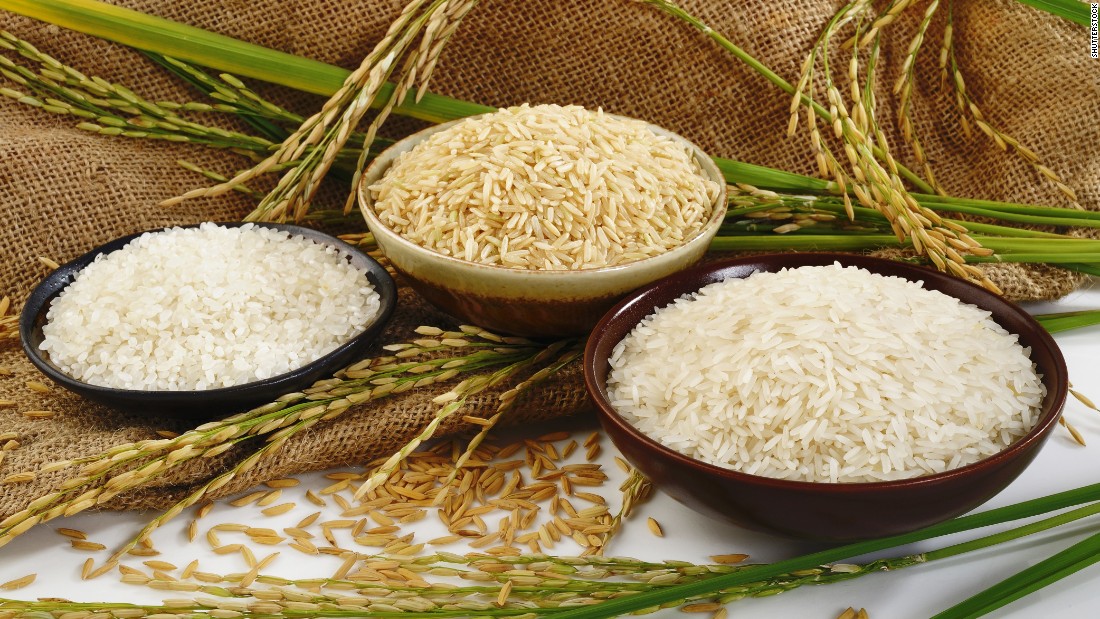
There are many varieties of rice but what they all have in common is that they contain carbohydrates, protein, trace amounts of fat and sodium and are gluten free. 

Compared to white rice, brown rice is often viewed as the "healthy" rice. Whereas white rice appears to be nutritionally inferior to brown rice because it is a refined grain (bran and germ are removed during the milling process which removes B vitamins, iron and fiber), white rice is typically enriched with iron and B vitamins. Unlike brown rice, containing 3.5g of fiber per cup (cooked), white rice has less than 1 gram fiber. The noticeable difference between brown and white rice is that brown rice is a whole grain (the bran and germ are retained, which means it offers a good source of antioxidants, vitamin E and fiber). 

But having said this, athletes should recognize that fiber is often the culprit of many GI issues during training and racing. Thus GI-distress susceptible athletes are encouraged to reduce fiber (and fat) in the 24-72 hours before a race to minimize the residue in the gut. While 3.5g of fiber may not appear to be a lot of fiber, some athletes are more sensitive to fiber than others. Considering that white rice can be eaten alone or mixed with honey, syrup, eggs or even peanut butter to make for a great meal or snack - in training and or before a race - many athletes rely on rice as it is a cheap, easy to find, easy to prepare and easy to digest carbohydrate source. For me and Karel, we always have a bag of rice in our pantry and we often buy the 90-sec micorwave bag of Jasmine or Basmati rice for when we travel to a race. 

Although the lower fiber rice options are ideal before/after training/racing, let's not stop at white rice and brown rice. There are many varieties of rice that are great in the daily diet of athletes. Understanding that rice is often consumed with other nutrient dense foods, like fruits, vegetables, legumes (beans and peas), nuts, seeds, lean meats, poultry and seafood, I encourage you to include this low cost, versatile ingredient into your diet as it is easy to incorporate into any dish. I recommend to prep 2-3 rice varieties ahead of time (~2 cups cooked per person) and store in the fridge so that you have your go-to rice options available to you anytime of the week.

Tips on cooking rice
  • The shape and length of the rice kernel (short, medium or long grain) determines its texture when cooked, in addition to the type to use in dishes and cuisines. 
  • Long-grain, which cooks light and fluffy with the kernels separated, is often used for making pilafs, stuffing, rice salads and jambalaya. 
  • Medium grain is moist and tender, commonly used for making paella and risotto. 
  • Shorter grain rice is short with rounder kernels and becomes moist and "sticky", making it a great option for rice puddings, desserts and eating with chopsticks. 
Here are the suggested cooking times and water/rice ratio for rice varieties:

Types of rice varieties
  • Basmati - An aromatic long-grain rice grown in India, Bangladesh and Pakistan. Basmati comes in white or brown varieties. It has a distinct flavor and aroma and produces a tender, fluffy texture and grains do not stick together. It is often used in curries and stir-fries, but is also great for side dishes.
  • Brown - Available in short, medium and long grain varieties, a half-cup brown rice equals one whole-grain serving. It contains more magnesium, selenium and fiber than enriched white rice and can be eaten as a breakfast cereal, used in sushi and puddings.
  • Arborio - A medium or short grain rice with a high starch content used to make risotto. Arborio is also used for rice pudding and other desserts.
  • Red - This whole-grain rice is rich in nutrients and high in antioxidants due to its varying hues of red color. It is available as a long-grain variety from Thailand and a medium-grain from Bhutan. It's nutty, chewy texture lends well to rice bowls, pilafs, rice salads and stuffings.
  • Black - Also referred to as "purple" or "forbidden" rice, the dark hue of this grain is due to its high anthocyanin content. It is a whole-grain rice available in both short and long-grain varieties. The short-grain variety is often used to make sticky rice porridge and rice pudding.
  • White - Available in short, medium and long-grain varieties, most white rice in the U.S. is enriched with thiamin, niacin, folic acid and iron. Avoid rinsing white rice before and after cooking, in order to keep the nutrients from being washed away.
  • Jasmine - Originally from Thailand, this rice has a distinctive floral aroma and nutty flavor that pairs well with Mediterranean dishes. It cooks tender, light and fluffy and is available in both white and brown varieties. Steaming, rather than boiling, provides the best results.
  • Wild - Despite its name, wild rice is actually not rice at all, but a semi-aquatic grass species indigenous to North America. Its long, slender, dark kernels have a nutty flavor, chewy texture and contain more protein than white and brown rice. Wild rice is often mixed with brown rice or bulgur wheat, and it pairs well with fruits, nuts, meats, poultry and fish in salads, soups, stews and pilafs. 
Information from this blog was adapted from Food and Nutrition magazine. May/June 2013 issue. Pg 16 and 17, written by Rachel Begun, Ms, RDN, CDN. 

Lake Logan Half Ironman - Race Report

Marni Sumbal, MS, RD


Although this is only my 2nd time racing the Lake Logan Half Ironman, it's one of my favorite half ironman events. With it being ~90 minutes from my house (outside of Asheville), I consider it a "home town" race. Plus, it's in the mountains so the weather is typically cool for August (50-60s on race day morning). Set Up Events puts on a great race, with a beautiful and calm wet-suit legal swim, challenging and well-marked/supported bike course and easy-to-navigate net incline/decline two-loop run. And because the race venue is tucked away in the mountains, the atmosphere is very calm, relaxed and nature-filled.

My mom joined me for this race as Karel was participating in the Purple Patch Greenville East Coast camp from Thurs - Sunday. We stayed at the Best Western Smokey Mountain Inn, about 20 minutes away from the race venue and the hotel was clean and the staff was friendly. We didn't take advantage of the complimentary breakfast due to our early morning check out but they did pack grab-and-go bags for all of the athletes, starting at 5am.

I woke-up to my alarm at 3:40am to give myself 20 minutes to get going in the morning. As I was sipping my warm cup of instant coffee (Nescafe instant espresso), made with milk, I got myself dressed in my race day outfit and reviewed the bike course map once more. As I was reviewing the map, I consumed my pre-race meal, which consisted of 2 Belgium waffles (each 210 calories) topped with nut butter (1 of them) and butter/jam (the other). Both drenched with maple syrup and topped with cinnamon. On the side, sliced bananas and a glass of OJ. I found this meal easy to consume and even though I eat a variety of different food combos before my training sessions, this meal seems to work the best for me. I finished my meal around 4:40am, packed up the car and headed to the race venue around 5:10am.

We arrived to the race venue around 5:40am and although there was a little traffic getting into the parking lot, I was able to get body marked and pick up my chip and enter the transition area by 6am, with plenty of time before my 7am wake start.

Since there was no bike check in on Sat, I pumped up my tires before leaving my car, put my 3 sport nutrition bottles on my bike and secured my Garmin between my aero bars.


It was so great to see so many familiar faces, along with my athletes Joe, Meredith, Lukas, Chris, Kim, Bryan, Leyla, Kim and Thomas. I also saw several other Greenville athletes and friends, like Stephanie Hoke and Katie and Chris Morales. Although I had a few nervous butterflies in my belly, I felt really calm and relaxed.

Of course, I also dealt with the thoughts of "how will I feel today?" but after laying out my transition area and giving it a triple check, I did my run warm-up on the run course (~5-8 min out and 5-8 min back of jogging with a few pick ups) and started to feel much better. I was excited to race! 


It was a little cool out so I kept myself warm with my Trimarni beanie and long sleeve jersey but after my warm-up, I was warm. I made sure to allow time to put on my Xterra Vengeance wetsuit and get in the water, for a little swim warm-up. Because it was wetsuit legal, I wore my short sleeve tri suit zipped up under my wetsuit, along with my Compress Sport calf sleeves. I also sipped on 80 calories of Clif Cran Razz hydration in a plastic throw away water bottle in the 90 minutes before the race. 


Around 6:55am, the open wave was instructed to get into the water again and we all lined up in front of the dock. I positioned myself to the far left of the buoys. When the gun went off, I took off hard to try to accelerate with a front pack and because the pack was fast (2 other guys and 1 girl), I wasn't able to settle into a rhythm until the 2nd buoy. It was a fast start but I didn't want to lose my pack! 

I could see two athletes far in the distance and I assumed one of them was my friend Katie, who races in the professional category and currently training for IM Whales. I was happy to be in the 2nd pack although I was side by side with another female, with pink goggles (I also wear pink goggles, TYR 2.0 special ops) and I couldn't help but think "Ahhh - all of this water and we are swimming right next to each other for the entire swim!" But instead of getting frustrated, I reframed the situation and told myself "at least you can stay with her."

The first part of the swim course went by really fast and I found a good rhythm. I made sure to stay on course by sighting a lot and taking the shortest distance possible around this circular course, always keeping the buoys to my right. After the two turn buoys, we started our swim back to the exit. The water felt a bit more choppy or maybe I was just tired. Either way, it felt long on the way back. Finally, we got closer to the bridge and suddenly, the water become so cold. I anticipated this as we swam into the spring water and the temp dropped to the low 60's - brrr. Good thing I warmed up in my wetsuit! I pressed myself onto the dock and as soon as I exited the water (it looked to be 6th place overall) I unzipped my wetsuit as I was running to the transition area. I could see Katie running out of T1 with her bike but I didn't see any other females ahead of me, except my pink goggle friend who swam next to me for all 1.2 miles of the swim- I passed her running to T1.


My transition was super quick - wetsuit off, cycling shoes on (no socks), helmet on (with shield) and I powered on my Garmin as I was heading out of transition and then I ran my bike on the grass to the mount line and started my ride up the hill.

I made sure to not put any power in my legs going up the hill and to wait until the down hill to settle into my rhythm. My legs felt just fine flying down the hill and I felt super fast for the first section of the bike course. There were a few rollers but I made sure not to push hard as I wanted to save my energy for the last 26 miles of the course.

I found myself being passed by a few guys in the early miles and I tried to use them for motivation to maintain a strong but steady tempo. But my legs felt kind empty. Although I didn't expect to stay draft legal behind these guys, I was a little annoyed that I didn't have that pop in my legs. I am usually very strong on the uphills, sitting up or out of my saddle, but my legs just didn't have it. I didn't let it get to me too much and just focused on riding what felt good, hoping that my legs would continue to open up.

During this time, I made sure to stay up on my liquid calories. I took 3-4 sips of my 250 calorie custom INFINIT bottle every 10-15 minutes. I adjusted my intake based on the terrain to make sure that I didn't sip down my nutrition when my heart rate was elevated. To keep my taste buds happy, I had watermelon flavor for my first bottle (yummy), grape for my second and caffeinated (50mg) pink lemonade for my 3rd bottle. I must have been well hydrated because I peed 3 times throughout the ride (while riding).

I never felt cold on the bike and kept thinking that the temperature was just perfect for riding. I would often look around and make note of the beautiful river flowing next to us, farm land in the distance, mountain views and farm animals. I even said hi to one of the cows who looked like he was really interested in the race.

Around mile 20-29, I started to feel a tiny bit better but I was still being passed by a lot of guys and I couldn't hang with anyone. I was hoping to at least stay draft legal behind someone but the ride ended up being pretty lonely out there for me. The only time that I found myself with others was from mile 30 to around mile 35-36. And thankfully, this was one of the more technical and harder sections of the course for me so I was happy to be with other athletes. But then those athletes rode away and I was once again alone.

I had waves of feeling good and then ok and then blah but I tried to just focus on riding well. I didn't feel good getting out of the saddle which was a sign that I had a little fatigue in my legs, likely from my previous training. But, I didn't let it get to me and just focused on one mile at a time and taking care of my attitude and nutrition.

When I got to the first steep climb on the course around mile 41, I was passed by my athlete Joe (assistant coach at Trimarni) and I was actually happy to see him. I was able to stay with him on the climb but then he rode away on the descend. I found myself very confident on the downhills so I was riding really happy, despite not feeling the best.

It was around mile 44 or so, on the big steep/long climb on the course, that I was passed by an open female. While I should not have let that pass get to me, I could not stay with her as she was riding super strong, in a heavy gear. Even though I wasn't riding slow, I just had nothing to give to stay with her. My legs felt empty.

With only about 10 miles left in the bike course, I thought about Karel at Lake Placid just two weeks ago and reminded myself that he felt empty on the bike and still put together a strong run. So at that point, I convinced myself that I was going to have a good run off the bike. Sure, it was hard for me to know how my legs would feel but I had two options - doubt my run or believe in my run. So, I decided to believe in my run, especially since I have been feeling really good with my run training/fitness over the past few weeks so I believe in myself that I could put together a good run off the bike. I also reminded myself that I have raced many half Ironmans where I caught ladies ahead of me in the later half/miles of the run. While I may not be a fast runner, I believe I am good at not slowing down when running off the bike, especially after a hard bike.

I ended up finishing almost all of my 3 bottles so I had trust in my body that at least I was nutritionally fueled and hydrated for the run. The 2nd place open female was long gone and assuming that Katie was a zip code ahead of me, I just focused on taking care of myself, hoping that it would get me closer to 2nd place.


When I got off my bike, I was happy to have my feet on the ground. While I was a little disappointed that I didn't have more of a spark on the bike, it was very windy and on this difficult course, I was found some satisfaction that I was 3rd open female. If anything, I need to remind myself how far I have come - there was a time when I hated riding my bike and now I love it (even when I am feeling blah). 

I dismounted my bike and ran on the grass toward the transition area. I quickly took off my cycling shoes, put on my Compress Sport socks and New Balance Zante Fresh Foam running shoes. I then put on my race belt along with my Nathan hydration belt (and 2 flasks). I had secured my Oakley sunglasses on my Trimarni trucker hat so that it would be easy to put on the hat (with the glasses) as I was leaving the transition area. I also put my Garmin watch inside my hydration belt pocket so that I could have one less thing to hold on to until I put on my hat. I then put on my watch as I was walking out of transition area and once I hit the timing mat, I started my watch and started running. 

With not a lot of athletes in transition area, it was nice to see so many spectators just outside of the transition area. When I started my run over the flat bridge and passed the parking lot, it was time to officially get into my rhythm. On this two loop course, with a net incline for 3 miles, I was looking forward to mentally breaking this course into sections. I just love loops as it works so well for my mind as I can focus on one segment at a time. I actually felt really light on my feet immediately and that feeling stayed with me until the turn around, around mile 3. I didn't focus on my watch, even though it was auto lapping but instead, I just focused on keeping good form and finding a good rhythm. To make sure that I had some energy left for the second loop, I made sure to not dig too deep on the first loop. While I wasn't running easy, it felt sustainable and good.

Before the turn around, I started to see more athletes, although there were not a lot of athletes on the course at that point. I saw Katie running back and she was way ahead so I had my eyes focused on 2nd place. Although she was a good 6 min ahead of me off the bike (I was told by my mom), I was on a mission. 

I knew I wasn't going to catch her in the first loop so my goal was to run well the first loop and then build my effort on the 2nd loop. While I didn't anticipate running any faster the 2nd loop, I felt like I had it in me to dig a little deeper - all while keeping good form.

I made sure to stay up with my nutrition, sipping my flasks every mile and then anytime I felt like I was getting a little low in energy. Each flask had 120 calories of EFS Pro cucumber (for a total of 240 calories for the run). I did not consume any other nutrition on the run and just had a few sips of water from the aid stations and used water for cooling my head as I got a little warmer as the run went on. 

Although one would think that running net decline for 3 miles would be "easy", you still have to work for it. And because we had some tailwind going "up", we had to battle the headwind running "down."

I was excited to be back near the transition area and the first loop went by super fast. I looked forward to changing up the terrain, onto the gravel and then the grass for a quick loop outside of transition area before heading back to the pavement for another loop. I received word from some spectators that my gap to 2nd place was now around 2 minutes so this gave me a little boost that I was gaining on her. I wasn't sure how close I would get but I decided that I would try my hardest and not give up until the finish line.


I just love this picture (taken by Beth Molzer) that captures my focus as I start loop two of the run. I am also super proud of my body for being able to keep such good form and not breaking down, despite not feeling energy in my legs on the bike. Oh how the body loves to keep you on your toes!

Not too long as I was starting my second loop, my athlete Thomas passed me - and didn't say anything to me! I laughed at myself that he passed his coach and didn't say anything so I decided to just use him as my rabbit and try my best to keep him in front of me. He must have hit a high moment because he started to pull away from me as if he was flying and he was looking good. I was super pumped for him, putting together a great run. I finally managed to get back behind Thomas and it was super motivating for me to stay right behind him as we both cheered for the other Trimarnis on the course, giving high fives to everyone that we saw.

After the turn around, I could see that my gap to 2nd place was about the same but I was not giving up until the finish line. I kept telling myself that it's not over until it's over! I had a few low moments between mile 7-9, where it just felt really long and never ending but I told myself just keep moving forward and you'll cover the miles. I had to play a lot of mental games to keep my effort going, like counting to 4 and just focusing on Thomas's feet ahead of me but it was working as the miles started to click by. For the last few miles, Thomas started to run away from me but I gave my best trying to keep him in my sights.


Surprisingly, after lacking energy on the bike, this was one of my best feeling runs in a very long time. Although I never caught 2nd place, I was thrilled with my 3rd place because I never gave up on myself and kept focusing on doing my best until I crossed the finish line. 


Every race provides a lesson, an experience and an opportunity. If we focus too much on the end result, we are unable to take away important lessons, experiences and opportunities which can only help us in future races. I had no time or placement goals for this race. I stayed in the moment and tried not to expend too much energy on those around me. I stayed confident in my abilities and trusted myself. I focused on things within my control and gave my best until I crossed the finish line. And the best part for me was finding out that I had the fastest open female run of the day and 2nd fastest female run split (missed first by less than 30 seconds). Yay for my running legs that had no energy on the bike - I guess they were wanting to run!

Thank you Lake Logan for the great race experience. I'm not sure if I will be back next year as we will be racing in Europe in June/July with Ironman Austria and then Challenge Prague half ironman, but this will continue to be one of my favorite race venues as it has shown me that a successful race isn't defined by what you can do easily but instead, what you can do when it's not easy. 

                                                                -----------------------------------

A BIG thank you to our 
2017 Trimarni sponsors and affiliates:

-Run In - for helping us with all of our running needs
-New Wave Swim Buoy - for keeping us safe and seen in the open water
-Mg12 - for helping our muscles stay relaxed
-Clif Bar - for quality ingredients in quality sport nutrition
-Cheribundi - for providing a safe, natural and delicious way to reduce inflammation
-Veronica's Health Crunch - for the most delicious hand made crunch - ever!
-Infinit - for customizable sport nutrition
-Levelen - for helping us optimize our hydration needs through sweat testing
-Hot Shot - for keeping Karel cramp-free!
-Solestar - for maximum stability, better power transmission
-Boco Gear - for helping us race in style
-Canari - for the most comfortable, functional and stylish gear
-Xterra - for the fastest wetsuit ever (so fast, Karel is now beating me in the swim!)
-Alto cycling - for enginnering the fastest race wheels
-Swamp Rabbit Inn and Lodge - for keeping our campers happy with perfect lodging options
-Salem Anesthesia - for your Trimarni support


Lake Logan half ironman - quick recap

Marni Sumbal, MS, RD


I had a lot of confidence going into the Lake Logan half ironman. I felt physically prepared and my nerves were at an all-time low. I had trust in my nutrition, skills, terrain management and mental strength and I was excited for the opportunity to get out and race.

RESULTS:

Swim: 29:29
T1: 1:44
Bike: 2:43.53
T2: 1:10
Run: 1:36.55
Total: 4:53.10
(the bike and run were a bit short from the total 70.3 distance)

I placed 3rd overall/open female and had the fastest overall female run and 2nd fastest run of the day (by 15 seconds).
Knowing that there was going to be some tough competition out on the course, I made sure not to doubt my own strengths when comparing myself to others. I actually went into this race with more confidence in my running than swim and bike! But, I made sure to stay within myself and trust my preparation going into this race. Although I didn't fully taper for this race as I was coming off a big load of training in Lake Placid 2 weeks ago, I still felt like I could put together a strong performance on this very challenging race course.

This season has been all about growing my confidence as an endurance triathlete. Although I love the Ironman distance, I have used this season to build my confidence as a "racer". By taking a break from the IM distance, I have been able to train and race more consistently. With my big season goal happening in just 5 weeks (Ironman 70.3 World Championship), Lake Logan was a step in the right direction that the hard work is paying off. While my goals for the IM 70.3 WC are realistic (I am not seeking a podium finish but instead, focusing on putting together the best race possible from start to finish), I am so thrilled to be going into my last race of the season and my 4th half Ironman of 2017, with confidence.

Many athletes believe that there is a connection between confidence and expectations. I disagree.
Expectations bring nerves, anxieties and unnecessary pressure. Expectations prevent athletes from developing confidence because if you judge or demand an outcome before it happens, and you don't meet that expectation, you feel like a failure. This does you no good.  On the other hand, if you have confidence and a strong belief in your ability to perform, your result will be a product of putting together the race that meets your capabilities. 

At the Lake Logan half ironman, I didn't waste my energy on the outcome. I actually had confidence in my friend Katie (Thomas) Morales that she would win the race and I was confident that I could compete with the other open females on the course. I didn't get caught up in times, results or metrics but instead, I went into the race with a strong belief that I could execute well on this challenging course.

I love training but I really love racing. Sure, I have my share of low moments and I question "why in the heck am I doing this???" during a race but I love the process of racing. I love seeing familiar faces before the race, I love the rituals before the race start, I love the excitement and anticipation in the 1 minute countdown before the start and the specific tasks that need to be accomplished between the start and finish line. And I love crossing the finish line and feeling satisfied in the effort. Even though it's rewarding to reach your time goals, place on the podium or win a race or your age group, a successful race should not be determined by the outcome, nor should it be judged by how on track you are to meet your expectations (ex. time goal, podium placement, overall placement, etc.) during the race. I can't tell you how many times I have heard and seen athletes give up during a race because they can no longer meet their expectations.

With this being my 11th season of endurance racing, I am still improving but most of all, I am still learning and loving the sport of triathlon. I just love the journey of evolving my fitness and skills as an athlete, season after season, and I look forward to the opportunity to showcase my hard work on race day.

If you focus too much on the results, you will likely burn yourself out from the pressure of having expectations. You will find yourself becoming disinterested in racing and coming up with execuses as to why you can't race or put together a good enough race. This is not what training and racing is about.

The Lake Logan half ironman provided me with another racing opportunity to put myself into uncomfortable, unfamiliar and unknown situations and to deal with those scenarios as they came about for 70.3 miles. This is why I train - to be prepared for the demands on race day. The outcome is out of my control but I can control how I deal with situations as they come about. And certainly, no race is without it's oh-no, not now, why me, moments.

As the defending female overall winner, I didn't go into the Lake Logan half ironman event hoping to win the race for the 2nd year in a row. I also do not plan to go into the Ironman 70.3 World Championship with a goal of placing on the podium. This does not mean that I lack self confidence or I doubt my abilities but I don't want to set an outcome expectation that would define success. Would I be thrilled if I landed on the podium at 70.3 worlds - you bet (and very shocked/surprised) but I am not chasing an outcome but instead, training for the opportunity to perform at my best.

We all define success differently on race day. For me, I was reminded, once again, that racing requires you to focus on the present moment and to stay calm, brave and in control, in the face of an obstacle. And when a low moment comes or energy drops, you can't give up on yourself. Sometimes, the best results are the ones that you can't predict or plan for. Racing Lake Logan showed me that success comes when you stay in the "here and now" without focusing on the past, anticipating the future or worrying about anyone around you. 

Excel at the half ironman distance with these tips

Marni Sumbal, MS, RD


On Saturday, I will be racing my 3rd half Ironman distance triathlon of 2017. And 5 weeks later, I'll be wrapping up my triathlon racing season with the Ironman 70.3 World Championship in Chattanooga, TN.

Although the distance has remained unchanged, athletes are covering the half ironman distance much faster/quicker than ever before. While the distance is not as long as that of an Ironman, I still respect the distance as covering 70.3 miles with the human body is no easy feat.

The half Ironman distance requires a lot of preparation. You must be committed to the training for there is no fake it until you make it or wing-it on race day. The training prepares you physically, mentally, emotionally and nutritionally as race day requires great skill, self-management and confidence.

Seeing that many athletes define athletic success as 1) A finish 2) Improvement in time, the true success in a half Ironman event comes from being great at not slowing down. Understanding that every race will be different, it is important to not go into the race with expectations or outcome goals but instead, embrace the challenge of overcoming obstacles, staying present and doing things well for 70.3 miles. 

As it relates to the race itself, here are a few of our suggestions as to how you can respect the half Ironman distance and excel on race day.

RACE WEEK
  • Training - sharpen, don't rest. While too much intensity can keep you from saving your best effort for race day, doing too little will leave you flat, stale and lethargic come race day. 
  • Making the week about your race - minimize stressors as much as possible
  • Mental focus/visualization - rehearse all scenarios
  • Sleep - with reduced training, don't compromise your sleep
  • Travel - arrive early so you are not rushed
  • Review course – don’t just focus on the weather, or one section of the course, or your competition

RACE MORNING
  • Pre-race meal – must be well-practiced. Don't just focus on the calories consumed but your food choices must work (ex. control blood sugar, keep you satisfied, digest easily, give you energy, etc.)
  • Arrive early to the race venue so you aren't rushed (suggest 90 min - 2 hours prior to your race start)
  • Routine - reduce nerves and anxieties by having a routine for yourself at the race venue
  • Warm-up - never ever neglect/skip your warm-up (on land and in the water)
  • Confidence - don't compare yourself to other athletes or think back to what you should have done better/more of. Believe in yourself. 
  • Trust yourself - no matter how you felt on race week, trust that your body will know what to do once you start the race

SWIM
  • 80% - don't go out too hard. If you focus on swimming 75-80% effort for the entire swim, you will swim your "fastest" effort with good mechanics, without slowing down to fatigue
  • Sight often - don't trust the feet of another athlete to keep you on course. Sight every 5-7 strokes (practice this in training so that it is familiar on race day)
  • Stay on course - focus on the turn buoys to help you complete the shortest distance possible. 

TRANSITION 1
  • Rehearse  - have a routine as to how you will transition from swim to bike, prior to exiting the swim
  • Stay calm - your highest heart rate of the race will likely be in T1. Try to lower the HR in transition and during the first 5-10 minutes on your bike
  • Make it quick and efficient - this is free speed. You don't have to be an elite athlete to have a fast transition. 
  • Understand your transition area - to avoid the chaos, anxiety and stress that occurs in transition, understand all of the specifics of your transition area so you can get in and out as quick as possible. Nothing good happens in the transition area 😏

BIKE

While pacing is important throughout your entire race, pacing on the bike is more important than you may think. There is great cost from going anaerobic or pushing too hard for even just a few minutes. While it's easy to have the mindset of "going hard" on the bike in order to gain time after a slow swim or to produce a faster bike split (or faster overall time), going too hard on the bike will fatigue your legs and will not give you the strength that you need to run as fast/well as you are capable of. Seeing that you will feel super strong and fast when you start the bike (thanks to taper), don't crush your personal best 20-minute time in the first 20 miles of the bike. The most important thing to remember is that you need to pace and fuel/hydration on the bike, in an effort to deliver yourself to the run, where you can then run well.
  • Understand your course - proper execution comes down to terrain management and understanding the details of your course.
  • Ride your bike well - being aero, sitting up and getting out of the saddle, along with varying your cadence are effective strategies to efficiently strong biking, which will also help you run well off the bike. 
  • Ride sustainably strong - ride as fast as possible with the least amount of work. There's no prize to crushing the bike and then suffering on the run. 
  • Fueling and hydration – this is a non-negotiable. If you can't fuel/hydrate for a given effort on the bike, don't expect to run well off the bike. Practice your nutrition in training so you have confidence with an easy-to-execute plan that will work on race day.
  • Race your own race - don't get caught-up in the pacing/racing plan of another athlete. Focus on yourself.
  • Stay in the moment - you will have highs and lows. Focus on the present moment and take care of yourself. 
  • Don’t chase metrics - racing is dynamic. You will perform your best if you listen to your body and adjust as you go. 

TRANSITION 2
  • Make it quick and efficient - ease up in the last few minutes of the bike and rehearse your transition prior to dismounting the bike. 
  • Walk and move out of transition - your run time does not start until you hit the timing mat outside of the transition area. Walk as you put on your hat, sunglasses, race belt, hydration belt, etc. 

RUN

This is where most triathletes validate how well or not well the race went. This is also the most dreaded, fearful and unknown part of the triathlon for many triathletes. Break the habit of always fearing the run. You must be confident going into your upcoming half Ironman. Hopefully your training has prepared you for the mechanical fatigue that you will experience on the run and you are familiar with not feeling good for a few miles when running off the bike, but eventually, that feeling does go away and you should be able to find your rhythm.
  • Forget the metrics - When you run well, you will not only enjoy the run but you will be able to do more with your body throughout all 13.1 miles. Don't chase a pace! 
  • Good form under fatigue - when you start to get really mentally and physically tired (around miles 7-13), focus on keeping good form and running with ease. 
  • Understand the layout of your course - not only will this help with pacing/execution but it will help with recognizing where the high and low moments may occur. 
  • Always listen to your body - take care of problems immediately when they happen. The goal is always to be able to restart running again so when there is a problem, address it quickly in order to get back to running. 
  • Stay up on nutrition/hydration – this is a non-negotionable and why you MUST practice nutrition in training, over and over and over and over again. 
  • Dig deep at the end – there's no benefit of digging deep and being mentally tough in the first 3 miles, if you resort to walking the last 10. Pace your own race and when you get to mile 10-12, you can then start pulling out your mental skills to help you dig deep until the finish. 
  • Walking is ok! - walk with a purpose. Walking is not failing, it is designed to help you run better between walking. No need to have a walk/run plan but walk before you really need to walk in order to reset form and to control breathing or to take in nutrition. 
While there are many tips to help you excel in the half Ironman distance, make sure you trust your training, stay in the moment, believe in yourself and be sure to thank your body. 

One-skillet egg and potato breakfast meal

Marni Sumbal, MS, RD


If you are a breakfast lover, you probably scratch your head when you hear that some people just don't care for breakfast. For me and Karel, we couldn't imagine functioning, let alone surviving, the day without a morning meal after our early morning workout.

Although there is great research explaining the benefits of the morning meal, breakfast can be difficult for many reasons. While lack of time or appetite rank among the top two reasons why it can be a struggle to eat first thing in the morning, I find that many individuals suffer from breakfast burnout.

Every morning it's the same thing for breakfast; eggs and toast, oatmeal, nuts and fruit or a smoothie.
While your breakfast option may be working for you, overtime you feel less inspired and motivated by breakfast and you begin to not look forward to your morning meal. But despite needing a change, every breakfast recipe that you find on the internet appears too complicated and unappealing and thus you are back to eating your same-old boring breakfast options.

If you are looking for something easy, healthy and delicious to eat for your breakfast meal, I have the perfect creation for you. While it does require the use of a microwave for heating and refrigeration if cooking in advance, your taste buds will enjoy love the combination of ingredients in this meal. And the best part, all you need is one-skillet when prepping!

Enjoy!

                               
    One-skillet egg and potato breakfast meal

Ingredients
  • 1 package frozen spinach (thawed until soft)
  • 1 small container pre-washed sliced mushrooms
  • 1 small white onion - chopped
  • 2 cloves garlic - chopped
  • 3-4 small yukon gold potatoes (washed, microwaved until soft and cut into chunks)
  • 4 eggs
  • Salt, pepper, paprika, cumin - to taste
  • Olive oil - 1-3 tbsp
  • Optional: Cheese, sour cream and salsa for more flavor

Directins
  1. In a large deep skillet, pre-heat to low/medium. 
  2. Add 1 tbsp olive oil and chopped onions. Toss and cook for 3-5 minutes, until slightly brown.
  3. Reduce heat to low and add mushrooms. Toss until mushrooms become soft. 
  4. Add spinach and stir to combine. Add more olive oil if/when needed. 
  5. Add potatoes and season to taste. Add more olive oil if/when needed
  6. Crack eggs into skillet (no need for a bowl) and scramble once all of the eggs are in the skillet. Continue to scramble for 2-3 minutes. (If you would like to make a frittata, you would scramble until the eggs become evenly distributed over the potatoes/veggies and then cover with a lid until eggs begin to rise).
  7. Turn off heat. Top with cheese, salsa and sour cream before serving. 
  8. Store in an airtight container in the refrigerator for up to 3 days. 


Overcoming exercise/training guilt

Marni Sumbal, MS, RD


For many athletes, exercise guilt is a constant struggle. Exercising in order to improve your physical, mental and emotional health weighs heavy on your mind as you know it's something you should do on a daily basis, especially if you are training for an athletic event, but every day, you feel pulled in all different directions, with little time to devote to yourself.

Guilt is often a big barrier as it relates to making changes in your lifestyle. You either feel like you are doing the wrong thing(s) or you are failing at doing the right thing(s). No one likes to feel guilty as it can cause great physical and psychological pain, so why is it that so many athletes have such remorse when sticking to an exercise routine or when training for an athletic event?

I find that there are two reasons why athletes experience exercise guilt.

Athlete status - Many athletes struggle with the "athlete in training" status. Perhaps it's a new title that is not yet accepted by the spouse/family as your new training regime is unfamiliar and perhaps is more time consuming that your past exercise regime or you don't quite feel like you should be dedicating so much time, money and effort to a sport, especially when your sport is just a hobby or you are just getting started. If you found yourself saying "I'm too busy, I don't have enough time, I'm not disciplined, I don't have willpower, I don't look or eat like an athlete, I'm too slow" you will constantly feel like you are not meeting your own expectations of what you think an athlete should look like or how an athlete should perform/train. If you are in constantly feeling like a failure, because you can't meet your standard of "fitness", you will always feel guilty about the time that you dedicate to training as it won't feel worth it (especially if it comes at a cost, like not spending as much time with your family or at work, compared to what you think you should be spending). This is nonsense. Own up to your athlete status and enjoy your "me" time. You deserve time for yourself and you deserve to explore your boundaries of what you are capable of achieving with your body. Whether you are comparing yourself to someone else, a past version to yourself or thinking that you should be doing more/less, accept where you are right now and stop the negative self-talk. Your exercise routine doesn't have to be perfect. Integrating training into your busy life is not easy and it will never be easy but you deserve to dedicate time to improving yourself, as an athlete but most importantly, as a human being.

Exercise addict - Do you feel anxious when you miss a workout? Do you feel guilty if you take a day off or cut a workout short? On the opposite spectrum of exercise guilt, from the individual who feels like the training/exercise is not worth the time, money and energy and should be spending more time with family and work, there is the athlete out there who is addicted to exercise. When the mind experiences a constant conflict between what the body should look like and how it performs, you may find yourself preoccupied with the endorphin rush of exercise, as it is a vehicle to your food choices (what you can/can't eat) and it serves the purpose of assisting with body composition goals. This athlete is addicted to exercise and feels an extreme amount of guilt when fitness standards are not met.
When an athlete is dissatisfied with his/her body, a great amount of guilt can come from not working our or working out "enough" to meet exercising targets. This may lead into a food addiction, restrictive and radical eating and low self-esteem. If your goal is to achieve an image or a number on a scale, and you feel guilty every time you don't workout, it is important to make a shift in your workout routine so that you work toward health and performance goals, without exercise becoming an obsession.

Whereas one individual may not be comfortable with his/her "athlete status" and may feel guilty when time is spent exercising, there is another individual who is addicting to exercise and may be letting exercise/training run his/her life.

So what's an athlete to do?

There's no doubt that guilt can be complex. Sure, you have to put in the time to train for an event but you also have to spend your time, money and energy on other things in life. You will never live a guilt-free life as it relates to exercising/training and let's be honest, guilt can be a good thing when it keeps you grounded and keeps your priorities in place. But feeling guilty, every time you do or don't exercise, will not help you live a happy and healthy life. 

If guilt is leading to unproductive behavior, liked doing something you shouldn't do (ex. exercising on a rest day or going too hard on an easy day) or feeling guilty after the fact (like skipping a workout because you felt like you needed to spend more time at work or not be away from your child for 30 minutes), reframe the situation so that you can put things into perspective.

The rest or easy day is important in your training routine as it allows you to stay consistent and to recover from the harder sessions. 

You can still be a great parent and a great employee, even if you take time out of your day and schedule in a workout. If anything, you will feel more fresh, focused and relaxed after your workout is complete, thus being more productive with your job/family. 

Although it's easy to talk yourself into guilt, you can also talk yourself out of guilt. Most of the time, the guilty thoughts that we think, come from within but it's very easy for others to make you feel guilty for your choices. Take a moment and think about what has made you feel guilty over the past few days.

The next time you feel guilty about dedicating time to something that makes you feel healthy and happy or when you feel guilty for not doing more (or better), ask yourself if you are judging yourself too harshly and if what you are thinking is really as bad as you make it out to be.

Guilt from spending time on yourself and your own needs/goals is no way to live life. So if that means training for a marathon, an Ironman or partaking in some other adventure, go for it. If you don't take care of yourself, you won't be able to take care of others. Get in touch with your own needs and create an environment where you can become the person that you always wanted to be, as you help enrich the lives of those around you.


Nutritional needs for the older female athlete

Marni Sumbal, MS, RD


Meet my nutrition athlete Christine. She is in the 70-74 year age group and she recently placed 1st in her age group at Ironman Lake Placid, in a time of 16:16.37. She was the oldest female finisher of the day and earned a slot to IM Kona (she declined the slot in order to focus on IM 70.3 WC).


Meet my nutrition athlete Stacey. She recently earned a spot to IM Kona at Ironman Switzerland by placing 3rd in the 55-59 age group in a time of 13:07.58.

These two inspiring ladies are among several older female athletes that I have the honor to work with on nutrition, along with several Trimarni coaching athletes who race in a 50+ age group category. Although it's easy to classify age based on when you were born (chronological age), these ladies, among many other female athletes, are showing us that sport can play a positive role in the aging process and that age is just a number. What can you do with your body at your age?

Although aging may negatively affect the physiology of the body relating to athletic performance, now more than ever, more older female adults are pursuing a sport as a way to exercise. Whether it's to improve health, maintain fitness, socialize or to stay competitive, consistent physical activity can offset some of the negative effects of aging, all while improving self confidence, psychological well-being, mood and reducing risk for disease.

Most athletes will experience a decrease in max power, max oxygen consumption, muscle strength, bone mass and flexibility/range of motion throughout the aging progress. While the statement of "use it or lose it" works for many, the aging body is not immune to illness, injury or other health setbacks which may prevent the older female athlete from maintaining a consistent exercise regime. Although there are many normal consequences of aging, a lifelong habit of exercise can certainly slow the aging process and improve quality of life.

As it relates to the nutritional needs for the older female athlete, we need to pay close attention to energy expenditure vs energy intake, macro and micronutrient needs and fluid intake, as well as the physiological changes that are occurring in the aging body as the diet and training will need to be tailored to each older female athlete.

However, I feel it's important to address a few of the other nutritional needs that should be discussed with the older female athlete to maximize performance all while keeping the body in good health. 
  • Food and drug interactions - The older female athlete my require the use of medications due to a chronic or temporary health condition. When determining the dietary needs and fueling regimes of the older female athlete, consider that diuretics (ex. blood pressure medications) may cause urinary losses of sodium, potassium and magnesium and NSAIDs may cause iron losses and kidney issues. Banned substances and other medications should be discussed with the older female athlete in order to optimize health without side effects (and fair play in sport).
  • Fluid needs - The older female athlete has less body water than the younger athlete. Thirst sensation decrease and the older kidney can not concentrate urine as well, which means more water is needed to remove waste. Less sweat is produced, especially if adequate hydration is not available. This brings challenges to dialing in sport nutrition needs during training/racing, especially in hot or humid conditions.
  • Daily diet - There are many reasons why an older female athlete may struggle to eat a well-balanced diet on a daily basis. Reasons may include, decreased appetite, caretaker responsibilities, increase fullness, eating alone, wanting to eat out in order to socialize, inability to purchase healthy food options, food aversions, digestion issues and constipation. It is important to take the time getting to know your athlete, so that you treat her as an individual and tailor the diet to her lifestyle and health needs.
  • Nutrient timing - Maximizing performance through the timing of nutrition is critical for all athletes. Seeing that the aging body may not respond to training stressors as well as the younger body, it is important to structure the daily diet so that nutrition is always consumed before and after workouts in order to reduce the stress response of exercise and to delay fatigue, while helping the body keep good form and focus. Additionally, the timing of nutrition (protein post workout) can help with tissue rejuvination which can help the older female athlete, who is at risk of losing bone/muscle throughout training. It is important to take a lot of time with the older female athlete, working on the daily diet and timing nutrition with training, as the foundation of great performances start with the daily diet.
  • Sport nutrition - The older female athlete requires carbohydrates, fluids and electrolytes similar to the younger athlete. Sport nutrition education is important when working with the older athlete as proper application of sport nutrition products will help with digestion and absorption, to delay fatigue and to optimize metabolic needs during training/racing. Depending on the sport and duration of the older female athlete, different sport nutrition products/strategies should be applied. Many older female athletes overconsume nutrition products during training in order to "get through" workouts and underconsume adequate energy (and nutrient dense foods) in the daily diet. It is critical to help the older female athlete structure her daily diet in a way that supports the current training load, prior to working on the application of sport nutrition.
  • Body image concerns - The older female athlete may suffer from body image concerns, similar to her younger counterparts. Therefore, it is important to de-emphasize weight and body composition, such as "you would perform better if you were leaner/lighter." It is important to promote healthy eating behaviors to the older female athlete as her focus should not only be on performance but also on disease prevention. The older female athlete should feel comfortable talking about her body image, food and weight concerns with a coach and sport RD, thus trust is extremely important.. Health and well-being should always be ahead of athletic performance. Because many older female athletes come from a era of fat-free foods and dieting, it is important to discuss the health consequences of disordered eating behaviors when applicable, even among the older adult population. Eating disorders affect females of all ages and there is no age discrimination for body image concerns. Many female athletes do not grow out of their struggles with food and the body. 
For the older female athlete, be mindful that the body becomes less resilient with age. There are more GI, cardiac, bone and muscle effects of training with an older body. Therefore, proper nutrition and fueling/hydration are critical to the body's ability to withstand training stressors, while keeping the body in good health.

Although sport participation provides general physical activity, it is also provides an opportunity to travel, make friends and to interact with like-minded individuals, of all ages. Competition is not just for young athletes. Sure, you may not be in your 20's but there's a good chance that you are now moving a lot faster than the people who you grew up with.


"Aging in not lost youth but a new stage of opportunity and strength."

2017 IM Lake Placid Race Report

Marni Sumbal, MS, RD


"The only way to achieve the impossible is to believe it is possible."

I woke up to my alarm at 3:40am on Sunday morning. Since Karel and I prefer not to sleep in the same bed on the night before a race, I woke up Karel after I got myself out of bed (Campy refused to get up that early so he stayed snuggled under the covers).

There was not a lot of talking that morning as Karel likes to get into his zone on race day morning. I let Karel do his thing, which started with 2 cups French Press coffee (brought from home) and then a pre-race meal of a bowl of oatmeal and a glass of Infinit MUD mixed with cow's milk. He also took in 1/2 croissant with jam as we were heading out of the door. For the next 90 minutes, he sipped on a bottle of water mixed with Precision hydration 1500 and took in 1 enervit pre sport just before his swim warm-up.

Karel is not methodical with this pre race nutrition but this approach has never failed him. He simply eats what he wants and doesn't overthink it. After 8 Ironman finishes, he has yet to have a nutrition related issue before or on race day so we don't need to fix what's not broken. 

Before we left the house, Karel did his typical routine of heading outside for a brief 10-15 min jog to help get his system going.


It was a refreshing morning, not too cold but in the low 50's. The predicted temps were absolutely perfect with little chance for rain. After our 10 minute walk up the hill and to the oval, Karel got body marked and then proceeded into the transition area to set up his bike bottles. While Karel was attending to his gear, I walked up to the bike special needs (behind the oval) to drop off Karel's bag, with 2 filled sport nutrition bottles inside. 


With Karel being number 402, he had a perfect spot, right behind the sign. I then walked over to the run special need drop off, behind the lake, on the out and back section of the run course before getting back into town. In his run bag, he had three filled flasks and a Hot Shot.

In total (including special needs)
Bike: 5 bottles of sport nutrition (3 bottles Levelen 5, strawberry citrus and 2 bottles INFINIT Trimarni base phase fuel). 1 Kits organic bar (~3/4 bar). 1 Enervit Cheerpack. Hot Shot.
Run: 5 flasks (2 x Levelen, 2 x EFS Pro cucumber melon, 1 Enervit Cheerpack). Hot Shot. Coke/Red bull/water from aid stations. 


Since we Karel was in transition by 5:2am, Karel had plenty of time to relax before the swim practice opened at 6am. I found us a spot close to the water for Karel to get in the zone before getting on his wetsuit. I tried to stay out of his way but still be available if he needed anything. 


Karel is a big proponent of swimming before a triathlon as it helps him feel relaxed and less anxious in the water. Although his swimming skills/fitness have improved drastically since his first IM in Placid in 2013, he still needs a good swim warm-up to get a good feel of the water. Our Xterra Vengeance wetsuits are extremely comfortable and light, with little restriction and just the right amount of buoyancy during open water swimming. 


I stayed put by the water so that Karel could get a few more sips of his drink around 6:30am, before lining up in the corral before the start of the race at 6:40am.


To be honest, I was a bit worried and nervous for Karel because of his prior sickness but as competitive as Karel can be on race day, I also know that he is a very smart racer and does not race with an ego. Although he can push through pain, I just hoped that Karel could get to the finish line, safely, as this was his comeback race from 2015 (intentional DNF due to torn plantar going into the race) and to see what he could accomplish on this course, after 4 years of completing his first Ironman. 


Karel lined himself up in the back of the sub 1 hour group of the wave start. We are big fans of the wave start as it makes for a fast swim by surrounding yourself by swimmers of a similar ability, although Karel mentioned that there were several athletes who should not have been in that wave. Karel was ok with being in a faster group than his predicted 1:03ish swim time and he was able to get clean water for smooth swimming until the 2nd loop. 


Karel was able to see his swim split after the first 1.2 mile loop and he was shocked to see a PR of 29 minutes. This gave Karel a big confidence booster but he made sure to continue to stay in the moment and only focus on one leg of the Ironman at a time.

After the swim, Karel lapped his watch but didn't look at it as he wanted to forget about the swim and prepare his mind for the bike. Little did he know, at the time, that he had a huge PR of 1:01! I was so thrilled for him.

As Karel was swimming his second loop, I walked back to our house to rescue Campy (more like wake him up) as I waited for Karel and our other athletes (Chris, Michela, Heidi and Adam) to come by on the bike. 


I gave Karel a big cheer as he flew by me. I then waited for the rest of the Trimarnis to come by before heading inside for some food and a little rest before heading out on my bike. Campy had the best seat in the house! 


Thanks to the new Ironman tracker app, I was able to track Karel and all of our athletes. I was receiving updates throughout the first loop of the bike and after Karel left Wilmington, I got on my bike and road a few miles away to cheer for him and the other athletes on the course. 


Karel enjoyed the first loop as he had fun flying down to Keene. His legs felt good and he was able to ride well until he hit Wilmington. At that point, his legs started to get a bit crampy and even with Hot Shot (which likely saved him from full blown cramping), he had no power in his legs. At this point, his competition was riding by him and he was struggling.

For the climb up into town, Karel had to self manage. Even though Karel isn't metric focused when he races, he could see that he was not pushing the watts that he was capable of holding. He just focused on taking good care of himself with his nutrition and making sure that he could deliver himself to the run. Without focusing on the next mile, he stayed present and rode an effort that was manageable to minimize the cramping. Needless to say, Karel could have gotten very upset and frustrated but he kept his cool and just trusted that he could still run off the bike. 


While waiting for Karel, I saw a handful of age group men pass by and from the tracker app, I could see that Karel was moving down places on the bike. Although his weapon is the run, I knew he wasn't having a good day on the bike. But no use telling him what he already knows - instead, I told him how awesome he swam by shouting "Amazing swim - 1:01!!!" If anything, I hoped that this would register in his brain that even though he was not riding well, he still had a great swim and something to reflect all of his hard work in the pool.


After cheering for some familiar female faces, I rode back to our house, walked Campy around as the male pro's ran by and then headed up the road to wait for Karel. 


When Karel got off the bike, the tracker told me that he was in 6th place in his AG - not too shabby! Prior to the race, I told Karel that even on an off day, he could still podium. Because Karel was not taking a Kona slot at this race, his IM Lake Placid performance was all about himself and seeing what he was capable of doing on this very tough, yet beautiful, course. 


Karel was moving pretty fast when I saw him - it must have been his new #silenthunter New Balance 1400v5 shoes. The thing with the Ironman is that it's very easy to un-commit from the day, especially when things are not going your way. Although I know Karel all too well and he never ever counts himself out, I wanted to make sure that after a 5:19 bike (not too his standards), that he knew he was still in it to podium.

When I saw Karel, I immediately told him that he was in 6th place so that he knew he was close to the top of his age group. I then proceeded to tell him that the guys in front of him did not look fresh. Even though we were only less than a mile into the course, I wanted to give Karel a little boost that he had the ability to run down a few guys to move up in his age group. The Ironman is very mental and even when you are not having the day that you hoped for, you can still do something amazing with the body so long as you believe in yourself and never stop doubting your abilities. 


After Karel passed by, I cheered on some of the female athletes that I knew and then went back inside so that Campy could get a power nap before Karel came back through town again.

I had a great time tracking all of the athletes and the Ironman tracker app allowed me to follow all of the Trimarnis and know exactly where they were on the course.

With all of the excitement, I made sure to rest my legs a bit so that I could make it through the day because being an Ironman spectator is hard work! 


I waited for Karel on the big hill heading toward town and told him that he looked good. I never expected for Karel to talk back to me but he told me that "I don't feel good at all." I was really surprised to hear Karel tell me this so this told me that Karel was really hurting. I wasn't sure of the problem, was it the normal Ironman hurt or something more serious so I just cheered him on and told him to do the best that he could. Thankfully, Karel was keeping up with all of his nutrition and fluids and he was peeing throughout the day (a sign that he was well-hydrated) so nutritionally, he was energized but sadly, his muscles were not liking the all day exercising. Karel was unable to keep the rhythm that he felt was good in the first 9-10 miles and for the rest of the run, it was all mental.

Karel was in 4th place in his AG and battling with a lot of demons in his head and in his body. Although he could have been satisfied with 4th, I knew his European mindset would not be happy with 4th place as technically, 4th place is not "podium" per European standards. His legs were fatiguing with every step and his mind was telling him to shut it down and just lay in the grass and go to sleep. Karel let his thoughts rant through his brain until finally, he had no more  negative thoughts and he simply became numb inside - he put one foot in front of the other and told himself that all the pain will be over when he got to the finish line. Quitting, stopping or slowing down was not an answer.

As Karel ran out of town for his second loop, he looked great on the downhill. A big part of me wanted to believe that he was just hurting from the hill because let's be honest, who ever feels good on an uphill?? After Karel passed by, I stuck close to the tracker and saw that somewhere on River Road, he was getting closer to the 3rd place male. I could see that Karel was not slowing down as the 3rd place male was slowing down. Karel said that when he saw the guy ahead of him stopping at an aid station and grabbing his quads, Karel felt a burst of energy, proudly pumped out his chest and ran by him as if he was just starting the run. Of course, Karel had nothing left inside of him but that simple pass gave him a tiny ounce of energy to keep digging deep to the finish.

Once Karel passed mile 20, his legs started to buckle. Karel was forced to walk as he no longer could get his mind to work with his body. Karel is no stranger to walking as he doesn't view it as failing so he walked the big hill into town (being passed by older women running by him - Karel made note to tell me this :) and finally managed to dig deep for the last 2 miles to the finish. Oh how cruel to run uphill, see the finish and then run out of town for 2 more miles! I saw Karel around mile 24 as I was cheering with Trimarni athletes Ariel and Stephanie and I gave him a huge cheer as I could tell he was suffering so much and he was so ready to get the pain overwith at the finish.  


I made my way to the finish chute and I must say, it was rather quiet. According to the tracker, Karel was in the top 15 overall amateur males so the finish line was a bit empty, for each athlete to enjoy. 


I was so excited to finally see Karel and SO relieved that he made it to the finish line. After all that he went through going into this race, all that he suffered with during the race and all that he has been able to accomplish and overcome since his first Ironman, in Lake Placid, in 2013, I knew this finish meant a lot to him. 


Karel was able to fist pump across the finish line but not too long later, he collapsed into the arms of the volunteers (oh the volunteers - they are amazing!) and he was put into a wheelchair as he was rolled to the medical tent.

With this being the first time that Karel was in the medical tent, I wasn't sure what to think about the situation. Of course, my first thought was "I hope it isn't life threatening." I was standing with Ariel and Stephanie at the finish and told them to head back out on the course to cheer for the other athletes as I went to the athlete medical information booth just outside of the finish line area.

I was able to speak to one lady of the medical staff (who was so nice and attentive) as I waited outside of the transition area and after she checked on Karel (I had to give her his athlete number), she told me that he was not looking good and that he appeared to be dehydrated and he was not talking and he was unable to speak or open his eyes. For some reason, I was not freaking out. This is not like me as I am a very sensitive person and certainly, I care about Karel as he is my world. But for some reason, I felt in my heart that he was going to be ok.

As I sat outside of the transition area for a good 30+ minutes, waiting for the medical staff lady to give me more information, I was anxious to see Karel, to make sure that he was ok and to give him the news that he was 3rd in his AG. So long as his health wasn't compromised, I knew that he would be thrilled with his podium performance. 


Eventually, after over an hour of waiting outside for Karel, the lady told me that he was not dehydrated and didn't need an IV (he only lost 3 lbs from pre/post race). She told me he was just exhausted and he was finally able to talk and drink some chicken broth. He was still unable to stand up on his own as his blood pressure was a little wonky and his quads were not working but finally, she let me inside of the transition area to see Karel. Although they typically do not allow this, she said that I had been waiting for long enough and perhaps by Karel seeing me, she thought that this may help Karel.

After 11 Ironman's, I have never been inside a medical tent before and have never had an IV after a race so I wasn't sure what to expect inside of the tent. There was a lot going on inside the tent (even though there were not a lot of athletes in the tent at that point) and I finally made my way to Karel, who was sipping chicken broth from a straw in a cup and laying on a cot, with about 5 volunteer medical staff around him. After talking to Karel for a good 10 minutes or so (this is 60+ minutes after he finished), he finally felt like he could try to stand up. It took 3 people to help Karel up as his quads were buckling under him but he was finally able to put weight on his legs and hobble his way out of the medical tent. 


At this point, Karel was ready for some food in his belly. We walked over to the food area and Karel sat down in a chair as I got him some french fries from the food tent. Of course, me being the sport RD that I am, had a backpack full of post-race eats for Karel - a spicy ginger drink (which is in the above picture - no, it's not a beer - Karel gave up beer in January of this year and hasn't had one since), some candy and saltine crackers. Although Karel enjoyed the ginger drink, the salty/fatty fries hit the spot. 


It wasn't too long later that Karel finally started to look, talk and act more normal - although he was moving slow. He picked up his gear bags and bike and we made our way back to the house so that Karel could clean up so that we could cheer for the rest of the Trimarni athletes. 

Campy was so excited to see his daddy and Karel was also happy to get a few kisses from Campy. There's nothing like the unconditional love from a doggy. 


After cheering for the athletes for a little bit, Karel started to get a bit more hungry. Around 8pm, we walked across the street to Lisa G's (pet friendly outside on the patio) so that Karel could fill his empty belly. Karel really wanted a burger and soup, which both hit the spot. However, Karel could only manage to eat about 3 bites of his burger until he felt full. Don't worry, the burger didn't go to waste as Karel finished it off around 3am when the post-race insomnia hit him hard. 


After a restless night of sleeping for Karel (Campy and I slept great!), we made our way to the award ceremony. Karel couldn't believe that on a day when he felt empty (almost all day) that his mind would win over his body to give him a podium slot and a slot to Kona. 


Because we decided early on this year that Karel would race IM Chattanooga for IM Kona 2018, Karel let his slot roll down. 


The roll down slot could not have been more special as Karel's friend, from Czech Republic, earned his first slot to Kona. Roman finished 6th AG (40-44) and broke 10 hours for the very first time - after just starting the sport 3 years ago! This was also Roman's first trip to the US! Karel served as Roman's translator throughout the week and helped him register for Kona (by translating). Karel was thrilled that his friend Roman earned a slot to Kona. 


Not only do I want to give a HUGE congrats to the Trimarni athletes who finished Ironman Lake Placid (Heidi, Adam, Chris, Michela) but I also want to congratulate my long-time nutrition athlete Christine for placing 1st AG and earning a slot to Kona. 
I must mention that Christine worked hard on her nutrition (daily and sport) for the past few months so that she could complete IM Lake Placid.......as the oldest female finisher of the day in the 70-74 age group! Talk about an inspiration! 
Christine declined her slot to Kona so that she can focus on the IM 70.3 World Championship in September. 


Karel and I would like to say thank you for reading this race report and for all of the cheers/support via email, text, phone and social media. We appreciate the support and we hope that we can continue to inspire you to work hard and to never stop believing in yourself.

As Karel always says, "the only bad race is the one that you don't learn anything from." Karel learned a lot from this race and even though he told me in the medical tent that he "never wants to do another Ironman again" because he thinks he is just too old for this sport, he is recovering a bit more every day and he once again has a fire inside his body to work hard to see what he is capable of achieving before the day comes when he can no longer do what he can do with his body. 


-----------------------------------------
A BIG thank you to our 
2017 Trimarni sponsors and affiliates:

-Run In - for helping us with all of our running needs
-New Wave Swim Buoy - for keeping us safe and seen in the open water
-Mg12 - for helping our muscles stay relaxed
-Clif Bar - for quality ingredients in quality sport nutrition
-Cheribundi - for providing a safe, natural and delicious way to reduce inflammation
-Veronica's Health Crunch - for the most delicious hand made crunch - ever!
-Infinit - for customizable sport nutrition
-Levelen - for helping us optimize our hydration needs through sweat testing
-Hot Shot - for keeping Karel cramp-free!
-Solestar - for maximum stability, better power transmission
-Boco Gear - for helping us race in style
-Canari - for the most comfortable, functional and stylish gear
-Xterra - for the fastest wetsuit ever (so fast, Karel is now beating me in the swim!)
-Alto cycling - for enginnering the fastest race wheels
-Swamp Rabbit Inn and Lodge - for keeping our campers happy with perfect lodging options
-Salem Anesthesia - for your Trimarni support


Ironman success - what is it?

Marni Sumbal, MS, RD


Oh that feeling of crossing the Ironman finish line. The hurt, the suffering, the doubts, the struggle.....that finish line experience makes it all worth it.

For most things in life, we are not judged by what we start but by what we finish. Most Ironman athletes would agree that there's nothing more fulfilling than crossing the finish line after covering 140.6 miles.

As it relates to defining a successful Ironman, what is it?  Is it a kona slot, a podium placement, a specific time, not bonking or suffering from GI issues or simply crossing the finish line? Is success an outcome, like a time, place or pace or is it something more personal?

I don't know any athlete who aims to have a "bad" Ironman race. We all want to experience success on race day and most of the time, we hope to feel good all day, with good mechanical and physical luck. Certainly, this is why we train - to feel prepared for a good race.

Although every Ironman athlete will have his/her own definition of "success", the real reward occurs once you arrive to the start line, hopefully without burnout, injury or health issues. As you stand at the start line, congratulate yourself for having the discipline, mindset, support and time to prepare for the extreme 140.6 mile event. The race experience itself is simply the bonus for all that training that went into preparing for an Ironman. Those who stand at the start line of an Ironman are a special group of people and not anyone becomes part of this club of being an "Ironman athlete."

Training for an Ironman is exhausting. It's sometimes boring, it's draining, time consuming and most of all, physically and mentally hard. Overtime, the Ironman distance becomes less daunting and confidence builds as the race nears. But the biggest struggle for most Ironman athletes is integrating training into an already busy, exhausting and stressful life. Ultimately, the goal for any athletes is to use training to become physically, mentally and nutritionally prepared for race day, all while optimizing available training hours, without risking injury, burnout or health issues. There is no reward for being the fittest, strongest, fastest or leanest athlete in training but instead, the true Ironman success comes when an athlete can manage the obstacles that are encountered on race day.

Far too often, Ironman athletes place a tremendous amount of pressure and expectations on themselves because they want to have a successful race. The truth is that it takes many years, of consistent training, to put together a successful Ironman performance that matches your true athletic capabilities. However, even if you are consistent with training, there are no guarantees that next year will be better than the last year. Performance improvements are not linear as life is dynamic and it will always require you to adjust your training strategies, with more/less time, money, support, mental and physical energy devoted to training.

Karel and I have completed a total of 19 Ironman events between us both. We have raced in the Ironman World Championship a combined 6 times and no matter how prepared we feel for a race, every race comes with its challenges and truth be told, preparation is much more than just being physically fit.

Therefore, a successful Ironman starts with arriving to the start line. The ultimate goal for any Ironman athlete is to arrive hungry to race, healthy, fit and physically, nutritionally and mentally prepared. It is much better to feel confident, but that you could have done more, than to wish you could go back in time and do less and recover more.

Secondly, remove the expectations on the outcome. While it is good to have a plan, understand that no Ironman race will go as planned. A successful Ironman is all about managing everything that you can't control, when it occurs when you least expect it. Preparation builds confidence but no amount of training will prepare you for what is out of your control. The Ironman is all about managing everything that comes your way as you remain an active participant on race day - no matter how good/bad your race is going.

Ironically, race day goes by quickly. All that training just for a one day, 9-17 hour event. Racing an Ironman is also a lot of fun thanks to the adrenaline rush, the signs and scenery, the cheers, the crowd support, the volunteers and surrounding yourself with like-minded athletes. But on race day, the hard part is not knowing what will happen over 140.6 miles. This is scary, overwhelming, nerve-wracking and uncomfortable. There are so many opportunities over 140.6 miles to convince yourself to quit, take it easy, give up, doubt yourself and to stop caring. Although some athletes have good luck and seem to escape the dark places of racing in an Ironman, but the real Ironman success comes to those who can manage what they are given (GI issues, a flat tire, rough wind, pain, empty legs, etc.) and still make it to the finish line. Racing an Ironman is not easy and rarely are athletes given an "easy" race day. Sure, some athletes can get to the finish line faster than others, even while facing obstacles, but this doesn't mean that you should term your race day as "bad" or unsuccessful, just because you have to deal with a lot of obstacles on race day.

To have a successful Ironman, you do need to be fit, healthy and prepared. But there will be things out of your control and you can't plan for everything. Rather than hoping for "no problems" on race day, give yourself permission to welcome obstacles on race day. And just because you run into an issue on race day, this does not mean that you are having a bad race. Reframe the situation and accept that Ironman racing will be difficult and it's not because your muscles are fatiguing and because you are physically and mentally tired but because an Ironman is an extreme event that is very difficult to master when you only have one day to potentially get it all right. Above all, don't give up when your Ironman race does not go as planned. A better scenario is to understand that there are things out of your control.

Respect the Ironman distance. If you are an athlete who is preparing for an Ironman, you can prevent issues by having a plan that reflects your preparation for the event but you also have to be prepared to change your plan as you manage what comes your way on race day. Instead of terming "Ironman success" as an outcome (time, placement, Kona qualifying), welcome the opportunity to race 140.6 miles by "successfully" overcoming everything that comes your way.

Ironman Lake Placid - quick recap

Marni Sumbal, MS, RD


Karel is a "make no excuses, make things happen" kind of guy. He has carried this motto through his life and this mindset has helped him overcome so much in sport.
Karel is not one to make excuses, complain or blame others when things don't go his way. Regardless of the situation or circumstances, he doesn't spend much energy on things out of his control, he always keeps an open mind and he will be the first to tell you that he will take responsibility for his choices and owns-up to his decisions. He also admits that he is not perfect and he does make mistakes.

As it relates to sport, he competes for himself because he loves competition. He's not afraid to fail and he doesn't worry about what other people think of him.

Excuses are a way to avoid failure. Karel doesn't dwell on the past or think "what if" but instead, he looks for the opportunity, the possibility or the chance that things go well, even when he's not destined to succeed.

Karel is a no drama, no excuses, make things happen kind of guy and his Ironman Lake Placid performance demonstrated just that. 

On July 10th, just 10 days out from race day, Karel came home from an easy spin and within an hour, he felt sick. The feeling turned into chills and sweating and suddenly he was in bed, with a fever. Although he did not have any above the neck issues (sore throat, coughing, runny nose), his body completely shut down for 48+ hours. Karel spent all of Tues and Wednesday in bed, struggling to eat, move or expend any amount of energy. Ironman Lake Placid was not longer a focus but instead, Karel was trying to beat the flu. He didn't complain but instead, he admitted that his immune system was down after his last load of training and he must have caught something. After 6 years of not getting sick, Karel was suffering.

But, he didn't expend energy on what was out of his control and instead, he just focused on letting his body take care of the healing process. Since we are not "quick-fix" type of athletes, we let his body naturally take care of things without rushing to the doctor (or store) for medication. Karel made his mom's garlic and potato soup that is known to help with healing, I kept Karel well hydrated and nourished with fruit, water, orange juice, applesauce and anything else that he could tolerate that would provide him with nutrients and he just slept until he felt 80%. On Thursday, he was feeling about 80% (he could think and move a bit more normal) but he knew his body was still struggling. For the next 2 days, Karel managed to exercise for about 30 minutes each day by spinning easy on his bike. On Saturday and Sunday, Karel was able to do a modified workout each day but at a very low intensity to not stress his cardiac system. With his muscles fatigued from the final training load, he never recovered from his peak training and the flu completely destroyed his immune system.

But still, Karel didn't complain.

Since Karel competed in Lake Placid for his first Ironman in 2013, he has always wanted to come back and race with his improved swim/bike/run fitness. As you know, in 2015, he tore his plantar two months before the race so he was not able to finish the race after the bike. With this being Karel's comeback race to prove to himself that he could race strong on this very tough course, under these new circumstances of going into his 8th IM with compromised health, he knew that he would need to be very careful with his pre-race training to not sabotage his health but at the same time, the priority to protect his health also left him with a lot of uncertainties of race day.

Before the race, I told Karel that he could only do his best and that's all that we could ask for. I also told him that even on a not-so-good day, it could still be good enough to be on the podium. You never know what will happen on race day and that's what we love about the Ironman distance. You simply never know what will happen until you cross that finish line and look back on all that you were able to accomplish and overcome.

Karel suffered on race day. Even with a huge PR in the swim, he was not able to produce any power in his legs and that empty-leg feeling left him with a bike time that he was far from proud of for the day. He didn't let his ego get the best of him as his competition was riding by him on the bike course as if he was pedaling backwards. Nonetheless, he still focused on being in the moment, taking care of what he could control (his attitude, his terrain management, his nutrition) and just taking the race mile by mile. He didn't think negative thoughts or throw in the towel but he just kept moving forward. When he got to the run (typically his favorite part of an Ironman), he didn't race with his usual running confidence but instead, he raced not knowing how his body would be able to run a marathon on empty legs.

I don't know how he did it but Karel was able to run with empty legs, a numb body, screaming quads and a body that wanted to lay down in the grass and not move for hours. He moved one leg in front of the other, walked at times to try to collect himself and with each mile clicking away on this extremely tough run course, he was never sure when his next step would be his last step.

The Ironman brings highs and lows and for Karel, his day started out with a high in the swim but for the next 8+ hours, he was able to conquer the demons in his head (telling him to quit) and managed to get to the finish line. While it wasn't the race that Karel trained and hoped for, it was more than he thought he could accomplish, under the circumstances that he was given going into the race.


Karel's no excuses, make things happen attitude clearly works for him. I don't know many people (including myself) who can face defeat, setbacks and failures, like Karel, and can still think that anything is possible.

Although Karel's race performance landed him in the medical tent (for the first time in an Ironman) for a good 60+ minutes due to complete exhaustion and being a bit delirious at the finish (no dehydration or IV's needed), shortly followed by Karel telling me that this was the hardest race that he has ever fought for and he doesn't think he can do another Ironman ever again (we all know how long that thought stays for), he was still able to put together the best race that he could, on the day, which landed him on the podium, with a slot to Kona.


Karel declined his slot to Kona for this year as he will be racing Ironman Chattanooga in late September and hopes to qualify for the 2018 Ironman World Championship.

There was no pita-party for Karel after the race. No excuses. No what-if's. No complaints.

Although this wasn't the race that Karel trained for, he reframed every obstacle in his way with a positive mind and conquered much more than he thought was possible by his body. Clearly, his mind was stronger than his body on race day and this helped him prevail on a very challenging course, on a very physically tough day.

Karel's Ironman race day was truly about digging deep. Digging deeper than he has ever dug before.
In a few days, Karel will forget how bad this race hurt his body and once he recovers from this Ironman (which will take a bit longer than in the past), I have no doubt that he will be mentally and physically ready to do it all over again in 8 weeks.

When it comes to being an athlete and performing with your body, the most important indicator of how well (or not well) your day will go is how well (or not well) you mentally respond to the difficulties that come your way.

Although it's normal to be disappointed in a race that didn't go as planned, remember that every race is a learning experience. With a "no excuses, make things happen" mindset, you may not only accomplish more than you thought was possible but you will likely learn far more from the bad races, than from the great ones, when everything seemed to easily go well. And it is from those very tough, how in the heck did I finish races that you will gain the necessary tools and confidence to one day, conquer your athletic dreams and make great use of all that you have learned in your many years of training and racing.

The only day that matters is race day

Marni Sumbal, MS, RD


Over the past few days, I have been surrounded by many inspiring Ironman athletes who are counting down the days until it is time to put all that hard work to good use (one more sleep left!). Although I am out there swimming, biking and running alongside hundreds of other athletes, my intentions with each workout are very different than the athletes who sport a blue wrist band.

As Karel sharpens up his body to race 140.6 miles on Sunday, I have been training my body to adapt to intentional training stressors. Karel has done the work for his race day and I am (still) putting in the work for my upcoming races. We each wake up with a workout on our training plan but with different mindset as to how the day will go and what we need to accomplish. Whereas I have great flexibility in my training and I don't have to read too much into my body signals, Karel, on the other hand, has to be very in-tune with his body signals so that he can perform his best on race day.

The Ironman athletes who will be racing on Sunday can now think back to all the training sessions that helped to physically and mentally prepare the body and mind for race day. The preparation is done and now the only day that really matters, is finally here. All the hard work is in the past and the only day that matters is the present moment.

I think most athletes can agree that training is fun. Although the early alarms and busy schedules can make training exhausting, preparing for a race is not as nerve-wracking as race day. Nobody is watching you, it's easy to give-in when it hurts and it's fun to push boundaries when there's no finish line to chase and you can always modify the workout/course when you want to change things up.

But not on race day.
Race day is the day that really matters. 

Race day requires you to believe in your abilities. To trust your training/preparation and to know that you can handle anything that comes your way.

Self-awareness and being in the moment will allow you to avoid and to overcome obstacles that will occur on race day.

Just like in training, race day requires a high level of motivation. You must never stop caring about your performance, from start to finish. Keep your focus on yourself and don't be disrupted by distractions, like the race pace of another athlete. There's no need to compare yourself to anyone else or say "I'm too slow" or "I'm having such a bad race." Hopefully you learned in training that you can never ever judge an outcome from a current moment situation.

Understand that your race will likely not go as planned so be prepared for the unexpected and the unfamiliar.

Race day is going to hurt and you probably won't feel great throughout the entire race. There will be high moments and there will be lots of low moments. Understand that you don't have to feel great all day to have a great race performance. Thoughts are not actions.


Stick to what worked in training and don't overthink race day pacing or nutrition. Your training prepared you for race day so please don't try anything new on race day. Go into the race with confidence by doing what worked in training.

Bring a positive attitude to your race and keep it high all day long. Your mind will wander, it will bring in negative thoughts like "you can't do this, walking would be so much easier than running, this hurts too much to continue" but you must catch and quiet these thoughts before they become so strong that you can't ignore them. Let your mind work with your body.

The work is done and it's now time to race!
Don't give up until you reach that finish line!


Staying busy in Lake Placid

Marni Sumbal, MS, RD


Now that we are all settled in and we have made Lake Placid our home away from home until Tuesday, it's time to look back on the past 48 hours as we have been very busy! 


My train-cation started on Wednesday morning with a 1.2 mile swim in beautiful Mirror Lake. Oh do I love swimming in this lake. With an underwater cable to keep me on course, floating small buoys to break up the swim and lots to look at in the lake, I am reminded of how much I love open water swimming when I swim in this lake. After my swim, I walked back to our house (1/2 mile away) and got myself ready for my second workout of the day - a 75- minute interval run. 


Although I got a little warm during my run, it was nothing compared to the heat that I have been training in in Greenville. Plus, the dry air was so welcoming. I was running happy, despite working hard with my body.

WU: 20 minutes on the start of the IM run course
MS: 6 x 6 minutes as (#1-2 build by 2 min to strong. #3-4 2 min EZ, 4 min strong. #5-6 strong) w/ 30 sec rest in between. 
Steady effort back home


I just love this part of the IM run course (River road) as you are running by farms, which eventually turn into a flowing river and plenty of mountain views. 


The roads were semi quiet, with only a few Ironman athletes out training, so it was nice to enjoy nature while working hard during my main set. 


As I was finishing my run, Karel headed off for a 3- hour ride (joined by his friend from Czech for 1/2 of the ride) so that he could get out on the course and wake up his legs. While Karel was gone, I got some work done on the computer, while hanging out with still-exhausted Campy. 


Later in the afternoon, as Karel was resting and watching the Tour de France on the NBC Sport Gold app, I headed out for an endurance 2 hour ride. It was nice to spin my legs and to not have to focus on structure in a workout. 


So happy riding here in Lake Placid! 


I rode out to the new out and back section on the bike course and although it is a short section, it is so historic! I rode by the Olympic biathlon and bobsleeding courses - so cool! The athletes are in for a treat! 


You can see the Olympic ski jumps in the far distance. 


After my ride, I grabbed a recovery drink (Clif protein) and Campy and I walked with Karel to Mirror Lake so that Karel could swim a loop of the course. We bumped into Trimarni athletes Adam and Ariel (Adam is the host of the Intelligent Racer Podcast - check it out!) and it was nice to see the town becoming more crowded with triathletes. 


With so much fueling/refueling and snacking between workouts, I was looking forward to a refreshing dinner so I made lettuce wraps stuffed with rice, crumbled cooked tempeh and provolone cheese. Around 9pm, it was time for bed and it was a great night of sleep to conclude our first official day in Lake Placid. 


Thursday morning started with another swim at the Lake - not complaining, I love open water swimming at Mirror Lake! But this time, I was joined by Karel and we both swam together for 1 loop of the swim course (1.2 miles). We started out smooth and comfortable on the way out, swimming side by side and then after passing the two turn buoys (~25 yards apart), we picked it up - swimming from one buoy to the next as strong and then smooth. It was nice to have the big buoys on the course as we used those as our markers for when we would pick up the effort. Karel has improved his swimming so much over the years and it was nice to be able to clock 29 minutes with him by my side for a semi-comfortable 1.2 mile swim. 


Karel has been a great guide and translator for his friend Roman who is from Prague. This is Roman's first time to the US (and first time racing in the US) and Karel is enjoying speaking so much Czech (his native language) here in Placid. Although, I think his brain is a little tired because he often forgets to switch from Czech to English when he talks to me right after having a conversation with Roman. 


After the swim, we walked back to our house and I got ready for my ride. I snacked on a Clif Mojo PB bar as I started my ride as the first 20 minutes or so was very easy before settling into a rhythm down to Wilmington. I reversed the IM bike course and ended up in the town of Jay, where I started my main set of intervals. It was fun to be on the IM Lake Placid course and to reflect on my first time racing here in 2013 with Karel (our first IM together). We were living in FL and I thought the Placid hills were so hard! Although our Greenville training has strengthened our legs, the wind was a bit exhausting today on my ride - and you can never beat the wind, no matter how hard you try. At least the views were pretty! 


I didn't have much time (or energy) to take a lot of pictures so I took a lot of mental pictures as I was enjoying my time on two wheels.

MS:
6 x 8 minutes build to strong w/ 2 min EZ spin in between (In Jay, toward Keen and back)
20 min recovery/smooth
30 min strong (starting from Wilmington)


The wind was straight in my face for my first 3 intervals but I managed to stay focused and to remind myself how lucky I am to be able to do what I can do with my body. 


It's been good for me to have my own training to focus on so that Karel can spend the time that he needs to focus on himself, without me being in his way. I know there are times when he just wants to be alone so it's been nice to have our own time to do what we both need to do here in Placid.

When I returned back from my ride, I was exhausted and just crashed on the couch with my recovery partner Campy. Karel was getting ready for a 20 minute shake out run so it was nice to have a quick chat with him before he headed out for his run. 


Around 2:30pm, we walked up to the lake and met up with our small group of Trimarnis who are racing at Lake Placid (Chris, Adam and Heidi. Also Chris's fiance Michaela is racing her first IM here in Placid) and we gave them a course talk and last minute tips for race execution. Our athletes are very prepared and we are excited to cheer for them on race day.

After our talk, Karel headed over to registration to make his Ironman Lake Placid athlete status official (with a wrist band) and I walked through the expo to say hi to a few familiar faces at the HOT SHOT and Ventum booth. It was also great to see Clif Bar in the expo.

When Karel returned home, I was prepping some food for dinner (roasted potatoes with garlic, salt and olive oil) and he got ready for an EZ 1 hour spin with Roman. As you can tell, Karel has been keeping himself moving with a good amount of resting, just to make sure he doesn't get too stale for race day.

The past two days have been great and we are just loving our time in Lake Placid. The weather has been amazing but it's expected to cool off over the next few days, which should be a great thing for all the athletes who are training/racing here in Lake Placid.


Hello from Lake Placid, NY!

Marni Sumbal, MS, RD


After over 1000 miles of driving, we finally made it to Lake Placid, NY. Although it was a looooong drive, divided into two days (7.5 hours of driving on Monday and 9 hours of driving on Tuesday), it all felt worth it when we arrived to our final destination. 


With Campy's 10th birthday approaching in September, we wanted to share this experience with him. As he gets older, we look forward to any and all opportunities to make memories together as a family. Campy is our furry child and he has a special way of keeping us stress-free, calm and appreciative of all the little things in life. Plus, he gives us non-stop unconditional love. 


It wasn't long into our road trip on Monday that we made a stop at the Flat Rock Village Bakery. Since we only end up at this bakery mid-long-ride (and jersey pockets not big enough for a mega cinnamon roll or a loaf of bread), we took advantage of this opportunity to stock up on some fresh local bread for the first leg of our trip. 


Campy was so excited for his road trip that he didn't nap for the entire day on Monday! He was so interested in all the sights and with no idea of where we were going, he was very alert throughout the entire trip. He's a great partner in the car and never complains or asks "are we there yet?"


After spending the entire day in the car, it was around 5:15pm when we finally arrived to our overnight stay, with our friends Katie and Chris Morales in Cross Junction, Virginia. 

Campy needed to stretch his paws so as Karel took a dip in the lake for a 35 min swim, Campy and I walked around the local lake. 


We then enjoyed a delish homecooked (vegetarian) meal of pasta noodles, squash, chickpeas and goat cheese. Oh so good! And a salad on the side. 


With a longer leg of our trip on Tuesday, we headed out around 6:30am after waking up without an alarm around 5:30am. Campy was exhausted from not napping on Monday so he slept throughout the entire trip. Just like on Monday, Karel and I switched off driving, a few hours at a time for each of us, while being entertained by lots of podcasts. 


We made really good time, with only one minor construction delay and arrived to Lake Placid around 4:15pm. 


I brought a lot of snacks and food in a cooler but we also made one lunch stop at Moe's for a delish meal. The views were beautiful in route to Lake Placid with the mountains views and green trees covering the hills.


After we arrived to our Airbnb, right on the run course (about 1/2 mile from the expo/lake/finish), we unpacked and Karel went for an hour shake-out run and I walked Campy to Mirror Lake. As Karel ate and relaxed, I headed out to the grocery (Hannaford Supermarket) to stock up on some refrigerated food for our stay.

We were all pretty exhausted when we arrived to Lake Placid (traveling is exhausting!) so it was early to bed, around 8:45pm when we all laid down to get a good night of sleep.

As Karel gets himself into "race mode" for his 8th Ironman, I am excited for my train-cation over the next few days as I will be doing a lot of training in prep for the 2017 Ironman 70.3 World Championship (and Lake Logan half) which is quickly approaching.

I am mindful that this trip is all about Karel so I am doing everything I can to make sure that he can get himself in the zone and I can't wait to cheer him on, as well as Trimarni athletes Heidi, Chris and Adam and nutrition athlete Christine, and all the other IM Lake Placid athletes. 


Off to Ironman Lake Placid - time to reflect

Marni Sumbal, MS, RD


It was only four years ago when Karel and I made the trip up to Lake Placid for the 2013 Ironman. Not only was this an amazing opportunity to make memories together in a new location but this was Karel's very first Ironman! Although I never take an Ironman start for granted, I couldn't believe that I would be sharing a 140.6 mile race course with Karel for my 6th Ironman. I was so use to seeing Karel on the sidelines that it was a little strange, exciting and special to see Karel on the race course. 


When we arrived to Lake Placid, we were in awe of the mountain views. The scenery was breathtaking and we felt so lucky that we could race in such a beautiful venue while soaking in all of the nature around us. Lake Placid was the last place that we both visited before we decided to move to Greenville, SC. After returning home from IM Lake Placid in 2013, it was only 6 months later that we decided to make the scary but exciting decision to leave the beach scene and familiarity of Jacksonville, FL and move to the mountains as we craved a bike friendly playground to maintain our active lifestyle and a fresh start to grow the Trimarni business. 


Crossing an Ironman finish line is always an emotional and exhilarating feeling, but knowing that I was sharing the entire race experience with Karel was extremely special. For the first time, I was able to share my race stories with Karel and he could share his experiences with me. It was so fun to talk about those inside details with each other - and walk a little funny together after the race. 


Although I went into the race with limited running due to another setback with my hips/back and we both had our challenges during the race, it was a great race experience to share together and it made me realize how much I love racing the Ironman distance. 


After the awards ceremony, I received a roll down slot to my 3rd Ironman World Championship just 12 weeks later. Although Karel was not able to come to Kona with me due to work (GM of the Jacksonville Trek Store), I was able to share the special experience with my dear friend Dr. G


Although I was celebrating my 7th Ironman without Karel, I was extremely proud of my body for racing so well (IM PR) just 3 months after Ironman Lake Placid. Somehow, Lake Placid taught me a lot about myself and since then, I have not been seriously injured and have experienced huge improvements in my fitness and racing performances.

Although our 2013 Ironman Lake Placid experience left us with happy memories, inside, Karel and I were both dealing with the news that my dad had stage IV cancer. A few weeks before our trip, my dad was in the hospital due to having major surgery on his spine. He was given little chance of walking again and a poor prognosis of making a full recovery from his cancer. 


My training was severely affected because mentally, it was hard for me to be in the zone during a workout. I couldn't clear my head and I wanted to be with my dad, in the hospital, as much as possible. It was extremely hard to wake up each morning, questioning how much longer my dad would be with us. But my dad's strength was contagious. I've always admired his positive attitude and his ability to live life to the fullest every day of his life and even during his cancer diagnosis, he still stayed positive. He was so excited for Karel to tackle his first Ironman and he was so proud of us to both for being able to do amazing things with our body, while celebrating our good health. After cancer took my dad's life after a hard 10-month fight, I learned that good health is a gift and we should never ever take it for granted. When an opportunity arises to do something amazing with your body, take it! 


It was then 2 years later, in 2015, when we returned back to Ironman Lake Placid with a few of our Trimarni athletes (Joe, Mike, Adam and Heidi). This was an extremely special experience to share Lake Placid with our athletes and to give Karel another opportunity to race on one of his favorite race courses. 


Sadly, things didn't go as planned leading up to the race. Near the end of May, Karel tore his plantar fascia after two super strong performances that gave him a lot of confidence with his fitness. He didn't get the diagnosis of the severity of the injury until he had a MRI just 24 hours before we left for IM Lake Placid. With this being Karel's first injury, he had a really hard time accepting that he would not be able to do the run at Ironman Lake Placid. This left Karel with a ton of emotions going into the race, including a lot of frustration. But knowing that he had his first Ironman World Championship just 12 weeks later, he made the hard but smart decision of pulling out of the race after the bike. 


After his race was over and he turned in his chip, he joined me out on the course to cheer for the rest of our Trimarni athletes. Although Karel was disappointed with how his second Ironman Lake Placid experience went down, it was a special experience to see our athletes cross the finish line. Although Karel's injury was very slow to heal (11 months), not running on it ensured that he wouldn't do any further damage.  


Karel's foot injury was tough to handle but we noticed that Campy was experiencing seizures more frequently while in Lake Placid. This was very scary. As soon as we returned home, we had to attend to Campy's health with several vet appointments to figure out what was going on with Campy's brain. Finally, we were able to control his seizures with medication and since then, he hasn't had a seizure. 


Admittedly, my head was not in a good place in the summer of 2015 with so much going on in our life over the past year. Despite Karel and I sharing our first Ironman World Championship experience together (and my 4th IMKona), I couldn't get my mind off Karel's foot, wondering what would happen to him on race day and still grieving over the loss of my dad. 


We both finished the race but I was very disappointed with my performance as my body and mind were not in a good place on race day. After IM Kona 2015, I decided that I would take a break from IMKona and just focus on training and racing without putting any pressure on myself to re-qualify. Since then, I have experienced huge improvements with my fitness and have maintained great health. I've also noticed an improved joy with training and racing. 


Thankfully, Karel's foot was ok for the run (picture from IM Kona 2016) and although he had a few niggles for the next few months, his foot finally healed about 11-months after the tear and he went on to achieve great results in 2016 - which happened to be his best season of triathlon racing at the age of 40! Karel completed 3 Ironmans within 4 months and ran all three marathons off the bike under 3:10! 


As we gear up for our 3rd trip up to Lake Placid today, it was important to reflect on all of the lessons that we have learned since our first IM in Lake Placid. Through the highs and lows of training and racing, we have learned a lot. 

-You can never predict the future. No matter how good or bad your training goes before a race, you never know what race day will bring you. Don't waste your energy trying to make assumptions or plan for what is out of your control. Be in the now. 

-Never wait for the right time to start or do something with your body. Life is too short to wait for the perfect moment. If you wait too long, your moment may never come.

-Make time out of your busy life to slow down and make memories.

-You deserve to be happy - in life, with your career and in your relationships. Don't let people steal your energy or make you feel less of yourself. 


-Work to live, don't live to work.

-When you think that things can't be any worse, there's something better coming your way.

-Slow down. Life rushes by fast. Always take note of the special/happy moments in your life.


-Tell the people in your life that you care about, that you love them.

-Some things in life will just not make sense. Accept that there is not always a reason for everything that happens to you in life.

-Money doesn't buy happiness. Use your money to provide you with life changing experiences.

-There's something special about being in nature. It just feels right.


Uninfluenced by metrics

Marni Sumbal, MS, RD


Over the past few weeks, I have noticed a significant improvement in my running speed at longer distances. While I haven't done any specific speed work in my training this season, I often find myself finishing a run workout saying "wow, I can't believe I just did that." I am not chasing pace, heart rate or miles but instead, I am defining a successful run workout by execution at this point in my season development.

Seeing there are many ways to guide and improve performance, identifying limiters and addressing weaknesses, I find that chasing metrics brings me great stress as gadgets have a way to rule a workout. Additionally, when a gadget/metric controls a workout, it's easy to chase numbers and to assume that fitness is not "good" when numbers are lower/slower than anticipated.

A workout is simply that. A workout. It doesn't define a season and it doesn't mean that you are destined to have a bad race if you don't hit your expected paces/speeds. I find that many athletes are so heavily focused on numbers that they simply measure workouts by the outcome. A good workout is when you hit your numbers and a bad workout is when you don't hit your numbers.
Similar to the relationship that some athletes have with their bathroom scale, a gadget has the opportunity to run or ruin your day.

There is so much to take care of when you are training, like your nutrition, form and mental strength and that can't be tracked on a monitor on your wrist. I have had complete trust in my training and I knew it was only a matter of time before I would see the hard work of consistent training paying off.

On Thursday morning, a day after I performed a very tough 2.5 hour brick (2 hour bike on the trainer and a 35 minute run on the treadmill with specific intervals for both sports), I had a mid-week long run that kinda scared me. Although my legs were a little tired from the Wed workout, I didn't make assumptions as to how the workout would go but instead, I focused on what I could control - effort, form, nutrition/hydration - and let my body do what it needed to do to execute during my workout.

WU: 20 minute EZ run

MS:
2 x 30 minutes w/ 2.5 min between
30 minutes as: 5 min EZ, 15 min moderate, 10 min strong

~8 min cool down

Like with any workout, I am not trying to chase a pace. I always try to do the best that I can, knowing that some days I am going to be tired, some days I will have low motivation, some days my head will not be in the right place and some days I am going to feel amazingly strong.

For the metric obsessed athlete, remember that your race day performance is the result of consistent training. Use your gadgets wisely and understand that performance improvements happen slowly and you don't "see" improvements on a daily basis. Sometimes you have to go through the bad/slow workouts to experience a breakthrough.

Some workouts won't be strong or fast, some workouts will be skipped or modified but hopefully, you will feel like throughout a season, you are making progress as you prepare for the day that allows you to put forth your absolute best effort.

So long as you don't lose focus and enjoyment in your personal journey, you WILL improve and you one day you WILL meet your performance goals on race day.


A great day starts with breakfast

Marni Sumbal, MS, RD


I love breakfast. 

There's something special about that first real meal of the day that helps to wake up my body and brain. I love starting my day with a happy and filled tummy. Plus, there's no denying that I love breakfast foods. Did someone say pancakes or french toast?? Yummo.  

Although research doesn't clearly demonstrate that eating breakfast has a positive effect on weight maintenance or loss, there are still valid reasons why nutrition experts continue to highlight breakfast as the most important meal of the day. 

Eating is all about personal preference but the timing of your meals may reflect your daily habits. Individuals who tend to skip breakfast are those who typically overeat in the evening or graze throughout the afternoon/evening. Additionally, if you didn't grow up eating breakfast, there's a good chance that as an adult you will not consider breakfast as an important or necessary meal. 


While the debate continues on whether or not breakfast is the most important meal of the day, athletes should appreciate the many benefits of eating an early morning meal as part of a healthy, well-balanced diet. 


Your body works best when you give it early morning fuel. 


Low energy, sugary cravings, moodiness, cognitive impairment, sleepiness and overeating, alongside lightheadedness, dizziness and poor concentration may occur when the body runs off little fuel throughout the morning hours. For overall productivity with your body, it's important to feed your body and brain throughout the day and this starts with a well-balanced, breakfast meal. 

In our latest Trimarni Newsletter (wait, what - you don't subscribe to it? Sign up here - it's FREE!), Joey featured a delish Blueberry Protein Pancake Recipe to go along with my article on why a great diet begins with breakfast.

As a sport dietitian, I hear similar reasons for not eating breakfast, such as:
  • I don't feel hungry.
  • I don't have time to cook.
  • I don't have time to eat.
  • I don't like breakfast foods.
  • I am trying to lose weight.
  • When I eat breakfast, I feel hungry all morning.
  • I feel lighter when I don't eat first thing in the morning.

Although athletes may think that these are valid reasons to skip breakfast, I believe that these are excuses because a change in lifestyle requires effort and many athletes are hesitant to change their routine because it requires work.

Most athletes would rather spend their time exercising than preparing (and sometimes eating) meals but when you are very active and expect your body to perform in workouts, skipping breakfast may lead to overeating, digestive issues, trouble sleeping and feeling lethargic throughout the day.
Even if research doesn't show an association with eating breakfast and weight loss, skipping breakfast to save calories is a very unsuccessful approach to weight loss as you may notice overeating/indulging, sugar/carb cravings and low energy levels throughout the day. If anything, a substantial breakfast satisfies and controls appetite, helping you be more productive with your daily
activities. Breakfast options can be quick and consumed on the go and, for the athletes who have yet to appreciate breakfast foods, non-traditional breakfast meals can certainly replace typical morning food staples.

To create a balanced breakfast, aim for the following range of macronutrients:
  • Carbohydrates (~50 -80g)
  • Fat (~15 -20g)
  • Protein (~20 -30g)
Food choices should be fresh, wholesome and naturally produced as you prioritize food with natural ingredients. Combine your breakfast meal with a glass of water to help with digestion.

If you lack creative breakfast ideas, here are a few suggestions:
  • Pita or wrap stuffed with scrambled eggs, veggies, leafy greens, salsa, guacamole and cheese. Serve with orange slices.
  • French toast w/ yogurt, seeds and fruit.
  • Hard shell tacos with beef, tofu or eggs, lettuce, tomato, onion, mushroom, guacamole, salsa, cheese and a dollop of sour cream.
  • Served with fruit on the side.
  • Oatmeal w/ nuts/seeds and berries and a glass of milk or yogurt.
  • Banana or apple with spoonful of nut butter on a slice of toast. Served with yogurt or cottage cheese.
  • Waffles with nut butter or butter, topped with yogurt and fruit and syrup.
  • Rice or potato w/ lean meat and veggies.
  • French bread, pita or wrap w/ marinara sauce + cheese and your choice of protein on top.
  • Cottage cheese or yogurt with fruit, goji berries, cacao nibs, nuts and granola.
  • Grilled tempeh + wrap/pita or bread + slice of cheese, lettuce. Fruit on the side.
  • Yogurt topped with granola, honey, nuts, seeds and fruit.
  • Lettuce wraps filled with lean protein, veggies, cheese and avocado.
  • Served with a side of rice/whole grains.
  • Smoothie made with protein powder, fruit, milk and
  • spinach/kale. Served with bread or waffle and a spoonful of nut butter on top.
  • Homemade muffin with butter on top and hardboiled eggs on the side.
  • Bagel with egg, cheese, lettuce and veggies.
  • Pita bread with hummus, veggies, lettuce and egg or lean meat. Served with fruit.

If you find yourself constantly saying "I know what I should do, but I just don't do it," consider that the food you eat is for fuel but it also benefits your overall health and reduces risk for disease and illness.

Why I never tell my athletes to lose weight

Marni Sumbal, MS, RD


There's not a day that goes by that I don't thank my body for what it allows me to do.
I may be an athlete, but I am also a coach.

As a triathlon coach and Board Certified Sport Dietitian, my job is to help athletes optimize performance for race day. Although many factors contribute to performance improvements, many coaches (and nutrition experts) believe that losing weight will aid in performance improvements.

Unhealthy weight control/loss practices are a serious problem in sport, especially in the two sports that I specialize in - triathlon and running. Too often, athletes are pressured by media, coaches and competitors to change body composition in order to boost performance. If losing weight was a guarantee to performance improvements, than any athlete who has lost weight would find it easy to succeed in sport. But this is far from the truth.

Many athletes are told (or assume) that they would be more successful in a sport if they lost weight or changed body composition. Regardless of whether or not weight loss may contribute to performance improvements, athletes who are asked or told to lose weight or change body composition are more likely to engage in unhealthy behaviors such as fasted workouts, skipping meals, replacing higher calorie foods for calorie-free/diet foods, fasting/cleansing/detoxing, using weight loss supplements, diuretics or laxatives and/or overexercising. These methods are not healthy or performance enhancing. Yet athletes feel pressure from coach to "lose weight."

So how do we break this cycle of brainwashing athletes that weight loss = performance improvements.

First off, it starts with the coaches, or those who are directly related to an athlete's ability to improve. Many coaches and experts wrongly place their own attitudes, thoughts, strategies and personal experiences with weight, dieting and body image on their athletes. Understanding that athletes need good role models that promote a positive self-image and healthy dietary and fueling strategies, I strive to be the change that athletes need to boost self-confidence when it comes to body image and performance.

Secondly, weight is a sensitive and personal issue for many athletes. Unfortunately, many coaches and nutrition experts do not realize how words can hurt or stick with an athlete. When a coach suggests to an athlete that weight loss may/will improve performance or if a coach makes comments about weight, the athlete is no longer able to recognize his/her individual strengths, improvements or skills but instead, feels a significant amount of pressure to change the way that he/she looks, often at any cost.

Coaches should consider how an athlete's lifestyle choices, mental and physical health, emotions and individual development can contribute to performance. Assuming that if an athlete weighs less that he/she will become a better athlete is not only wrong but it is on the verge of being unethical. There are so many other ways that an athlete can become a better athlete. We must stop assuming that when an athlete looks differently, he/she will become faster, fitter, stronger or better.

When I work with athletes (coaching or nutrition), I always consider the possible outcomes of my advice. I do this through getting to know my athletes as much as possible. I listen to my athletes to understand where they are at in their individual journey and their current relationship with food and the body. I explore every outlet possible to help an athlete improve performance and to get the most out of their body, without placing the focus on the body. Many times, athletes will come to me with a weight loss goal and without focusing on weight, they unintentionally lose weight because lifestyle habits have changed. While a coach or nutrition expert may mean well, telling an athlete to lose weight/change body composition can do more harm than good when coaches do not take careful consideration of the risks and benefits for each athlete that he/she suggests to lose a few lbs. Additionally, most athletes do not seek out professional guidance and support when starting a weight loss journey so no one is there to watch over an athlete for extreme behaviors, reduce misinformation and to debate against unhealthy dietary practices that can sabotage performance and health.

As a coach and nutrition expert, I take performance very seriously but more so, I take eating disorders and the health of my athletes very seriously. I don't believe in targeting weight as the limiter or best next step toward athletic success. Instead, I focus on the many ways that an athlete can improve performance and sometimes this results in a favorable yet unintentional change body composition, like eating "enough", fueling properly, timing food with workouts, strength training, mental strength, quality sleep, good recovery practices and consistent training. While weight loss may lead to performance improvements, we can't assume that reducing body fat will benefit every athlete. There are no shortage of cases where athletes have experienced a temporary boost in performance in the initial phases of changing body composition but it's no uncommon for these athletes to eventually experience eating-disorder/disordered eating symptoms, overtraining, hormonal issues, menstrual irregularities (female athletes), low bone density, a weakened immune system, chronic injuries and a performance decline (or a sporting career cut short) overtime.

Sports are designed to build self-esteem, boost confidence, promote physical strength and endurance, improve skills and teach life lessons. Being an athlete should not involve great psychological and physical stress, especially as it relates to body image. We have too many athletes spending far too much time trying to weigh less because a coach, trainer or nutrition expert suggested to do so.

To ensure athletic success, I advise coaches, nutrition experts and trainers to stop advising athletes to lose weight and instead, focus on good lifestyle practices to help athletes optimize performance. If you think that your athlete may be taking extreme measures to change body composition in an effort to become a "better" athlete, here are some of the warning signs to watch out for:
  • Eating too little, exercising/training too much
  • Increased focus on weight, body composition, size, appearance
  • Using caffeine or boosters to get through workouts
  • Sudden change in mood
  • Feeling the need to be perfect, persistent feelings of inadequacy
  • Rapid/notable weight loss
  • Significant energy deficit during advanced training
  • Injuries (stress fractures) and overuse injuries
  • Symptoms of overtraining 
  • Hormonal/health issues
Coaches - let's help athletes build a better relationship with their bodies and with food. With proper education, support and guidance, athletes are more likely to improve performance and maintain great enjoyment for the sport for many years to come when they don't feel pressure to look differently.

Athletes - love your amazing body and be sure to thank it daily. Rest it, respect it, nourish it and fuel it. 


Weekend meal prep - A must for endurance athletes

Marni Sumbal, MS, RD


It's been a lot of fun to share Karel's 8th Ironman journey with him in route to IM Lake Placid (well, 9th IM journey if you count his 2015 IM Lake Placid DNF after the bike due to going into the race with a torn plantar fascia). Like all endurance athletes, Karel has had his share of confidence building workouts but now comes the time when the body is tired and every workout can make one question race day readiness. The great thing with Karel is that he is a born racer - he just loves and lives for race day so no matter how flat and tired he feels in this final push before his taper/sharpening (which is all normal), I know his body and mind will know exactly what to do on July 23rd. I can't wait to be on the sidelines with Campy to cheer him on (along with Trimarni athletes Chris, Heidi and Adam and Trimarni nutrition athlete Christine). 

Being an age-group triathlete is tough. There's no denying that we all have a lot to balance when you decide to call yourself an athlete as an adult. Taining, life, sleep, work are always in a tight balance but when the training picks up in peak season, it's critical that nutrition does not get pushed to the side in order to train more. Sadly, many athletes fall victim to the typical scenario of more time with training = less time for meal planning.

Although being tired, exhausted and not having enough time are common (and valid) excuses for not being consistent with meal prep, if you care about your health and athletic development and want to make the most out of your training, it's important to get your nutrition in order by planning ahead. Waiting until you are hungry or trying to make food decisions in the face of exhaustion will not let you make the best decisions. Additionally, waiting too long to eat or not caring about what you eat will neither assist in ideal fueling/refueling. Understanding that the way that you fuel yourself between two workouts dictates how quickly you can recover and adapt to training, your training doesn't end when you finish a workout and wipe the sweat off your face, while cooling off in the AC. As an endurance athlete, nutrition can't be an afterthought as it is part of training.

Although meal prep involves planning and that takes time, you are taking control over your diet when you plan ahead. Considering the food choices that athletes make when they are exhausted, starving, lacking an appetite, tired or even rushed, meal prep makes post-workout eating convenient, accessible, easy and effective. And since most endurance athletes are checking off their longest workouts on the weekend, you will have more time for rest and recovery when you know that your meals are ready for consumption.

While I hope that you are making healthy eating part of your weekly routine, I can't overstress the importance of prepping food for your weekend training so that you can get the most out of your body when you place the most stress on your body. 

Here are some of the foods that I prepped for this past weekend of training. I can't tell you how great it felt knowing that real food was ready for us when we returned home from our hot and exhausting workouts and finished up our recovery drinks. 


Potato and veggie egg casserolePeppers, onions and corn layered on the bottom of a casserole dish, coated with olive oil. Then topped with thinly sliced potatoes and covered with 5 scrambled eggs (seasoned with salt, pepper and mixed with a splash of milk). Baked at 425 degrees for 45-60 minutes. Then topped with cheddar cheese.   


Sliced fruit
Grapes, strawberries, peaches, cherries, watermelon, blueberries.


Refreshing veggie "salad"
Chopped cucumbers, tomatoes, green peppers and garlic, mixed with chopped mozzarella and dressed with olive oil, salt and lemon vinaigrette. 


Jasmine rice
Seasoned with salt and turmeric 


Sweet potato cookies, banana bread and banana bread muffins
All from Run Fast, Eat Slow cookbook. 

Changing your perception of race weight

Marni Sumbal, MS, RD


Most athletes have heard that weight affects race day performance and the lighter you weigh, the better that you will perform. Or the opposite - the heavier that you are, the harder your body will have to work.

While it's easy to assume that you will perform the best when you are near the bottom of your weight range,  an "ideal" race eight is not a guarantee of having your best performance on race day. I can assure you that even if you lose fat from your butt, thighs or stomach, you won't become a better athlete on race day just because you weight less You still need fitness and good health to perform the best with your body so the idea of "weighing less" is not effective if you are just chasing a number on the scale.

Karel and I have never ever chased a "race weight." Our goal is always to arrive to a race with a body that is resilient, strong, healthy, injury-free, fueled and fit.  We have no rules in our diet and we never assume that weighing less will help us be better athletes.
I've always believed that a number on the scale does not define me or my athletic capabilities nor does it determine how well I will (or won't) perform with my body on race day. This is why Karel and I never ever weigh ourselves. We have a scale but it is only used to weigh our luggage when we travel. I see food for fuel and for nourishment and I really believe that if I use food and sport nutrition properly, my body will return the favor by helping me stay healthy and consistent with training. 

As a sport dietitian, I am not oppose to helping athletes reach a healthy weight on race day as many athletes will come to me asking for help to get them to their "race weight" because they were told (by a book, article or coach) that x-weight will improve performance. However, I am not for making extreme changes in the diet or training just to lose weight. My focus is always on performance and health. 


Some athletes may benefit from losing 10-30+ lbs as this will help reduce risk for injury. A loss in body fat and an increase in lean muscle mass can certainly improve overall health and performance in certain athletes, so long as the approach for weight loss is not quick, extreme or restrictive, this is a practical reason for working with a sport RD. 


If you have a weight goal in mind that is based on a past performance, you may find that no matter how much you train and how little you eat, you still can't seem to achieve the weight when you performed your best. Working with a sport RD can help you identify any trouble areas in your diet and you may be surprised that you need to eat more or change your relationship with food and your body in order to change your body composition. 


As an athlete, you must accept that your body will change throughout a season and year after year. Assuming that you must weigh the same (or less) to experience continual improvements in your sport may put you at risk for health issues and constant frustration with your body. The constant chasing of a race weight may also increase the risk for disordered eating.
To race at your best, consider that your "race weight" should occur naturally (and not forced) as you aim to meet your nutritional needs throughout the day, as you intentionally fuel before, during and after all workouts and consistently follow a well-designed, periodized training plan.


If you take the time to understand your basic nutritional needs, aim to eat well-balanced style of eating, maintain a healthy relationship with food and the body and understand how to use sport nutrition properly, all while timing your nutrition with training to properly adapt to training stress, you WILL achieve your "race weight" come race day as you will be racing with a healthy and strong body. 

If you are currently trying to reach your race weight through calorie restriction, food elimination, dieting, cleansing, fasting, low carb eating or eliminating sport nutrition, I encourage you to stop sabotaging your health and performance as your end goal is to be prepared for race day. There's not much you can do with a lean body if you can't do anything with it on race day. 


I give you permission to stop chasing a race weight. No matter how much you weigh, what you look like or what you think others think about your body, you can still do something amazing with your body on race day. Fuel your body, nourish your body and thank your body.