We’d love to hear from you.

We welcome your thoughts, experiences, comments, suggestions, questions or personal stories. If you don't hear from us right away, please note that your email is very important to us. We will do our best to respond with 24 hours.


Greenville, SC

Trimarni is place where athletes and fitness enthusiasts receive motivation, inspiration, education, counseling and coaching in the areas of nutrition, fitness, health, sport nutrition, training and life.

We emphasize a real food diet and our coaching philosophy is simple: Train hard, recover harder. No junk miles but instead, respect for your amazing body. Every time you move your body you do so with a purpose. Our services are designed with your goals in mind so that you can live an active and healthy, balanced lifestyle.

Blog

Andy's Sprint Triathlon Race Recap - surviving the cold

Trimarni


We find it beneficial for our early season campers to participate in a race on the last day of camp. It's a great opportunity to dust of the rust in an early season race, applying everything learned from camp. Not surprisingly, every time we combine a race with a camp, our campers do incredibly well at the race. By removing any expectations or pressure to perform, our campers can simply focus on the small details while staying in the present moment. If only athletes could do this at the longer distance races and not get so overwhelmed by outcomes! 😁

We also find great value in doing a "short" distance race. For many long distance triathletes, short races become "not worth it" and are brushed to the side in favor of more training for half or full distance triathlon events. But in the short events, there's less breakdown and risk for setbacks alongside so many incredible opportunities to go through the motions and emotions that are experienced in long distance racing. 

Karel's knee was bothering him running last week so he stayed on the sidelines to cheer for our campers and I decided to race. My last sprint triathlon was in 2006 and my one and only triathlon with a pool swim was in 2003. I was excited to set out of my comfort zone and do something that was unfamiliar to me. Additionally, with predicted temps in the 30's, I knew this race would really be uncomfortable for me. 

Human instinct tells us to stay safe in our comfort zone but I don't think I'm wired this way. Maybe it's a swimmer thing (as swimming is not the most comfortable sport) but I enjoy putting myself in new and unfamiliar situations. There's always a bit of nervous and apprehension but I love the feeling of being challenging. Although I don't always enjoy the discomfort of uncomfortable situations, I crave the feeling of satisfaction when it's over. Perhaps that's why I've completed 17 Ironman distance triathlon events. 

Over the past year, I've put myself in a lot of different uncomfortable situations but I knew that this sprint triathlon would test me in ways that I've never been tested before. With a predicted race morning temperature of 33 degrees, I found myself thinking "how am I going to do this!?!?!"

In the afternoon of our third day of camp, Campy and I got in the car to drive the bike course. We drove the last four miles of the course in route to the aquatic center to pick up my race packet and then the first 10 miles on the way home. Not knowing the bike route brought a little anxiety prior to the race but after driving the course, I felt much more comfortable knowing where the turns were as well as the descends and hills. 

With my last triathlon happening 6 months ago, it took some time to pack my transition bag but it felt good to have to go through the stress of packing for a 3-sport event. Karel worked on my bike while I was out to make sure it was race ready. I ate similar meals/snacks to what I would do for a long distance triathlon and kept with a normal routine of getting to bed early and clearing my mind by watching something on Netflix. I was asleep before 9pm but that early morning alarm was still a shocker to the system. 

I woke up at 4:45am and had my typical long workout/pre-race meal of a bagel w/ peanut butter and jam a few spoonfuls of yogurt. I dressed myself in layers to stay warm and I spent some time foam rolling and doing a few of my go-to ECFit moves before we left the house at 5:15am. Unlike normal training, having a routine and sticking to a tight schedule is something that you only experience on race day. Plus there are the swings of emotions from "why am I doing this?" to "I'm excited to race." 

We cranked up the heat in the car and during our 15-minute drive, I kept my mind free of negative thoughts. This was really helpful as I knew once I started to get into a negative spiral of thoughts, it would be hard to get out of it. I made sure to keep myself as warm as possible while setting up my transition area - although I was still a little cold. 

Having thought of all the possible clothing combinations for the bike, I decided to go with a tech shirt, long sleeve jersey and vest. I draped the items on my bike handlebar so that it would be easy to put on each item. Even though I wanted to have a quick transition, I also wanted to have an efficient transition. I also had a large towel to dry myself off as well as a small towel to stand on after the swim to keep my feet from getting too cold. I had one pair of Hot Hands (which I've never used before) for my shoes (under my toe covers) but my athlete Therese saved the day and gave me two more to put inside my gloves. I jogged to get my chip and still couldn't get myself warm but once I stepped into the aquatic center, I finally felt warm. Just that quick change in temperature changed everything. It was the relief needed that no matter how cold I was going to be, I knew that the cold feeling wouldn't last forever. 

My style of racing is to get stronger in the back half of long distance racing as it takes me a while to warm-up so I knew it would be hard for me to go hard from the beginning as the distances were too short for my physiology and how I've trained my body for the past 16 years (400 meter swim/14-mile bike/3-mile run). I made sure to get in as much of a warmup as possible so that I could swim somewhat hard from the start of the race. I did my stretch cord exercises that I normally do before I swim in training and then I was the first one in the pool for a ~10-minute swim warmup. I found it really important to get in the water before the race as my body would not allow me to go hard without some type of swim warm-up. Several of our campers joined me and nearing 6:45am, the pool had several more athletes swimming. I practiced snaking under the lane line as well as diving in. 

Nearing 7am, the race director told us that this would be a very tough and miserable race but that we were all strong enough to do it. I lined up near the front as it was a seeded start and I was racing in the open category. I was the 5th athlete in the water and just like that, the race started. 


I had one girl swimming strong in front of me so that was great motivation to keep me pushing. I didn't focus on any times/paces/watts throughout this race as my focus was staying present and just going through the motions of racing. It felt a little strange swimming with so many eyes of the other participants watching from the pool deck but I stayed focused on the girl ahead of me. She was really fast and I was unable to catch her.


As I was nearing the end of the 400, I started to get scared about what was about to come. Although I warmed up in the pool from my effort, as soon as I pulled myself out of the pool and ran outside, the shock of the cold on my wet body nearly took my breathe away. I even said outload "OMG this is crazy." 


I removed my swim skin and dried off my shorts and my sports bra with my towel and then put on socks, my shirt, long sleeve jersey, vest, gloves, helmet and cycling shoes. I jogged my bike to the mount line and headed out to the coldest bike ride of my life. 

The girl ahead of me was several minutes ahead as she had a quicker transition than me but I wasn't focused on her as I was cold and I didn't want to make any careless mistakes. My upper body was somewhat comfortable but my thighs were so cold, it felt like knives sticking into my legs. I was hoping that as the ride continued, I would get warmer and although my upper body felt ok, my hands got colder and colder. It was hard to grip my bars and change my gears so my focus was on staying safe. It was really hard for me to push hard as my body wasn't really working well but I stayed focused on whatever I could control. I ended up passing the girl ahead of me in the first few miles (she was on a road bike) which gave me a little energy boost. The downhills were hard because I was so cold and couldn't use my bike skills like I wanted but I still tried to execute the best I could on the course. Although some of the roads are normally really busy, traffic control was great, the course was well-marked and I didn't find any issues in the course - the roads were quiet. 

The bike ride was short compared to what I am used to racing so I kept reminding myself that it would be over soon. I sipped on INFINIT in my hydration bottle (trying to take a few gulps every 15 minutes) throughout the bike. As I was nearing the end of the bike, my feet were actually a little warm and I didn't want to remove them from the shoes but I knew it would be beneficial to practice a flying dismount so I made myself remove my feet from my shoes and perform a flying dismount at the dismount line. 


After running my bike to my rack and racking my bike, I went to unclip my helmet and I could not feel my hands. I tried and tried to unbuckle my helmet but I could not get my hands to work. Karel told me to come to the fencing and he would help but I didn't want to get in trouble for outside assistance. He told me that it was ok as others were getting help with things so I had him undo my helmet as my hands were not working. It took time for me to put on my shoes and hydration belt. Although I didn't need my hydration belt for the run, I wanted to rehearse everything as if it was a long distance triathlon. I put my gloves back on as I was still a bit cold but I removed my vest and jacket as I knew I'd warmup on the run. 


I was the first female out of the transition area and almost missed the exit out as I was so disoriented from being so cold. I kept a smile on my face because I felt so accomplished from finishing the bike. I really only had one speed for the run and didn't push it because well, I wasn't able to find any more gears. I just ran what I felt was strong in the moment. The run course was a two loop run with a fun off-road hill in the middle of each loop. I really enjoyed the run. I was passed by the girl who beat me in the water around half way in the 2nd loop and she was flying. I finished the race feeling accomplished and went out to cheer for our athletes. 


Although I had nightmares of the cold for the next 48 hours, the feeling has passed and this race is now an experience in my catalog of racing. 

Life is hard and sometimes it's really difficult. Life forces us to deal with a lot of uncomfortable situations and experiences, along with other uncomfortable emotions like pain, loneliness, fear, worries, anxieties, frustration and sadness. As an athlete, sport gives us opportunities to experience similar emotions - but in the context of doing something that we enjoy. If we always avoid uncomfortable, new and unfamiliar scenarios, there's no growth. Racing gives us the reason to embrace challenges. 

I survived the race. I went through the familiar motions of racing but I also proved to myself that I am a lot tougher than I ever thought I could be. Feeling uncomfortable is a sign that you are trying. Don't be scared of being uncomfortable. Stepping out of your comfort zone is how you improve, develop and grow. Be motivated by self-growth. 


2022 Early Season Camp Recap

Trimarni


With so many training routes available to us in and around Greenville, SC. no two Trimarni camps are ever the same. With several returning athletes to our 2022 Early Season triathlon camp, we made sure to give our athletes new workouts, new routes and new experiences. 

Every Trimarni camp includes the following: 
-Safe run and cycling routes
-Specific structured workouts (swim/bike/run)
-Proper recovery and nutrition focus
-Education
-Specifically designed routes so that no one is too fast or too slow
-Terrain management execution
-Skills, technique and form focus
-Race specific tips

Our campers settled into Greenville, SC. on Wednesday afternoon/evening and we started our first day of camp bright and early on Thursday morning. The day before camp is always a bit hectic for me as I'm packing swag/goodie bags, printing off liability forms, triple checking the weather and pool reservations and answering any last minute questions from our campers. I always send out an itinerary before our camps so that our athletes know exactly what to expect - from where to met, what workouts they will be doing and what to bring to how to fuel and eat throughout camp. 


Day 1
90-minute long course swim
3-hour ride
40-minute run

We started the day at 7:30am at the Westside Aquatic Center. I reserved two long course lanes for our group. Prior to getting in the water, I handed out the goodie bags filled with products from some of our amazing partners. I ordered the cutest reusable bags for the items - each bag had a specific animal/nature print on it. 

For the group swim, we started off with a warm-up and then spent some time working on technique with a series of single arms drills. We finished with 8 x 50's strong effort at the end from a 'dead' start (no pushing off the wall) to simulate open water swimming. 

After the swim, we had a short break for the campers to refuel and get ready for the bike/run workout. 
We met at Furman University by the amphitheater at 11am and spent an hour in an empty parking lot working on bike handling skills. Knowing the confidence (and safety) that comes with proper bike handling skills (like sudden stopping/braking, u-turns, getting out of the saddle and high speed cornering), we made sure our campers had an opportunity to work on their skills before heading out to real world conditions. 
We took a short break (~20 minutes) to have a snack before heading out for our ride. Although we were out for 3 hours, some of this time was spent talking about specific terrain management execution to help athletes ride more efficiently over rolling terrain and punchy hills (without losing speed/momentum). Thankfully, we have so many different types of terrain that our campers are constantly applying and learning new skills. 

After spending a little time back and forth on one stretch of road with a series of rollers, we rode to our "main set" out and back. This ~10 min stretch of road included a few twists on a somewhat flat (bumpy) road and then it included a short climb with a few gentle switchbacks. Our athletes rode this section (out and back, up and down) 3 times with several opportunities to work on climbing, descending and cornering. 

When we returned back from our ride, it was time for a run. It was getting warm out and for several of our campers, this was their first "warm" workout outside so we needed to be mindful to not overstress the body. 

The run workout was a short warm-up followed by 3 rounds of (3 min steady, 2 min strong, 1 min very strong w/ 30 sec walk between). After each round, 2 min best easy pace. We stayed on one side of the Furman lake so that everyone could see one another and support each other. The campers ran really strong and accumulated several running miles after a packed first day of camp. 


Day 2
90-minute long course swim
Run-bike-run-bike-run-bike-run


The morning started off a bit cool outside so we were happy to be swimming indoors. Our campers arrived with their race kits on (and swimskin) to get a feel of swimming in their new race kits. With the race on Sunday, we used this swim as a "race rehearsal" and practiced a few race strategies specific to the Sunday race. With this being a pool swim to start the triathlon race, we had our campers practice diving, jumping or sliding in to figure out the best strategies to start the race. We then practiced getting out of the pool to simulate the elevated HR from transitioning to swim to bike. Lastly, we practiced "snaking" under the lane line. We had our athletes start close to one another to feel like they were in a race and they practiced turning on the wall and then moving into the next lane. For some, they felt more comfortable going under the lane line into the next lane prior to turning. This was great practice for everyone as they gained a lot of confidence going into the race. We then finished the swim with a bit of pulling since the race rehearsal practice was of high intensity. 

Because of the weather, we needed to change our original plan of doing a run after the swim and then an afternoon bike. We told our campers the night prior that they would be doing a "fun" mega brick workout. With wind gusts up to 30 mph and colder conditions (40-50s), our mega brick would give them a quality workout in a safe environment. 


After a break to refuel, we met at Pointset Park for the brick. The athletes started off with a 15-minute run and then got on their bikes for 3 x 8 minute big gear repeaters on Paris Mountain (descending down for recovery). After the BG work, back to the park for 3 x 3 min strong effort running up a steady hill w/ EZ jog between. Then back on the bike for 2 x 10 min up Paris Mountain (alternating 2 min choice, 2 min BG) w/ descend down for recovery. Then another run - this time "only" 2 x 3 min strong effort up the hill. Then, a climb up Paris mountain (~2.2 miles). The wind wasn't too bad since we were covered by the trees but there were a few gusty segments as we were descending. It was great practice for everyone to work on the important skills of descending on switchbacks, with gust/side winds. The last run was an EZ jog. 

In total, the athletes did almost 45 minutes of running and almost 2 hours of riding (~3300 feet elevation gain in 19 miles). It was a mega brick and our athletes finished feeling very accomplished. 

In the evening, we had our typical pizza party with delicious pizza from D'allesandro's. I always look forward to our pre-race and camp pizza parties as it's a chance to talk to our athletes in a more relaxed setting. 


Day 3
3 hour ride 
20 min run


We went from summer to fall to winter over 72 hours. It was a chilly 40-degree start to the morning but we have no shortage of hills where we live to warm up the athletes. We used the first hour as a warm-up and rode to our "out and back" segment where the campers had 3 efforts to ride in the TT position and ride up and down a steady long climb. It was a quality workout and everyone worked really hard. It was great to see the athletes support one another and showcase their resiliency and strengths. For some of our repeat campers, it was great to see how much their skills (like descending) have improved over the years! 

After the ride, our campers did a "pre-race" 2-mile run on a concrete track with 100 meters fast strides to finish each loop. Although Saturday was a "short" day of training with only 3.5 hours, our campers had to pick up their race packets in the afternoon (and drive the bike course) and prepare for their race on Sunday!

Day 4 - Sprint Triathlon!


I'm so proud of our athletes. Not only did they complete a sprint triathlon on the last day of their training but they raced in very cold conditions - 33 degrees! We didn't have one complaint by our campers and everyone showed up prepared and focused. With the pool swim to start, our campers felt very prepared because they practiced their starts, turns and exits on Friday. On the bike, our athletes were prepared with Hot Hands (to keep toes/hands warm), towels and dry clothes to layer up on the bike. For the run, our athletes wore their hydration packs/belts similar to a 70.3 so that they could practice going through the transitions similar to a long distance race. Even though this was "only" a sprint, everyone (including myself) went through similar motions and emotions similar to a long distance triathlon. From the very early alarm to pre-race nutrition and laying out gear, this was a valuable opportunity to "dust off the rust" and race. After everyone finished, we went for an easy jog on the course and cheered on the other athletes before the award ceremony. Every athlete on our team received an award (with one 4th place just off the podium) which was the bonus to a fun, educational and incredible 4-day training camp. 

I love every camp experience for our athletes but this recent camp will be one that I'll never forget.

Our athletes were constantly being thrown out of their comfort zone yet no one complained. It was incredible to see their resiliency day after day. Everyone stayed mentally strong and focused, no matter what obstacle got in their way.

Always a swimmer

Trimarni


This morning we said good-bye to our master swim coach who has been instrumental in helping so many people around our area with their swimming fitness, while also sharing his contagious passion for swimming. 

Bill - our masters swim coach - is leaving us in Greenville to be closer to family in the Midwest. 😢
For the last few years, having Bill on deck kept me accountable, having fun (I love social kick!) and working hard.

Going into my 30th year of swimming, I’m still showing up to swim “practice.” I will often modify his sets depending on my training needs but he’s always there for on-deck coaching.


I’ve had some of my best Ironman swim times over the past few years (first time breaking an hour at IM Kona without a wetsuit in ‘19 and going 55:43 at IM Lake placid last summer).


I swim often and my sweet spot is around 3500-4500 yards 3-4 times per week. I don’t like being out of the water for more than a day. Bill has given me so many good cues to help my stroke/technique. He also encouraged me to incorporate more fly when I swim which seems to even out my technique flaws.


I’m a swimmer for life and I hope that everyone can develop a love for swimming. It’s always hard to get started but swimming is such a great sport for the mind, body and soul.

                                              
🏊‍♀️ Give yourself some type of workout for structure to hold you accountable to a quality swim.
🏊‍♀️Never stop working on your technique. Using pool “toys” like the snorkel can help.
🏊‍♀️Make it social and swim with a friend.
🏊‍♀️Have someone video you so you can see your stroke.
🏊‍♀️Be patient. Enjoy the process and don’t get frustrated. Don’t let your watch/timing clock ruin a quality swim because you can’t hit certain times. Even the off days count.
🏊‍♀️Change up the scenery when you can. Drop in to a masters group, swim at a different pool or go to the open water.
🏊‍♀️Zone out and enjoy being weightless without any distractions.


Swimming is my happy place. When I'm in the water, I feel so happy. 


3-day Bike Skills Climbing Camp

Trimarni


I consider myself to be a good cyclist. But it wasn't always this way.

There was a time - not too long ago - that I was terrified to ride my bike on any type of road that resembled going downhill. I would squeeze my brakes and feel so unstable and this caused me to absolutely dread going downhill. Although I could have avoided going downhill by selecting races and routes that were flat, the problem was that I love climbing. And when it came to tight turns, switchbacks or roads where I couldn't see what was coming next, I would find myself frozen with fear, often with tears in my eyes. Pretty much, if the road wasn't going up or it was flat, I was freaking out. 

When we moved from Jacksonville, FL. to Greenville, SC. I had no choice but to work on my bike handling skills. I was an experienced triathlete with really poor bike handling skills and this showed on our challenging terrain that is littered with punchy climbs, twists, turns and steep downhills. 

With Karel having a lifetime of cycling/bike mechanic/bike racing experience, he worried about my safety - and joy for bike riding in this beautiful cycling playground - if I didn't improve my bike handling skills. 

Over several years, I gradually saw my skills improving. By watching Karel, I improved tremendously. I'd watch when he changed his gears, how he was shifting his weight to turn and how he was moving his body to descend. Although he would often be out of my sight on the downhills, simply being with him meant I was riding on roads that were slightly out of my comfort zone. There were many times when I would stop and cry because I was so scared but overtime, I found myself improving. 

Learning new skills is incredibly scary but if you keep doing what's familiar, you'll never improve. More so, if you try something for the first time but you haven't learned the right skills to perform that skill safely, you may find yourself feeling "out of control" and thus, going back to old/bad habits..or crashing. 

Thinking back to my personal journey of being a scared and fearful cyclist who could never showcase my fitness because of my lack of skills to becoming strong, confident and comfortable on any type of bike, I want to make sure that other triathletes/cyclists can experience a similar joy and confidence for riding. 

When it comes to teaching bike skills, Karel has the cycling experience and I have the ability to understand what triathletes fear/worry about when it comes to riding in certain situations. This combo has allowed us both to help so many athletes get stronger, faster and more confident on the bike - all by learning proper skills and better terrain management. 


The convenience of the indoor bike trainer has created a false sense of confidence with regard to feeling prepared for race day - especially among triathletes who ride triathlon (or TT) bikes. It's easy to build fitness indoors but it's impossible to improve bike handling and terrain management skills. The moment you begin to climb a steep hill, descend or take a tight corner (or u-turn), your FTP is of little benefit.

As a coach and athlete, I know there are far too many athletes who experience great anxiety, stress, worry and fear when it comes to riding outside. I also see a lot of athletes perform below their athletic potential because they lack basic, fundamental bike handling skills and terrain management awareness. There are many experienced triathletes who have very inexperienced bike handling skills.

Just because you can push a lot of watts on the indoor trainer, this doesn't mean you are exceptional at riding your bike outside. I know triathletes love to obsess over power numbers and miles ridden and spend money on carbon upgrades, dual-sided power meters and race wheels but if you want to ride stronger, faster, smarter and safer, you owe it to yourself to invest in your skills.


We just finished our 3-day bike skills climbing camp and these ladies learned so much. It was incredible to see how quickly they improved their skills and how easily it was to transfer those 'parking lot' skills to real world conditions. 

On day 1 we focused on the following skills: 
-Clipping in (not scooting the bike but actually starting pedaling from a stationary position). 
-Sudden/panic stopping
-Cornering
-Balancing - shifting the weight off the saddle for better stability
-U-Turns 

After the morning session, we had a break and then went out to real world conditions. With so many terrain options for us in our cycling playground, we went to the quiet roads by Paris Mountain and practiced the skills that we taught in the morning. We really focused on riding corners at fast speeds (tight corners and sweeping turns).

For many athletes, you probably know how to clip in and out, make a u-turn and how to stop. But if you don't know how to do these simple skills on hills, when going fast or suddenly, this can become a threat to your safety. Additionally, because all of these skills require that you get out of the saddle and shift your weight, it'll be very difficult to perform other skills like getting out of the saddle or cornering. 


We spent some time on this tight switchback to work on corning at high speeds.

On day 2 we focused on the following skills: 
-Getting out of the saddle/climbing
-Stopping on a steep downhill. 
-Starting on a steep uphill. 
-Learning how to use a CO2 (it's not uncommon for cyclists to have a Co2 and not know how to use it). 

After the morning session, we had a break and then went out to apply these skills to real world conditions. This afternoon session brought a few fears (and tears). This was the session that I struggled with the most - descending on steep downhills. This change in gravity can be very uncomfortable and the normal response is to squeeze the breaks to avoid "crashing" or experiencing "speed wobbles." But to ride downhill safely, a lot of things need to happen from how you position your body, how you position your pedals, when you break (and how much)...and staying relaxed. We started off on rolling hills and then transitioned to a much steeper hill. The hill we selected was a "safe" hill in that there were no turns and once you got to the bottom you carried that momentum back up the next hill. We were so proud of everyone applying new skills and overcoming fears. 


On day 3, we put it all together and spent almost 2 hours on Paris Mountain (a ~2.3 mile climb). We went up for ~10 minutes, then descended down. We did this a few times. We then moved a little further up. Although the climb was a great workout and they could practice their climbing skills and changing gears, the ability to descend several times - on the same road - brought a lot of confidence. At the very end of the session, everyone climbed to the top and then descended down the mountain. 

We hope that this camp gets you excited for all the skills that you lack (or need improvement) as learning proper bike handling skills can make for a fun, safe and confident riding experience - no matter your fitness level or racing experience. Never settle - there's always room to get better. 


The Whole Enchilada MTB event - event recap (and tips)

Trimarni


I can't remember when it happened but Karel told me he registered us for The Whole Enchilada MTB event at the Whitewater center in NC. I was excited for the opportunity to test my new skills (thanks Lon!) and to use this event as a "long" training ride. Although the GPS shows 44 miles, the accurate distance (wheel measured) was 50 miles - which would be my longest ever MTB ride. 


Earlier last week Karel and I went to the pump track in TR (a few miles away) and practiced some of our skills. While it feels like we are playing, there is some fear, discomfort and anxiety that is produced when practicing/learning new skills. I was proud of myself for finally getting the rhythm of "pumping" and conquering my steepest ramp. I struggled on some other areas but I know that I will be an ongoing work in progress. Karel is still struggling on the jumps as he is very fearful about crashing. I know he will get it one day but right now, his recent crash last May is still preventing his brain from trusting the right skills to keep him safe. 

Tip: If you have a weakness or a certain skill scares/worries you, don't wait until race day to put yourself into that uncomfortable situation. To be race ready, it's not just about the fitness that you accumulate over months of training but the skills you develop to help you stay present, relaxed, safe and confident on race day. I rarely hear of triathletes practicing their "skills" in an empty parking lot or spending a few hours on a more challenging course to work on bike handling skills. You may also find it to be a valuable investment to participate in a skills camp. For example, in our upcoming bike skills climbing camp on Fri-Sat, we will be working with our campers on 15 important bike handling skills (betcha didn't know there were 15 important skills that can keep you safe and riding confidently in any type of terrain/condition). 

After a quick and easy 2 hour drive, we arrived to the center around noon. We picked up Chipotle on the way (our favorite go-to when traveling) so that we would have lunch ready for us after we did a short recon ride. I had watched a few videos and studied the map so I had a few segments in mind for our recon ride. But when we parked, a "local" started talking to us and told us where we should ride and that he would even ride with us for a few miles to get us out to a good place to check out some of the course. Since this event covers all the trails in the park, we knew we couldn't recon the entire route the day before. Our new friend/guide (and his dog) showed us the East Main Loop, which included a few technical features and a lot of twists and turns. I'm still working on my tight turns, berms and switch so it was good to get out there and practice. I struggled on a few technical areas and got really frustrated on this root section on an uphill that I just couldn't clear. After 4 tries, we finally moved on. Although I can get over some challenging rock/root segments, I really struggle on uphill segments with those features as it requires the right gear, shifting the body weight forward and backward (my rear wheel kept slipping) and a lot of power. Many of the inclines when mountain biking are well over 20% (short and steep) so it requires a lot of power but also pressure on the front and/or rear wheel while also shifting the weight. 

After our 1 hour/7 mile ride, we ate our lunch at a picnic table and then worked a bit on the computer (hotspot) down by the manmade whitewater river. It was cool and windy outside but it was relaxing to work outside so close to nature. At 5pm we picked up our stuff when packet pick up opened and by 5:45pm we were heading to our hotel. We picked up pizza from a local pizza place and after checking into our hotel (Holiday Inn Express), we ate dinner, finished up some work and went to bed around 9pm. 

Tip: Knowing that pre-race fueling is so important, don't leave your pre-race eating to chance. Additionally, avoid long lines and waiting for food by ordering food online. I ordered Chipotle while we were driving (online) and picked it up around 10 miles from the venue. I have been using this service for the past year when traveling and find it to be a huge stress-reliever. I often order the food at least 10 minutes before we plan to arrive so that even if we are early, we aren't waiting. I also ordered our pizza 3 hours prior to picking it up so that we didn't have to wait for food when we were tired, hungry and needing to check in to our hotel and unload the car. By doing a little research before you travel, you can ensure that you will meet your nutritional needs without spending unnecessary time, energy and money. I also brought a cooler and bag of food to ensure that we wouldn't be hungry throughout our quick trip. With YouTube, blogs and the internet, it can be helpful to do some course recon of your event. Keep an open mind as everyone has a different perspective but you can still gather some helpful info like where to park, what to expect, etc. 

We woke up around 5:45am and prepared our coffee (Karel brought his travel espresso machine - doesn't leave home without it when we travel) and I had my instant coffee. I brought food as a backup but we had plenty of options at the continental breakfast. We both had eggs with pancakes. I also had a banana w/ PB and Karel had oatmeal. We also had a glass of OJ. We left the hotel around 7:15am and arrived around 7:30am. With an hour before the start, we had time to warm up on our bikes, go to the bathroom a few times and soak in the chill vibe of the race. Funny story - we parked next to a nice guy who asked Karel about chain lube. As they were talking, I noticed he had an accent. I asked him where he was from originally and he said Czech Republic. I laughed because neither Karel or Mikey could hear that they had the same accent. They quickly switched from English to Czech and now we have a new friend (and even more of a coincidence - his wife swam in college with one of my athletes!). It was around 40 degrees so a bit cold to start but with experience from previous MTB rides, I knew we would warm up. I had another banana before making my way to the start. I put on my 1.5L hydration pack (filled with 4 scoops INFINIT custom formula) and stuffed my pockets with bars, gels and chews (I mostly use bars to satisfy my tummy when we mountain bike as it's always a full body workout). Karel had NBS in his hydration pack and stuffed his pockets with a variety of sport nutrition products. 

Tip: Even with low key or non-priority events, there's always an opportunity to practice and learn. Don't miss out on an opportunity to practice your nutrition, gear, equipment and anything else that can help you build confidence for your more important event. Far too many athletes just "show up" and forget that every race is a learning opportunity. Take every race seriously - even the fun events. 


Around 8:25am we made our way to the start and Karel positioned himself in Wave 1 and I waited for Wave 2 (which were arranged by guesstimate paces). Karel and I have been really busy lately with a lot on our mind but we kept reminding ourselves that we "get" to do this and there's nothing more fun than spending all day in nature. I didn't feel scared or anxious for the event but had a little nervous energy as this was all new to me. With this being my second ever mountain bike event, it was much bigger than the first one and all new trails that I have never seen before (except the 7 miles that would come at the end of the race). There were two races going on at once (half and full) but everyone started together. 


Karel's wave went off fast and he said it was super uncomfortable. His HR was high and he was working really hard to stay near the front. Karel absolutely loves mountain biking but he was not liking the hot pace from the start. Eventually it spread out but he pushed himself until the end. My wave went out hard and I could feel my heart pumping. It usually takes me around 90 minutes to start to feel good when I ride so I embraced the uncomfortable feeling. On top of this, I also felt uncomfortable with people behind me as I felt like I was slowing them down. Thankfully everyone was really nice and I just told whoever was behind me to pass me anytime. I did the same when I needed to pass someone- I would just say "anytime you get a chance I'll pass you." There's no passing on the left/right with MTB but just passing when it's safe to do so (however you can get around). For the first hour, it felt like there was always people around me but I tried not to spend extra energy on that and instead just focused on myself. I knew I would be slower on the twisty sections and downhills so I used the climbs and flat sections to my advantage and really pushed those. 

I stayed up on my hydration - drinking from my pack every 10-20 minutes and then using my frame bottle (2 scoops Skratch) when I was on the more open/flat sections and could grab that bottle. I started eating my Supra bar around 75 minutes in (taking a bite when on the wide open sections). I had one stop to remove my arm warmers and put in my pocket - I tried to do it as I was riding but realized it would be quicker, safer and easier to just stop and do it. 

As for the course itself, it had almost everything. I didn't find there to be any difficult features like rock gardens (I'd say there are more difficult sections in Pleasant ridge where we did our 6 hour event). But there were so many difficult sections like rocky switchbacks when climbing, sooooo many roots, steep downhills with so many bumps and tight twist and turns between trees. 

Once things spread out and I was riding by myself, I felt much more comfortable. At one point a pack of deer ran by me and it reminded me why I love being in nature. The time went by so fast and before I knew it, I had been riding for 3 hours! With so much to focus on, I never had time to think about how much I had left. I literally took things mile by mile. Everyone was so nice and encouraging. There were only a few ladies doing the whole event so I found myself around guys the entire race. 

I was really proud of myself for getting over some really tough segments on Goat Hill. There were rocks/roots and switchbacks as we were climbing (and super steep) and although I unclipped at the top after clearing the hard parts, I just didn't have that power to take another pedal stroke (or I would lose my balance). Lon told us to "get angry" with some of those climbs and that's just what I did. I really went after them and felt so accomplished. There was one climb with a very tight switchback and I have no idea how I cleared it climbing as there were so many rocks and I wasn't able to do it the day prior. There were a few segments where I did unclip as I didn't feel comfortable going over the feature or I hadn't learned the skills yet. With the course taking us over every trail, somehow Karel managed to see me twice and gave me a cheer. The signage was great and the course was really well marked, even though there were a few sections that were a bit confusing. I had to stop once as a sign on a cone fell over with the strong winds but two other guys assured me which way to go. 

I never felt low energy although I could feel my legs getting a bit tired in the last hour as that is where the most challenging features were and it became harder to choose good lines and to gather the power to get over them. I had the root segment on my mind from Friday and when I approached it, I went after it but I fell. I scraped up my arm a little but it wasn't anything serious. I tried to unclip with my left foot but it must have slipped and I fell over. No biggie - onward I went. 


As I got closer to the finish, I saw Karel and he gave me a cheer. I was happy to reach the finish line but I was shocked how good I felt. After 5 hours and 50 miles, I felt like I could do it all again. The course didn't have long climbs and there were some open road flat segments on gravel (and around a lake) which allowed for recovery. However, the downhill segments can be as hard as the uphill, especially when your legs are tired. I love my new bike that Karel built for me two weeks ago (this was my second ride on it) but I'm still getting used to the dropper post (which I love). 


Once I crossed the finish line, I chatted with Karel and we exchanged stories. Karel ended up 8th (although it looks like he was higher up as there may have been some issues with timing) and I couldn't believe I was 2nd overall female (a good 45 minutes behind first, which was a 20 year old). Karel enjoyed the taco bar after his race and we went back to the car to put on our run gear for a quick trail run. After getting my award for 2nd overall female, we went for a 20 minute trail run. My legs felt pretty good and overall, I didn't feel too beat up.

Tip: The nutrition you consume in the day before, the morning of, during a workout and after does not just help your current situation but also how you recover and the state of your body during your next workout. The better you fuel/hydrate, the easier it will be for your body to recover and get stronger from your effort. Even if you feel good with nothing/little, you could feel great and that's where gains happen. Because long workouts, high intensity workouts and races can be really hard on the immune system, protect yourself by fueling/hydrating well before/during/after. Your body will thank you. 

The best part of the event was taking a warm shower in the locker rooms before driving home. I had a recovery drink as I was walking to the shower. 

As I mentioned online....

While I’m super stoked about my performance after three months of learning how to mountain bike, it would be wrong of me to not share my Friday recon ride with Karel where I was frustrated and tearful after failing four times trying to get over a technical uphill rooty section.
As we age, it’s so easy to want to stay in our comfort zone. We don’t want to be too uncomfortable, as we may end up with a broken bone or a broken ego. Continuing to do what we’ve always done is safe. We know we’re capable of it and can be successful at it, and that’s a comfortable feeling.
It’s too easy to think we know a lot. Accumulated experiences do bring confidence but if all you do is repeat those same experiences, it’s hard to improve.
Be a beginner again. Learn a new skill, open your mind to new techniques, invest in yourself. It’s ok to struggle, stumble and even be a bit fearful.
Life is short. Let it be a lifelong pursuit to begin again.


Happy 75th Birthday Dad

Trimarni


Today is my dad's birthday. He would have been 75 years old. 
I can't believe that I've lived the last 8 years without my dad in my life. I really don't know how I've made it this long as my dad was such an important person in my life. It also makes me sad that I don't have any pictures with my dad after the age of 31. It's just not fair. 

I often wonder what he would think about my current lifestyle, my career and all the bikes we've accumulated over the past few years. I wonder what he would think about Greenville, SC. We had only been living here for a few weeks before he passed away after a 10-month fight with cancer. I wonder which one of our four cats would be his favorite :) 

It's been a tough day today. I really miss him. I miss his advice, his stories and how proud he was of my accomplishments. 

During my long run this morning, I couldn't help but think about my dad and what his passing taught me about life. I know that his death really changed how I wanted to live my life. 

Take good care of yourself 
My dad was never sick, he was at a very healthy and lean body weight and he ran 3 miles every single day for decades. When my dad was diagnosed with stage IV cancer, he asked for my advice on how he could eat better. As a medical professional himself, he had knowledge of healthy eating but he didn't feel that it was needed to make changes in his diet as he was the epitome of good health. Although healthy eating doesn't guarantee a life free of disease, it can help with better quality of life. And the definition of healthy eating looks different for everyone. For many people, until there is a major health setback, it's normal to reset making meaningful changes for health. This doesn't include nutritious eating but also better sleep, stress management, reducing alcohol consumption, setting boundaries (learning to say no) and making "me" time. Don't wait until a major medical problem or a brush with death to take good care of yourself and to make changes to your lifestyle. If you are wanting to do something about your unhealthy habits or just desire to make a change, here are a few tips: 

  • Write down what changes you'd like to make and then pick only 1-2 of them to focus on to start. 
  • Consider the struggles/traps that you may experience and how you will overcome them. 
  • Consider working with a professional for support. 
  • Share your changes with your close friends and family - people who will encourage you instead of undermine you. 
  • Recognize that change doesn't happen overnight. There will be setbacks and struggles. 
  • Track your progress and continually address what's working and what needs tweaking. 
Don't wait to live your life
My mom and dad had a lot of exciting travel plans after he retired. Sadly, he never made it to that day.  My dad loved his job. He worked for the VA as an optometrist for over 30 years. My dad taught me the value of getting a good education and working hard for it. I spent over 10 years pursuing three degrees - from undergrad to graduate school to becoming a registered dietitian. I love my "job(s)" but it was a lot of hard work, time, money and struggles to get to where I am today. I see a lot of people hating their job. They are miserable and stressed every day of the week, year after year. I'm not coming from a place that money is everything but don't let your one chance at life slip on by for a job that makes you unhappy (and perhaps unhealthy). 
Karel had to work incredibly hard to make it in the USA. He came here with a backpack and gave up cycling at the age of 20 to work 3 very hard working labor intensive jobs a day. He was not living. He was barely surviving. But it's what he had to do to "make it." 
Take an inventory of your life - how is your job affecting your physical and mental health, your sleep and your relationships? Like Karel, you may have to endure a stressful situation for a few years to become financially stable but there needs to be a finish line in sight. It's very difficult to enjoy life when you are under constant stress and pressure. 
I'm not saying that you need to quit your job and life will never be stress-free but the situation with my dad taught me to never waste a day. Maybe there's another job out there where you don't make as much money as you do now but you can spend more time with your family, your mental and physical health is better and you can spend more time doing things that make you happy. The point I'm trying to make is that you shouldn't wait until you are retired to enjoy life. Enjoy life now, you only get one chance at it. If you are feeling like life is slipping by and you are not enjoying life because of your job, here are a few suggestions: 
  • Consider a different work environment. You may love what you do for a career but the corporate culture that you are in isn't beneficial for your mental and physical health. 
  • Consider a different position within the same company. 
  • Change your career. Go back to school, get a different job, start a small business. Like many things in life, sometimes your career may not be the right fit anymore. 
  • Communicate with your boss. Learn to set boundaries so that you are not taken advantage of by others. 
  • Use your vacation days. Everyone needs to reset the mind and body. 
  • Save money and be wise when you spend. Working less or changing a job for less money may be more achievable than you think. 
  • Consider moving to a more affordable city/state. You may be able to do the same job in a different location but the cost of living is much less (which means it's much easier to live without needing to work as hard). 
  • Don't forget that your health, family and a low stress environment are all needed for a happy, quality filled life. 

Uncomfortable body day - when you feel fat

Trimarni


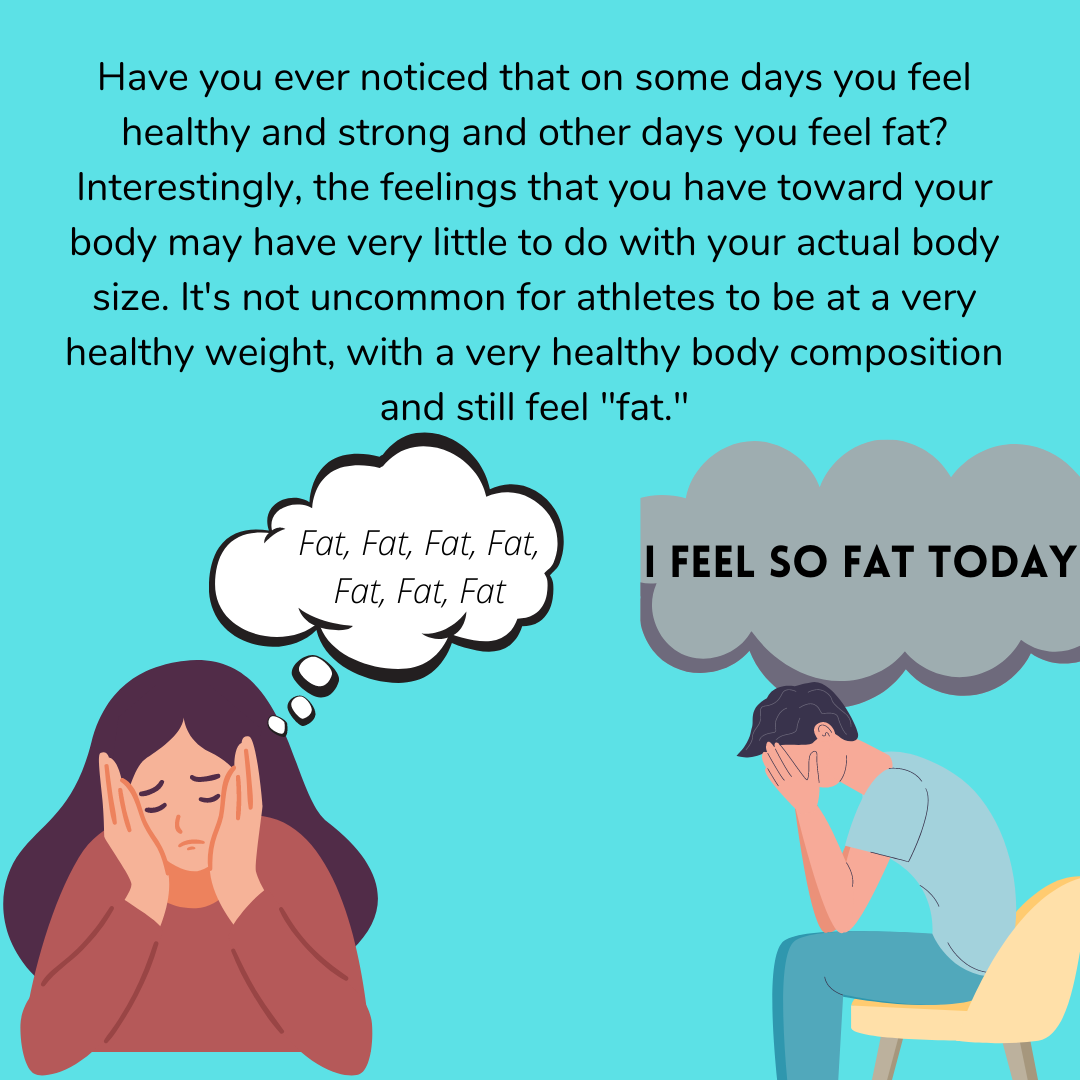
When it comes to self-image (the mental image that you have for yourself), it can fluctuate a lot from day to day, or even minute to minute.

If you are having an awesome day or you crushed a hard workout, your perception of your body may be really good. You don't worry about what you eat and you carry on with your day with positivity and confidence.

But if you are stressed and anxious, you made a mistake, had a bad workout/race or someone said something to you that made you feel less worthy, your self-image may become negative - which makes you feel fat.

Additionally, during moments of high stress and anxiety, a preoccupation with your body is not uncommon. When things/life feel out of control, you may direct your focus to food and exercise as a coping mechanism.

The next time you experience a "I feel fat" thought, give yourself space to get to the root of what triggered this misinterpreted feeling.

As a reminder, diet culture has taught you how to use food to gain a feeling of control. Tightly controlling your diet with rules and an off-limit food list is a simple solution to deal with stress, anxiety, low self-esteem or fear of failure. Turning to food to feel control over your body may seem like the only way to deal with uncomfortable emotions but it doesn't have to be this way.

It’s important to recognize that feeling “fat” has nothing to do with your body and everything to do with your feelings.

It's time to crush those negative thoughts. Your body isn't a problem. Do not belittle yourself with insults. Your body is amazing. 

Sport Nutrition 101 - making a case for sport drinks

Trimarni


If you are a long distance athlete, you've likely experiences several pronounced and uncomfortable symptoms related to unsuccessful fueling/hydration methods. Headache, dehydration, swelling, bloating, sleepiness, lethargy, lack of appetite, nausea, chills, fatigue, deep muscle aches, moodiness and dizziness are not just performance limiting but they are also extremely risky for your overall health. 

Proper fueling during intense or long duration exercise can help you sustain a desirable effort to maximize training adaptations. 
Proper fueling/hydration also minimizes the stress load to help keep your body in better health.
Proper fueling/hydration in training also helps you practice fueling strategies for competition as you can train the gut to tolerate nutrition while exercise at various intensities.

Contrary to the opinion of other nutrition experts, I'm a huge proponent of prioritizing sport drinks during training. I've also had great success prioritizing liquid calories during long distance training (for myself and for the hundreds of athletes that have consulted with me on sport nutrition).

If you are training for a long-distance event (90+ minutes) or training intensely in the heat for 60+ minutes, a sport drink provides a practical and easy way to obtain fluids, electrolytes and carbohydrates, in the right formulation to optimize digestion and absorption. Because you will always need to consume fluid when you train in the heat, a sport drink makes the most sense as the most practical, convenient and easy-to-replicate source to meet your fluid, sodium and carbohydrate needs.
Most sport drinks are very safe and effective but are often misused or neglected – especially in the heat.

Let's learn a bit more about sport drinks and clear up any confusion around sport nutrition products. 

Sport Drink Formulation
For a sports drink to work effectively, it must have the same or less than osmolality of blood. As a reference, blood plasma has an osmolality of 280-300 milliosmoles per kilogram and a bottle of Gatorade has an osmolality of ~330 mOsm/kg. A sports drinks osmolality (Iso-, hyper- or hypotonic) is dependent on the carbohydrate type (ex. glucose, fructose, maltodextrin) and concentration (grams) in a solution (fluid ounces) – in other words, how quickly it can absorb into your blood stream. If a drink’s osmolality is greater than the blood’s (concentrated or hypertonic), liquid will be pulled from the blood and into the intestine to equalize the two concentrations – this net movement of water is theoretically dehydrating. A iso- or hypotonic drink, in contrast, will provide a favorable osmotic gradient so that water diffuses into the cells. If you fail to replace the fluids and electrolytes (sodium) lost in sweat, a cascade of negative events occurs, such as a rise in osmolality, a drop in blood pressure and an increase in heart rate. In contrast, if you drink too much water too quickly and don’t consume drinks with adequate sodium, sodium levels will drop as body water levels rise, causing cells to swell. The tonicity of your sport nutrition is extremely important and likely the main contributor to GI issues, dehydration and early fatigue/bonking. The liquid component is very important and why so many athletes experience issues with only consuming solid food, gels and chews (especially when running). 
Takeaway: 
-Hypotonic - lower concentration of fluid, sugars and salt than the blood. Fast absorption into the bloodstream for quick hydration and electrolyte release. Ideal when you need to hydrate quickly and are not trying to maximize carbohydrate consumption (example during high intensity running, running off the bike and post workout).
-Isotonic - similar concentration of fluids, sugars and salt to blood. When your focus is more on carbohydrate delivery than on hydration/sodium. Because the energy and electrolyte release is slower, a isotonic beverage requires more time to get across the gut wall. This is ideal for long bike rides. An isotonic beverage would work well for a high intensity and/or moderate length bike workout, a swim session and low intensity longer runs. 
-Hypertonic - higher concentration of fluids, sugars and salt to blood. Because of the slow absorption rate, it's not advised to rely solely on chews/gels/bars during your workout. Concentrating your drinks (ex. multi-hour bottle of sport nutrition) is a culprit of Gi issues, nausea and feeling extra thirsty as your body has to move water from the bloodstream to the intestines to dilute fluids before absorbing them. A hypertonic beverage is ideal post workout when you are trying to maximize carbohydrate intake. 

What about Juice, Coconut Water or making my own sport drink?
Because fructose uses a different intestinal transporter compared to glucose and once in the bloodstream, has to be taken up by the liver to be processed into a usable fuel source for the muscles (which can take up to 90 minutes), juices are not recommended as a "sport drink" during exercise.

Although coconut water contains calcium, phosphorus and magnesium (electrolytes found in sweat), sodium and chloride are the major electrolytes because they reside in the extracellular fluid. Compared to a sugar-rich hydration beverage, coconut water is a safe and natural option to occassionally enjoy as an alternative to water. However, to sustain moderate to high-intensity exercise for longer than 90-minutes, the body depends on ingested carbohydrates and sodium – both of which lack in appropriate amounts in coconut water. Additionally, if you are paying extra for coconut water to increase your daily potassium intake, look no further than the produce aisle – a large potato contains 1553 mg of potassium! If you enjoy the taste of coconut water over plain water, choose it for light activity. But to prevent dehydration, replace lost electrolytes and provide the muscles with carbohydrates, a well-formulated sport drink is encouraged. In all other situations, plain water should be your go-to hydration beverage.

As for making your own sport drink - leave it to sport nutrition companies. Instead, make your breakfast, lunch and dinner as you can get more bang from your buck by preparing your meals instead of being a chemist in your kitchen. 

Gels, Bars and Chews
Gels, bars and chews are highly concentrated, portable sources of carbohydrates that are easy to consume during exercise but they lack the fluid and electrolytes that you’d find in a sport drink and are not in the right formulation by themselves to be easily digested and absorbed. Same goes for salt pills. Most gels and chews contain around 100 calories (or 25g of carbs) per serving. More concentrated in carbohydrates compared to a sport drink, gels and chews must be consumed with water to encourage gastric emptying. For every 25g of carbohydrates, at least 12-16 ounce of water should be consumed. Athletes may prefer to dilute a gel into a flask or bottle of water to create a more dilute concentration. Considerably low in sodium (50-100mg), gels and chews are ineffective to replenish sodium lost in sweat. Remember, your fluid, sodium and carb intake will be for nothing if it’s just sloshing around in your gut. As a refresher, scroll back up to re-read about the tonicity of a sport drink and how complicated fueling/hydration becomes when you try to meet your sodium, fluid and carbohydrate needs with different sources. 

This doesn’t mean that you can't consume solid food or a gel or chews during long distance training, but to minimize GI issues and to simplify sport nutrition, I strongly advise to prioritize liquid sport drinks when you train (and race) and use chews/swig of gel for a central nervous system pick-me-up and bars/solid food to keep the tummy happy.

Digestion and Absorption


When applying the topic of sport nutrition, it's important to understand that just because you are consuming carbohydrates, sodium and water, this doesn't mean that your muscles are receiving what you are consuming. If a product is not consumed properly (or formulated properly when mixed), it'll simply hang around in the gut - causing bloating, a sloshy stomach, heart burn, belching, vomiting, gas and/or diarrhea. fluid ingestion. This can further lead to dehydration and glycogen depletion.

Water is absorbed in the small intestines and by the time it enters the large intestines, roughly 80% absorption has occurred. The rate of gastric emptying and intestinal absorption are dependent on the volume and formulation of the beverage. The greater the concentration, the greater the osmolality. This is why you should never concentrate your sport drink – like putting 400-600 calories (2 or 3 hours worth of calories) in one bottle that only has 28 ounces of fluid. When you drink water, there’s a drive for the water to dilute the blood (water moves toward blood) but if you drink a more concentrated beverage than blood, like a hypertonic sport drink or soda or juice, water will move from inside the bloodstream and into the gut – which is dehydrating. The inclusion of electrolytes and glucose in a beverage promotes retention of fluids. When you add a little sugar with sodium (as in a sport drink), you can pull a great amount of water across the small intestines, optimizing water absorption. To help with fluid and electrolyte loss, it's not just about the carbs. You also need to ingest water and electrolytes from a sport drink to keep plasma volume at normal levels. 

There's also an added benefit of a sport drink having multiple carbohydrates for better digestion and absorption but I'll save that for another blog. 


With all this in mind, there are several reputable sport nutrition companies out there to help meet your needs. Here are a few of my favorite sport drinks: 


Swim and Run: 
-Skratch
-Clif hydration
-Fluid
-NBS Carbo-hydration
-Base
-Nuun endurnace 
-Osmo
-EFS
(Don't forget to wear a hydration pack/belt to make it easy to fuel/hydrate when you run. My go-to is Naked)

Bike: 
-Infinit (no protein/fat added)
-Carborocket
-Maurten 320
-Skratch superfuel 


What else should you look for in a sport drink? 
  • Simple ingredients - carbohydrate, sodium, natural flavors, preservative (ex. citric acid). 
  • Taste - vary the flavors of your sport drink. If you don't like the flavor or texture, you probably won't drink enough of it. If you love it and consume it too often/frequently, you may experience taste bud fatigue and dread it on race day. Consider refreshing and light-tasting flavors especially for the later half of longer workouts. 
  • Texture - A sport drink should feel hydrating. If it leaves a funny taste in your mouth or if it's difficult to consume, it's not the right drink for you. 
  • Avoid caffeine, protein, fat and other "boosters" in your drink. If you need a boost, get it from an outside source so that you aren't stuck with those added products in your drink (as many times they can cause GI distress). 
  • Reach out to a sport dietitian for help. Finding and utilizing sport nutrition is a science and involves a bit of trial and error. Take away the guessing and reach out for help.

Unconventional long distance triathlon training

Trimarni


I'm a big fan of repeatable workouts. I feel there is great value of doing a workout several times over the course of several weeks as you know what to expect and you can focus on executing better each time (especially under fatigue). I also believe that certain workouts are worth repeating year after year. There's no need to reinvent the wheel. 

When training for a three-sport, ultra endurance event like an Ironman distance triathlon, I feel that the best training approach is to find the least amount of training needed to produce the biggest training gains. However, among the endurance triathlon community, I find that far too many athletes are doing the same workouts over and over, hoping for different results. Every weekend is a long ride (5-6 hours) followed by a run (20-40 minutes) and the next day is a long run of around 2 hours (and maybe a swim or bike before or after). The training is somewhat predictable for the majority of long distance triathletes and this often results in burnout, injury, illness, excessive fatigue or a plateau in fitness. This isn't to say that this type of training isn't productive but after a few years of building your endurance, a new training stimulus is needed - not just physically but mentally. 

Endurance training is needed to build endurance capacity. Endurance training improves VO2 (max oxygen uptake), increases capillary density of working muscles, increases blood volume, decreases heart rate at the same intensity, increases mitochondria and so much more. But to truly prepare an athlete for a ultra distance triathlon, I feel too much weight is put on the long workouts as the way to ensure race readiness. But what about building strength, resiliency and improving the lactate threshold?

Taking a look inside our training/coaching methods, I'd say they are a bit unconventional. Our athletes aren't doing the typical "Ironman" training workouts that the majority athletes are doing. Yet our athletes feel prepared for their races because they are strong, resilient and healthy. We haven't always been this way but we have learned so much over the past decade of coaching endurance athletes. We found that endless hours of riding and running and continuous swimming didn't help our athletes become strong and resilient for race day. 

It's important to understand that unconventional training isn't the opposite of conventional training. Conventional training methods are effective. But we have found that our unconventional training produces similar results to conventional training - like strength, resiliency and most importantly....endurance. Most importantly, it provides extra benefits like bigger gains with less work. This isn't to say that our workouts are easy (you can ask our athletes - they work hard) but the workouts are a mix of quality, skill and happy workouts - a nice blend of workouts to keep our athletes physically and mentally healthy while optimizing fitness for race day readiness. 

I'm currently training for my biggest racing load of my endurance triathlon journey. I will be doing an Ironman, followed by a half ironman and then another half ironman - all within 6 weeks. Each race is two weeks apart. Then seven weeks later, I have another Ironman. I'm not sure how this will all work out but I know that I need to be incredibly strong and healthy in order for my body to perform well and not risk a health issue before/during this ambitious race schedule. 

My overall endurance is great. I don't find there is much value in spending every weekend doing long rides. Additionally, our terrain is very challenging, hilly and technical so our miles go by very slow and those miles are very demanding. Running is very hard on my body and brings the greatest risk for injury so I have to be very careful with how I go about my run training. I love to swim but after 30 years of swimming, I still need to focus on my technique. 

Finding different ways to stress my body helps my body adapt to different stressors. Because physiological gains are made in the later half of a long workout, I like finding different ways to stress my body so that it perceives the workout as "long." In other words, I not only mentally and physically feel like I've been training for many hours but physiologically, my body doesn't know the difference. Less time spent training = similar training adaptations. 

Here are a few examples of my last two weekends of "long" workouts: 
3/12: 
90 min Bike + 23 min Run (2.88 miles) + 90 min Bike + 42 min Run (5.21) = 3 hour ride + 1 hour run (~8 miles)
Bike workout (trainer)
WU: 15 min EZ
Pre set:
3 rounds:
2.5 min Moderate effort and 80 - 85 RPM
40 sec Strong Effort and fast RPM
1.5 min Steady smooth Z2 type of effort and choice RPM
---
4 min EZ spin
---
MS:
6x
1 min hard
4 min @ sub threshold/Sweet Spot and 80 - 85 RPM
2 min at steady smooth Z2 and 90+ RPM
---
10 min fast cadence recovery (100+ rpm)
---
5 min EZ spin

Run #1: Best EZ pace
Run #2: Steady effort

For this workout - the first "brick" of the 90 minute ride + short run was not too challenging, it was very doable like a mid-week brick. However, doing the same ride on fatigue legs was much more challenging and stressed my system similar to the last hour of an Ironman bike. And then running for over 5 miles after 3 hours of riding (and a 20 minute run) made for very tired legs - again, similar to the later miles of the Ironman. I needed to stay up with my hydration and fueling similar to a long workout and I also went through a lot of highs/lows - again, similar to a long distance triathlon. 

The next day was a "long run" of 1:35/11 miles with a main set of 2 rounds of 4 x (1.5 miles of hill repeaters - 4 loops up and down a steep hill in Furman) and then a loop around the Furman lake. I took a reset break between the sets. Doing this run on tired legs from Saturday and including hills (a safe way to get the HR up) provided a valuable training stress with low risk of injury for me. 

On Saturday (3/19) I did a slightly different workout of 
Run (5.28 miles) + Bike (80 minutes) + Run (12.5 miles)
My first run was a form focused run w/ 20 sec walk breaks every mile. 43 minutes and 5.28 miles. All of my runs include hills because well, that's where we live - it's very hilly!
I then did a 80 minute ride on the trainer (I love riding outside but I need to do the trainer for steady state work since we don't have flat where we live and steady state is not a strength of mine). The trainer ride was similar to last week except it was 6 rounds of 4 minutes sweet spot into 30 sec strong followed by 2 min EZ spin. I then went back outside for another run of 1:45 (12.5 miles) and included 3 x 10 min loops of a tempo effort around 45 minutes into the run. 

In total, I ran almost 18 miles and for the 12.5 mile run, my legs were incredibly tired. It felt like I was nearing the end of the Ironman. But I was able to practice good nutrition, work on my mental skills and focus on keeping my form in check. Of course, I was also receiving a lot of great physiological gains from this 3 hour and 45 minute "long" workout. 

And then on Sunday - 3:44 (34 miles) of mountain biking with over 4000 feet elevation gain followed by a 20 min run off the bike. 

This is just to show that there are different routes to get to the same final destination.
Make your training count and don't just count your training miles. 


What did we learn/do at our MTB clinic/camp?

Trimarni

 
\

In early January, I found myself watching a lot of mountain bike skill videos on YouTube. As a complete newbie, I want to learn as much as I can so that I can improve my skills while building confidence and safety. Although I still love triathlon training and racing, I really love bike riding. It was only a matter of time until I added a mountain bike to my collection of bikes.

Karel is much more experienced and skilled than me in mountain biking, there are several skills that he is struggling to learn on his own. And after breaking his hand last May, there are certain obstacles that cause him to tense up (ex. bumps, drops and jumps). Karel has been an exceptional teacher as he has taught me how to go up and down certain rock garden features and how to safely navigate over roots. But since neither of us don't know what we don't know, we felt it would be worth our time, money and energy to invest into a mountain bike clinic. 


In late January, Karel came across Lon from Single Tracks Skills. I reached out to Lon regarding a private camp for me and Karel. Karel participated in his first Xterra triathlon at Oak Mountain in Pelham, Alabama which is the location where Lon holds his group and private camps. Karel was really excited to share the trails with me as I only saw the trails from my feet (I participated in the trail run race). 

Because of our busy schedule (and Lon's high demand for group and private camps), we set the dates of March 14th and 15th for our private skills session. 


When Karel and I arrived to Pelham on Sunday afternoon (13th), we headed right to Oak Mountain. The 5 hour drive went by rather quickly. I was really tired and sore from my morning long run (with hill repeaters) but I was really excited to get out on my mountain bike. I was surprised with my skills as I hadn't been on my mountain bike in two weeks (I'm trying to balance Ironman training and riding off-road) and this was a new trail that I had never scene before. With Karel as my guide, we rode for ~90 minutes and loved every minute of being in the company of all the trees. The trails were very well maintained and each trail had its own special features. I could tell Karel was super happy as he loves riding his mountain bike and it only feels like "play time" for him - never training/work. 


We met Lon at 10am at the South trail parking lot in Oak Mountain (FYI - the entry fee is $5 per person per day). Lon was extremely personable and throughout the entire day, we could tell that he was very invested in us and wanted to help us however he could. I really liked how he would show us a skill, break it down for us, tell us why it was important and then have us practice. He also gave each of us different cues and skill progressions based on our abilities. With Karel being much more advanced than me, Lon did a great job working with each of us - paying attention to and recognizing each of our skill sets. Karel enjoyed seeing me progress and I really loved seeing Karel do things that he didn't think that he could do. Karel's objective from this camp was to improve his skills, speed and terrain awareness so that he can ride faster, stronger and better in his races. Although I want all of that too, I'm not there yet. My focus is on riding "fast" and technical sections better (and safer). I really like mountain biking because it's very similar to swimming - fitness can only take you so far. There are so many skills to learn with specific movement patterns and techniques. Although some people have a natural ability to learn skills quickly, many people get on a mountain bike and get lucky with certain skills.....until they don't. It's very important to me that I learn skills correctly so that when I advance my skills and fitness, I can keep myself safe so I don't get seriously injured. 


Because we purchased Lon's online clinic in February, we had watched most of the videos which allowed us to move quickly through the ground control skills. For the first two hours of our camp, we spent time on a grass field practicing "ground control" skills like body positioning, braking, jumping, hops, pedal drops and turning. As much as we wanted to ride the trails and practice skills there, we found great value in practicing skills in the field. Just before lunch we went to the trails to practice some of the skills that we learned. Immediately I felt so much more confident with higher speed off camber cornering and riding over small obstacles. Karel was learning super quickly and he found himself doing skills he could never do before (like jumping over logs). 

After eating lunch by our car (we brought bagel sandwiches that I made in our Airbnb),  it was time to head out into the trails. 

Although we spent all afternoon on the trails (in perfect sunny 60-degree conditions!), we didn't cover a lot of miles. To get the most out of this camp, Lon would stop us at certain sections of the trail to discuss specific features. "Section training" is something that Karel does with me when we ride. Anytime we come up to a specific trail feature that requires a specific series of skills (or something that scares/worries me), we will stop at that feature and discuss it. Sometimes Karel will help me understand the best "line" to take whereas other times Karel will demonstrate how to go over/around the feature a few times before I try. Sometimes I will succeed and sometimes I won't. But I always try a few times before moving on. 

Lon new the trails so well that we covered so many different features. There were so many teachable moments out on the trail and it was extremely beneficial to be able to spend time on each specific feature. Because Lon's skills are exceptional, Karel found it really helpful to ride behind Lon and to learn directly from him. Lon even played a game with Karel where he would call out when to jump or bump over certain features and Karel would do whatever Lon told him to do. It was truly a "game" for Karel and I think that's why he loves "playing" on his mountain bike. 

Around 4:30pm, we made our way up to "blood rock" which is a series of tricky to maneuver, uneven and jagged rocks (this was also part of the Xterra Oak Mountain bike course). This segment was more for Karel but I learned a lot watching Lon (and Karel). Nearing 6pm, we headed down the mountain on the trails and I felt really confident with my skills. I learned so much after one packed day! Karel and I were exhausted and we couldn't wait to do it again the next day. 

Unfortunately, we only had one nice day of weather. We shorted our next day to two hours and focused on pumping and jumps at the BMX track and then went to the "lightening" trail which was a series of steep bumps and berms. Even though it was a little sketchy due to the light rain (and cold), we spent a good amount of time on two specific jumps where we both practiced jumping. I have a long way to go but it was fun to feel my progress and to feel much more confident on this type of terrain. The nice thing about Oak Mountain is that for every advanced feature, there is also a less advanced feature on the side. To be honest, even though the weather wasn't ideal on Tuesday, it provided a great "real life" scenario of how to ride on wet conditions. Karel and I learned so much about how to ride over roots/rocks and selecting the best line when it's wet/rainy. 

Karel and I drove home on Tues afternoon and left with so much excitement and eagerness to continue to work on our skills. Lucky for us, we have an awesome pump track just a few miles down the road in TR where we can practice our skills. I'm really excited about my next MTB event on March 26th. It's been fun to combine Ironman training with mountain biking but I've never considered us to adhere to "conventional" Ironman training methods. 


If you are new to mountain biking or want to improve your skills, we highly recommend Lon from Single Tracks Skills. He's an exceptional teacher and phenomenal rider...and an all around incredible human. 

Why a bike-focused camp is the best bike upgrade

Trimarni


Earlier this week, Karel and I traveled to Pelham, Alabama for a 1.5 day private mountain bike skills camp/clinic with Lon from Single Track Skills. I'll write more about that experience in my next blog but the opportunity to work with a professional coach was an incredible investment of our time, effort and money. 

Since 2014, we have organized, planned and executed over 15 group camps. While our training camps are fun, memorable and challenging, there is a common theme for every Trimarni training camp - bike skills and terrain management. 

The convenience of the indoor bike trainer has created a false sense of confidence with regard to bike handling skills - especially among triathletes who ride triathlon (or TT) bikes. It's easy to build fitness indoors but it's impossible to improve bike handling and terrain management skills. The moment you begin to climb a steep hill, descend or take a tight corner (or u-turn), your FTP (or power) number is of little benefit. 

At my mountain bike skills camp/clinic, I was learning a diverse new set of riding skills to help me ride safely, confidently and efficiently on challenging terrain. Because these skills are not developed naturally and will require time, practice and patience, I know how to work within my current skill set and how/where to improve. 

Thankfully, this doesn't apply to triathletes as there are no rock gardens to navigate, off-camber turns or roots to ride over. Because triathletes ride on pavement, the set of skills needed to ride safely, confidently and efficiently are somewhat easy to learn (and there aren't a lot of them to learn). However, triathletes would much rather obsess about power numbers and miles ridden and spend money on carbon upgrades, dual-sided power meters and race wheels than to invest in improving bike handling and terrain management skills. A skilled cyclist on a mediocre bike will likely outperform an unskilled cyclist on an expensive, top-of-the-line bike. The same is true for a skilled cyclist who may not be as strong as an unskilled cyclist. Just because you can push a lot of watts on the indoor trainer, this doesn't mean you are exceptional at riding your bike outside. 

As a coach and athlete, I know there are far too many athletes who experience great anxiety, stress, worry and fear when it comes to riding outside. I also see a lot of athletes perform below their athletic potential because they lack basic, fundamental bike handling skills and terrain management awareness. 

It doesn't matter if you are training for a pancake flat bike course or a hilly, technical and challenging course. If you want to ride stronger, faster, smarter and safer, you owe it to yourself to invest in a bike-focused training camp. 

We have a few spots left in our three group training camps for 2022. Our first camp is April 1-3rd in Greenville, SC and it is a bike skills climbing camp. Our camps are open to the public - you do not have to be a Trimarni athlete to attend.

To learn more about our camps, click HERE.

If you aren't sure if a Trimarni group camp is right for you, I'm honored to share some of our athlete testimonials.....


Societal (body image) pressures of female athletes

Trimarni


Today is International Women's Day. A day to celebrate women's achievement, raise awareness against bias, stereotypes and discrimination and to take action for equality. A day to move closer and to eventually achieve a gender equal world. 

Although every day should be an important day to celebrate women's achievements while calling out inequality, today is an important day to remind female athletes that the power to change starts from within. When you take this approach, the world is better off. 

Far too many young girls, teenagers and young adults believe that the external view of their body defines their perception of their physical self. And when a female doesn't feel good about her looks, she may be hesitant (or refuse) to participate in sports, try out for a club, join a team or lack confidence in a professional setting. Many little girls grow up idealizing certain celebrities, athletes and influencers with the idea that they must look a certain way. These girls grow up to become teenagers and then adults. Throughout life, bodies change. When a female struggles to accomplish a certain body, she can become very self-conscious and may resort to unhealthy and drastic measures. 

There's no denying that conventional mainstream media has greatly contributed to negative body image among girls and women. All over TV, movies, magazine covers and ads are females looking thin, defined and beautiful. Messages about body image are almost always shaped by the media, beauty and diet industry and claims of health and fitness. With a unified message showing how all women should appear - this creates an idealized body image. Let's not forget that most "perfect" bodies are digitally altered and filtered. If you are like most women, you have been criticized, bullied or shamed by others - or you criticize yourself - for being "too big" and not fitting the standard. 

Due to lack of representation of women who do not meet an idealized image or beauty standard, race, age or ability, it's very difficult for a women and girls to see themselves as beautiful......and normal. As a result, women and girls have unrealistic expectations of what a female body should look like and this creates feelings of low self worth and inadequacy. If we want a world with gender equality, we need to change the norms and expectations about the female body. Age, race, religion, ethnic origin, socio-cultural status, ability and identity should carry the same weight as body image when it comes to social inclusion. 

On International Women's Day, I encourage you to think about your relationship with your body. 
  • When do you feel most dissatisfied with your body? 
  • Where did your toxic attitudes about your body and negative self-talk come from (and when did they begin)? 
  • Who taught you to hate your body? 
  • Who taught you to love your body? 
  • What changes do you make with your diet/exercise routine when you feel "off" in your skin? 
  • Why do you feel great pressure to change the way that you look? 
Helping female athletes develop (and maintain) a healthy relationship with food and the body is a topic that I will always promote. I've written over 30 articles on the topic, created a program to helping female athletes unlearn toxic dieting behaviors and fix the dysfunctional relationship with food and the body that is sabotaging performance while negatively impacting mental and physical health and it's a subject matter that I discuss with all of my nutrition and coaching athletes. 

Far too many female athletes struggle with the contrast between a body that is healthy and performs well in sport and a body that meets "social standards." While some athletes see weight loss as a means for sport improvements, many athletes adhere to rigid eating rules to look a certain way. When a female athlete has issues with how she looks, there's a good chance that this athlete will intentionally undereat and overexercise in an attempt to change her shape, size or weight....but with this comes the inability to meet energy, hormonal and nutrient needs. Food and body image become a mental stressor as health and performance deteriorate. 

There is no escaping the fact that female athletes are objectified. Glorifying unattainable standards of the body of a female athlete can negatively impact the self-esteem of women - especially young female athletes. Female athletes do not deserve to be judged, shamed and sexualized. A female athlete's looks should not override the celebration of her athletic ability.

The power of change starts from within. In a society where societal expectations and pressures on how a female body should look often drive females to diet, exercise and cosmetically change their image/shape/size, how can we move to a more gender equal world if women constantly feel the need to change to meet a standard? 

This leads me to an even more important question....

Who the heck is setting this body image standard that you feel you need to achieve?  

A set of beauty standards with the mission of achieving an ideal (or approved) shape, size, weight or appearance does not help us move toward equality. 
It's unfair and unrealistic. Far too many women are discriminated against simply for being (or not being) a certain size.

Let's stop the objectification of the female body and see every body type as an amazing piece of art. Your body is a gift and it should be celebrated and cherished. Body diversity is normal. Only when you care for your body properly, can we move closer to female body acceptance. 


A sense of belonging in sport

Trimarni


Does it matter if you consider yourself an exerciser or an athlete? I say yes. 

When you sign up for an athletic event, you have a responsibility to embrace your athletic identity. You don't have to be competitive against others but you should desire to challenge and better yourself. 

Because your thoughts and beliefs about yourself lead into your actions and behaviors, embracing your inner athlete means including your athletic lifestyle within your self-identity. 

Once you learn to learn to identify as an athlete, you start to behave like an athlete. You make better choices with your sleep, nutrition and lifestyle, which will likely improve your overall motivation and quality of life. 

While it's powerful to identify as an athlete, it's also important to identify as a member of a team or community. 

When you are around likeminded individuals, you feel a sense of belonging. This brings acceptance, confidence, connection, fun, motivation and accountability. Your tribe can help you find strengths, skills and abilities that you didn't know that you had. Being part of a team means being part of something that is greater than yourself. 

We all crave a sense of belonging and it's necessary for a healthy and happy life. Belonging to a group that embraces who you are (rather than needing to hide or change yourself) is important. A big part of feeling confident as an athlete is knowing that you belong. And this 'belonging' can be in a team or in a competition/race/event. 

As an athlete, you can easily destroy your confidence when you feel you don't belong. It's easy to look for reasons why you aren't good enough. 

OR, you can remind yourself of the reasons why you belong where you are.

Regardless of your experience level, you belong. You didn't improve by chance. You are doing the work and improving because you belong. 

To help build a strong case for why you belong and to help you find your tribe/community, here are a few tips: 
  • You should never have to change yourself. When you try to "fit in," you may try to impress others or change yourself for the group you are around. A true sense of belonging is that those around you accept you for who you are and appreciate your authentic self. 

  • Identify your core values. These are the beliefs that are most important in your life. Knowing your values can help guide your actions and help you make decisions. Your core values are what you care about the most. 

  • Spending time with people is critical to help with feelings of loneliness and boredom. Your tribe should be composed of people who share mutual affection and trust for one another. Your closest support system should play a positive role in your life and happiness. 

  • You can't show off your true self and be accepted if you don't know what your true self looks like. Belonging is all about feeling accepted for who you are. This acceptance starts from you accepting who you are and not feeling the need to change in order to be liked. 

  • Say yes to new opportunities and experiences by maintaining a curious mindset. To grow, you must accept others for who they are. Less judgement, more acceptance. 

6 Hours on the Ridge mountain bike event recap

Trimarni

It was nice not to feel rushed in the morning. We spent around an hour eating/working between 7-8am and then got ourselves ready to leave. We prepared everything the night prior (food, sport nutrition, gear, etc.) in addition to our hydration packs (2 each), which we kept cold in the fridge. We left around 8:20am and arrived to Pleasant Ridge (event venue) around 20 minutes later.

I had a cinnamon raisin bagel w/ peanut butter and jelly at home and then had a Chobani cherry flavored yogurt in the car. I sipped on water in the car and had another bottle of Skratch to sip on at the venue. Karel had oatmeal at home and ½ bagel w/ peanut butter in the car. Compared to Friday weather which was warm (70) and sunny, Saturday was much colder – in the upper 40’s. With a lot of outdoor riding in the cold, we both had an idea of what to wear, with most of gear removable (ex. leg covers, arm warmers, jacket, etc.).

After we arrived, we set up our area in the “loop” section of the course. We used a small table for our nutrition and we also brought a chair, foam roller and blanket for the ground. With this being our first of this type of event, we weren’t sure what to bring but I felt like we covered the basics with what we needed a just a little extra. We set our stuff up next to our friend Thomas who was also participating in the event. With only ~60ish participants, we saw a few familiar faces (well more like faces that Karel knew from the bike scene).

After Karel parked the car in the designated parking lot, we made a bathroom stop in the indoor bathrooms (there were no port-o-potties). Thomas and I reconned the start and finish of each loop which included a bit of climbing and descending on dirt/gravel. At 9:45am, we made our way to the “athlete briefing” and at this point, I felt a bit nervous as everyone was lining up for the start. Karel got to the start of the line whereas Thomas and I stayed more toward the middle. There weren’t a lot of ladies at the event but a few lined up near the front so I knew they were much more experienced than me.


Once the announcer said go, we made our way on the grass, and then on to the road before starting the first climb of the loop. The course was pretty simple – a 5.8 mile loop with ~600 feet elevation gain. The course started with the more technical features (rocks) and then made its way into a flowing section where you could get some good speed. I’ve learned with MTBing that even with the downhill sections, there is no “resting” as you are always on – being focused, alert and moving the body. Then came a mile of roots/rocks – although not super technical, it does require a lot of focus and skills to get through. There were a few berns and rollers, which I am still not great at when it comes to picking up speed. Then came a short grass section at the front parking lot where most people used for drinking/eating before a mile or so of climbing with a few hard efforts to get over obstacles. Nearing the end of each loop are big tree roots to get over before descending back down to start it all over again.

When we started the loop, there wasn’t much rolling as it was single file and a few people started unclipping and walking. Karel warned me of this in advanced so I knew what to expect. I was able to eventually get riding until I struggled over one obstacle and had to unclip. Since I’m so used to riding by myself (or with Karel a little ahead of me), it was challenging to navigate the terrain and the actions of the other riders. I let other riders pass me as I didn’t want to get in their way. There are still so many skills that I need to continue to work on.

After getting through the rocky section, we came to a very tight right turn switchback which I usually clip out for. Well I completely forgot about it and approached it way too fast, which then caused a slowdown behind me as I tried to unclip but found myself somewhat falling. I struggled once again on another section that I find challenging – it goes from a curved downhill across pavement and then up the hill – but the hill is somewhat curved with a tree branch to navigate around, a few rocks (which are always wet) and then a few more limbs. I really messed up with my gearing at this place and had to unclip again. I let more people pass as I pushed my bike up a bit to a place where I could get momentum to clip in again. Once I got back up, I found myself near the end of the pack and behind four guys. Although I felt like I could ride a little faster than them on the climbs, I felt like I needed to play it safe and smart for the next few miles.

It was only 15 minutes and 2 miles into the ride when I passed a paved trail, changed my gears to accelerate up a short climb and boom – I couldn’t pedal anymore. I thought my chain dropped so I got off the bike and went to put the chain back and then I felt a rush of sadness – my chain broke. With 5 hours and 45 minutes left in the event, my day was ruined in 15 minutes. I blamed myself for not making smart gearing choices but later on, Karel blammed himself that after he waxed our chains, he didn’t put my chain link on correctly and it bent and then broke off. He said he’s never made that mistake before but I don't blame him. We learn and move on. Anyways…..

I wanted to get back to the race start/finish area before Karel finished his loop so I scooted and pushed my bike .88 miles on the path. The spectators who were around asked if I was ok and I responded that my chain broke. Two guys under a tent asked me if I was ok and I asked if either of them know how to fix a broken chain link? One of the guys stood up and walked over to me and my bike. Thankfully, he knew how to fix it and thankfully, Karel brought his toolbox, an extra chain (and two extra links) as well as two extra tires. Karel was prepared for everything. Although it felt like this issue took forever, it only took him 10 minutes (8 minutes I spent walking with my bike). And just as he started fixing it, Karel rode by in 4th place. I didn’t want Karel to stop as I didn’t want him to ruin his race so I told him that my chain broke but this guy was fixing it. I am so grateful that I was able to get help! During this time, I started to get a little warm so I took off my leg warmers and ear cover. After what felt like the longest 18 minutes, I got back on my bike and rode back to where I broke my chain (another .88 miles) to restart where I left off.

At this point, I had a rush of thoughts going through my mind but never did I think about quitting. Sure, I’m competitive but I can still be competitive and not be winning the race. This event was all about learning and exploring my limits while testing my skills. I wanted to give it my best effort and I wasn’t going to let a little setback derail my day. I had many more hours to go and I know from experience after 17 Ironmans, that anything can happen but you have to keep yourself moving toward that finish line.

I tried to stay up on my hydration which was a lot easier with my hydration pack compared to grabbing solid food out of my jersey pocket. I brought my new favorite bar – Supra Beet the Competition – and had the package open before I started for easy nibbling.

One thing I’ve learned to love about mountain biking is the need to always be focused. I am constantly thinking about what’s in front of me and what’s just ahead of me. With distinct features of each part of the course, I never felt bored or that time was passing by slowly. Because I hit my lap button my computer for each lap, I didn’t have any idea of the time of the day or how long I had been riding. I do a similar thing in an IM as it really helps me stay focus on the present moment. Once I started to feel like I was getting into a good rhythm, I got to an obstacle where I needed to unclip with my left foot (non-dominate foot) and I wasn’t able to unclip. I thought maybe my cleat was stuck with mud or something but either way, I fell over because I couldn’t unclip. To get myself back up, I had to slip my foot out of my left shoe. I looked at the bottom of my shoe (which was still attached to the pedal)and the cleat was still on the bottom of the shoe but something was preventing it from coming off the pedal. I tried to wrangle with it but I couldn’t get it off. At this point I thought my day was officially over – just less than 2 hours into the event. Well, I still needed to get back to the race venue (1.75 miles away) so I slid my foot back into my shoe and then clipped in with my right foot and told myself that I needed to ride with the best skills possible for the next 1.75 miles – no second guessing! Nearing the main parking, Karel passed me and I told him that my cleat was stuck. I wiggled my shoe around to show him as he slowed down and he said for me to tighten it when I got back to the race venue. I told Karel that maybe this wasn’t my day and I should quit the race as it felt like a good idea at the time. I could just cheer for Karel since he was having a great race and it seemed like nothing was going my way. But Karel told me that there was still so much left in the event and this would be a great training day for the Ironman. He was right and I tossed that quitting idea out of my head.

Once I got back to the race venue, Karel was there. I didn’t want him to stop for me but he said he needed to take off some of his clothes as he was getting hot and he needed a break as he moved himself up into 2nd place but totally blew up and moved back to 4th. He quickly looked at my shoe and noticed the bolt fell out. He pulled the shoe off the cleat and told me to get my other pair of shoes. This stop only took 90 seconds. Thankfully, I brought a 2nd pair of shoes (and a 2nd helmet) just in case. I put on a fresh pair of shoes (which actually felt really good) and made my way back up the hill for another loop.

At this point I had been riding for 3 hours – which is a really long time. But it was also halfway in the race which meant I still had another 3 hours. Although this event was a “6-hour event” the results are based on who can complete the most laps in 6 hours while making the cut off time of 5:15hrs (or 3:15pm) to start the last lap. And you can stop as much/little as you want.  I lost track of how many laps I had done and what time of the day it was so I kept on riding. Sometimes I would choose the right line but other times I was just so tired that it was hard to muscle my way over the rocks. The positive of my two stops is that it put me on the course pretty much by myself so I was rarely around others. Some of the faster riders would pass me and would call out in advance or I would hear them coming and I would pull over an unclip. Everyone was really nice and looking out for one another.

For our “aid station” we had a Mexican coke bottle (opened) that I sipped once but only used that station to swap out hydration backs. Each pack was filled with ~2 bottles (each bottle was filled with 2 scoops INFINIT). I had one pack of fruit punch and another pack of strawberry lemonade. Just like in an Ironman, I like to change flavors to prevent taste bud fatigue.


Although I didn’t have any low moments, nearing the last hour, my back really started to hurt (lower right side). I was getting tired. The accumulated elevation gain, jerky movements to get my bike over obstacles, climbing, descending and falling/unclipping made my back feel like I had just done hours and hours of deadlifts. I tried to engage my core more and do whatever I could to relax my bike. Nearing 3pm, I saw my mom, her boyfriend and Campy at the venue and that just made my day. I wasn’t expecting them so I stopped and stretched my back as I said hi. Once I got to the last lap, I told myself to make this my best lap. I made all the obstacles (except for the first rock/root series) and finished feeling relieved and accomplished. 


Karel finished a little behind me as he was able to overcome his low moments and really push the 2nd from last lap to make that 3:15 time cut off. So he was able to squeeze in one more lap for a total of 10 laps, 5:44, 58.3 miles and 6355 feet elevation gain. Karel came in 3rd place. He credits relying on a lot of the mental skills that he uses in an Ironman to help him get through the low moments during this race. I completed 7 laps in 5:06, 43 miles, 4000 feet elevation gain and 1st place AG (out of 2). There were some really strong ladies there which inspires me to continue to work harder to get better. We received really cool awards which was a nice bonus to this grassroots event.


Karel and I were completely smashed after the event. So incredibly sore and exhausted. But we also had a lot of fun. The vibe was awesome, everyone was really nice and supportive and we got to ride our bikes in nature for almost 6 hours on a beautiful Saturday!


Marni laps (including stops)


1 – 1:09 – broken chain
2 – 41.07
3 – 44:05
4 – 47:33 – broken cleat
5 – 44:05
6 – 44:35
7 – 44:05

Karel laps (including stops)

1 – 33:22
2 – 31:56
3 – 32:47
4- 31:30
5- 33:00
6- 35:30
7-39:00
8- 35:00
9 – 32:00
10 – 34:42


My first MTB event - race report part 1

Trimarni


On November 15th, Karel asked me if I wanted to ride his old mountain bike on the trails behind Furman University. After seeing how much fun Karel was having on his mountain bike, I thought it would be fun to try. 

For my first ride, we ventured a few miles down the road. Karel taught me the basics of riding a mountain bike on very easy trails. There were no obstacles to overcome but instead, I learned how to move my weight, adjust the gears and go over curbs. It was a very fun and enlightening session. 

A little over a month later (December 24th), I went for my first official mountain bike ride at Dupont State Forest. This ride was much more technical with rocks, roots, gravel, water crossings, climbs and descends. Karel took his time explaining line choices and helping me build my confidence going over more technical obstacles. We would stop and discuss the more challenging sections and although I would try, there were many obstacles that I could not get over. As the ride continued, I could feel myself getting tired from this new activity. Karel was impressed with what I was able to do (although I felt like I complete beginner) and he felt like I was ready for a more technical course - Pleasant Ridge. 

The Pleasant Ridge trail system is only 20-minutes away and one of Karel's favorite "local" places to mountain bike. With several loops within the main loop (~5.8 miles) to choose from, Karel once again took his time with me as we practiced going over tree limbs, roots and rocks as well as body positioning on turns, descends and climbs. I picked up a lot of new skills really quickly It really helped having Karel show me what to do and talk me through the steps. After my second ride, I mentioned to Karel that I would like to do an event on Feb 26th - 6-hours on the ridge. It was a local, small event and it would be on a course that I could practice on. Karel was excited for us to do our first mountain bike event together but we both knew I had a lot of work to do to prepare for this event.

For the next seven weeks (along with swimming, running, trainer riding and road biking), I went to Pleasant Ridge at least once a week to practice. With each time, I got a little better. Sometimes I would fall, struggle and get frustrated but sometimes I would succeed. When I did succeed, I would cheer out loud and say "Yes! I did it!" After several rides, I was able to confidently do the Sassy's Pass loop as well as the short and long loop (in both directions). When I returned back to Dupont two weeks before the event, I found myself with a lot more confidence to try harder obstacles. 


At night before bed, I would watch videos of mountain bike skills and watch races/events. When I had a little free time, I would even practice skills (like unclipping and clipping in with either foot) outside our house. 

Knowing that the race course would include a section of the trail that I had never been on before, eleven days out from the event, Karel felt like I was ready to try the JFA upper loop - I called this the "black diamond" loop as it had a lot of technical rock features which required good speed, body position, line choice and confidence. For this ride, I struggled on every feature but one. I felt like a failure. I almost passed on riding the next day but I knew I had to go back and conquer my fears. I spent four hours on the course and made sure to master as many obstacles as I could. There was one that I continued to struggle with until my last loop when I successfully got over rock after rock after rock. There was one root section on a hill that I could not get over as I just couldn't get the right speed and strength after two previous rocks. Karel told me not to get upset when I can't clear an obstacle as there are times when the best riders in the world have to unclip.

On the week of the event (Tuesday), we did a recon of the course and I didn't make it over any obstacle on the upper loop. I don't know if it was fear, fatigue or a combination of both but I did not ride well that evening. We went back on Friday for one last recon and I succeed without any falls (and only one unclipping for the root section). It was a great confidence builder going into the event. 

It was fun going through the motions and emotions of "race week" as it's been a while since I've raced. With the triathlon race season kicking off in a few months, it was helpful to practice race week workouts, pre-race nutrition/hydration and preparing gear, equipment and sport nutrition. It doesn't matter how many times I pack for a race, it always feels overwhelming. 

Although I have great endurance from long distance racing, my skills are a work in progress. But I am willing to learn and I am having fun - even when I make mistakes. 
The reason why I wanted to write part I of this race report is to help others who may be in a similar situation as myself. 

When you do something for the first time or if you are new to a sport, there will be things that you struggle with. Although this is a normal part of developing, it's very easy to become frustrated after making mistakes. When you can't handle your frustration (or anger), there is a good chance that you will quit. If you see yourself as a failure, it's difficult to have fun. 

I selected 6-hours on the Ridge as my first mountain bike event for a few reasons: 
-I could practice on the course - it was familiar to me. 
-It was time-based and not mileage based. 
-It was a loop course so I could stop/rest at anytime. 
-It was local, which minimized stress/planning/travel. 
-It was a small event. 

In learning how to mountain bike, I've had to really work on my self-talk. It's so easy to be hard on myself but an important skill is to learn to move on and not dwell on the past. When you have high expectations or you desire perfection, the risk of getting frustrated, disappointed and upset increases. This rigid thinking sets you up for failure because there's no way that you can predict what will happen on race day. 

Frustration is not as bad as it seems. It can actually be a great motivator to get over (literally) the obstacle that is blocking your path. But if your frustration causes a negative emotional spiral, this can morph into anger - which affects your ability to make good decisions. 

I'm proud of myself for finishing my first MTB event and not giving up. This journey has not been easy but it's been also been extremely rewarding, eye-opening and motivating to feel like a beginner again. 

From Elite to Beginner - a reminder for the experienced triathletes

Trimarni


Over the past year, I've gone from elite triathlete to complete beginner. 

In 2021, at the age of 39, I had one of my most successful seasons in 16 years of competitive long-distance triathlon racing. 
  • IM 70.3 Chattanooga - 3rd overall female
  • IM 70.3 Blue Ridge - 2nd overall female (missed first by 2 seconds)
  • IM Lake Placid - 3rd overall female
  • IM 70.3 World Championship - 11th age group
Over the past 12 months, I've also trained for and raced in three new sports......gravel biking, trail running and mountain biking. Although my triathlon experience has given me tools to use for each of these new events, I had to remind myself that I was a beginner. Whereas in half and full distance triathlon racing, the experience is very familiar and routine for me, I was filled with curiosity with each new sport. The novelty of each event made it fun and exciting. But with each 'first time' I also knew that I would be learning a lot throughout the experience and the best race day mindset was to free my mind from expectations. 

Over the past 16 years of endurance racing, I've become good at racing. However, it wasn't always this way. If I only look at results, I won my age group at my first Ironman in 2007 (18-24 age group) and did not win my age group again until 2017 (35-39 age group). Since 2017, I have won my age group at two more Ironmans (IMWI '18 and IM Lake Placid '21). I guess you could say that it took me ten years to become an overnight success.

I love the sport of triathlon because I love to swim, bike and run. I also love what triathlon has given me - a job, a reason to travel, friends from all over the world, and a way to help others step outside their comfort zone. It's also fun to have experience and success in the sport that I love. 

Although I can put myself into 'autopilot' mode when it comes to swimbikerun over 70.3 or 140.6 miles, I can't tell you how many times I've freaked out, fallen and struggled with trail running, gravel riding and mountain biking.  Instead of knowing, I am growing. There are no expected outcomes but instead, so many possibilities. With these new sports, I have a lot of learning to do - primarily with my skills. I am having a lot of fun feeling like a beginner again but it sure is frustrating at times.

This past weekend I participated in my first mountain bike race (race report coming soon). I was nervous and excited. Although this was a small race, I was still anxious about the event. I checked my email obsessively for the "race day" email from the race director. It came a day before the event and I still had unanswered questions like....where do we park, where do we pick up our race numbers, how are our laps recorded, what is the course, will there be bathrooms available, etc. 

Although I still look at the athlete guide of each of my 70.3 and Ironman events, the information is generally the same. For most every triathlon, I know what to expect. 

But I'm a beginner at gravel biking, MTBing and trail running - how should I know what to expect? I'm going to make mistakes in order to learn. I'm going to have questions. I'm going to say things that may sound silly to the expert. I'm going to get excited about basic things. I'm going to struggle when the expert will sail. 

In each of my new sports, fellow competitors and participants have been extremely helpful, supportive and kind. As I'm being passed on the course, I receive cheers and encouraging words. I always try to do the same. There are all different types of gear, equipment, clothing, skills and body shapes/sizes which makes these sports very welcoming.

For the individual who is looking to stretch their comfort zone, do the impossible or accomplish a dream, triathlon is the perfect sport. In my book Athlete to Triathlete, I talk about how welcoming the sport of triathlon is and how supportive and nice the people are. I want to believe that most triathletes are supportive of an inclusive and diverse triathlon community. But those who are experienced in the sport have a responsibility to help grow the sport of triathlon. 

There are a lot of beginners out there - many more than the hard core athletes who have been doing the sport for 5-10+ years. For many newbie triathletes, like myself, these individuals are in it for the experience.....because it's fun. To keep the sport of triathlon accessible, friendly, welcoming, less intimidating and inclusive, here are a few tips: 
  • The way that you do something may not be the best way for a beginner. Put yourself in the shoes of the beginner before providing tips, suggestions and advice. 
  • The beginner needs to have fun in order to stick with the sport. I'd like to think that every athlete started a sport because they found it fun. To ensure a positive race/event day experience, don't make fun of athletes who don't look like, act like or think like you. 
  • Don't steal the joy from the newer athletes. Complaining about the course, the weather or providing your negative opinions about the event is not how we grow the sport. Only offer helpful advice that will ensure a positive race day experience for the athlete and leave your complaining to the event organizer. 
  • Look around you and offer help as needed. Like waving to a car that passes you as you ride to bike, you want to be the kind, welcoming, helpful experienced athlete that makes for a great race day experience in the eyes of a newbie. 
  • Keep an open mind. Even for the expert, there are still new things to learn, mistakes to be made and areas of improvement. Tame your ego. 
As a reminder, an athlete can be dedicated and competitive and still be in it for the social aspect and fun experience. The excitement of signing up for an event or reason for completing an event may not be for the competitive aspect but for health and wellbeing and a sense of accomplishment. 

Let's not forget that every elite athlete was once a beginner. 


For the love of the bike

Trimarni


Sometimes it feels like life is moving very slowly. But today it feels like the last year rushed on by us. 

One year ago today Karel received the heartbreaking news from his brother in Czech that his dad suddenly passed away from COVID. It was shocking news as it all happened so quickly. Like many people, we continue to mourn the loss of a loved family member and the separation of Karel's family on the other side of the Atlantic only adds to the grief and sadness. Coping with loss is difficult but this pandemic adds to the emotional hardship. Karel was not able to travel to Czech for the funeral service due to a country lockdown. No family hugs, sharing of memories or celebration of life. Instead, Karel and I watched the funeral online from our kitchen. 

It's been said that exercise will not extinguish grief but it can help ease the grieving process. 

Although Karel and his dad didn't have the same point of view on certain topics and issues, they both shared a very strong love for cycling. Three of our four visits to Czech were during the airing of the Tour de France. It was the highlight of the year for Karel's dad to watch a few stages of the race on TV with Karel. They spent hours talking about the riders, bikes, technology and race tactics. 

While Karel and his dad both shared a strong passion and competitive spirit for cycling, they both shared a love of the bicycle. Enamored with all things bike, much of the memories between father and son involved cycling. Karel's dad loved hearing about our triathlon events and always wanted to know the details of Karel's "current" race bike and training. 

As with any bike aficionado, Karel has an extensive bike collection. Along with a triathlon bike and road bike, Karel has recently added a gravel and mountain bike to his collection. Unfortunately, Karel's dad never got to hear about all of the off-road adventures that Karel has been on over the past year. 

Between us both, we have 8 bikes (4 bikes each) that we can ride outside. And nothing makes us happier than being outside on a bike. Whether it's shredding on the single track, riding on gravel, road biking in a group or feeling the aerodynamic benefits of the triathlon bike, cycling has been a source of therapy. When Karel is on his bike, he doesn't feel the stress of training for a race. He feels joy, excitement and happiness as bike riding has always been a passion that was shared with his dad. 

Cycling can be a dangerous sport but we haven't let the fear stop us from creating so many memories on two wheels. Thankfully we live in a very bike friendly community where we can truly enjoy the benefits of having a bike - like seeing new sights, climbing mountains, feeling the exhilaration of descending at high speeds and connected with friends on two wheels. For Karel's dad, there was no indoor riding. Maybe an occasion or two of riding on the rollers. But he either rode outside or he didn't. Only in his very late years of masters bike racing did Karel's dad get on a trainer (a very sh!tty one Karel says) but only very occasionally. To Karel's dad, the bike was meant to be outside. The appreciation that Karel's dad had for the bike has helped to awaken Karel's love of outdoor adventure (hence the additional two bikes to the collection for off-road riding). 

Karel's dad had such a strong impact on his life. The unassuming bicycle has great power for mental health and well-being.

The simple act of building and riding bikes keeps his father's memory alive....all for the love of the bike. 


Leaving sport due to burnout

Trimarni


As a long-distance triathlon coach, I realize that there will be a time when an athlete will no longer need my coaching services. When this time comes, my hope is that my athlete is not leaving the sport with resentment but instead, due to a new life chapter. It's also my hope that the athlete continues to swim, bike and run, even if it's not to be competitive or to participate in events. Far too often I hear of athletes leaving the sport of triathlon on bad terms. Instead of reflecting on all the great experiences, accomplishments and memories when moving on to the next chapter, the athlete sees triathlon as a waste of time/money/energy, the athlete sells all equipment/gear and family/friends are very bitter about how time/money/energy was spent over x-years/months on a "lifestyle" hobby. 

As a collegiate swimmer, I experienced a bit of burnout before my senior year.  I didn't hate the sport of swimming but mentally I needed a change. I picked up cross country running for one season and realized two things: how fun it was to run off road and how much I missed competitive swimming. I ended up finishing off undergrad with four years of collegiate swimming. All I needed was a short break to realize how much I loved swimming. Still today, I love to swim. I've been swimming for almost 30 years and have never gone more than 2 weeks without swimming. 

Every athlete has his/her own threshold when the rewards are not enough to maintain the effort. Burnout is a response to the demands and stressors of a sport without appropriate physical and mental rest and recovery. Burnout is not the same as overtraining although overtraining can play a role in burnout. Sure, sometimes your heart just isn't into it anymore or you need a change but far too often, athletes let things build up for far too long (too much of the same thing) and instead of making small changes, it all comes crashing down.  Unfortunately, many athletes experience signs of burnout like staleness, fatigue, reduced interest, and lack of focus, drive and motivation but an acquired resilient and mentally tough mindset can prevent the athlete from recognizing that there is a problem.  Instead of taking a step back and making small changes for better life/training balance, the athlete quits the sport all together. It's not uncommon for sport to harm an athlete's well-being. 

Endurance athletes are known to put too much on the daily plate and fail to value rest and recovery. Most endurance athletes do not get enough sleep to feel rested and do not prioritize nutrition to be well-fueled and nourished. with so much going on in life - family/work/social life/extracurriculars/travel - training for sport is usually added to an already busy lifestyle. There are also endurance athletes who become fully consumed by sport as a way to fulfill or reinvent identity as an athlete or to escape the stressors of life or to feel a sense of control and a training passion turns into a training obsession. And what once started as a fun new active lifestyle of growth, development and exploring your capabilities can easily spiral into burnout due to perfectionism, high expectations, rigid standards, inadequate rest and recovery, inadequate energy intake and overexertion. Regardless of the reason, many athletes begin a sport with good intentions but leave on bad terms.

To reduce the risk of sport burnout, here are a few tips: 

  • Don't rush the process. Stay patient and always remember why you started the sport. 
  • Focus on yourself and your own journey. Don't compare or try to keep up with the training of another athlete. 
  • Focus on the process, not the outcome. 
  • Have hobbies/activities/friends outside of sport. 
  • Don't set high or unrealistic expectations.
  • Avoid a perfectionist mindset. 
  • Communicate with your coach. 
  • Enjoy short breaks away from sport. 
  • Take care of yourself physically - rest doesn't not mean you are lazy. 
  • Take care of yourself mentally. 
  • Stay passionate, not obsessed. 
  • Don't feel pressure to look a certain way (ex. change your body image). 
  • Address self-talk. 
  • Find ways to feel satisfied and accomplished. 
  • Involve others/socialize when you train. 
  • Keep training fun. 
  • Work with a sport psychologist.
It's normal to lose interest and motivation in your sport, to take an extended time off from training or to move on to a different sport. But more often than not, I find that triathletes will leave the sport due to burnout - too much accumulated too quickly.

Take care of yourself mentally and physically and remember, sport is fun.  If you find yourself obsessing over outcome goals, training with a perfectionist mindset or holding yourself to high personal standards, there's a good chance that you are increasing the chance for sport burnout. Sport should add value and meaning to your life without compromising your mental and physical health. 

Sunglasses for off-road riding

Trimarni


On Saturday morning we drove ~50 minutes to Clinton, SC for the recon group ride of the Gravel Battle Sumter Forest race. Southeast Gravel puts on great events and as an added feature, many of the events include a free recon ride to preview the course. 


There must have been over 60 cyclists attending this group ride, which eventually split into the long route (74 miles) and short route (44 miles). We rolled out at 10am and finished the ride just before 2:30pm. We ended up with 70 miles, 4 hours and 19 minutes (including regroup stops and a water refill) and around 3000 feet of elevation gain. I like this gravel course because it has a nice mix of pavement and gravel and the longest gravel section is around 8 miles. The gravel sections can get a bit dicey due to lots of holes so you need to keep yourself focused throughout the entire ride. There are a few gravel hills but they mostly come near the end (with a few spaced out throughout the route) but much of the rolling hills are on the pavement. There is even a water crossing near the end of the ride which gives you something to look forward to throughout the ride. The roads are very quiet - aside from a few dogs which is very normal on country roads. If you are new to gravel riding or are looking for a great course to be competitive (or just to have fun), I recommend this course - or any of the Southeast Gravel series. 


After a bit of time gravel biking, mountain biking and trail running, I quickly noticed how important appropriate sunglasses were for off-road riding (and running). As it relates to riding, sunglasses are not just to shield your eyes from the sun but they are protecting your eyes from debris. I can't tell you how many times I was pelted in the face with tiny rocks when riding on the gravel with the group. 

With coverage and comfort in mind, here are a few other important features when selecting a good pair of off-road sunglasses:
-Adjustable nose piece
-Big lenses
-Durable
-Should not slip/fall off 
-Comfortable and light
-Shape and lens tint/coating (to prevent eye strain)
-UV protection
-Air flow (vents)

Saturday was my first time wearing photochromic shades. From forested areas to the open road, my lenses constantly adjusted to the light, changing from dark to bright depending on the conditions. It was like having two pairs of sunglasses in one….a must for off-road riding.


When I received my Rudy Project Cutline Photochromic sunglasses, they were clear (as pictured on the left). But as I was riding, my sunglasses transitioned to a darker shade of purple. I was unaware of this change as I was able to see clearly throughout the entire ride - no matter if I was tucked in the forest with little sun, with the sun at my back or on the open road. Automatically adjusting to lighting conditions gives these sunglasses so much versatility than standard sunglasses. Of note, a photochromic lens is a transparent lens that reacts to light. It has an optimal filter that absorbs WV and infrared radiation while passing visible light. This results in the change of lens color from dark to clear/light. The lenses do not change instantly but take 30 seconds to a few minutes to adjust but they are a great option when you will be faced with different conditions. 

Although my dad is no longer here, he was very passionate about his job as a VA optometrist and I know he would agree that no matter if you are a professional or competitive athlete or a fitness enthusiast, the right pair of sunglasses makes all the difference when you are off-road. 

Because of their versatility, photochromic lenses are great for cycling in various conditions - especially for off-road riding. Take good care of your eyes and make sure to always wear sunglasses to protect them from sunlight, UV rays, dust, glare and debris. 

Note: In doing some research for this post, I came across an article discussing the difference between photochromic and transitional lenses. I found that in many articles, the words were used interchangeably but here's a description of the difference: 

"Photochromic or "adaptive" lenses darken when exposed to UV light, such as when you walk outdoors. When you are no longer exposed to the effects of UV, (i.e. walk indoors), the lenses return to their clear state. Transitions lenses are photochromic lenses that block 100% of harmful UVA and UVB rays."


Homemade Nutty Granola

Trimarni


For athletes experiencing an increase in training volume, granola makes for a delicious and nutritious energy-dense food to help with meeting carbohydrate and energy needs. Granola makes for a delicious topping to yogurt or to enjoy by the handful.

In our recent newsletter, Joey shared her scrumptious granola recipe. After she shared it with me, I immediately replied "I need to make this!" 

Homemade Granola
By Joey Mock, RD, LD, CLT

This is an easy to make and delicious homemade granola recipe. Grab a handful and eat it as it is for a snack or add it to cereal, yogurt/smoothies, or top a salad with it. Mix up the nuts/seeds and dried fruits for variety each time you make it.

Ingredients
  • 4 cups old-fashioned rolled oats
  • 1 to 1 ½ cups raw nuts and/or seeds (pecans, walnuts, almonds, pumpkin seeds, etc)
  • ½ teaspoon fine-grain sea salt
  • ¾ teaspoon ground cinnamon
  • ½ cup melted coconut oil or olive oil
  • ½ cup maple syrup or honey
  • 1 teaspoon vanilla extract
  • ⅔ cup dried fruit, chopped if large pieces (dried cranberries, tart cherries, apricots, raisins)
Optional additional mix-ins: ½ cup chocolate chips and/or coconut flakes*


Preparation
  1. Preheat oven to 350 degrees F and line a large, rimmed baking sheet/sheet pan with parchment paper.
  2. In a large mixing bowl, combine the oats, nuts and/or seeds, salt, and cinnamon. Stir to blend.
  3. In a pourable measuring cup, mix the oil, maple syrup and/or honey, and vanilla. Pour over oat mixture and mix well until everything is lightly coated. Pour the granola onto your prepared pan and spread in an even layer.
  4. Bake until lightly golden, about 23 to 25 minutes, stirring halfway. The granola will further crisp up as it cools.
  5. Let the granola cool completely (about 45 minutes). Mix in dried fruit (and optional chocolate chips, if desired) with a spoon breaking up large clumps of granola if desired.
  6. Store the granola in an airtight container at room temperature for 1 to 2 weeks or in a sealed freezer bag in the freezer. If freezing, let it warm to room temperature before serving to thaw the fruit.
  7. Enjoy!
*If you like toasted coconut in your granola, stir the coconut flakes into the granola halfway through baking.