We’d love to hear from you.

We welcome your thoughts, experiences, comments, suggestions, questions or personal stories. If you don't hear from us right away, please note that your email is very important to us. We will do our best to respond with 24 hours.


Greenville, SC

Trimarni is place where athletes and fitness enthusiasts receive motivation, inspiration, education, counseling and coaching in the areas of nutrition, fitness, health, sport nutrition, training and life.

We emphasize a real food diet and our coaching philosophy is simple: Train hard, recover harder. No junk miles but instead, respect for your amazing body. Every time you move your body you do so with a purpose. Our services are designed with your goals in mind so that you can live an active and healthy, balanced lifestyle.

Blog

Greenville Cycling: Caesar's Head and Pretty Place

Trimarni


What you need to know before climbing Caesar's Head
Distance: The actual climb from Hwy 11 is 7.83miles.

Elevation gain: Start at 1078 feet and finish at 3228 feet (total gain = 2084 feet).

Grade: According to my Garmin, the average grade is ~5%. There is nothing crazy steep on the climb but there are two or three segments (right after a switchback) where the grade switches to over 8%. Around 5 miles into the climb, there is a short section that is "flat" - which provides a nice change and a great place to actively recover. It doesn't last long as within a few minutes, you are back climbing again.

Road condition: The road condition is ok but not great. There are several bumps and cracks. There are a few smoother sections that have been recently repaved, but it's more bumpy than smooth. While it's fine for climbing, there are some rough patches in the switchbacks - which requires excellent bike handling skills when descending on a switchback.

Scenery: The climb and descend is beautiful. Depending on the season and weather conditions, you'll be able to see different aspects of nature. You are tucked within the trees for most of the climb but as you get closer to the top, you can peak through the trees and see the rolling hills.

Recommended bike/gearing: Road bike or tri bike. We have taken many of our private and group endurance campers up (and down) Caesar's Head - they were all on tri bikes. While it's more fun on a road bike (especially the descend), the climb is very doable for a tri bike (but you will be in the base bars for nearly all of the climb). You'll want your climbing gears; Semi-compact crank. 52-34 chainset and11-30 (or 28) cassette.

Descend: The descend has a few tight switch backs and you can pick up a lot of speed with the longer stretches. The first few miles are a bit more technical, whereas the last few miles are more sweeping. This is one of those descends to know in advance as you'll gain confidence after doing it a few times.

Climb with a view? The view at the top is worth it - on a clear day. Caesar's Head is a well-known scenic point in our area. There's a viewing deck at the top with a beautiful view of Table Rock lake and the mountains. Be careful walking to the viewing deck as the walkway can get slippery with your cleats on (wood) and there is a boulder to walk down at the actually viewing deck.

Traffic: Depending on when you go, the road can get very busy with cars (ex. weekend, late morning). Since Dupont Forest is on the other side of Caesar's Head (popular for MTB and hiking), it can get rather busy with cars, as well as motorcycles, on the weekend and late morning during the week. There are some tighter sections that will require cars to wait until they pass you but there is also room for passing in the turns - with an extra lane for the tighter switchbacks.

Difficulty: I'd rank this as a moderately difficult climb - especially because it is a long climb. You can expect to be climbing for well over 45 minutes. You certainly need good endurance and fitness but if you have great fitness/endurance, you can ride this fairly comfortably and not feel gased at the top. For many, just getting to the top is a huge accomplishment. For most of our campers, they find it challenging but we've never had anyone struggle and not get to the top. There is another option to get to the top. You can climb the backside of Caesar's Head, starting from the North Carolina side. This "climb" is very gentle (~4 miles) and the road condition is much more smooth and no steep sections.

Honest feedback: This is one of our favorite climbs to "show off" when we have visitors (campers or friends in town). It's one of those climbs to check off your bucket list when you are wanting to climb in Greenville. There's even a natural watering hole to fill up your bottle around 2 miles to the top.


----------------------


What you need to know before climbing to Pretty Place
Distance: The actual climb from 276 (the descend after Caesar's Head) is 5.09 miles.

Elevation gain: Start at 2068 feet and finish at 3030 feet (total gain = 962 feet).

Grade: I'd call this flat with some rolling hills. There is one steeper section that feels extra steep because everything else is fairly flat or rolling. It's a very controlled climb where you don't really feel like you are climbing.

Road condition: The road condition is good. It's a very open country road with lots of land around you. A few bumps but overall smooth.

Scenery: Picture-taking worthy! It's called pretty place for a reason. It's actually an open-air sanctuary/chapel overlooking the rolling hills of Greenville.

Recommended bike/gearing: Road bike or tri bike. I combined this climb with Caesar's Head as you may as well see Pretty Place since you've already made your way to the top of Caesar's Head. Since you'll be doing this in the middle of a ride (there's no quick or easy way to get here without some climbing), you'll likely have your climbing gears on your bike: Semi-compact crank. 52-34 chainset and11-30 (or 28) cassette.

Descend: It actually feels like you are descending more than you are climbing on the way to Pretty Place and climbing more than descending after you leave Pretty Place. The road is a tight (yet peaceful) two-lane road so depending on traffic, you may need to be extra attentive.

Climb with a view? The view at the top is worth it. It's a well-known scenic point in our area. Make sure to check the website in advance as the chapel is often closed for events.

Traffic: Since it's a one-way in and out type of road (two-lane road), it may get busy. Cars are mostly patient but there isn't a lot of room for cars to pass if there is traffic in the opposite direction.

Difficulty: I'd rank this as an easy climb. However, your legs may be tired after climbing Caesar's head.

Honest feedback: This is another climb to check off your bucket list when you are wanting to climb around Greenville. If you can't bike to Pretty Place (or Caesar's Head), I suggest to drive to these scenic points to enjoy the view. 


Pictures taken on 6/12
Tri bike
Riding time: 5:31
Total Miles: 92.9
Total elevation: ~7900 feet
Run off the bike: 52 min/6.25 miles/~1025 feet
Swim before bike: 3100 meters


Greenville Cycling: Paris Mountain

Trimarni


What you need to know before climbing Paris Mountain:

Distance: The actual climb from the bottom of Paris Mountain (starting on Old Buncome) is 2.17 miles. You can also climb Paris Mountain starting on State Park Road/253, which is a 3.69 mile climb. In total - from one side to the other, it's ~5.8 miles. With a climb to start and a descend to finish, there's a little bit of everything between (rolling).


Elevation gain: From the Old Buncome side (which is where we usually start as it's closer to our house - ~10 min bike ride away) - start at 1168 feet and finish at 1972 feet (total gain = 1565 feet). From the State Park Road side - start at 1283 feet and finish at 1972 feet (total gain = 1690 feet).

Grade: According to my Garmin, the average grade (Old Buncome side) is ~6% but there are only two steep pitches (the first is around 7% and the last one at the top is ~10%. The climb has a few segments where you can change your cadence and pick up some speed - even though you are still climbing.

Road condition: Great! The road was recently paved and compared to the road conditions around the area, I'd call this excellent. It's very smooth!

Scenery: Regardless of when you do this ride (fall, winter, spring or summer) you'll enjoy the scenery around you. While you will mostly be tucked under a canopy of trees, you can see downtown Greenville on your right (through a neighborhood gate) and on your left, you can see the foothills of the Blue Ridge Mountains.

Recommended bike/gearing: Road bike or Tri bike. Your typical climbing gear set-up will do.

Descend: The descend has a few switch backs but nothing too tight. This is a good climb for those who are wanting to practice descending skills. I'd consider it a safe descend as you can always see where you are going (or which way the road is turning). Aside from the top when you start the descend, there are no segments where you would gain too much speed that you would feel out of control on your bike.


Climb with a view? Aside from a written statement "You made it" on the top of the climb (on the other side of the road), there's no view to enjoy at the top.

Traffic: Paris Mountain is home to many houses. However, it's a very popular cycling route (for example, Karel and I did three repeaters on Paris Mountain yesterday and we must have saw a dozen cyclists within an hour). Cars expect cyclists so I consider it a very safe bike route. There's plenty of room for cars to pass as you are climbing or descending.


Difficulty: A climb is a climb. If you are a good climber, you can make the climb as hard as you'd like it to be (you may want to check Strava before you try to go after any segments - we have a lot of speedy professional cyclists in our area!). We have taken many triathletes athletes up Paris Mountain and I'd say it is a moderate climb. Not easy but not extreme. If you are new to cycling or you don't have a lot of experience climbing on your bike, you'll feel incredibly attemping this climb. No matter how far you get up the climb, you'll feel accomplished.

Honest feedback: This is a go-to climb when you are visiting Greenville. Because it's just off the Swamp Rabbit Trail (by Furman University - off Roe Ford) and close to Traveler's Rest, it's a good option to include in your ride - especially if you want to get in some extra elevation.


Greenville cycling: Sassafras Mountain

Trimarni


What you need to know before climbing Sassafras: 

Distance: The actual climb from Rocky Bottom is 4.68 miles. The last time I climbed it, it took me 36 minutes and 32 seconds (7.6 mph average and 66 average cadence). However, if starting the climb from Hwy 11/178 (which is where we were coming from on our ride), you need to factor in the climbing that occurs before the actual Sassafras climb. So technically, it's a 11.8 mile climb with a little descend before Rocky Bottom.

Elevation gain: Start at 1766 feet and finish at 3396 feet (total gain = 2580 feet).

Grade: According to my Garmin, the average grade is ~7% but there are several sections that are ~20%. There are a few quick downhills to recover but otherwise, it's a long grind to the top with several 8-14% sections. There's a nasty pitchy segment near the beginning of the climb and another one in the last 1.5 miles.

Road condition: The road itself is fairly good (considering that we have pretty bad road conditions in South Carolina). There are a few segments that are not smooth (cracks/bumps) but otherwise, the road condition is fine for the pitchy segments.

Scenery: You probably won't spend much time looking at the nature that surrounds you (trees) as you will be putting all of your energy into making sure you don't stop pedaling - and fall over. But since you are tucked into the forest, you can attempt to soak in the nature that surrounds you to take your mind off the suffering.

Recommended bike/gearing: Road bike. Semi-compact crank. 52-34 chainset and11-30 (or 28) cassette.

Descend: The descend has a few switch backs but otherwise, you can pick up a lot of speed with the long downhills. While you won't want to climb this sucker twice, you will want to descend it again after you get a feel of it the first time around. If you like speed, this is a fun descend.

Climb with a view? The view at the top is worth it. You climb all the way to the highest point in South Carolina. There's an observation tower at the top (behind the gate at the parking lot) with a panoramic view of the mountains. You can even stand in North Carolina and South Carolina at the same time.

Traffic: Depending on when you go, the road could get busy with cars (ex. weekend, late morning). However, there is plenty of room for cars to pass you and the road is pretty wide open with lots of room for cars to see what's coming as they pass.

Difficulty: I'd rank this as our most difficult climb. There is another option to get to the top. You can climb the backside of Sassafras from East Fork Road to Glady Fork Road. This "climb" is very gentle until you reach Carolina Point. The total climb is 5.63 miles (total elevation gain 1144 feet) but the last 1.47 miles (after you make a left turn toward Sassafras) is where you will hit the last pitchy segment before the top.

Honest feedback: Once you climb it, you'll never want to do it again (until your friends convince you to do it again and then you think "it seemed like a good idea at the time!"


Pictures below taken on 5/30
Ventum NS1 Road bike
Riding time: 4:54
Total miles: 83.0
Elevation gain: ~7300 feet
Run off the bike: 48 min/5.8 miles/~900 feet


Why we moved to Greenville, SC

Trimarni


I've learned that if you want something in life, you have to put it out into the universe.

In late 2013, Karel was placed in a difficult situation. With a change in upper management at the Trek corporation, his 6-year position as the GM of two Trek concept stores in Jacksonville, FL was in jeapordy. With an exceptional boss (before all the changes), he was in a position that he would need to answer to new management - if he kept his job.


Around that time, I was was working PRN as a clinical dietitian at Baptist Medical Center Beaches and Trimarni Coaching and Nutrition was in it's second year of being an official business (LLC). In early 2013, I had mentioned to Karel about working with me to help grow the Trimarni business, but that scary ask would require a big change - leaving a secure job with a stable income.


With all the changes at Trek, it felt like the right time to take a leap of faith. Karel quit his job (which brought us to Jacksonville, FL in 2008) and began working for himself (well, technically for me since I own the Trimarni business 😉). He bought the RETUL bike fit system from his old boss and with an exceptional bike mechanic reputation in and around Jacksonville, Karel was able to hustle for a few months as I continued to work PRN (as needed) as a clinical dietitian, coach a handful of triathletes and provide local nutrition consults. Karel was still new to the sport of triathlon (his first race was in the summer of 2012) but he had been "in" the sport since we met in 2006.


With nothing keeping us in Jacksonville, FL. we started to dream about living near the mountains. After racing Ironman Lake Placid in July 2013 (pic above), we were ready to trade the beach life for mountain life.

Plus, cycling in Jacksonville was becoming extremely unsafe. While we had a great network of friends in the area, we craved something different in order to live a healthy and active lifestyle.

I had heard about Greenville, SC from a nutrition athlete that I had been working with for a few weeks. In January 2014, we took the 5.5+ hour trip to Greenville to check out the area (for a quick 2-day stay with my nutrition athlete). It was a cold and dreary weekend but we quickly fell in love with the European vibe of the downtown. And we felt a sense of calm when we saw the mountains while enjoying our morning coffee. Greenville felt right.


Plus, we heard of Greenville from a contact at Trek Travel who had nothing but incredible things to say about the cycling community in and around Greenville. George Hincapie helped to put it on the map as he lives in Greenville (along with many other professional and up-and-coming cyclists) and also has a beautiful botique-type hotel that caters to the cycling afficinado. You'd never guess that Greenville is a popular and growing cycling destination as we lack bike-lanes and smooth, well-paved roads. But what we have in return are countless bike-friendly country roads, endless climbs (with scenic views) and patient drivers. Of course, this all depends on where you ride but lucky for us, we have so many safe and fun riding options. It truly is a cycling playground in and around Greenville.


After our visit, we struggled for a few weeks as we really missed the Greenville vibe. By mid March, we were convinced that Greenville was the right place for us. In April we made it official by traveling back up to Greenville to find a rental home within 24- hours of arriving. 


Although it was a scary undertaking to leave all that we knew in Jacksonville, SC., it was a risk worth taking. And we left a lot. I had developed a great relationsip with the local news station for live TV segments on nutrition. I was able to do a lot of speaking events in the area and we had so many awesome friends. But with anything in life, sometimes you have to give up the good to go for the great.

Since our move in May 2014, we haven't looked back. We have been so happy in Greenville - and never bored with our swim, bike and run options. It truly is a hidden gem in the south (Shhh...don't tell anyone!). Plus, the people are incredibly friendly. I like nice people. 😊


To showcase our incredible cycling routes, I will share a few blog posts this week, featuring some of our most challenging climbs.


If you are ever interested in visiting Greenville, send me an email as I'd love to help you plan your trip.


TriWeek: Transitions

Trimarni


With so much focus on improving your swim, bike and run fitness, it’s easy to neglect what happens in between each discipline on race day......the "Transition" area.

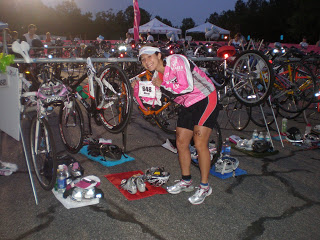
Transitions are unique to triathlons as you will need to move from one sport to the next as you make your way from start to finish. The transition area is the place where you keep your race day gear/equipment/nutrition and perform skills like putting on your bike helmet and running shoes. The transition area can be stressful and chaotic but it’s not an area for rest or socialization. It’s important to remember that your race time includes everything that happens from the start of the swim until you reach finish line.


Most triathletes will experience their highest race day heart rate in the first transition area. After exiting the swim, the rush of running to your bike can make even the most experienced triathlete feel a bit winded. Exhaustion, rapid breathing, and nerves can have your fumbling your way through the transition area. As with any component of triathlon, you need a plan.

Transitions offer a unique opportunity to save time with little physical cost. However, as an unfamiliar component of triathlon racing thats only performed a few times per year, the transition area often brings great physical and emotional stress. Even with a "brick" (back to back) workout, it's difficult to match the pressure, nerves, chaoes and elevated heart rate that you will experience on race day.

TIPS FOR A SPEEDY TRANSITION 


  1. Create an auto­pilot plan. You need a simple plan from swim to bike (Transition 1: T1) and bike to run (Transition 2: T2). Leaving decisions to chance costs time and increases the risk for mistakes The less stuff you have,the less overwhelmed you will be. The transition area can be crowded, so keep your space tight and orderly.
  2. Understand the transition layout.­ Study the layout of the transition area when you arrive to the race venue. Look for permanent landmarks (e.g. a light post) to help you quickly locate your designated bike rack. A brightly colored transition towel/mat can also make it easy to spot your gear amidst the chaos.
  3. Understand the rules. Every race is different. Some triathlons require you to put your swim and bike gear into a bag provided to you at athlete check-in. Many races don’t allow personal items and bike pumps to be left in the transition area throughout the race. Rules are typically explained in the athlete guide or at the pre-race athlete briefing.
  4. Visualize. Before you finish the swim and the bike, mentally rehearse the upcoming transition process. By thinking ahead, you can lessen the panic and anxiety that often occurs when it is time to finally commit to the transitioning process.
  5. Laugh it off. No transition will ever be flawless. Wild things happen when you are racing. Stay calm no matter what goes wrong. If anything, give yourself a laugh when you put your helmet on backwards or you stumble over your wobbly feet.


    How to practice transitions in training 
  1. Purchase a floor bike stand for quick transitioning from swim to bike and bike to run. This stand is also ideal for storing your bike in your house/garage as well as when you travel by car to your races. 
  2. Set-up your area for the transition that you want to practice (ex. swim to bike or bike to run). It can be your assigned brick workout or an additional workout just for practice.
  3. For swim to bike, practice running to your bike (barefoot and somewhat wet) and then transition into your bike gear. I do not recommend attaching your shoes to your bike unless you are very experienced with this skill. The key is to make sure you can smoothly mount your bike despite distractions (athletes around you, people cheering, obstacles in your way, etc.). On race day, I suggest to roll your bike a few feet away from the mount line and to the far right/left for a smooth transition on your bike.
  4. For bike to run, practice dismounting before a designated spot (this is called the dismount line. There is also a mount line. Both represent the point where you are allowed to get on and off your bike outside of the transition area). Practice running with your bike to your transition area (with your cycling shoes on). It takes skill to run with your bike - walking your bike in and out of the transition is just fine. Be careful walking/running with cycling shoes on!
  5. Practice, in a specific order, how you will remove your bike gear and then put on your run gear. Because triathletes typically have more to put on in T2 compared to T1, it's important to have a game plan for the order you will put on your gear. It's not necessary to sprint out of the transition area - I suggest to start with a power walk before transitioning to a run as you reach the T2 exit.
  6. You do not need a specific transition workout to practice your transitions. I suggest to spend 10 minutes, once or twice a week, practicing transitions in the weeks leading up to your race. Have your friend/spouse/kids time you and aim for a faster time each time. Most importantly, make sure you have a detailed plan so that your transition is an orderly and smooth process.
  7. As a reminder, it's best to practice your transitions with an elevated heart rate. The entire transition experience will change when your heart rate is high, there are other athletes around you and people are watching you!

    To learn more: Athlete to Triathlete 

TriWeek: Triathlon Running

Trimarni


While you’ve likely run at some point in your life, triathlon running is very different than running as a standalone exercise. During a triathlon, by the time your feet hit the pavement, nearly 70% of your race duration is already complete. As a triathlete, the swim and bike will exhaust your body, making your legs feel like heavy bricks by the time you start running. As a triathlete, its not uncommon for your normal running mechanics to change due to fatigue. Oh, and theres also the physical and mental struggle of having to run with depleted energy stores and slight dehydration.

To properly prepare for a triathlon, you cant train like a distance runner or track sprinter. Even if you are already an experienced runner, transitioning to triathlon may not be an easy adjustment mentally or physically. But with the right training, you can feel excited and confident for the triathlon run.


Becoming a better triathlon runner is much more than training for speed or distance or accumulating weekly running miles. Proper run training means thinking like a triathletenot like a runner.

One of the most important physiological components of successful triathlon racing is resiliency. The stronger and more efficient you are, the easier it is to run well under fatigue. Training to improve your 5K or half marathon times in a road race will not guarantee that you will become a faster runner off the bike. Training for a marathon or targeting a 2+ hour run to become "ready" to run a marathon off the bike in an Ironman will not translate to a better race day performance.

Historically, most of the top triathletes lack a background in competitive running. Some elite triathletes can run faster off the bike relative to their own stand-alone run times! Not surprisingly, triathletes who are strong on the bike and efficient in the swim tend to fair better running off the bike than their competitors. In other words, becoming a better triathlon runner is not just about becoming a better runner.

Run Training: 5 Tips
  1. Don’t be afraid to run easy. You should be able to hold a conversation without getting out of breath.
  2. Improve your swimming and biking. Without a doubt, what precedes the run immensely impacts run performance. To become a better runner off the bike, the answer is not harder running or longer running, but being consistent with your running (and staying injury-free) as you train to become a stronger cyclist and open water swimmer.
  3. Before a stand-alone run, dedicate at least 5-10 minutes to mobility, glute strength and active stretching.
  4. Incorporate walk (or reset) breaks into your running to reduce fatigue and to help support the central nervous system.
  5. Learn how to take in nutrition (e.g. sport drinks) while you are running. Become comfortable wearing a hydration belt/pack everytime you run so that you can drink on a schedule.
When you are in the early part of a workout or race, its easy to hold good running form. But when fatigue sets in, your running technique will quickly fall apart. Your posture slumps, cadence slows, and stride length increases. You also lose communication with your glutes and hamstrings, which comprise your posterior chainthe muscles that help your leg propel you forward after your foot hits the ground. Not only that, but the oxygen cost of running increases, making it more exhausting to run. Its no surprise why so many triathletes shuffle (or walk) en route to the finish line.

To prevent these breakdowns from happening, always focus on your running mechanics. Form over force. Identifying and correcting your individual mechanic flaws will help you move with optimal mechanical efficiency, while also mitigating some of the injury risks that occur under fatigue.

Different terrains affect your running form, pace and tactics. Although most triathlon runs take place on asphalt or concrete, its beneficial to train on a variety of surfaces.

Triathlon is a strength-endurance sport. Even at the sprint distance, you need to be strong. A decrease in running economy is often linked to dehydration, glycogen depletion, a decline in neurological muscle activity, and muscle damage. But thankfully, training can improve running economy.

The more power you can generate with each stride, the faster you can run. The stronger your glutes, core, and lower legs, the longer you can generate that power with good form.. Because of the corrosive nature of running, there’s great risk for injury when you chase running miles or paces. Bricks, progressive efforts, easy efforts, double run days, hills, endurance efforts, soft impact runs, and treadmill running can help you become a better triathlon runner.


Dont be afraid of running on hilly terrain. Triathlon running requires you to be strong and resilient. Compared to flat surfaces, hills make for an effective training tool because they promote more economical running form when your heart rate is elevated. In other words, unlike speed work on flat terrain or on the track, you don't have to rely on propulsion to raise your heart rate. This may help reduce the risk for injury.

The treadmill may look like a boring way to run but it’s actually a valuable training tool—one that allows you to build your mental strength while controlling the specificity of your workout. And because the treadmill belt is smooth and cushioned, it can be more forgiving on your joints, especially for an easy run. Research shows that when you set the treadmill on 1% incline, it closely simulates the energy cost of outdoor running. By increasing the incline even more, you can simulate different types of hills. Some treadmills are even equipped with a decline mode to mimic running downhill hill. 


Dehydration and glycogen depletion severely impair your running ability, especially in hot environments. Learning how to take in calories, electrolytes, and fluids in training keeps your body functioning well - this is also a critical component of successful triathlon racing. To keep your hands free to comfortably swing by your sides and to reduce neck and shoulder tesntion, a good, ergonomically designed hydration belt (or pack) will let you carry your nutrition with you. It’s sort of like having an insurance policy against dehydration, bonking and heat related stress, by allowing you to drink on your own schedule.

To learn more: Athlete to Triathlete

TriWeek: Triathlon Cycling

Trimarni


Sandwiched between the swim and run, the bike portion of the triathlon is the longest discipline in both time and distance. With nearly 50% of your race time spent on two wheels, insufficient skills and not enough time in the saddle will cost you valuable time and energy on race day.  Proper bike training will not only help you get faster on the bike but youll minimize the effect of cycling on your running legs.

When it comes to triathlon gear and equipment, cycling is by far the most expensive discipline. Plus, training outdoors has its hazards, especially when you are sharing the road with cars, pedestrians, and nature. For these reasons, many triathletes dont train properly, or spend a considerable amount of time cycling indoors. At the end of the day, preparation for the bike portion of a triathlon is about having the right equipment, doing the right training, and constantly working to improve your bike handling skills.


The cycling culture may look intimidating, but as long as you are riding a bike and having fun, you are part of the club. The way to building bike fitness is fairly straightforward: Go ride your bike. But to truly showcase your cycling fitness, proper bike handling skills and training are critical for safety, confidence, and efficiency. Knowing how to corner, brake, descend, stand, climb, and change your gears will take your bike fitness to an entirely new level. For most triathletes, due too much indoor riding (or a dislike of riding a bike), these fundamental skills are lacking.


Bike handlingAlthough it seems basic, you must learn how to signal a turn, making a u-turn, point to something in the road, and take in nutrition (from a bottle or your pocket) as you ride. All of these tasks require you to ride your bike with only one hand. The only way to become efficient at this skill is to practice. In an empty parking lot, practice lifting one hand at a time off the handlebars to learn how to balance yourself on your bike. Then practice grabbing your water bottle from the cage and looking behind you as if you were able to make a turn.

Cycling Skills: 5 Pro Tips
1. For smoother shifting, braking and turning, anticipation is key. For example, change your gears right before you really need to, especially when approaching a hill. 

2. Don’t wait until you are on the side of the road to perfect your flat-changing skills.

3. Learn the rules of riding on the road. Know how to signal appropriately when making a turn or pointing out a hazard on the road. Try to anticipate the decisions of the drivers (cars) around you.

4. Check your bike (cables, brakes, tires, spokes, chain, etc.) before every ride. Don’t forget to pump your tires. The recommended tire pressure can be found on the sidewall of your tire. Give your bike a quick clean after every ride. 

5. In wet weather, stay off the painted line, watch out for oil, and break earlier than usual, especially when taking a turn. Look out far enough ahead so you can see and react to any obstacles on the road or on the shoulder.
As a newbie triathlete, the improvements you make in fitness will impact your performance more than an expensive set of race wheels, aero helmet, or high-end bike components. That being said, having the essentials will certainly make triathlon bike training much easier.


Purchasing a bike
You may have noticed that a triathlon bike looks very different than a traditional road or hybrid bicycle. The major difference is the geometry of the frame and handlebar set-up. A road bike is typically light, stiff, and responsive. Equipped with drop bars, this allows you to make use of multiple hand positions, which makes for more comfortable climbing and descending. Easy to handle, a road bike also makes it fun to enjoy a casual ride and to constantly work on your bike-handling skills.

A triathlon bike puts you in a more compact, forward, aerodynamic position, lessening drag and letting you apply more direct transfer of power to the crank. This position also lessens the load on your quadriceps to ensure more efficient running off the bike. Built for speed in a straight line, a triathlon bike handles very differently than a road bike. It’s not uncommon for beginner triathletes to feel unstable on a tri-bike compared to a road bike.


Purchasing a bike is a big investment, but your first bike likely won’t be your one-and-only forever bike. Buying from your local bike/triathlon store will help you find the right bike size for your body and budget. Plus, a new bike comes with a warranty and may even come with a service-package from your local bike store (LBS).

For beginners, there's nothing wrong with starting on a hybrid bike (that's how I got started!). However, it's recommended to invest in a road bike. Although clip-on aerobars allow you to rest your elbows on pads to lower your body in a more aerodynamic, tucked, position, the road bike is not set in a position for you to be aerodynamic on the aerobars and ride efficienty in the drops and base bars.

Although an aluminum bike frame is durable, carbon is light, which makes for a smoother ride when on the road. Also, electrical shifting, while quite a pricey upgrade, allows you to change your gears with just a push of a button (electronically) instead of using conventional shift levers and mechanical cables. Not only is electronic shifting quick and precise but you can also shift better under a heavy load – like pedaling uphill or when standing out of the saddle.

For an extra upgrade, you may want to consider disc brakes (over rim breaks), which have more responsive and stronger braking power and control, especially in wet conditions. Regardless of the bike you choose, you need to understand the inner workings of your bike and take care of it. A clean bike is a happy machine.

To learn more: Athlete to Triathlete

TriWeek: Triathlon swimming

Trimarni


Triathlon swimming is much more different than swimming in a pool. The training, swim stroke and demands of triathlon swimmers is very different than that of the competitive pool swimmer. Inefficient stroke habits in the pool will come at a cost in the open water. Recognizing the challenges of the open water triathlon swim (rough water, crowds, no lane lines), triathlon swim training should emphasize technique, strength, stamina and power.

If you lack a swimming background, you may notice that your current fitness level doesnt translate easily to swimming. Unlike the experienced swimmer, who has a fishlike ability to slice through the water, if you are inexperienced and try to swim fast, youll quickly feel exhausted and out of breath. And since improvements are slow to make and getting yourself to the pool can be a logistical challenge, triathlon swim training is usually the first to go for the time-crunched triathlete.

The most basic swimming skill to master is learning how to hold your body in the water. This is called body position. On land, you have great body awareness when it comes to movement. But once you submerge yourself into the water, most of your body weight is dispersed. It can take a while to get used to feeling weightless in the water.

Proper body position will help you move forward in the water with minimal energy wasted. By learning how to keep your head, hips, and feet in a straight line, youll create less drag, making swimming less exhausting. Because your lungs give the upper body natural buoyancy, you need to learn how to hold up your hips and legs. Sinking legs means more mass to move through the water, which in turn means drag to be overcome by excessive kickingwhich wastes a lot of energy.

Recommended "toys" to help with body position, alignment and tautness: Snorkel, buoy (or buoyancy shorts) and ankle strap/lock.
Most of your propulsive force comes from the upper body. A powerful catch and pull (not excessive kicking), moves you forward. By catching, or holding, the water with the fingers, hand, forearm, and upper arms, you are literally grabbing the water and pulling yourself forward. A high (but efficient) stroke rate is key for open water swimming.


Whereas proper body position and alignment will help reduce drag, the hips and legs play an important role in propulsion. When timed appropriately with your stroke, hip movement can contribute to overall power. Although forceful kicking offers little return on investment regarding propulsion, trying to power through the water with only your arms is not the most economical way to swim. When you kick, keep your feet relaxed and pointing away from you (not toward the bottom of the pool). Avoid scissor kicking (crossing your legs), as this can throw your body out of alignment. Kick timing is key. A two-, four-, or six-beat kick pattern will help drive your momentum forward. As for moving through the water, your body shoulder, torso and hips - should roll throughout each stroke.

Before you try to swim faster or longer, do yourself a big favor and spend a significant amount of time improving your body posture and stroke mechanics in the pool. I suggest aiming for 3-5 swim sessions per week of around 30-60 minutes. Frequent swimming will help you keep a good feel for the water while allowing you plenty of opportunities to improve your technique and build endurance. There's no point swimming longer and harder with poor stroke habits.  

Feeling out of breath while swimming? The struggle is real.

Although swimming freestyle has many moving parts, breathing should be rhythmic and timed with your stroke. As one arm is extended in front of you, you’ll breathe to the other side by slightly turning your head (not your entire body) so that your chin is near your shoulder.

Trying to both exhale and inhale when your face is out of the water is counterproductive. Before you turn your head to take a breath, exhale, forcefully, through your mouth and nose when your head is in the water, as if you were blowing out a dozen birthday candles. When you turn your head to breathe, you’ll find it easier to take in air without gasping.

You’ll likely have a preferred side for breathing but learning how breathe to both sides (bilaterally) can help in choppy open water, or if the sun is getting in your eyes. More so, many stroke flaws—like crossing your arms over the midline of the body, scissor kicking, and a sinking outstretched arm—develop when you only breathe to one side.

Open water swimming

As a triathlete, it’s important to think like an open water swimmer. But before you jump into the big blue sea, master your technique in the safe and controlled environment of a swimming pool. Open water swimming requires a special set of mental and physical skillsskills that can only be achieved by swimming in an open body of water. In the open water, practice sighting, staying on course, and managing the unpredictable nature of the open water as you swim at different intensities, surrounded by other people.

Open Water Swimming Tips:


1. Review the course. Take notice of the water movement. Make note of the sighting buoys, particularly the turn buoys. Look for landmarks like a brightly colored building, cellphone tower, flagpole, or large tree to help you navigate the open water and stay on course.

2. The shock of cold water can cause your lungs to contract, causing hyperventilation. Before you take your first stroke, go waist deep, submerge your face in the water, and blow bubbles.

3. Use a copious amount of Vaseline or anti-chafing cream around your ankles, arms, neck-line, and back to minimize chaffing.

4. Don’t ruin your swim by skipping the warm-up. Spend 10-15 minutes on the dry land and then in the water to promote blood flow and elevate the heart rate. During this time, you can also adjust your swimsuit/wetsuit, cap, and goggles.

5. Aerophagia, or the act of ingesting air while swimming, can cause gas, stomach cramping, or belching. Avoid starting out too hard, breathe every other stroke, and forcefully exhale through your nose and mouth when your face is in the water.

To learn more: Athlete to Triathlete

I also suggest: Tower 26: Master open water swimming

It's National Triathlon Week!!

Trimarni

It's National Triathlon Week!

National Triathlon Week is a nationwide USA Triathlon initiative to celebrate the sport of triathlon and all of the members of the multisport community. From June 22-28th, 2020, National Triathlon week is focused on education, celebration and participation in the multisport lifestyle, with each day having a theme. National Triathlon Week, or #TriWeek, is a celebration of triathletes and all members of the multisport community — including officials, coaches, race directors, families and friends of triathletes and so many more.


Why Tri?
Training for a triathlon adds purpose to your exercise regime. As a way to improve health, boost self-confidence, overcome a fear, stretch physical limits or be a role model, there’s no escaping the obvious of being drawn to the challenge of participating in a three-sport event.

Despite your nervous energy, excitement and curiosity, it’s normal to feel a bit overwhelmed by a new multisport endeavor. For example, you may be intimidated by all the gear used in a triathlon. Although triathlon is an equipment-heavy sport compared to running, you don’t have to break the bank just to cross the finish line. Another challenge to this multisport lifestyle is balancing training for three sports with work, family and life. By having clear expectations of the available time that you can realistically dedicate to training each day, you can build your training around your life and still achieve positive fitness adaptations. Even if you come from a great fitness/sport background, it’s important to find the best training prescription for you, within the framework of your life. By best advice is to start conservative and remain flexible. Above all, optimize your available training hours by focusing on quality over quantity. This strategy will ensure a fun, enriching and sustainable triathlon journey.

Over the next week, I'll be sharing information from my most recent book Athlete to Triathlete to help you make the most of your triathlon training journey. If you are new to the sport, returning to the sport, or consider yourself tri-curious, I am excited for you to learn more about this incredible sport, which also serves as a fantastic lifestyle.

How did I get into the sport? 
I came from a swimming background. I swam competitively throughout High School and College. During the summer of my Junior year of college, I learned about a triathlon event on a bulletin board at the local YMCA (where I was teaching spin classes). I had recently found myself enjoying cross country running (as a break from swimming in the fall) and I really enjoyed teaching spin classes. My dad bought me a Trek hybrid bike for my birthday (a few weeks before the race) and I "trained" on the bike by riding around my neighborhood. My dad came with me to the race I was so nervous, excited and scared. I had no idea what to expect. As a 20-year old, I found myself as the only person in the 18-24 age group. The triathlon was fun and challenging but I just loved the atmosphere and the people in the triathlon community. Although I was super sore and exhausted, I was instantly hooked.

After finishing my first sprint triathlon, I signed up for another sprint triathlon a month later (with a pool swim). My biking was my weakest sport and I really struggled - it was frustrating and uncomfortable. I found it incredibly difficult to run off the bike and not get tired. Although I found this second triathlon as a big struggle, I craved more. After graduating from college, I moved from Lexington, KY to Dave, Florida for graduate school. Missing the comraderie of competitive sports and craving a goal (with a finish line), I was searching for a new athletic adventure.

Within a few months, I found myself training for my first marathon (thanks to the advice of a friend at 24-hour fitness, where I was working out to stay in shape). I was a little afraid of this distance and with limited time to train due to grad school, most of my running was on the treadmill. Lucky for me, I had great time-management skills due to many years as a student-athlete. I had intented to register for the Disney marathon in 2005 but the race closed its registration before I had a chance to sign up. New to the running world, I didn't know all of the ins and outs of marathon training and racing. I signed up for the Miami Marathon and completed my first marathon in Jan 2005. Little to my knowledge, I qualified for the Boston marathon after finishing my first marathon (in a time of 3:38). I was so sore, exhausted and tired and couldn't believe what I just did with my body.


Once I realized that endurance sports were calling my name, I bought a triathlon bike (with the money I didn't have from being a poor graduate student) and after finishing the Boston Marathon in April 2006, I signed up for my first half Ironman (Disney) and full distance Ironman (IMFL) in May and November of 2006, respectively.


Although I've been in the sport for 14 years, I am still learning and I still enjoy triathlon training and racing. I've had my share of turbulant lows and setbacks but triathlon provides me much more than finish line experiences. I am not ready to give up. Most of all, I love the opportunities that triathlon has given me - the places I have traveled to, the people I have met and the love I have developed for using and moving my body.

 2019 Ironman World Championship - my 16th Ironman and 5th Ironman World Championship
(Photo: Justin Laau)

TriWeek Virtual Challenge

Check out the #TriWeek Virtual Challenge presented by TOWER 26. It's perfect for all levels of athletes, from beginner to experienced. Sign up today.

What you need to know about hot weather sport nutrition

Trimarni


You may be able to get away with haphazard fueling and hydration strategies in the cold winter months but if you are experiencing warmer temps, now is not the time to "wing it" when it comes to utilizing sport nutrition during your long workouts.

If you've ever struggled with understanding your carbohydrate, sodium and fluid needs during a long workout, you've likely experiences several pronounced, uncomfortable and performance-limiting symptoms related to underfueling, overfueling, dehydration and overhydration such as headache, no urge to urinate, sleepiness, lack of appetite, nausea, bloating, fatigue, muscle aches, moodiness and dizziness.

Proper fueling during intense or long duration exercise helps you sustain a desirable effort to maximize training adaptations. You can also practice fueling strategies for competition and train the gut to tolerate nutrition while exercise at various intensities.

Contrary to the opinion of other nutrition experts, I'm a huge proponent of prioritizing sport drinks during training. I've also had great success prioritizing liquid calories during long distance training (for myself and for the hundreds of athletes that have reached out to me for sport nutrition consulting). 

If you are training for a long-distance event (90+ minutes) or training intensely in the heat for 60+ minutes, a sport drink provides a practical and easy way to obtain fluids, electrolytes and carbohydrates, in the right formulation to optimize digestion and absorption. Sport drinks are very safe and effective but are often misused or neglected – especially in the heat.

Sport Drink Formulation
For a sports drink to work effectively, it must have the same or less than osmolality of blood. As a reference, blood plasma has an osmolality of 280-300 milliosmoles per kilogram and a bottle of Gatorade has an osmolality of ~330 mOsm/kg. A sports drinks osmolality (Iso-, hyper- or hypotonic) is dependent on the carbohydrate type (ex. glucose, fructose, maltodextrin) and concentration (grams) in a solution (fluid ounces) – in other words, how quickly it can absorb into your blood stream. If a drink’s osmolality is greater than the blood’s (concentrated or hypertonic), liquid will be pulled from the blood and into the intestine to equalize the two concentrations – this net movement of water is theoretically dehydrating. A iso or hypotonic drink, in contrast, will provide a favorable osmotic gradient so that water diffuses into the cells. If you fail to replace the fluids and electrolytes (sodium) lost in sweat, a cascade of negative events occurs, such as a rise in osmolality, a drop in blood pressure and an increase in heart rate. In contrast, if you drink too much water too quickly and don’t consume drinks with adequate sodium, sodium levels will drop as body water levels rise, causing cells to swell.

What about Juice and Coconut Water?
Because fructose uses a different intestinal transporter compared to glucose and once in the bloodstream, has to be taken up by the liver to be processed into a usable fuel source for the muscles (which can take up to 90 minutes), juices are not recommended as a "sport drink" during exercise.

Although coconut water contains calcium, phosphorus and magnesium (electrolytes found in sweat), sodium and chloride are the major electrolytes because they reside in the extracellular fluid. Compared to a sugar-rich hydration beverage, coconut water is a safe and natural option to occassionally enjoy as an alternative to water. However, to sustain moderate to high-intensity exercise for longer than 90-minutes, the body depends on ingested carbohydrates and sodium – both of which lack in appropriate amounts in coconut water. Additionally, if you are paying extra for coconut water to increase your daily potassium intake, look no further than the produce aisle – a large potato contains 1553 mg of potassium! If you enjoy the taste of coconut water over plain water, choose it for light activity. But to prevent dehydration, replace lost electrolytes and provide the muscles with carbohydrates, a well-formulated sport drink is encouraged. In all other situations, plain water should be your go-to hydration beverage.

Gels, Bars and Chews
Gels, bars and chews are highly concentrated, portable sources of carbohydrates that are easy to consume during exercise but they lack the fluid and electrolytes that you’d find in a sport drink and are not in the right formulation by themselves to be easily digested and absorbed. Same goes for salt pills. Most gels and chews contain around 100 calories (or 25g of carbs) per serving. More concentrated in carbohydrates compared to a sport drink, gels and chews must be consumed with water to encourage gastric emptying. For every 25g of carbohydrates, at least 12-16 ounce of water should be consumed. Athletes may prefer to dilute a gel into a flask or bottle of water to create a more dilute concentration. Considerably low in sodium (50-100mg), gels and chews are ineffective to replenish sodium lost in sweat. Remember, your fluid, sodium and carb intake will be for nothing if it’s just sloshing around in your gut.
 

This doesn’t mean that you can't consume solid food or a gel or chews during long distance training, but to minimize GI issues and to simplify sport nutrition, I strongly advise to prioritize liquid sport drinks when you train (and race) and use chews for a central nervous system pick-me-up and bars/solid food to keep the tummy happy.

Digestion and Absorption 
When applying the topic of sport nutrition, it's important to understand that just because you are consuming carbohydrates, sodium and water, this doesn't mean that your muscles are receiving what you are consuming. If a product is not consumed properly (or formulated properly when mixed), it'll simply hang around in the gut - causing bloating, a sloshy stomach, heart burn, belching, vomiting, gas and/or diarrhea. fluid ingestion. This can further lead to dehydration and glycogen depletion.

Water is absorbed in the small intestines and by the time it enters the large intestines, roughly 80% absorption has occurred. The rate of gastric emptying and intestinal absorption are dependent on the volume and formulation of the beverage. The greater the concentration, the greater the osmolality. This is why you should never concentrate your sport drink – like putting 400-600 calories (2 or 3 hours worth of calories) in one bottle that only has 28 ounces of fluid. When you drink water, there’s a drive for the water to dilute the blood (water moves toward blood) but if you drink a more concentrated beverage than blood, like a hypertonic sport drink or soda or juice, water will move from inside the bloodstream and into the gut – which is dehydrating. The inclusion of electrolytes and glucose in a beverage promotes retention of fluids. When you add a little sugar with sodium (as in a sport drink), you can pull a great amount of water across the small intestines, optimizing water absorption. To help with fluid and electrolyte loss, it's not just about the carbs. You also need to ingest water and electrolytes from a sport drink to keep plasma volume at normal levels. 

Here's a snippet of a presentation I gave to the Trimarni coaching team on the topic of warm weather hydration and fueling.


Don't wait until a setback occurs to appreciate the power of sport nutrition and how a sport drink can enhance performance, protect your immune system and promote quick recovery.

The elephant in the room: triathlon diversity

Trimarni


I want to believe that there is diversity in the sport of triathlon. I wish I could say that triathlon is an easy-entry, welcoming-for-all sport.

Across the nation, public discussions about race and racism have increased in volume and intensity. Looking away and remaining silent will not change the real-life consequences that others experience. The conversation has become too loud to ignore. While uncomfortable to many, the current state of our nation requires us to no longer ignore these tough conversations. There's a sense of responsibility and urgency to bring these topics to the forefront within the triathlon community. Yes, deep discussions about race, gender, gender identity, class, sexual orientation, religion, and culture may be uncomfortable and conversations may bring feelings of anger, guilt, discomfort, sadness, and ignorance. But if we can all engage in constructive dialogue and learning, we can all work together to shift the conversation into something positive.....Diversity in the sport of triathlon.

As it relates to triathlon, it's an exclusive sport. Triathlon is a costly hobby, requiring a lot of time, support and resources. To do the sport, you need much more than a pair of running shoes. It's not an easy sport for the youth to enter and a hobby that easily becomes too time-consuming and expensive as people age. It's an upscale lifestyle - difficult for any individual, regardless of race, to enter and maintain. Triathlon is predominantly (not exclusively) a white man’s hobby, supported by organizations and companies targeting individuals with a high socioeconimic status. Yes, there are many barriers to entry for the sport of triathlon, but there are significant limitations for minorities.  
Yes, triathlon requires motivation, discipline and dedication but it is a time consuming, expensive and egocentric hobby.

To bring about positive change and unity to the sport of triathlon, we must not ignore the fact that social norms and cultural underpinnings influence our experiences. Struggles for place, power and opportunity are woven throughout history, often because of skin color. No matter your background, many people are given advantages due to affiliation. Triathlon may appear exclusive, but this doesn't mean it can't be diverse. 

As it relates to the topic of white privilege, privilege is freedom to do what you want to do and think what you want and say what you want and act as you please. It is not based on what you have done or failed to do. It has nothing to do with whether or not you are a "good" person. Some people are given opportunities, bestowed upon you by the institutions with which you interact - not simply because you are a hard working, kind and intelligent human being. Some are born with privilege. It's the reality that some people were born with access to power and resources. Doors are open to some people that are not open to other people. If you are a minority, it's not easy to access the door to triathlon.

I realize that this conversation is uncomfortable. If you feel like these words are delivering a verbal attack on your ego - "How dare you say that my success is given to me. I am not wealthy, I work incredibly hard, nothing has been given to me!" - read on. We can't live in a society that constantly tells us that "you only get what you deserve and only earn what you work for." Even if you are an incredibly hard worker, there are still inequalities relating to gender, disability, sexual orientation, socioeconimic status, ability, age, size, weight, culture, religion, etc. 

As it relates to the current topic of race, we can't fully dismantle structural racism if people of color only have a small voice or presence in the sport of triathlon. It's time for a new normal. Thankfully, we have tools, resources and voices to deal with diversity in sport. Like training for an event, understanding diversity in triathlon is an intellecutal activity that we must continue to work on. But for equality and inclusion to work, drastic changes must occur. Not just adding people of color to a triathlon add on social media. We must start over and build a better plan, together as a diverse community.

If you are ready to do the work so that triathlon can evolve into an inclusive environment, the first step is understanding your privilege and how it has shaped your perspectives, experiences and interactions. It will take time to to remove the influence of implicit bias so that you can understand situations for what they are and not how you perceive them to be. Learning to see your own privilege is an important pathway to self-discovery. Here are a few self-reflection questions to help get you started (adapted from NASP).
  1. When was the last time you felt uncomfortable about your ethnicity, race, gender identity, ability level, religion, and/or sexual orientation? What provoked you to think about it or acknowledge it?
  2. When watching TV, or a movie, how likely are you to watch shows whose characters reflect your ethnicity, race, gender, ability level, religion, gender identity, and/or sexual orientation?
  3. When using social media, how diverse is your feed? How diverse are your friends and followers? How diverse are those that you follow?
  4. How do you feel, respond and act when others make negative statements towards individuals of a different ethnicity, race, gender, ability level, religion, sexual orientation, and/or gender identity than yourself?
  5. How often do you go to social settings and events where the majority of individuals are of a different ethnicity, race, gender, ability level, religion, sexual orientation, and/or gender identity than yourself?
  6. How diverse is the community in which you live?
  7. How diverse is the community in which you exercise? 
  8. How do you feel when you are in a community that is different than your neighborhood?
  9. What steps can you take to make triathlon more inclusive and diverse?
Now it's time to get to some reading. Here is a short list of the articles that I found helpful in my learning, discussions and deep-thinking as it relates to the need for immediate action and change in the sport of triathlon .


READING LIST

If you found this article helpful, I ask that you share it with your friends, family and triathlon community. If you are deeply committed to social justice work, you have to be willing to listen, learn and engage in sensitive, uncomfortable and difficult conversations. 

Farm tour: Bees and fiber

Trimarni


In addition to giving my love to all of the farm animals, two farm highlights were beekeeping and weaving.

When I learned of all the things that needed to be done around the farm, one of my bucket list farm to-do's was to dress up in a beekeeping outfit and see the bees at work. Mission accomplished.

The only downside to this was that within one-hour of arriving to the farm, I got stung by a wasp on my wrist. Not only was my hand in a lot of pain, but as the day went on (and for the next 72 hours), my hand continued to swell - big time. I could barely use my hand.


While my allergy to stings/bites is incredibly uncomfortable, I wasn't going to pass up on the opportunity to see the magic life of bees.


Julie is extremely passionate about fiber spinning and weaving. She has several looms around the farm property and plenty of furry animals to help her pursue her love of spinning fiber into yarn. Inside the Sheppard's Croft (where we stayed) there was a large floor loom. Within 30-minutes of teaching me how to use it, I was well on my way to creating my own wall hanging from a variety of fibers from the farm animals. I totally got into it and spent the rest of the evening - and the next morning - finishing my piece. It took me about 3 hours total to make my wall hanging.

Julie gave me full creativity to make it my own - making sure I had lots of shades of my favorite color pink. We even took grapevines from the farm to add to the wall hanging. I loved the process of using the loom and seeing how the final product turned out.


And here are a few more videos from our time at the farm.


Thank you Julie (and Karel) for a wonderful birthday to add to my book of life! 


Say hello to my furry farm friends

Trimarni


I'm a 28-year vegetarian and based on the pictures I share on social media, it shouldn't come as a surprise that I love animals. I can't help myself when I see a dog, cat or farm animal - I just have to say hello. Truth be told, I've been known to have great conversations with my furry friends (#noshame). I even rescue spiders and ants from our house so that no creature is ever harmed.

While there was a lot to do around the Jehovah Raah Farm during my birthday trip, I couldn't wait for the moment when I could be with the animals.

Located in Candler, North Carolina, Julie (the owner) uses the fiber from the animals to spin into yarn. On the farm you will find Alpacas, (Suri and Hucaya), Angora Goats, Angora Rabbits, Shetland Sheep, Scottish Highland Cattle, Llamas, Honey Bees, Road Island Red Chickens and Black Spanish Turkeys - all freely grazing around their little piece of heaven. Julie even taught me how to spin fiber into a wall hanging on a large floor loom.

As you can imagine, my phone is filled with pictures of animals from the farm but here are a few of my favorites. Enjoy!


Celebrating my birthday at Jehovah Raah Farm

Trimarni

For my 38th birthday, I went off the grid and to a farm.

A week or so birthday my birthday, Karel and I saw on social media  that our friend Dane and his wife Celia celebrated their anniversary on a farm. I didn't consider the idea of visiting a farm, but I couldn't stop looking at the pictures of the cute farm animals. Oh do I love farm animals.

A few days before my birthday, Karel mentioned that we should go to the same farm to celebrate my birthday. What a great idea! Yes that's right. This trip wasn't my idea. It was all Karel.

It wasn't more than an hour after Karel mentioned it on an evening walk with campy that I was on the phone with Julie (the owner) to book our trip. The entire process of booking our stay was rather easy - I called her and told her when we wanted to come and that was it. We paid the $125 for our stay when we arrived. Originally we wanted to stay on my actual birthday of the 31st but she had someone visiting that weekend. So we decided to stay Monday until Tues as a belated birthday gift.

Julie was incredibly thoughtful in the days leading up to our visit. She texted me to make sure I was well taken care of during our stay. I mentioned to her that I was a vegetarian and she wanted to make sure I was ok with a hide that was in the Sheppard's croft (the guest house on the property) or else, she would be happy to remove it. She wanted to give me fresh eggs and asked if I ate eggs. She made us fresh cinnamon raisin bread for our arrival. She even asked me about my favorite colors (all shades of pink) so that she could gather yarn and fiber for a weaving project.

Over the years, I’ve learned that experiences are better than things. Experiences become part of who we are. We then become a sum of our experiences. Self-identity should not be tied to possessions but an accumulation of the people you’ve met, the places you’ve been, the lessons you’ve learned and the experiences you’ve had.

Experiences provide genuine connections which make them worth so much more than any object. Sharing our experiences allow us to bond with others in a deep and meaningful way.

I wasn't sure what to expect from our farm trip but we were certainly off the grid with no internet. I welcomed this temporary change and embraced the full experience of farm life.

Since I took a bunch of pictures, I thought I'd break down our farm trip into different segments. The first is a look inside our stay at the Sheppard's Croft at Jehovah Raah Farm.


Made of wood! 

A "bed" of roses (literally)
The Sheppard's Croft (where we stayed)

The bedroom and floor loom (Julie taight me how to use it and made a beautiful wall hanging!)

The kitchen - a step back in time. 

Another view of the kitchen. 

A beautiful wood table outside in the back. 

Art or function?

Love the repurpose of materials! 

How cool! 

More antique stuff in the kitchen. 

The coffee grinder wasn't used. Karel brought his travel espresso machine 😉

The front room. 

Shower and bathtub. 

Art in the bathroom. 

More art. 

Fiber from the animals. 

Soap dispenser. 

Wood table and llama flower piece. 

Outside the house. 

The Sheppard's Croft

Homemade cinnamon raisin bread. We polished this off in 24 hours. Oh so yum!

The backyard view of the house at sunset. 

In pursuit of the American Dream

Trimarni


The American Dream

The hope for a better life.
Human rights.
Democracy.
Attaining success from sacrifice, risk-taking and hard work.
Freedom of speech.
Independence.
The land of opportunity.
Economic prosperity.
Safety.

In 2000, Karel left his home country of Czech Republic and traveled to the United states with nothing but a backpack. He told no one that he was leaving his country in an effort to pursue the American dream. It takes great courage to leave your country, family and friends and go to a new country where the language is foreign and you have to start a new life with nothing.

For the dream to function properly, the basic rights of individuals must be respected. This was far from the truth in Karel's story as an immigrant trying to make a living in the United States of America. When Karel arrived to America, he quickly realized that his dream was harder than once imagined. But like most immigrants, he persevered with a strong work ethic. He kept fighting for his dreams to come true. And finally they did. I often ask Karel if he wants to leave America in pursuit of a better place to live. His response as always been "The United States is the land of opportunity. You can come with nothing and become something." From Karel's upbringing in a communist country to living a life he never dreamed of, to becoming a US Citizen eighteen years later - he has taught me so much about history and what it means to be an American living in the United States.

Despite our turbulent US history, American's are still struggling to see each other as fellow citizens of the same nation. So many people - including native-born Americans - are struggling to obtain safety, freedom, equality and opportunity. As stated in the Declaration of Independence, everyone has certain "unalienable rights, that among these are life, liberty and the pursuit of happiness."

The pursuit of happiness means every person in the nation has the right to build his/her own life, to seek to live his/her own dream. Although everyone's dreams and desires may differ, the freedom to pursue them is the same. This is the core of the American dream.

It's a privilege to be an American. Opportunities are here that don't exist in other places in the world.

The American dream should not have to do with race, religion, gender or ethnic background. Regardless of your gender identity, class, race, religion, ethnicity, social class or socioeconomic status, everyone has an opportunity - as a human being - to do work to become successful. Sadly, this is not the truth.

Our nation is struggling. It's divided. Politics, police brutality, a global pandemic and an international human rights movement - alongside other ongoing issues like global warming, sexual assualt, animal rights, LGBTQ discrimination, wage inequality, homelessness, human trafficking, disability discrimination, deforestation, weight bias, air pollution - has turned the American dream into a nightmare.

Throughout all of my life, I've learned that every human being has a story. I love listening and learning from people that I cannot relate to. I connect with people who are different. An opportunity to meet someone who is not like me makes me feel more human. Diversity not only makes our world incredibly special but it helps us build trust, respect and empathy for others. I have a deep appreciation for diversity in my life.

Every human being goes through difficult moments and lives through experiences. We must appreciate these differences in upbringings and perspectives. More so, we must be willing to learn from others. By doing so, we can add a deeper layer of understanding ourselves and others. These different perspectives and background are necessary in our lives as without them, biases, standards and stereotyping will prevent us from becoming a more unified society.

Stories need to be told. And we must listen. Open your ears and eyes with an open mind, without judgement, free of prejudice and with your heart. While it may be impossible to fully understand what someone else is going through (or has gone through), it's important to take the time to try and understand.

Do the work to get to know other people. Be a good ally, be empathic, accepting and welcoming. Listen and learn.

Consider the privileges you’ve been given as many people are living a life story with deep pains, wounds and scars.

Stress and disordered eating

Trimarni


We are all experiencing challenges during which words just can't describe what we are feeling.

Politics, police brutality, a pandemic and an international human rights movement - alongside other ongoing issues like global warming, animal rights, LGBTQ discrimination, wage inequality, homelessness, human trafficking, disability discrimination, deforestation, weight bias, air pollution - may make it impossible to make sense of our emotions.

No matter how hard you try, you can't avoid stress. And sometimes it gets the best of us. Stress can become a problem when you are unable to cope. Without a productive and healthy outlet, stress levels can escalate.

Poor body image and an unhealthy relationship with food can cause stress but it also works the other way around. The relationship between stress and disordered eating is a vicious cycle.

When you feel overwhelmed or out of control, it's natural to find ways to cope with those unpleasant and uncomfortable feelings. Feeling stressed and overwhelmed can trigger disordered eating behaviors, which are used as a coping mechanism. In turn, compulsion, obsession, fear, stress and negative thinking raise stress levels. You can trick yourself into thinking you are alleviating stressful emotions, feelings and thoughts but in reality, those issues are exacerbated. Disordered eating can cause stress levels to spike. When you are so fixated on food, weight and your body, it can overtake everything in your life.

Because people who struggle with disordered eating habits are highly susceptible to stress (and the other way around), stress can contribute to the development of an eating disorder.

In case you missed it, I recently had the opportunity to have a healthy conversation with Registered Dietitian and elite runner Kelsey Beckman on body image, dieting and disordered eating. I hope you find it helpful. I provided a few options for your listening/viewing pleasure.

If you are struggling, please reach out for help. You don't have to suffer alone.

38 years old: Another journey around the sun

Trimarni


And just like that. I am 38 years old. A birthday is much more than an occasion to receive gifts. It's a chance to celebrate and to give thanks. It's a special occasion to rethink life, to reflect on the past, evaluate the present and make plans for the future. A birthday is a transition from what was to what can be. It's a spiritual refresher.

37 was a difficult year for me. I wrote about (most of) it in my 2019 Year in Review blog.  

"Life can be difficult, unfair and tough to understand. If I had to use a word to describe our 2019, it would be strength. We had to find strength to experience the highs and we had to find strength to get through the lows. Triathlon provides us with many life lessons but in 2019, life hit us hard. Throughout the year, there were several occassions when our hobby of triathlon was put to the aside in order to deal better with the hard times. As athletes, it can be difficult to stay positive, hopeful and focused during stressful, sad or difficult situations. Uncomfortable feelings can leave us with doubt, anger and anxiety. Struggle to balance stressors appropriately and health (mental or physical), joy for sport and motivation can quickly diminish. There were times throughout the year where it was difficult to start a workout. There were even times when we debated about not starting a few of our races. With each workout or race, our strength was tested. And life presented us with a lot of moments to see how strong we really are."

And here I am. 38 years old and experiencing a new normal of life that is sometimes filled with uncertainty, stress and worry. But yet I've lived another year and I have another opportunity to live life to its fullest. As I do every year on my birthday, I will take stock of my life, the people in my life and most importantly, express gratitude and thanks for the opportunities and experiences I've been given, the memories I've been able to make and my health and well-being. A birthday is not just a day but thousands and thousands of days put together. 

As I celebrate the coming of age in another year of life, I'll share my answers to 38 "this or that" questions about my favorite things. 

  1. Almond butter or peanut butter? Peanut butter 
  2. Pop music or rock music? Pop music
  3. Stuffed animals or dolls? Stuffed animals
  4. Morning or evening? Morning
  5. Breakfast or dinner? Breakfast
  6. Summer or winter? Summer
  7. Road trip or plane ride? Road trip 
  8. Snow or water? Water
  9. True love or $10 million? True love
  10. Book or movie? Movie 
  11. Chocolate or vanilla? Vanilla 
  12. Free coffee or free Wifi? Free wifi
  13. Comedy or drama? Comedy
  14. Reading or writing? Writing
  15. Singing or dancing? Dancing 
  16. Flowers or trees? Trees 
  17. Phone or computer? Computer 
  18. Gold or silver? Silver 
  19. Adventure or relax? Adventure
  20. Blueberries or strawberries? Blueberries 
  21. Wing it or plan it? Plan it
  22. Watch or play sports? Play sports
  23. Pasta or pizza? Pizza
  24. Ocean waves or rain sounds? Ocean waves
  25. Babies or old people? Old people
  26. Time machine or magic wand? Time machine
  27. Shorts or pants? Shorts
  28. Amusement park or nature park? Nature park 
  29. Crushed ice or cubed ice? Crushed ice 
  30. Serious or funny? Funny
  31. Outside or inside? Outside 
  32. Pancakes or pastries? Pancakes 
  33. Pretzel or chips? Pretzels
  34. Luxury hotel or Airbnb? Airbnb
  35. City life or beach life? Beach life
  36. Loud or quiet? Loud
  37. Proactive or procrastinator? Proactive
  38. Life is good or life could be better? Life is good 
Bonus questions:
  • Dogs or cats? Dogs
  • Netflix or amazon prime? Netflix
  • Sensitive or tough? Sensitive 
  • Open minded or close minded? Open minded
  • Indecisive or decisive? Decisive
  • Idealistic or realistic? Realistic 
  • Hair up or hair down? Hair up
  • Dinner out or dinner in? Dinner in
  • Gifts or experiences? Experiences
  • Speak to animals or speak every language? Speak to animals 
  • Farm or zoo? Farm
  • Jeans or dresses? Dresses 
  • Neutrals or colorful? Colorful 
  • Sunbathe or get in the water? Get in the water
  • Socks or barefoot? Barefoot 
  • Speak my mind or choose my words? Choose my words 
  • Twitter or Facebook? Facebook
  • Neat freak or organized? Organized

Dear Dad

Trimarni

Dear dad,

It's been six years since I last saw you, spoke to you, touched your hand and hugged you. Six years ago I had to say good-bye to you. The time we had together wasn't nearly enough. I only got to spend 32 years of my life with you as my dad. There are still so many questions that I need answers to and you are no longer just a phone call away.

I miss your words of wisdom. I miss your sense of humor. I miss your knowledge of everything. Not a day goes by when I don't think about what life would be like if you survived your 10-month fight with cancer.

When I find myself in a situation or scenario that leaves me confused, concerned or worried, I imagine what you would say or do if you were still here. I wish you were here to share in the happy moments and to help me through my struggles.


You left this world with so many great memories and you left people with a lot of great memories of you. You liked people and people liked you. You made people laugh. You always smiled. You were active and fit. You told the best stories. You always had time for others and you helped whoever you could with whatever you had. Thank you dad for your love. Thank you for being a kind, hard working human being who encouraged me to be the best person I can be and do the best I can in everything I wish to achieve. 


They say grief gets easier to bear as time goes by but I still miss you tremendously after all these years. I didn't know how big of a hole your passing would leave or how much loneliness I was about to experience. There's a lot of you in me, dad. You were my tower of strength. You gave me the best gift anyone could give another person - you were always there to support me. 


Thank you for the patience, love, guidance and understanding that you showed me in accepting me as I was. Thank you for being the best possible role model I could have hoped for in a dad. Thank you for supporting me in my every ambition and helping me through stressful times. You always taught me to never give up. Although life has been difficult without you, I promise I won't give up. You were the one who helped me to become the strong, hard working and passionate woman I am today.

Thank you for your constant love and support for the first 32 years of my life. I will continue to make you proud as you watch over me from above. 

Love, 
your daughter Marni

----------
Here's the tribute I wrote to my dad on the first year after his passing.
1 year ago.

Healthy coping during stressful times

Trimarni

In today’s fast-paced, stressful and unpredictable world, it’s important to have a toolbox of healthy coping mechanisms. A coping mechanism is something that helps you deal with something that is difficult or uncomfortable. Truth be told, nearly every coping mechanism can provide a benefit. However, some coping mechanisms have negative consequences associated with them.

For example, do you often reach for a beer, glass of wine or hard liquor to help unwind after a long or stressful day of work? What does your alcohol consumption look like in social situations or during difficult times? Alcohol functions to slow down the central nervous system, helping you feel more relaxed. It also reduces inhibition, memory and judgement. For many people, having a drink is the easiest way to deal with something that is uncomfortable or to distance from a stressor or challenge. As a result, alcohol becomes a crutch and barrier to developing more effective and healthy coping strategies.

Another example is using food as a coping mechanism. Individuals vulnerable to an eating disorder often experience circumstances in life where they feel trapped, a loss of control or pressure to succeed. Food is used as a coping mechanism to help gain control and as a way to relieve stress. Whether it's overeating (ex. binging) or restricting (anorexia), controlling food and the body provides a false sense of safety. Sadly, once trapped within the eating disorder, people struggle with how to live without it. They don't know who they are without it or how to cope without it. There's often a "voice" that is problematic and disruptive, causing a great feeling of helplesness. This negative and controlling voice can distort logic, make threats, be overly critical and demanding and can make it incredibly difficult to trust your own decisions and abilities. 

With the unpredictability, stress and external pressures of life, you may be experiencing a wide range of difficult emotions. Some of which are familiar but others may be new to you and thus, extremely uncomfortable. If you've lived a life of pushing away uncomfortable feelings, it may be incredibly unnatural to come face to face with your emotions. Learning how to embrace these inner demons or dark emotions is the first step to coping with stress, anxiety, worry and fear more successfully.

Currently we are all experiencing great stress. Even though we've been given a temporary reset and an opportunity to be creative and to slow-down, nothing is easy about our new normal. If you have recently found yourself overwhelmed with life's stressors, it's time to do some soul-searching to determine if you have been self-medicating with drugs, alcohol, excessive exercise, overspending, avoidance, overeating or some other type of instant gratification or temporary emotional relief. Just because a strategy helps you endure emotional pain, it doesn’t mean it’s healthy.

Whether it's food, spending, exercise, drugs or alcohol, it's very easy to become addicted to something, especially when it's used as a means to cope or to escape complex emotions. To cope in a productive way, it's important to first understand the root of the problem - which situations, traumas or emotions are driving you toward your unhealthy coping mechanism. Learning how to handle stress, anxiety or any other uncomfortable emotion - without the use of drugs, alcohol, food, exercise or spending - is healthy and positive for the mind, body and soul.

I’m incredible grateful to my best friend and amazing Licensed Clinical & Sport Psychologist Dr. Gloria Petruzzelli for sharing her knowledge on this topic and why we need to face our emotions head-on while developing healthy coping skills.


A healthy conversation about body image, fad diets and disordered eating

Trimarni


In our body-image obsessed culture - supported by a multibillion-dollar industry that profits from body dissatisfaction, the idealized body image, dieting and fear of fat - creating a healthy relationship with food and your body can be incredibly difficult. Sadly, even in a global health crisis, weight loss, appearance and body image are still priorities for many people, athletes and businesses.

The diet culture is constantly reminding you that you are not good enough at your current weight and being a bit thinner or more toned will improve your health and happiness. In other words, changing what you look like will make you happier, more successful or will make people like you better.

What starts as an innocent attempt to eat a bit healthier or lose a few lbs can easily spiral out of control. When body image dissatisfaction is present, "healthy" eating can quickly turn into dieting which can turn into disordered eating. For many, it doesn't stop there. Dieting is considered to be a precursor to eating disorders due to its restrictive and controlling nature. When we restrict what we eat, we deny our body and brain what it needs. This restriction doesn't just cause weight loss but it can result in malnutrition, nutrient deficiencies and starvation. At a neurobiological level, this can trigger an eating disorder.

As an athlete, fitness enthusiast or health conscious individual, you have a very close relationship with your body. If you have a disordered relationship with food or unhappy thoughts or feelings about your body, you may not be aware of (or care about) the long-term damage that can occur by manipulating your eating and training in order to change your body image.

Social media is oversaturated with images of athletes with six-pack abs, tight glutes and strong, slender legs. Constant exposure to these images can make you believe that you are not built like an athlete - increasing body consciousness, lowering self-esteem and intensifying body dissatisfaction.
Chasing the idea that weighing less will enhance performance can make it easy to mistakenly slip into unhealthy, extreme and disordered eating behaviors.

Successful athletes come in all shapes and sizes. To be successful, you need to be healthy and strong. You need to be consistent with training and you need to take care of your mental health, just as much as your physical health. Restricting food, eliminating food groups or overexercising does not make you a better athlete. It makes you weaker and more fragile.  It takes work to embrace your unique traits, strengths and qualities but the process of developing a positive body image is worth it.

If you would like to learn more about body image, fad diets and disordered eating, mark your calendars for Friday May 29th at 10am EST. Head over the to Trimarni Coaching and Nutrition Facebook page where I will be having a live conversation with Kelsey Beckmann RD, LDN. Not only are we both dietitians who specialize in working with athletes but we are both competitive athletes. With considerable personal and professional experiences between us both, we will be sharing our perspective on these three very important topics so that you can learn how to nourish, fuel and train your body while maintaining great health and a great relationship with your body.