We welcome your thoughts, experiences, comments, suggestions, questions or personal stories. If you don't hear from us right away, please note that your email is very important to us. We will do our best to respond with 24 hours.
Trimarni is place where athletes and fitness enthusiasts receive motivation, inspiration, education, counseling and coaching in the areas of nutrition, fitness, health, sport nutrition, training and life.
We emphasize a real food diet and our coaching philosophy is simple: Train hard, recover harder. No junk miles but instead, respect for your amazing body. Every time you move your body you do so with a purpose. Our services are designed with your goals in mind so that you can live an active and healthy, balanced lifestyle.
We left our house on Wednesday morning around 4:20am and arrived to the GSP airport just before 5am. It was a smooth check-in with our two suitcases and two Scicon hard cases w/ our bikes inside. Each bike case weighed ~50lbs so we were able to check those items for free on Delta and then just pay $40 each for our suitcases. We felt a bit rusty with the entire airport process as the last time we traveled via plane for a race was October 2019 for the Ironman World Championship.
We flew to Detroit, had a ~2 hour layover and then flew to Albany. Both flights were smooth and went by quickly (we napped on both flights). It was fun to meet up with a few Trimarnis in the Detroit airport before they made their way to Burlington.
Since we flew into Burlington in 2013 for IM Lake Placid, I decided to try out the Albany airport and ~2:15 hr drive. It was an easy process from luggage pick-up to getting our rental car (right across the street from the airport - no shuttle needed) and then a straightforward drive to Lake Placid. I rented a SUV but all they had left was a Jeep Wrangler for us. I was a bit worried but it actually worked out great as we could place our bike cases in the Jeep upright and there was still room for our suitcases.
We made a quick stop at Chipotle for lunch in route to Lake Placid. The last part of the drive into town is always so beautiful. Even though the weather was cloudy and a bit rainy, the scenery is just incredible.
We arrived to our rental home around 3pm and checked out our home away from home. I booked this rental home two years ago and thankfully the owner allowed us to carry over our rental to this year. The 3-story house was huge so we shared it with 8 of our athletes. And it was in the perfect location - just a a block from Mainstreet (and close to the Bluesberry Bakery - Karel's favorite place in Placid) and less than a mile to the new transition area at the high school (the layout of the course/transitions/expo was a bit different this year due to construction at the Oval).
As Karel and the other Trimarni's put together their bikes, our groceries arrived just after 4pm. I ordered our first big batch of groceries from Hannafords by using Instacart. Although there was an extra fee including, this delivery grocery service worked out perfect as we didn't have to spend 60+ minutes shopping for food after a long day of travel. Throughout the rest of the week, others made quick stops to the store as needed.
After unloading groceries and making a large salad, we all headed out for a shake-out spin by heading down the back part of the course (the "three bears) and then making our way to River Road to ride the run course and then back into town. It was a nice 45-minute spin to shake out the fatigue from traveling and sitting all day.
By 8:30pm we were all pretty exhausted and headed off to bed.
I tried to sleep in as long as I could on Thursday morning to ensure a restful night of sleep. I made it until almost 8am so it was a solid 10.5 hours of sleep. I was so excited to get into Mirror Lake as it's been several years since I've swam in that picture-perfect lake.
After eating a pre-workout meal, we walked down to the swim start at the lake for a one-loop swim of the course. Some of the buoys were out and along with the cable under the water, it was easy to stay on course. We all regrouped at the turn buoys so that we could scope out the landmarks along the course.
After the swim there was a well-needed stop at the bakery before heading back to the house to change before the bike ride. We all headed out on the bike course and descended down to Wilmington before making our way back up to town. It was nice to be out on the course and to get the body back to a familiar place of exercising. After our ~90-minute ride, a few of us went for a short 20-min run. It was a triathlon type of day! We finished all of our training for the day before 1:30pm which worked out perfect as we checked in for the race around 2:30pm (at the equestrian center - we drove there).
It was fun to share the entire pre-race experience with our athletes, especially our two first timer Ironman athletes. We had 8 female and 1 male athletes racing Lake Placid which made for a great group filled with a lot of positive energy.
After checking in, the rest of the day was pretty chill. We watched the Olympics, ate and relaxed. There was a lot of laughing which helped keep the nerves away. Karel did a longer ride on Thurs (~4 hours and 77 miles) after he swam with us, and then finished off the day with an evening run (37 min, 5 miles). Karel's hand is still weak and numb after he broke it from his MTB crash 9 weeks ago, but overall it's getting better.
Friday was a pretty chillax day. We went for another swim and I had to resist the urge to swim two loops as I was feeling so good in the water. I was really happy with how I was swimming and most of all, how I felt in the water. I had been dealing with some niggles in my left bicep for a few weeks but thankfully it didn't affect me once I got to Placid.
After the swim, I went for an easy 30-minute run around the lake and checked out the transition area, logistics of going from swim to bike and bike to run, as well as orienting myself with how we started loop two of the bike. Today was all about familiarity and getting to know the ins and outs of the course.
I spent a little time laying out my gear for my gear bags and filling my bottles. I had my sport nutrition powder in baggies (which I filled in advance) so it was easy to just pour each baggy into a bottle or flask without second guessing or overthinking (I also brought extra nutrition just in case). I also labeled my bottles so it would be easy to know what was what and what goes where on race day morning. I waited until Sat late afternoon to fill with water and then put the bottles/flasks in the fridge.
On Friday evening we had our traditional pizza party with pizza from Bazzis. We finished the evening with a course talk and tips discussion for our athletes. I just love sharing these experiences with our athletes as I can take the focus off myself. Plus, I love our athletes because they are really cool humans. And we have a lot of fun together. Add in Karel and his witty sense of humor and I assure you that you will be laughing a lot when you stay in a Trimarni team house. :)
After another good night of sleep, it was finally here. One more day before the race.
I went out on my own for my ride and headed to the transition area. I first rode the start of the bike course as it was all marked on the ground. I then carried on to the run course to get more familiar with the equestrian park loops (inbound and outbound). I then headed down to River Road (run course out and back) and did some intervals out there. I just rode until I felt good and then headed back (~75 minutes). I did a quick 5-min jog off the bike just to test out my shoes, hat and hydration band one last time to ensure that everything was fitting like I wanted it to for race day. Overall I didn't feel great on the bike and felt a bit flat on the run but I didn't let it get to me. I knew my body would show up on race day. I couldn't stop smiling because of the beauty of this course. I kept thinking, we get to race here. I never felt nervous but instead, I was really excited to train all day for 140.6 miles.
After my morning shake out workout, it was time to eat. I repacked my bags and around 1pm, we biked our gear to the transition area, dropped off our bikes (most of us Trimarnis were together since we all checked in together), walked through the transition area so that we knew where all the ins and outs where, and then walked back to the house. We also timed how long it took us to walk from the transition area to the swim start (~21 minutes) as we would be doing the same on race morning and wanted to know how much time to give ourselves. Due to COVID precautions, there was no gear bag rack but instead we put our bags by our bikes. I kinda liked this as I could keep everything right by my bike and access it easily on race day morning. Because of the predicted rain, I put my running shoes and socks in a large ziplock bag and folded my bags down tight overnight.
The weather had been perfect all week - in the 70's for the high and into the mid 50's at night. The water temp was hoovering around 68-70 degrees, which was also perfect. However, there was a 90% chance of rain on race day so we all prepared ourselves for a wet start to race morning.
After eating my last big meal of no chicken noodle soup (Amy's brand) and a bag of Basmati rice around 3pm, I watched the Olympics in bed on my Ipad, ate almost a full bag of granola around 5pm, did a little more foam rolling to loosen out and I was ready to fall asleep around 7:30pm. I expected a light night of sleeping and I had a solid few hours of sleep until 1pm and then it was a few hours of tossing and turning to the sound of rain outside our basement windows, until the alarm went off at 3:45am.
There was a time, not too long ago, where I felt tremendous pressure to perform on race day. I carried a lot of weight on my shoulders from the pressure I felt from those who were watching/tracking me. I felt pressure to meet the expectations of others in order to prove my athletic worthiness.
As a result of this faulty mindset, I was not reaching my athletic potential.
When all of our 2020 races were cancelled due to the pandemic, I was given a first-ever opportunity my long-distance triathlon career. Even though I've never been one for obsessing over metrics, each training session often felt like a pass or fail exam based on how I performed. But in 2020, for the first time in fourteen years, I was able to return to the joy of training without the pressure of racing and needing to prove my athletic worthiness.
And then it happened.
I took my fitness to the next level. When I returned to racing, I raced better than I have ever raced before in my life.
And I was having a lot of fun. .
Although I've experienced a lot of success in the sport over the years, I finally learned how to race at my best and how to truly be in the moment. Not just on race day but in training. I learned how to center my mind in the present moment without worrying, chasing or wishing for a certain outcome.
When you are focused, you're thinking about what's happening right here, right now. When you are in the moment, you are completely immersed in the experience without any thought of other things that could be distracting or pulling on your attention. And this is where the magic happens. Without any pressure on the outcome, you can respond to changes more quickly and most of all, you allow yourself to have fun. Joyfully experiencing what's happening in the moment - without being distracted on things out of your control - is extremely powerful.
Your race day performance is determined by a number of factors - from genetics and training to nutrition and luck. But most of all, it's affected by what's happening in the mind. To perform up to your potential, you must remove all of the the things that interfere with a negative or poor state of mind.
I still love the sport of Ironman-distance racing but most of all, I am grateful that I still have the ability and willingness to train for Ironman-distance racing. When you train for a 140.6 mile event, athletic burnout and chronic health issues (or injuries) are far too common. But it doesn't have to be this way. Factors like chasing a race weight, undereating/underfueling, metric obsessions, a pass or fail mindset, unrealistically high expectations, haphazard training, a "more is better" training approach, a reduced sense of accomplishment, rigid standards and perfectionism will suck the fun away from training. More so, with so much unpredictability of long distance racing, being unable to cope with challenges and obstacles can lead to excessive pressure, nerves, stress, panic and anxiety. Long distance triathletes so often feel controlled by the goals they are pursuing, which keeps them trapped in the sport despite losing the love, joy and fun of training. There's no denying that pressure to perform can take a great mental toll.
On the eve of Ironman Lake Placid, I told Karel that I don't have any specific goals for the race but to just tell me what I need to hear on race day based on how I was performing. My mind was removed of outcome goals, free of metrics and I didn't feel shackled by the competition. At Ironman #17, I didn't feel like I needed to prove anything. I raced with grit, drive, gratitude and focus. I emptied my mind of as much interference as possible so that I could full compete to the best of my abilities.
I raced with joy. I raced with respect for the distance and love for the sport. This doesn't mean that the day was easy, comfortable or pleasurable. Ironman Lake Placid was very challenging. We had rain, sun, gusty wind and lots of hills to climb. But the experience as a whole was a lot of fun. I was always smiling. For 140.6 miles, every upcoming mile was something that I looked forward to doing. My motivation for racing was not about the race outcome but the joy of covering 140.6 miles with my mind and body.
If you are currently struggling with emotional or physical exhaustion, a reduced sense of accomplishment or negative feelings about your sport, take a look at the pressure you feel. To some extent, you are the only one who decides what pressure to put on yourself. Even the pressure that you feel from others will be filtered through your perfection of what you think they expect of you.
Sport is not pass or fail. Remove the standards that you place on yourself and get rid of the perfectionist mindset. And most of all, don't forget that sport is fun. It's honor to get to do what you can do with your body and mind.
Every Ironman triathlon journey is different. Not just the training, but how my body responds to the training in the context of my life.
With only 5 days until Ironman Lake Placid, I’m incredibly grateful to my body for allowing me to consistently train for my 17th 140.6 mile race. I never take a start line for granted, especially when I am healthy and injury-free.
I no longer feel like a beginner but I still have great respect for the Ironman distance. I know how important it is for the body and mind to work together as you can’t make your body do something that the mind doesn’t want to do.
For me, Ironman race day is a day of self discovery. I love that you don’t have to be fast to have a successful day, you just have to be really good at not slowing down.
The Ironman is all about staying present, being proactive, troubleshooting, nailing the small details, focusing on the mile you are in, keeping the body fueled and hydrated, not letting your mind get overwhelmed by the distance/weather/competitors and most importantly, always finding a way to move forward until you reach that finish line.
Here's a look back at some of my 2021 training stats:
SWIMMING Longest swim: ~6300 yards
Typical weekly swimming yardage: ~13,000-17,000 yards. Primarily long course meters (as of May). 👉Favorite goggle choice right now: TYR Special Ops 2.0 (clear and polarized)
April 25th: Meals on Wheels recon ride w/ friends (6:12, ~8000 feet elevation gain)
👉Typical weekly biking hours/miles: ~8.5-9.5 hours/130-150 miles 👉Average "long" ride length: ~4 hours 👉What type of bike did I train on? Triathlon bike ~55% of the time/Road bike ~45%/Gravel bike ~5%. 👉Most memorable rides: Overcoming two gravel crashes (within two weeks) and completing 7 of the 8 GVL WBL group rides.
Running Longest run:
June 20th: 2:12 (16 miles): Ironman Pacing, race simulation run. MS: 90 min as: 1 mile IM effort w/ 20-30 sec walk/reset between).
July 4th: 20.6 miles total (double run day): 13.3 miles (1:47) in AM (MS:1,2,3,4,5,4,3,2,1,5 min faster tempo w/ 1 min rest, jog or walk between), then 7.34 miles (1:04) in PM.
👉Average weekly running mileage: ~40 miles/week (~5.5 hours) 👉I almost always run 3 days in a row, but never more than that (except at our camp I ran five days in a row). One to two runs a week are stand alone runs (no bike before) and I do at least 2-3 runs a week off the bike. I always include walk breaks when I run. 👉Current favorite running shoe: New Balance Fuel Cell RC Elite.
Biggest Training Load week: 👉June 21st 20 hours and 24 minutes 17292 yards swimming (4 hours and 25 minutes) 10 hours and 12 minutes biking (172 miles) 5 hours and 48 minutes running (41.9 miles)
Racing block (April - June) 👉3 x 70.3 distance events in 7 weeks (two of which were within 2 weeks of one another).
Most difficult brick (bike/run) workouts June 19th 👉4:25 ride/75 miles (~5500 feet elevation) 1st hr: aerobic warm-up 2nd hr: Alternate 10 min moderate-strong / 10 min aerobic 3rd hr: 20 min Ironman effort/ 10 min EZ x 2 4th hr: climb Saluda grade Everything after: Steady strong
Run off the bike 👉1:06/8.29 miles (~1100 feet elevation gain) WU: ~15 min form focused running 1 min walk/jog then: MS: 3 x 1.5 mile at strong and sustained effort w/ 2 min EZ jog/walk in between. CD: EZ jog
-----------------
June 23rd 👉1:36 trainer ride: WU: 15 min EZ spin 10 min build the effort by 2.5 min to Z3+. 2 min EZ spin MS: 6 x 5 min at strong sub threshold effort (Z4) with 3 min EZ spin following each. then 20 sec all out spring/very fast cadence / 2:00 min EZ spin CD: 8 min EZ spin to flush the legs.
Followed by: 👉1:21 (10 mile) run MS: 3x 3 mile descend #1-3 to and over IM effort (by mile), each with 1 min reset walk in between each 3 mile segments. 10 sec walk between each mile. CD: EZ jog
Personal Accomplishments:
Maintained normal hormonal health (regular monthly menstruation).
No sickness/illness.
No injuries/physical setbacks.
Maintained joy for training.
Consistency with training.
Met new training partners and strengthened friendships with current training partners.
Purposeful and structured training.
Kept training fun.
Listened to my body.
~80% workouts outdoor (bike/run).
Stayed up with daily mobility.
Never felt like training was taking over my life.
Used sport nutrition for every workout, no fasted training (ate before every workout).
First gravel ride (and race), first trail running race.
As an athlete, you hear a lot about eating enough calories, staying well hydrated and fueling your workouts appropriately with proper sport nutrition.
Although macronutrients are very important, let's not forget about the smaller nutrients - vitamins and minerals. Micronutrients play an important role in immune function, protection against oxidative damage, bone health and energy production.
Exercise stresses many metabolic pathways and increases the turnover and loss of micronutrients. As a result, a deficient intake or absorption issue can negatively impact health, body composition and performance. Although many vitamins and minerals are of concern - like B vitamins, zinc, magnesium, calcium and some antioxidants - many athletes struggle with consuming adequate iron.
Because iron is an essential mineral that assists in the transport of oxygen from the lungs to the rest of the body, we can't expect our muscles to execute the work we ask of them if iron stores are depleted.
Recognizing how detrimental an iron deficiency (or even worse, anemia) is on athletic performance and overall health, athletes will benefit from regular blood testing every 3-6 months.
DAY ONE As with many of our campers, we had to change our tentative training schedule due to weather. With tropical storm Elsa making her way up from Florida, the weather forecast had us worried. To play it safe, we swapped a few things around and thankfully, it all worked out.
We started the morning at 9am for a 75-minute long course swim workout at the Westside Aquatic Center. We reserved three lanes for our campers. We like to start each camp with a swim workout as it's a nice way for the athletes to settle into camp and to release any nerves or worries. We mostly focused on technique with a series of drills w/ toys (ex. snorkel, buoy, fins, paddles, kick board) and finished with some open water specific work (ex. sighting).
After the swim, the campers had a short break before we met at Trailblazer parking lot around 11:30am. Most of our campers stayed at the Swamp Rabbit Inn in TR, which was just a 1/2 mile from where we started and finished our bike/run workouts at Trailblazer Park. Hoping to miss the predicted afternoon shower, we had a quick turn around from swim to bike. The athletes were advised to have a recovery snack and meal after the swim but the main recovery would happen in the late afternoon/evening due to a packed first day of camp. Campers also had a varied mix of sport nutrition products from NBS, Infinit, Skratch and other various products that I collected from Run In to keep our athletes fueled and hydrated.
We biked out on the trail to the country roads, headed toward Marietta and then to Pumpkintown. Right on River Road and we made our way to River Falls. I absolutely love this 5.6 mile loop that I discovered during our last GVL WBL group bike ride. The loop has a little of everything - a climb, descend, a flattish fast section and then a section to recover. We broke into small groups to keep everyone safe getting out to the loop and then we did 3 loops on the course - the first was a get-familiar loop, then heavy gear on the climb and then a 'best effort' time trial. The campers did amazing. To make things even more fun, on the last loop, we had our campers do the climb twice so that they finished on the top of the climb at Eedee's car. After the ride, we made our way back to Trailblazer Park for a run off the bike. The bike was ~3:20 and ~56 miles and close to ~3000 feet elevation gain. Everyone did a great job managing the terrain.
For the run off the bike, we had everyone do a 45-min form focused run. The loop was 1.3 miles and they reversed direction at the end of each loop so that they could see one another and cheer each other on. Although they were tired from the first full day of camp, everyone did a great job focusing on good form, fueling, hydrating and rhythm on our undulating terrain. We always encourage our athletes to take "reset" walk/stop breaks so that was a theme throughout our entire camp to help reduce the residual stress to allow for good form running.
Day one ended just before 5pm, which made for a packed first day.
DAY TWO
We had another swim on the schedule for day two but a bit earlier to start the day. The campers arrived around 7:40am for a 8am-9:15am long course swim workout. This swim was a bit more specific so after warming up and spending some time on technique, it was time for the main set - which was a ladder or pyramid, depending on the lane/fitness abilities. After the swim, we all headed over to Furman for a run workout. We parked near the amphitheater which allowed us to be close to bathrooms, and our cars, so that everyone could stay well fueled and hydrated throughout a very humid, 75-min run workout. We started with an easy jog around the lake and then woke up the posterior chain with 3 rounds of hill strides (10, 20, 30 sec w/ easy jog down). After the hills, another jog around the lake and then it was time for the main set. The campers had a steep hill to climb on the back side of the Furman lake, followed by strong running downhill. Then to the bell tower and back where this section was a reset. Each loop was a little over 1/2 mile and they repeated the set for three times total. Afterward, another loop around the lake for a quality 75-minute run workout.
We gave the campers a little bit of time to rest, recover and refuel before an afternoon bike session. We met at 1:30pm at Trailblazer park and headed out the same way that we did on day one and headed to our ~5 mile loop. Our campers did two loops working on terrain management but overall, this was a lower stress ride. Although our terrain is never easy and brings effort no matter where you ride (unless it's the swamp rabbit trail), we wanted our athletes to finish the ride feeling better than when they started (which they were all pretty tired when they started). Somehow we missed the rain as the sky was turning pretty dark. We finished the 2.5 hour ride around 4:30pm which concluded day two of camp.
DAY THREE
It's going to be a great day of camp when you get to swim in the open water at Lake Jocassee. We all caravanned to the lake and parked at the Kayak station off Bootleg road. We started the morning with a 70-minute open water swim workout. After a 10 min out and back warm-up in the cove, the athletes did 2 x 20 min loops (with sighting "polls") with a little rest in between. We then finished with 3 short out and back sections around a poll as build to strong. After the swim, it was time for a run.
There's no getting around it but a run at Lake Jocassee is going to be hilly. Really really hilly. Our athletes had 3 x 30 min out and back loops with each loop starting on a big long hill out of the parking lot. The loops were as follows: Steady, strong, steady. Walking was absolutely allowed and encouraged. The weather started out hot and humid but we were greeted with a wonderful downpour on the last loop of our run. The athletes were very strong and never gave up. We had planned to enjoy a dip in the water too cool off after the run but the rain shower took care of that for us.
As for the afternoon, the campers were encouraged to rest, relax and refuel. Several of them made a visit to Run In to visit Dane - our shoe fairy :) Then it was time for our traditional camp pizza party (with 10 delicious pizza's from D'Allesandro's).
DAY FOUR
With this being day four, our campers were very sore and tired but they also brought a bit of excitement to the workout as it was the last day of camp. We left Trailblazer Park around 7:45am and headed out the same way that we had gone the past two rides. We continued on Pumpkintown to the very end and crossed Hwy 11. We had a quick SAG stop at the gas station before we started our 12-mile "climb" to the Eastern Continental Divide. We picked this route as it has a lot of characteristics similar to the Ironman Lake Placid bike course. The 12-mile segment to the divide has three distinctive sections. The first is a 3-ish mile section with several switch backs. Then we have a ~3-ish mile section of longer rolling hills and descends. Once we cross a bridge, the last section of 3.8 miles is the longest and most steady section of climbing. After everyone made it to the top, we regrouped and headed back down. Whereas it took the campers at least an hour to 75 minutes to get to the turn around at the top, it was a fast and fun ~40 minutes (or less) to return back to the gas station. Several of our campers are still gaining skills and confidence on downhills so we helped them out, especially on the switchbacks and steeper segments. I had a big sigh of relief when everyone made it back to the gas station/SAG stop in one piece. We then headed back for the last 22 miles to conclude all of the biking at camp. The campers finished with ~71 miles in ~4.5 hours of riding (with ~5000+ elevation gain). After the ride, a 2.5 mile loop (with one last big hill because, why not :) + extra so that everyone finished the run together with around 25 minutes of running.
We are so proud of our campers. They really impressed us. Although this camp was by design, an intentional training overload, our campers would not have been able to safely tolerate this load without all of their consistent, previous training. Camp, like racing, is the fun part where you get to showcase your hard work...most of which is lonely, monotonous and tough because it occurs behind-the-scenes, when no one is watching.
Every training camp is a different experience. No matter how much planning goes into the camp schedule and routes, we always feel like we are needing to be flexible due to uncertainty. The timing in the season, the campers, the weather.....there is just no way to predict how the camp will unfold.
But after every camp, we find ourselves saying "that was the best camp." I don't know how it happens but every camp turns out to be the most rewarding, exhausting, memorable and fun experience.
We planned the timing of this camp to occur two weeks before Ironman Lake Placid. We did this for two reasons. The first reason was to help our athletes break out of their normal training routine and overload the body in a safe, beautiful, challenging environment. With us watching over them, we could also keep our athletes in good health knowing that they were finishing off their Ironman training with a lot of residual fatigue. Secondly, in the case that Ironman Lake Placid was cancelled (we planned this camp back in the winter), we didn't want our athletes to go through another mental let-down and to feel like all of the training would go to waste. If the race was cancelled, we could still give our athletes an Ironman-inspired training camp.
Thankfully, Ironman Lake Placid is a go and seven of our eleven campers were able to put together a solid 4-day training camp to finish off a one (to two) year journey in route to the Ironman Lake Placid start line. As for the other campers, they will receive a nice boost in fitness, endurance and resilience from the intentional training overload.
Over four days in Greenville, SC, the campers stretched comfort zones, practiced their race day nutrition, worked through mental challenges, tested their physical limits and kept each other accountable during the low moments. There were laughs, smiles and tears and a lot of hills to climb. This camp was memorable for many reasons but it was extra rewarding to witness how several of our athletes have developed over the past few years. Although we were inspired by the work ethic of every athlete, it's extra special to see how the confidence, endurance, resilience and skills of our returning athletes improve year after year. It makes us so very proud as coaches to see how our athletes develop, as we know long-distance triathlon training is not easy and it comes with a lot of setbacks, obstacles and sacrifices.
Over four days, our campers accumulated over 17 hours of training. ~3.5 hours of swimming ~10 hours of biking (~10,000+ feet elevation gain) ~4 hours of running (~3000+ feet elevation gain)
Some workouts came as a physical challenge whereas others were more mental. But our campers kept showing up and they never gave up. There were no excuses, just focus, persistence and grit. Even with a few changes in the tentative schedule due to weather, our athletes never complained. And even on day four - the longest and most challenging bike session - it was as if our campers got stronger as the camp went on and finished the workout with strength and determination.
As for me and Karel, we are exhausted. Training camps are fun and rewarding but they are very mentally draining for us. The constant worry of their safety while making sure each athlete is receiving the right type of training stress without risking a health issue is very stressful for us and we typically finish camp feeling mentally drained and physically exhausted. We try to keep things simple for our athletes so that all they have to do is show up prepared for each training session. This requires a lot of behind-the-scenes work. I'm incredibly grateful to those who help us out in our camps. Alvi and Eedee were super helpful and I could not have done it without them. The constant worry of their safety while making sure each athlete is receiving the right type of training stress without risking a health issue is very stressful for us and we typically finish camp feeling mentally drained and physically exhausted.
Now that our campers are done with camp, it's time for them to let their training marinate as they recover from the intentional training overload. For some, they will soon experience a breakthrough in their training as they continue to train for their upcoming events. For the rest, it's time to sharpen the body and mind for in less than two weeks, it's time to celebrate the journey at the start line of Ironman Lake Placid.
I've been here before, I know the feeling......sixteen times before I've questioned why I do this sport around 3-4 weeks out from Ironman race day.
That final prep in the Ironman journey is always a tough time.
Whereas my previous racing block (three 70.3's in 7 weeks) kept the motivation high for training, the past three weeks have been all about embracing the grind. I'm extremely thankful that I have not had any physical setbacks since the summer of 2019 and after 15 years, I am still passionate about long distance triathlon training and racing. A lot of that comes from having such a great playground for biking and running. But that doesn't mean that this last training block was smooth sailing.
There was self-doubt, there was fatigue, there was soreness and there were some niggles. But through it all, I've been consistently showing up and letting my body and mind work out their differences. However, on Friday last week, my body said "not today" and my mind agreed. I enjoyed the entire day off from any type of exercise and it felt amazing. It's funny how life gives you recovery days when you need them the most.
As I countdown the weeks until Ironman #17, I can't help but think about the discipline that is needed to train for a 140.6 mile event. It takes a lot of focus, resiliency and persistence. While the motivation is high at the beginning, you really have to keep your "why" in mind when the real fatigue sets in.
Every athlete needs a high level of dedication, passion, desire and commitment in order to perform at a high level or to physically meet the demands of a long distance race. For many athletes, the motivation to athletically succeed is borderline obsession. Since training for an athletic event may resemble excessive exercise, you may forget your "why" and instead, be grinding along with an unhealthy obsession.
For every athlete, it can be difficult to understand whether or not your discipline and struggle is "normal."
Since training requires placing intentional training stress on the body, it's important to recognize that something is not "normal" when training becomes unenjoyable and instead, feels like a chore or obligation.
Training for an Ironman should not be combined with feeling the need to control everything - from metrics to body weight. I've learned a lot from Ironman distance racing and one thing comes to mind - you can't control what happens during a 140.6 mile event. For the athlete who is seeking performance gains, it's completely normal to be disciplined to your training. Persistence and consistency are two sure ways to gain fitness and confidence for race day.
However, tying self-worth to physical performance and/or a body image, while obsessively comparing your fitness, metrics or body image to another athlete (or a past version of yourself) is a sign that training is an obsession.
As a sport dietitian who often works with athletes who are experiencing the negative mental, emotional and physical consequences of severely altering the diet and training excessively in route to an ultra endurance event, it's important to explore the shift, when a natural desire to be better turns obsessive and excessive.
Passion turned obsession
Overexercising to the point that fulfilling sport-related goals become more important than almost anything else in life.
Training is specifically used to control body weight.
Training provides a sense of power, control and self-respect.
Constant obsession with food and weight.
Refusal to miss a workout no matter what.
Difficulty/inability scaling back workouts due to sickness, injury, fatigue or poor sleep.
Conflicts between family, friends, kids and/or training partners or feeling alienated.
Anxiety and guilt when a workout is missed or if exercise volume isn't high "enough".
Little to no enjoyment for exercise, but continues to train/exercise anyways.
Haphazard training with little structure/quality to training.
Self-worth is tied to physical performance, race results, training metrics or body image.
Constant comparison to other athletes (ex. Strava, social media).
Lack of satisfaction with personal achievements.
Rigid food rules and dietary restriction.
Feeling out of control in many areas of life.
Denial that there is a problem.
Never feeling good enough.
Understanding that it is very difficult to differentiate between "disciplined" and "obsessive," I encourage you to explore your current lifestyle (and mindset) to determine whether your current eating patterns and training regime is serving you well. Yes, you will need to make a few extra sacrifices at times in your long distance training journey but the global context of race day readiness should not feel like an addiction.
To get to the root of your "why" explore your feelings of self acceptance and athletic worthiness to understand if your body image struggles and/or exercise obsession is tied to your body image, lack of self-believe or poor self-esteem.
Training for an athletic event should be a challenging. It's not going to always be easy. But it should also be a fun and enjoyable experience for your body, AND for those around you, who care, love and support you. Sport does not discriminate among body types or fitness levels. If you have recently found yourself paying more attention to your appearance, metrics or race goal than to your own health or enjoyment of the process, your desire to become a better athlete may have shifted into an unhealthy obsession. Too much of anything can be negative so it's important to be able to differentiate between an unhealthy addiction to exercises versus a healthy discipline to train.
The past six weeks have been difficult. Although Karel's broken hand is surgically repaired, the recovery process has been rather painful and slow. Since I failed to blog about the crash back in May, here's a six-week check-in.
May 18th - The crash
Gearing up for IM 70.3 Chattanooga, we were both in a bit of a taper funk. Karel had been watching mountain bike racing on TV and after participating in the recent Xterra event, he was so excited to get back on his mountain bike. With a happy ride on his training plan for the afternoon, he opted for the mountain bike trails at Pleasant Ridge Park. Around 3:20pm, Karel set out for a ~90 min ride while I opted for the indoor trainer and treadmill. Again, we were both in a funk and an indoor training session seemed like the path of the last resistance for myself. Nearing the end of my run, I received a call from Karel but I ignored it as I figured he was just calling me on his way home. It went to voicemail but I never received the notification that he left a message. After my run, I called Karel as I was warming down and he told me that he was driving home and he would need me to take him to the ER as he was pretty sure he broke his hand. I was a bit taken back as Karel has excellent bike handling skills and I never thought that something like this would happen to Karel - especially on a trail that he has ridden so many times in the past. And he has never broken a bone before despite several bike crashes in his bike racing days. Karel was playing around on some jumps and unfortunately, timed a jump wrong (at high speed) and hit the other jump. This threw him off his bike and upon impact, he hit is arm/hand at a very strong impact. There were only a few scratches on his knee, elbow and chin. Karel knew right away that something was wrong when he looked at his wrist and it was swollen the size of a tennis ball and not situated in the right anatomical position. Thankfully, two mountain bikers rolled up to Karel and helped him (and his bike) return to his car. No bike damage occurred. Karel was still in a bit of shock when he drove himself home but the pain was really strong.
I quickly changed, made us both a smoothie (I was worried about Karel's blood sugar dropping and then him fainting alongside the pain) and we drove to the ER. I brought my computer as I figured it would be a wait and boy, was I right. Certainly this wasn't how I envisioned our evening going but that's life. Unfortunately, I was not able to sit in the emergency room waiting room with Karel due to COVID rules so I had to sit outside and Karel waited inside. We waited over 2 hours until Karel was seen in the ER and then another two hours in the ER. Once Karel was admitted to an ER room, I was allowed inside to be with him. We didn't leave until almost 10pm (after arriving a bit before 6pm). I felt so bad for Karel just sitting there in so much pain. And then things got worse as the resident doctor had to put Karel's wrist back in place (it took two attempts) and that pain was unbearable for Karel - he was shaking and holding back tears.
The x-ray findings: Osseous structures: Comminuted, impacted distal radial fracture. There is slight apex volar angulation of the fracture. Query nondisplaced ulnar styloid fracture. Soft tissues: Mild soft tissue swelling noted about the wrist.
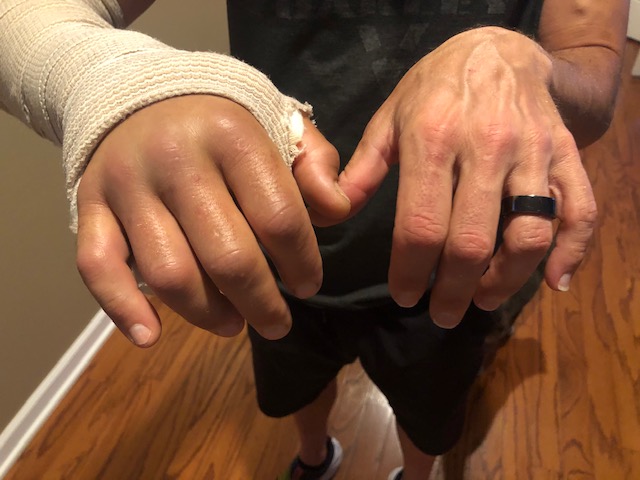
We were hoping that the temporary full arm cast along with the pain medication would help Karel after his ER visit but the pain only got worse. And it wasn't just the wrist but the nerve pain that was causing tremendous pain. The hand was swollen and his fingers were all numb and "dead" and he had no movement in his hand. Karel wasn't able to sleep for the next few days as the pain was just so intense. He was able to nap a little during the day but it was a very difficult few days for him.
May 20th - Visit with Surgeon
After several phone calls and urgency, Karel was able to have an appointment with the surgeon at the Prisma Hand Center on the 20th. Still on a lot of pain medication, Karel reported his pain as 10/10 (although it was likely 20/10 if that was a thing). Thankfully, the surgeon had an opening on Friday so Karel was able to get his hand repaired the next day. The evening was pretty bad for Karel as his pain was so extreme that he didn't even think he would make it until the next day. We decided to cut off the cast to see if that would provide some relief and sadly, it didn't. Karel couldn't wait until the surgery - most of all, he just wanted to be knocked out so he didn't have to feel the pain any longer. We emailed the surgeon to let him know our concerns about the ulnar nerve which may have been causing the issues that he was experiencing in his last two fingers as well as in his elbow.
May 21st - Surgery
As I was driving to Chattanooga for the 70.3, Karel was in surgery (with my mom there to help him out). The surgery took around 2 hours because alongside putting in a radius plate and 11 screws, the surgeon also opened up Karel's wrist and elbow to dissect the ulnar nerve to see if he could find the reason why Karel was experiencing such intense nerve pain. Sadly, he couldn't find anything.
Once Karel woke up from surgery, he was in no pain! But this was just because of the nerve block and his right arm was completely numb. He laughed that it felt like this foreign object was attached to him that he had no control over but he didn't care as he was in no pain and it was such a relief after a brutal past few days.
May 25th - PT
Karel's first PT visit was a bit discouraging. He was given a custom cast but there was little that he could do with his hand. The nerve pain continued and his little finger and ring finger felt like they were on fire. He wasn't able to even lightly touch the ulnar side of his hand without pain. He had no strength in his hand and it was very swollen. All to be expected after all that his hand went through, but the PT (and surgeon) were still concerned about the ulnar nerve. Karel must have yanked and hit his ulnar nerve upon impact which caused the nerve issue.
June 1st - Surgeon follow-up and PT
Although the fracture was healing very nicely and the swelling was going down, Karel continued to struggle with the burning pain in the small finger and under the ring finger. The burning was traveling all the way down the ulnar side of the hand. Karel got off the pain meds but after trying to get off the Gabapentin for the nerve pain, there was a drastic increase in pain and anxiety. So he had to restart the Gaba but was able to get off the Oxy (which he only took for a few days). It was quite the trial and error to figure out the medication schedule as even with Tylenol, Ibuprofen, Aspirin and Gaba, nothing was giving Karel relief. Most of all, Karel just wanted to sleep and he was unable to do to the pain. And Karel is one with a high pain threshold and does not like to take any medications. The surgeon suggested for Karel to get a nerve study if things did not improve in the next two weeks. The PT session was ok. The swelling went down so Karel was able to get a slightly smaller cast and was able to do a few more exercises.
Although it was nice to have Karel in Roanoke with me and our athletes for the IM 70.3 Blue Ridge race, he was in tremendous pain. Throughout this entire journey up until about three weeks ago, Karel has slept in a separate bed than me as he is unable to make it more than 2 hours at a time without needing to get up and ice or heat his hand due to the pain.
June 15th - Surgeon follow-up and PT Four weeks after surgery, things are starting to improve. While better, the nerve pain is still bothersome. At this point, the fire in the fingers has changed to a feeling of ants crawling around in the fingers. Still some burning. The range of motion is slowly improving and the swelling is finally going down. He still has a big lump around his wrist and has little strength in his fingers. The only finger that has normal strength is his middle finger. It's been very frustrating for Karel as he can't use his dominant hand and even the most easy tasks like picking something up, eating or pushing a key on the computer or phone is very difficult. He is making progress at PT and he is very committed to his exercises.
June 17th - off medications, starting supplements
Karel really wanted to get off the Gaba as he wasn't comfortable taking this medication - especially now that he didn't feel like it was helping. It took about a week to taper off the Gaba. The hand is slowly improving and he is able to use it a bit more and the pain is much less. The pain comes and goes so it is much more tolerable. And he is finally able to (mostly) sleep through the night. The biggest improvement is being able to get back to some type of exercise routine- which provides structure to the day and helps with the discomfort of the hand as it takes his mind off his hand. Because his hand may take up to 6 months to regain full strength, Karel hasn't been able to do any of his scheduled races and the return to biking and swimming has been slow. But he is very grateful that he is able to exercise. We are also extremely thankful to our dear friend Stephen who is a hand surgeon (and triathlete) who has been so helpful as a sounding board for Karel. Because Karel has never been through this before, we don't know what's normal vs. not normal so Stephen has helped with so many of Karel's concerns. Currently Karel is taking Carnityl, NAC - N-Acetylcysteine, and Alpha-Lipoic Acid (all from Thorne) to hopefully help with the nerve pain (advised from a friend of ours who had success with these supplements).
Training update
Pain is no fun as it's a major disrupter to quality of life. But Karel wanted more than anything to get back to exercise - even if it wasn't comfortable. And I sure do miss my training partner. We do almost all of our outdoor riding together so it's been tough to have to do so many of my rides alone. The surgeon and PT gave Karel the OK that he was allowed to exercise so long as he wore his removable cast for the first few sessions after his surgery to protect the hand. After a few weeks, Karel no longer needed the cast but continued to tape his hand to brace it. He is also using gel pads for extra padding on the bike as the vibrations on the road cause him a lot of discomfort.
48 hours after his hand surgery, Karel got on the trainer for an hour spin. He said it wasn't comfortable but he was happy that he did something after being so sedentary for the past 5 days.
The next week (May 24th) Karel was able to do a few indoor trainer rides and two runs on the treadmill. On Sun 30th, Karel ran outside with me. He was a bit winded and exhausted during the run outside. Total exercise this week: 6.5 hours.
The following week (May 31st- June 6th) was a bit of a setback due to pain. But Karel brought his bike and trainer to Roanoke and he was able to do a few trainer sessions and runs outside. Total exercise this week: 6 hours.
On the week of the 7th-12th, Karel attempted his first swim at our friend Kristen's neighborhood pool. It was more of a splash (not structured) s Karel couldn't really use his hand but just move it through the water. He mostly used fins but he was able to get in 3000 yards. He went for another swim on the 11th. It wasn't comfortable but it did help to take his mind away from the nerve pain. On the 10th, Karel attempted to ride outside on his road bike (I rode with him) and it was really uncomfortable as he couldn't put any weight/pressure on the hand. He didn't enjoy the ride outside but was craving that feeling of being outside on his bike. I don't think he's ever gone more than two weeks in his life without riding his bike outside. Total exercise this week: 10 hours.
On the week of the 14-20th, Karel found himself in a bit more of an exercise routine. He tried the tri bike vs. the road bike and while it was a little better to just rest the arm on the bars outside, the vibrations on our bumpy roads made it hard for Karel to enjoy the ride outside. He has been using the tri bike indoors (he really dislikes the trainer ;) He really loves riding outside so he was trying everything he could think of to find a way to ride outside. Running seems to be the most tolerable as nothing touches the hand when he runs, so that has been the one constant over the past few weeks. Total exercise this week: 15.5 hours.
On the week of the 21st-27th, riding outside is still very uncomfortable and while the hand strength is improving, he still doesn't have full usage of his hand. It's also very hard for him to drink while riding. Karel is finding creative ways to tape/brace his hand while exercising and he has also made some adjustments to his tri bike with extra padding to help where his hand rests. He is able to swim a few times a week, but he still needs to brace his hand with tape to give it support. He's also using a lot of pool toys to help with swimming. Total exercise this week: 16.5 hours.
And here we are today. This week has been a somewhat good one for Karel. I see the improvements that he is making everyday but Karel can't see the small improvements. He is still frustrated that he can't do simple things around the house, while eating or when exercising as he lacks mobility in his wrist and strength in his fingers. He feels more comfortable on his gravel bike on the road as it is a bit of a better feel on the handlebars. This past Saturday we rode together and it was his longest ride at 4 hours. He just wanted to complete the ride more than anything. He mostly stayed in the aerobars (which he doesn't enjoy as he likes to change up his position, especially while climbing) and he had a few low moments but overall, he was just happy that he is able to ride outside - even though it wasn't comfortable. He feels like his fitness is low as everything feels hard but again, he is just happy that he is able to train and get back into a routine. Total exercise this week: 18 hours.
Although this has been a really tough experience for Karel, he really wants to get back on his mountain bike. And I also want him to get back out on his mountain bike. But right now, he still lacks the strength to be able to ride on the trails and to use his mountain bike gears. While the first few days of his injury really tested him, each day he wakes up and focuses on what he can do on that day. He isn't waiting until everything is perfect but instead, just taking each day as it comes and doing whatever he can on that day. The first few weeks he didn't try to follow any type of training plan but now he is able to train with more purpose. Right now the hope is that he can compete in the IM 70.3 World Championships and follow it up a week later at Xterra Utah and then in December, at the Xterra World Championship. I hate seeing him in pain and I am hopeful that he can continue to improve the strength in his hand and that the nerve pain continues to lessen and will eventually go away. We never expected this injury to be so debilitating but we try to keep this all in perspective that it could have been much worse. Because his job of bike fitting, working on bikes and working on the computer requires the use of his hand, it has been tough for Karel to not be able to do certain things that were once so simple and routine. It has taught us to never take anything for granted....and that we are more capable than we think (and sometimes we just need a bit of creativity!)
And thank you for those who sent Karel edible gifts. Chocolate makes everything better :)
It’s well-accepted that the combination of protein and carbohydrate makes the perfect post-workout snack. 💪
Add in water and sodium and you are nailing your recovery nutrition. 💧
This combination helps you achieve the desired training adaptations from your workout by promoting muscle tissue repair, replenishing what was lost in sweat and maximizing glycogen synthesis to help reduce soreness while accelerating performance adaptations.
To optimize recovery, begin consuming a carbohydrate and protein snack within 45 minutes after a workout, when blood flow to the muscles is still high. Don’t wait to refuel!
Keep in mind that full restoration of depleted glycogen stores can take up to 48 hours.
Because your daily energy and carbohydrate needs are higher on intense or high volume training days, don’t be concerned about the extra calories affecting your body composition goals.
A well-designed recovery nutrition plan plays an important role in promoting quick recovery so you can stay consistent with training.
No athlete enjoys seeing a DNF (did not finish) after their name when looking at the event results.
I've experienced two DNF's. The first was the Miami Marathon on January 28th, 2007. The reason why I remember that date is because it was my very first blog post. I find it so ironic that I decided to start my blog right after my first DNF. The second DNF was actually a DNS (did not start) when I fainted on race day morning at the 2017 Ironman World Championship in Chattanooga, TN.
Karel has had one DNF to his name. It was Ironman Lake Placid in 2015. Karel tore his plantar during a run workout a few weeks before the race and while he was tempted to run on it in order to finish the race, he made the smart decision to only swim and bike. It was really hard to give up his timing chip in T2 but it was the right decision to not further impact his recovery.
Although we have only experienced three DNF's, I can't list the number of Ironman races that we have wanted to quit while racing. At one point during every one of my 16 Ironmans, I have contemplated the thought of quitting as whatever I was struggling with didn't feel "worth it." I've had GI issues, I've been severely undertrained on the run due to a previous injury, I've had biomechanical issues and of course, the typical very low-moment thoughts of "why am I doing this to myself, this sport is stupid."
Karel had three near-quitting experiences. In 2017 Ironman Lake Placid, when he had the flu the week before the race and still under the weather on race day. He ended up in the med tent as he was severely dehydrated after the race. Then at the 2018 Ironman World Championship when his Di2 malfunctioned, he had to complete most of the 112 bike course in one small gear which taxed his legs before the marathon. Then, two weeks later, at Ironman Florida (in Haines City), he was struggling emotionally and physically from the first step of the run and he wanted to quit so badly as he had nothing in his body. I wouldn't let him quit. He ended up in the med tent again due to exhaustion.
Whether you are running in a 10K or in a marathon, participating in a sprint distance or full distance triathlon, there's no guarantee that just because you trained for a race that you will finish the race that you start. Racing is hard, especially long-distance, endurance racing. Therefore, on race day, no matter what is thrown your way and no matter how badly your ego is bruised, I encourage you to do everything in your abilities to try to reach the finish line. Although your health should never be severely compromised just to reach the finish line, many DNF situations involve giving up before exhausting all possible options. For example, you may be in a bad condition, struggling to move one step forward. But with 2 or 10+ hours left in the race, you still have time to stop and take care of yourself.
A DNF can cause major regret and it can crush you emotionally. But it can also serve as a big motivator to prepare better (or to make better choices) in order to finish your next race. Sometimes a DNF is inevitable from the start but for all other situations, here are some tips to deal with a DNF:
No regrets - Regret leads to feelings of sadness, shame, guilt or remorse. Sure, you may be disappointed or sad, but spending the next few weeks with great emotional distress over your decision is not good for your soul. Life is full of experiences and sport is no different. Every setback or disappointment is a new learning opportunity. Move on with acceptance. Even the most experienced athletes make mistakes or poor "game time" decisions. And even when everything is dialed in - from nutrition to gear - some elements out of your control.
Allow yourself to grieve - It's not just about the medal. It's about the time that went into training, the finish line experience and so much more. Before you quickly register for another redemption race, give yourself time to feel your emotions. Express your thoughts and feelings with your coach and close family/friends, both of which can help you sort through the cluster of thoughts between your ears. Ultimately, time will allow you to heal and move on. Your emotions are valid. Sometimes it's good to get yourself back out there but other times, it's good to give yourself a break.
Be proud of yourself - You may be dwelling over what didn't go well, but there were things that went right. You prepared yourself for the race, you made it to the start line and up until the decision to stop racing, you hade the skills, fitness and abilities to move yourself forward. In the days after the event, give yourself space. Avoid looking at other competitor's results or browsing social media forums and posts from the race. Remind yourself that your experience is unique to you. If you are in need of help, consult a professional - not social media for "expert" advise of what you could have done a better job of.
Learn lessons - Some DNF situations are brought on by something that is completely out of your control. Extreme weather, injury during a race, crash, equipment/gear malfunction, etc. As much as you try to problem solve and troubleshoot, some situations just suck. But if the DNF happened because of a situation within your control, what can you do differently in the future? What can you learn from this experience? Here are some commons reasons for a DNF:
-GI issues (diarrhea, sloshy stomach, abdominal cramping) -Overfueling/overhydrating -Underfueling/dehydration -Nausea/vomiting -Cramping/side stitches -Ongoing injury -Not heat acclimated -Poor choice of clothing -Outdated, poorly maintained or poorly designed gear/equipment -Blisters, hot spots -Pain -Fatigue -Exhaustion -Illness -Menstruation/PMS (females) -Improper pacing -Poor terrain management -Poor pre race fueling/taper -Inadequately trained/underprepared/overtrained -Unable to meet a cut-off time
Check your ego at the door - It's easy to assume that a DNF means that you are not cutout for the race distance/event. It's also easy to give up when you are not meeting your race goals. When it comes to racing, a lot can happen. No athlete is "too good" for mishaps. You can't learn much if you give up every time something goes wrong. Long distance racing is an adventure. You are on a personal journey from start to finish. It's important to not adopt an race day attitude of pass or fail based on metrics, age group placing or finishing time. That is not what racing is all about. As I mentioned earlier, Karel and myself have struggled through many long distance triathlons. Many of which we have felt like we were in exceptional fitness going into the race - but unfortunately, we had to overcome obstacles during the race, which didn't validate our fitness level. One of the reasons why we have made it to countless finish lines (despites setbacks occurring) is making a commitment to always finish what we start. A finish line isn't about showing how fast you are as an athlete, but who you are as a person. It's about finding meaning for continuing, beyond a finishing time or place. When you show up to a start line, you are putting yourself out there. Racing means vulnerability. Giving up when things don't go your way sends the message that a race is only worth finishing when a specific result/goal is achieved.
Accept that it will be hard - I love full distance triathlon racing. 140.6 miles - just me, my mind and my body. But no matter how well I prepare, I know that race day will be hard. Inevitably, no matter how good the day is going, things will get tough. Things will go wrong. Once you let frustration, doubt and defeat creep into the mind, it can be really difficult to make good decisions and bounce back. Instead of being stubborn with a purpose, the rest of the race feels like a waste and eventually, "it" all becomes too much to handle. Surrendering to negative thoughts, quitting feels like the only good option. Rarely will you have a race where dropping out won't cross your mind at least once. If you will exacerbate an injury or a health issue, quitting may be justifiable. But if a DNF happens because a goal was missed, the race feels too hard or you are not happy with the outcome, remind yourself that any result is better than no result. Even if you have to sit on the side of the road for an hour to figure out your issue or walk until you are pulled off the course, you can only learn if you keep on trying.
To avoid a DNF in your near future, here are a few tips:
Avoid expectations or an all-or-nothing mentality. Race with processed driven goals, not outcome goals.
Race for something/someone bigger than yourself.
Work with a professional on areas that you are not an expert in. Sport psychology, sport nutrition, training, racing....don't let race day by the day when you hope everything works out for the best.
Expose yourself to different challenges and scenarios - in training and in future races.
Don't wait until race day to test/practice gear, equipment or sport nutrition.
Remind yourself "Finished is always better than did not finish. And did not finish is better than did not start."
Don't chase results. Remind yourself that racing is about feeling challenged and overcoming obstacles.
You gain strength every time you persevere through something difficult.
You may be able to get away with haphazard fueling and hydration strategies in cooler temps, but now is not the time to wing it when it comes to utilizing sport nutrition products during your long workouts.
If you've ever struggled with the application of sport nutrition, you've likely experiences several pronounced, uncomfortable and performance-limiting symptoms related to underfueling, overfueling, dehydration and overhydration such as headache, no urge to urinate, sleepiness, lack of appetite, nausea, bloating, fatigue, muscle aches, moodiness, diarrhea, sloshy stomach, headache and dizziness.
Proper fueling during intense or long duration exercise helps you sustain a desirable effort to maximize training adaptations. You can also practice fueling strategies for competition and train the gut to tolerate nutrition while exercising at various intensities.
Contrary to the opinion of other nutrition experts, I'm a huge proponent of consistently using sport nutrition during training - regardless of the workout intensity and duration. I've also had great success prioritizing liquid calories during long distance training (for myself and for the hundreds of athletes that have reached out to me for sport nutrition consulting).
If you are training for a long-distance event (90+ minutes) or training intensely in the heat for 60+ minutes, a sport drink provides a practical and easy way to obtain fluids, electrolytes and carbohydrates, in the right formulation to optimize digestion and absorption. Sport drinks are very safe and effective but are often misused or neglected – especially in the heat.
Sport Drink Formulation
For a sports drink to work effectively, it must have the same or less than osmolality of blood. As a reference, blood plasma has an osmolality of 280-300 milliosmoles per kilogram and a bottle of Gatorade has an osmolality of ~330 mOsm/kg. A sports drinks osmolality (Iso-, hyper- or hypotonic) is dependent on the carbohydrate type (ex. glucose, fructose, maltodextrin) and concentration (grams) in a solution (fluid ounces) – in other words, how quickly it can absorb into your blood stream. If a drink’s osmolality is greater than the blood’s (concentrated or hypertonic), liquid will be pulled from the blood and into the intestine to equalize the two concentrations – this net movement of water is theoretically dehydrating. A iso or hypotonic drink, in contrast, will provide a favorable osmotic gradient so that water diffuses into the cells. If you fail to replace the fluids and electrolytes (sodium) lost in sweat, a cascade of negative events occurs, such as a rise in osmolality, a drop in blood pressure and an increase in heart rate. In contrast, if you drink too much water too quickly and don’t consume drinks with adequate sodium, sodium levels will drop as body water levels rise, causing cells to swell.
What about homemade concoctions? Because fructose uses a different intestinal transporter compared to glucose or sucrose, and once in the bloodstream, has to be taken up by the liver to be processed into a usable fuel source for the muscles (which can take up to 90 minutes), juices are not recommended as a "sport drink" during exercise. Focus on your daily meals and resist the urge to be a scientist when it comes to formulating sport drinks.
As for coconut water, although coconut water contains calcium, phosphorus and magnesium (electrolytes found in sweat), sodium and chloride are the major electrolytes because they reside in the extracellular fluid. Compared to a sugar-rich hydration beverage, coconut water is a safe and natural option to occasionally enjoy as an alternative to water. However, to sustain moderate to high-intensity exercise for longer than 90-minutes, the body depends on ingested carbohydrates and sodium – both of which lack in appropriate amounts in coconut water. Additionally, if you are paying extra for coconut water to increase your daily potassium intake, look no further than the produce aisle – a large potato contains 1553 mg of potassium! If you enjoy the taste of coconut water over plain water, choose it for light activity. But to prevent dehydration, to replace lost electrolytes and provide the muscles with carbohydrates, a well-formulated sport drink is encouraged.
Gels, Bars and Chews
Gels, bars and chews are highly concentrated, portable sources of carbohydrates that are easy to consume during exercise but they lack the fluid and electrolytes that you’d find in a sport drink and are not in the right formulation by themselves to be easily digested and absorbed. Same goes for salt pills. Most gels and chews contain around 100 calories (or 25g of carbs) per serving. More concentrated in carbohydrates compared to a sport drink, gels and chews must be consumed with water to encourage gastric emptying. For every 15g of carbohydrates, at least 8-ounce of water should be consumed. Athletes may prefer to dilute a gel into a flask or bottle of water to create a more dilute concentration. Considerably low in sodium (50-100mg), gels and chews are ineffective to replenish sodium lost in sweat. Remember, your fluid, sodium and carb intake will be for nothing if it’s just sloshing around in your gut.
This doesn’t mean that you can't consume solid food or a gel or chews during long distance training, but to minimize GI issues and to simplify sport nutrition, I strongly advise to prioritize liquid sport drinks when you train (and race) and use chews for a central nervous system pick-me-up and bars/solid food to keep the tummy happy.
Digestion and Absorption
When applying the topic of sport nutrition, it's important to understand that just because you are consuming carbohydrates, sodium and water, this doesn't mean that your muscles are receiving what you are consuming. If a product is not consumed properly (or formulated properly when mixed), it'll simply hang around in the gut - causing bloating, a sloshy stomach, heart burn, belching, vomiting, gas and/or diarrhea. fluid ingestion. This can further lead to dehydration and glycogen depletion.
Water is absorbed in the small intestines and by the time it enters the large intestines, roughly 80% absorption has occurred. The rate of gastric emptying and intestinal absorption are dependent on the volume and formulation of the beverage. The greater the concentration, the greater the osmolality. This is why you should never concentrate your sport drink – like putting 400-600 calories (2 or 3 hours worth of calories) in one bottle that only has 28 ounces of fluid OR consuming a sport drink with protein or fat. When you drink plain water, there’s a drive for the water to dilute the blood (water moves toward blood) but if you drink a more concentrated beverage than blood, like a hypertonic sport drink or soda or juice, water will move from inside the bloodstream and into the gut – which is dehydrating. The inclusion of electrolytes and glucose in a beverage promotes retention of fluids. When you add a little sugar with sodium (as in a sport drink), you can pull a great amount of water across the small intestines, optimizing water absorption. To help with fluid and electrolyte loss, it's not just about the carbs. You also need to ingest water and electrolytes from a sport drink to keep plasma volume at normal levels.
As a helpful reminder regarding sport nutrition application, keep things simple, consistent and easy to repeat. Practice, practice, practice.
The gut is a very important athletic organ because it is responsible for the delivery of nutrients and fluids during exercise. The gut is highly adaptable and should be trained repeatedly in training - just like the muscles and heart. Unfortunately, many athletes are reluctant (or afraid due to body composition concerns, previous GI complaints and 'they sayers') to take in recommended amounts of carbohydrates, calories, sodium and fluids before and during long workouts. Sadly, this results in underfueling in training and far too common, overfueling on race day.
By practicing your pre-race and race day nutrition many times prior to race day, you can improve absorption of nutrition, improve gut tolerance and learn what works (and doesn't work) to reduce the chance of GI distress and to improve performance.
Although GI distress is common among endurance athletes, race day performance-limiting upper- and lower-gastrointestinal (GI) issues are highly preventable.
Although causes are diverse and symptoms vary, there are ways to reduce your risk so that you can perform to your abilities and not spend unwanted time on the side of the road, in the bushes or in the portable toilet.
"National Triathlon Week is a nationwide initiative to celebrate the sport of triathlon and all of the members of the multisport community. This week is geared toward education, celebration and participation in the multisport lifestyle. The schedule for the week features a new theme each day, with a spotlight on all of the components that make this sport so great. National Triathlon Week, or #TriWeek, is a celebration of not only triathletes, but all members of the multisport community — including officials, coaches, race directors, sponsors, families and friends of triathletes and more."
Triathlon has been part of my lifestyle for the past 15 years. It's given me so much and has helped me through some really tough times. The swimbikerun lifestyle has taught me how to overcome obstacles, love my body in motion and to experience the rewards that come with hard work, patience and enjoying the journey.
I've learned so much since my very first triathlon. Even if you see me as this triathlete today....
This is how it all started......
When I participated in my very first triathlon (2003), I knew little about the sport. As a collegiate swimmer, I felt extremely comfortable with the pool swim (little open water experience) but the bike portion was super scary for me. I had a little experience with running so I was so relieved when my feet finally hit the pavement for final leg of the triathlon. I was equally exhausted and thrilled at what I had accomplished by finishing a sprint distance triathlon. It just seemed so crazy to me that my body could cover the distance of a sprint triathlon and that I did it by swimming, biking and then running.
One year later in 2004, I participated in an Olympic distance triathlon. I had just graduated from college and I was a few weeks away from traveling to Florida for graduate school. I owned a hybrid bike and helmet but my triathlon equipment list was minimal - running shoes, swim suit, goggles and a bike (with a kick stand).
In 2005, I participated in my first marathon. I was in graduate school studying exercise physiology and I missed training for an event. After spending the last ten years as a competitive swimmer, I missed the comradery of training/competing with others.
In 2006, I was bit hard by the endurance bug. I completed the Boston Marathon, my first half ironman (IM 70.3 Florida at Disney) and my first Ironman (IM FL). Not only was I amazed at what my body was able to achieve but I loved the triathlon environment. The athletes were so supportive, inspiring and positive. Biking was always my weakest leg of the triathlon - and the most unnerving to me. However, over the years I've been able to go from weak to strong. And since my cycling skills have dramatically improved, I love riding my bike.
Karel came from a competitive cycling background and after a lifetime of bike racing, he was seeking a new challenge in 2012. He really struggled with swimming. He could barely swim 25 yards without getting out of breath. And for the first few years of triathlon racing, he would experience great anxiety when swimming in the open water. Interestingly, he became a fast and efficient runner. He lost a lot of his top-end bike speed and power but he still has a strong love for being on two wheels (although the tri bike is not his favorite ;)
Although I still feel like I have a lot more to learn and to accomplish in the sport of triathlon, I have learned the most from 12+ years of triathlon coaching. Although my specialty is endurance triathlon training and racing, I know exactly how it feels to be a beginner triathlete. It was scary, overwhelming, fun and exciting.
When I started the sport, there weren't a lot of resources for beginner triathletes - especially for individuals who had some type of athletic or fitness background. I felt like I had to learn as I went along. Because of that, I made some mistakes and had to figure things out the hard way.
As I was writing my last book Athlete to Triathlete, I took myself back to when I was new to the sport of triathlon. Confused and overwhelmed yet excited and eager to try something new. I wanted to provide practical and easy-to-read chapters that were related and applicable to individuals who are new to the sport, are re-entering the sport after a break or have dabbled in the sport without much understanding of what triathlon is all about.
The sport of triathlon has experienced significant growth since becoming an Olympic sport in 2000. Since I crossed my first finish line in 2003, much has changed in the sport. From gear and equipment to the training and fueling - triathlon has evolved and grown over the years. However, there are still several barriers to entry - such as cost, time and intimidation. From the outside, triathlon may appear complicated, exhausting, elitist and overwhelming. For these reasons, many active individuals are hesitant to train for and participate in a 3-sport event.
To help grow the sport of triathlon (specifically, making it more inclusive for women, youth and various ethinic groups), I hope that my book Athlete to Triathlete will simplify the sport to help individuals safely and confidently enter the sport of triathlon, while exemplifying that the sport of triathlon is welcoming to newbies and beginners. I want others to feel the same excitement that I felt as a newbie - but also train for races in a smart and productive manner.
Athlete to Triathlete also serves as a triathlon training guide with features such as:
How to choose a triathlon race
How to plan your season of training and racing
Race day gear checklist
Transition and brick workout tips
Training principles and measuring progress
Rest and recovery
Motivational tips
Tapering for a race
Swim, bike, run gear
Open water swim tips
Warm-up recommendations
The pre-race check-in and race-day procedure
Triathlon lingo - yep, there is a language spoken by triathletes
What to expect at the race (from start to finish)
Nutrition guidelines for training and racing
Race day rules
Strength and stretching pictures
Workout advice tailored to swimmers, bikers and runners
Detailed, day-by-day training plans to prepare for a Sprint or Olympic distance triathlon (12-week training plans).
And so much more!!!!
Along with ordering my book, you can help me get the word out by writing an Amazon review and sharing with your friends, training partners and anyone else you feel would benefit. You can order your copy here: Athlete to Triathlete.
"Drink as much as you can and take lots of salt tabs!"
This is what I've been reading a lot of lately on social media as it relates to the advice that triathletes are receiving in route to their upcoming hot long distance race.
Racing in the heat is extremely taxing on the body. The biggest consequences include heat stress/exhaustion/stroke and dehydration. Anytime the weather is above 86-degrees F, there will be some type of stress to your cardiovascular system. For the athlete with a hot weather race on the schedule, you must be smart, flexible, attentive and safe when exercising in the heat. Times will be slow(er) than normal and you can't chase metrics. Your primary goal is racing smart and doing the little things well. It probably won't be your fastest race and on paper, the race results may not showcase your current level of fitness but in such extreme conditions, your only goal is to reach the finish line without compromising your health.
Most athletes will overhydrate before and during a hot weather race. There will be many haphazard nutrition "plans" that involve the excessive consumption of salt pills, excessive consumption of sport drinks and lots and lots of water. Because you will be physiologically limited in the heat, there a limit as to how much sodium, fluid and carbohydrates your body can digest and absorb. You can't replace everything that is lost in sweat (and metabolic heat).
There are several approaching triathlon races where the weather is predicted to be in the mid to upper 90's. That's hotter than hot when you are racing for 70.3 or 140.6 miles. To be honest, these conditions are not safe for the human body and racing in such brutal conditions poses a significant risk to health. While hot conditions are sure to compromise the health of the body, there are ways to mitigate the stress response to the heat and to safely reach the finish line. By understanding the body response when exercising in hot weather and learning how your fueling and hydration can help you , you will have the necessary tools to fuel and hydrate like a pro.
For the past seven years, Father's day has been hard for me. This year is no different. But then again, today is no harder than any other day. After losing my dad to cancer, every day is Father's Day - I think about and miss my dad every single day.
At first I wasn't going to write a Father's Day post. Acknowledging this day and not being able to show my dad how much I love him, makes today very hard.
Today is not my first Father's Day without my dad. Since the age of 32, I've had to remember my dad instead of being with my dad. But I know I'm not alone. Others are missing their dad and Father's Day without a father is just plain hard.
I have so many wonderful memories with my dad. At swim meets, running events and triathlon races to academic accomplishments like graduating from college, earning a Master's degree and becoming a Registered Dietitian. And then there are milestones like starting my own business, getting married, adding a dog to our furry family and moving. He was always just a phone call away and I took advantage of that by calling him at least two or three times a day - every single day. He was patient, smart, kind, funny and handy.
While I cherish those moments with my dad and I'm thankful for the person that I was able to call dad for 32 years, it hasn't been easy. Beyond buying our first home, writing three books, adding more furry members to our family, trying to navigate through difficult life circumstances and experiencing personal and athletic accomplishments, it's the big things, little things and everything in between that makes me really miss my dad on Father's Day. I successfully reached adulthood but I still need my dad. It's all those moments and experiences that are the hardest.
I miss my dad every day. This Father's Day is no different. The grief is hard because my love for my dad was so strong. But my dad lived every day to the fullest and never wasted a day. I continue to do the same and know that my dad is still with me, every single day.
If you are missing your dad (or father figure) today - especially if it's your first Father's Day without him - please know that you are not alone. Although grief is painful, love and comfort comes with loss.
It can be hard to find the right words to describe how grateful you are to have had such a great relationship with your dad. Grief can be complicated. But your feelings and emotions are valid. It's ok to "feel" how you feel.
But today, I choose to celebrate what I had with my dad, instead of being sad over what I no longer have. I had 32 incredible years with the best dad on this Earth.
Whether you're a casual jogger or an experienced athlete, you may believe that changing your body composition to reduce body fat levels will help you reach your athletic goals, improve your self-worth or feel more like an athlete. After all, how many times have you heard that lightening-up will speed you up? Don’t be quick to believe everything that you hear.
With any type of sport, it’s normal to look to others and see where you stack up based on performance, training volume, and body type. Although exercise can be a great activity to improve your overall health, there’s a downside to competitive leanness.....chasing the idea that weighing less will enhance performance can deprive you of the fuel and nutrients you need to optimize performance and maintain great health.
The media is oversaturated with images of athletes with six-pack abs, low body fat levels, lean arms, and long slender legs. Constant exposure to these images can make you believe that you're not good enough —increasing body consciousness, lowering self-esteem, and intensifying body dissatisfaction. Constant bombardment by images of an unrealistic body type can make it easy to slip into unhealthy or disordered eating behaviors, which increases your risk for sickness, hormonal disturbances, mood changes, injury, an energy deficit, and burnout.
Success looks different on everyone. You don't need to strive for the perceived "athlete body." Instead, learn to embrace your unique traits and strengths. To enhance your fitness journey, don’t let your body image define you. What matters most is what you can do with your body, not what it looks like. Not every human body is going to look the same.
Run because you love to run. Wear a swimsuit that makes you feel proud of your body. Keep showing up because working out is fun. You get to define your own success - your body is not an object that defines you. If you avoid signing up for a race because you fear being judged for how you long, crush those mental demons. Let go of comparison and be proud of your physical strengths. Never let your insecurities define you.
Instead of bashing your body, thank your body.
Be proud of what your body can do and all that it’s capable of achieving. How you perceive yourself largely influences your actions.
Discard the bathroom scale if it leads to self-destructive thoughts.
Wear clothes that make you feel good when you exercise.
Create goals that make you feel proud of your body.
And most of all, figure out how you need to eat, sleep, and train in order to stay healthy for the long term.
How you need to look to perform at your best may be different than how you think you need to look.
The process of developing a positive body image takes time, but to love your body in motion is worth the patience and hard work. Athletes come in different shapes and sizes. If you watch any race—from 5K or marathon to a sprint or long distance triathlon—you’ll see racers of all different body types celebrating across the finish line.
Sport doesn’t care what you look like. Your body belongs at any workout or race.
For more information like this, subscribe HERE to the FREE weekly Trimarni newsletter.
Saturday - one day out The pre-race routine was a bit different than normal at this race. After a restless night of sleep, I woke up feeling super tired. I was hoping that my morning ride would wake me up but all I wanted to do was go back to sleep. I pre-rode the run course twice (which was marked with arrows on the ground) and included a few pickups on the course where it felt safe to do so (it's on the Greenway so there were other bikers and runners/walkers to navigate through). As I was riding, I mentally put myself into certain scenarios and made mental notes of what sections would feel tough and where I would find myself feeling strong. The run course was not flat but instead, gentle inclines spread out throughout the two loop, out and back, out and back course.
I received this in my packet when I checked in.
After I returned back to our Airbnb, I told Karel that I felt so tired and my legs felt super heavy. Karel suggested that I not run but I wanted to do a short run just to remind myself that even with tired legs, I can still keep good form and run well. After my ~75 min spin, I ran for all of six minutes just to shake them out. I came back feeling tired but also excited to race. I had trust in my body and I knew it would know what to do once I started the race.
View on the run course.
After I ate my breakfast of a cinnamon raisin bagel w/ peanut butter and banana along with two hardboiled eggs, I finished packing my gear bags and headed down to the race venue a little before 10am. My scheduled check-in time was 10-11am and unlike past races, this race required us to check-in our bike when we checked in for the race. Karel dropped me off and I made my way through the check-in line and then selected my run drop off ticket time (I choose to drop everything off at that time) and then I picked up my bus ticket. I asked to be on the 4:45am bus and was able to receive a ticket for that time. After I got all my stuff, I walked to the car where Karel parked and I put the bike stickers on my bike and put my bib number on my hydration belt. I had my two flasks for the run filled only with powder as I didn't want to fill them w/ water and powder on Saturday and sit out in the 90-degree heat for 24 hours. Karel and Campy walked with me as I checked in my run gear bag (no access to our run bag on race morning) and then dropped off my bike to be loaded on to a truck to transport to T1. I was a bit nervous about having someone else transport my bike but after seeing how they were safely racking the bike on a rope and wrapping each individual bike with moving blankets, I felt much better about the situation. I deflated my tires a bit before as the bike would be sitting out in the hot sun for the entire day.
In my run bag I had: my Roka sunglasses, a cooling towel (pre-wet and stored inside a baggy), two flasks w/ Skratch Orange powder (1 scoop each), my hydration belt (Naked), New Balance running shoes and my visor. I had all of the loose items in a throw away plastic bag so that I could quickly pick everything up at once and put things on as I was running to save time. The only things I planned to put on at my transition before the run was my shoes and my hydration belt.
After dropping everything off, I was so tired and just wanted to sleep. Karel encouraged me to take a short nap as he reminded me that I probably wouldn't sleep well anyways the night before the race. I was hesitant to nap as I am not much of a napper but it felt really good to lay in bed for about 2 hours and lightly sleep for about 45 minutes. We watched some of Unbound Gravel in the afternoon and I spent a little time on mobility and foam rolling throughout the afternoon. As for the rest of my meals, I had a bag of basmati rice (microwave kind) combined with a can of Amy's no chicken chicken noodle soup. I did the same thing before Chatty and it worked really well. I haven't been having any vegetables in 24 hours before my races and I just stick with easy to digest foods. I ate all of the rice/soup in the afternoon (I hate some at 2pm and then the rest at 4pm) and snacked on pretzels, granola and blueberries throughout the day. I laid down for bed around 7pm and feel asleep around 8pm. I slept pretty good until around 1pm and then I was lightly sleeping until my alarm went off at 3:30am.
Race Day After I woke up, I took my time getting out of bed and made myself a cup of coffee (I do Nescafe Gold instant coffee) and a Cinnamon Raisin Bagel w/ peanut butter, strawberry jelly and a banana. I had no problem getting down my pre-race meal. I also had a glass of water. After I ate my food and did some mobility and foam rolling, I went for a short jog around the block to get my digestive system going. I ran into our neighbor across the hall and he needed a ride to the venue so we happily offered to take him. Oddly enough - his bib number was 705 and mine was 703! How crazy. Around 4:10am we left for the race venue at Rivers Edge Sports Complex. Karel drove us (Campy came along for the ride) and arrived just before 4:20am. I was able to get on a bus just before 4:30am and ended up sitting next to our athlete Greg. I brought with my two bags - my morning clothes bag with my swim stuff (I brought my swim skin just in case as it was right on the verge but ended up being wetsuit legal at 76.0) and my bike bag w/ my helmet, socks and cycling shoes, along with my bike nutrition and bike computer. After a 40 minute ride to the lake (which included a 20 minute wait at a church parking lot to let other buses through due to the small and tight roads at Carvins Cove Resevior, we arrived right around 5:30am. During the 20 minute wait, I decided to make good use of my time by putting on my AMP cream on my legs and arms/shoulders, sunscreen and body glide.
It was nice to finally get off the bus, take off my mask (required on the bus) and check out the lake and transition area for the first time (we were the first people to ever be allowed to swim at the cove). I made my way to my bike and my first priority was to check my bike to make sure it was safe to ride. I checked the tires, brakes, electronic shifting and gears. Afterward I found a pump and pumped up my tires. I accidentally bent my valve and got a little worried so I called Karel and he reassured me that I would be ok. After I set up my transition area and my sport nutrition (INFINIT in the hydration frame "bottle" and Carbo-Hydration from NBS in the BTA (between the aerobars) bottle, I then did a walk through of the transition area so that I knew what row my bike was in and how I would run to my bike after getting out of the water and then where I would exit the transition area. The transition area was pretty packed and tight so after I visualized my strategy from swim to bike and took note of the row that I was in for my bike (as well as any visual landmarks to help me quickly identify my bike) I made my way toward the port-o-potties and found several of our athletes doing some dynamic warmups by the swim start area. It was so great to be around so many of our athletes (we had 18 athletes racing) as I just love our team and all the positive energy they radiate.
After doing a warm-up jog and going to the bathroom, I checked my bike once more and then dropped off my clothes bag and put on my wetsuit and cap and grabbed my goggles and throw away sport drink bottle of Skratch (strawberry lemonade). I took 5 Gu aminos and had 2 Ginger Cliff chews around 6:10am, which was about the time we started lining up for the swim start of 6:30am. I found Kaley and Lisa, two great Trimarni swimmers and we chatted and laughed for the next 20 minutes, which was great energy to start the race. We positioned ourselves in the back of the 28-30 minute swim group. After the national anthem, the gun went off and it was time to start the race.
1.2 mile swim - 28.17, 3rd fastest female swim, 1st fastest age group (35-39)
I anticipated that the water would be warm at 76 degrees and with a wetsuit (non wetsuit legal is 76.1) but after jumping off the dock into the clean water of the reservoir, it was refreshing to finally be in the water. The course layout made it really easy to find a good rhythm as we swam out to the first turn buoy and then followed yellow buoys (I think that was the color) for the first half of the swim and then it switched to orange buoys for the 2nd half of the swim. I just focused on one buoy at a time. The water was clean, fresh and not choppy which made for a pleasant and fast swim. I was passing a lot of swimmers and after making my way to the next red turn buoy, I couldn't believe how fast this swim was going and how amazing the water felt - it was so clean! And the mountains around us were so beautiful. I was swimming super happy and didn't want it to end. As I made my way around the 2nd turn buoy, the water started to get a little choppy so I just changed up my rhythm and found myself passing more people. As I made my way to the swim exit, I felt like I had a good swim but had no idea until the end of the race how fast I swam. This may have been my fastest ever 70.3 swim! I don't wear a watch when I swim in a triathlon race so I had no idea of my time until Karel told me after I crossed the finish line.
T1 - 3:13 I removed my cap and my goggles and removed my wetsuit to my waist. As I took off the sleeves, I let go of my cap and goggles so that they would stay in the arm of the wetsuit (one less thing to carry). I made my way through the tight transition area and started my bike computer, put on my socks and cycling shoes (I wore my compression socks under my wetsuit) and put on my helmet (visor up so that it wouldn't fog). I grabbed my extra "emergency" nutrition (Skratch krispy bar, Ginger Cliff chews and a gel) and put my swim stuff in my Blue gear bag so that it could be shuttled back to the finish area. I made my way out of the transition area. I was expected to mount the bike right after crossing the bike out arch but we had to mount our bikes at the top of a hill...which made for a very long run with cycling shoes on out of the transition area. But since we had a lot of climbing to do to get out of the transition area, I didn't stress about it and just made my way as quick as I could to the mount line, moved my way to the far right and out of the way of other riders and got on my bike, clipped in and off I went.
56-mile point-to-point bike, 20.46 mph average, ~3300 feet elevation gain (it ended up being 55.2 miles), 3rd fastest female bike, 1st fastest age group.
The first 2.5 miles of the course are punchy and technical. The road condition was pretty good so I just stayed mostly on my base bars as to not take any risks in this beginning section. I was passing several cyclists and wanted to safely make my way onto the main road - Lee Hwy. Having driven the course (and riding the 28-miles on the Blue Ridge) on Thursday was really helpful as I knew what to expect in each part of the course. The next 21 miles were on gentle rollers that allowed us to ride pretty fast, mostly in the aerobars. After passing several athletes in the first few miles of this section, I found myself pretty alone with just a few guys in front of me (or passing me). I was able to settle into a good rhythm and my legs felt pretty good. I had good energy and I was really looking forward to the climb. I took in 2 Clif Ginger chews around 15 minutes before the climb (around mile 19 of the bike). As we made our way NorthEast to Buchanan, we rode on well-paved roads surrounded by fields and beautiful mountain views. The sections of the road that had two lanes were coned off for us. The police and race staff did an exceptional job marking the course and keeping us safe. And it was just a treat to know that the entire Blue Ridge was closed for us (no cars). I didn't focus much on my computer but I was averaging 23.4 mph for the first 23 miles (59 minutes). After making the turn to head to the Blue Ridge, we started the climb and approached the "conquer the Claw" inflatable arch.
For the next 4.76 miles and 30 minutes (averaging 9.25 miles), I switched my computer over from my metric screen showing lap time, speed, cadence, lap normalized power and 3 sec power to my navigation screen. Since I had the map loaded in my Garmin from Thursday's ride, I found it beneficial to have it on as I was riding on the Blue Ridge so that I always knew exactly where I was on the course and how many more miles I had left in each part of the climb. This helped me with pacing and also helped me execute the climb to the best of my ability. After the first 23 miles, I did not have any metrics on my screen for the remainder of the ride and just entirely rode by feel and used my navigation on my computer to help me with my pacing. I stayed up on my liquid nutrition and took in another two chews before the long descend (around mile 34 in the bike). There was nice cloud cover which kept me feeling comfortable. Although I remained the female leader on the course until we finished the Blue Ridge, on the tracker I was "virtually" passed somewhere after 27 miles. Kathryn Buss is a local professional cyclist and triathlete and completely crushed the bike course. When she passed me with only 6 miles to go, she flew by me. She told me "great riding" but I didn't even have time to say anything to her. Part of me was a little crushed that she was flying by me but I also kinda liked not being the leader and instead being the chaser. I felt this to be a little less stressful starting the run and not having to worry about who was behind me but instead focusing on who was in front of me. I passed several guys on the course and many of them gave me a cheer and were super nice. Also the spectators and volunteers were incredible. I grabbed a bottle of water on the 2nd aid station to sip and cool myself but the aid stations were a bit dicey and dangerous with bottles falling everywhere so I didn't grab one at the last aid station. I ended up finishing 400 calories of INIFNIT in 1.2 liters of water and then another 26 ounce bottle of NBS Carbohydration with 200 calories. In total I consumed 600 calories of liquid nutrition and about 120 calories worth of Cliff Chews (Ginger). So ~720 calories for the 2:42 hr ride. The views on the Blue Ridge were stunning and although I was in race mode, I made sure to enjoy the moment and find gratitude in this experience. The last few miles of the Blue Ridge were a little punchy as the rollers didn't have good rhythm to them so it was a bit more of climbing than descending but once we turned on to the main road again from the BR parkway, it was a fast and fun, semi technical 6 miles into town. We rode through the downtown of Roanoke and it was great to have so many cheers throughout the course.
T2 - 2:16 After dismounting my bike, one of my cycling shoes fell off the pedal as it hit the ground. I didn't realize it until a volunteer ran up to me with my shoe. It was a long run on the grass field to my spot on the rack with my run bag. As I was making my way to my rack, I saw the leading girl run out of the transition. At this point I was virtually 2:39 behind her (although it was only about 90 seconds in the moment due to the rolling start). I removed my jersey and put all my bike stuff in my bag and put on my running shoes and hydration belt and grabbed my bag with all my stuff and ran out of the transition area. I made my way to the bottle fill table and filled up my flasks with water (a volunteer helped me) from cups and then made my way through the run course on the grass (which I liked the soft surface) as I put on my visor, sunglasses and cooling towel.
13.1 mile run (it ended up being 13.2 miles), 1:43:50 (Garmin had 1:42.49, 7:48 min/mile - just a few seconds slower per min/mile than Chatty two weeks ago). 5th fastest AG, 9th fastest overall female.
As I started the run, I expected to see Karel to give me an update but no Karel. I was a little worried but later learned that Campy needed to smell every bush and it's hard to speed walk with our 13.5 year old pup. The first mile out to the aid station was ok but I didn't feel the best. I just didn't feel like I had good rhythm so I made a quick stop after the aid station to reset my form and stretch out for a few seconds. I had the 2nd biker in front of me which was nice for added cheers as I was the 2nd female on the course. I knew I had some strong and fast female athletes behind me but I used the first loop to just find a good rhythm. I sipped on my flasks about every mile and as needed if I needed a pick-me up. No GI issues. It was getting hot and there was no ice on the course for the first few miles, just water in cups. As I made my way back to the spectator field street, I got a little pick me up. I saw Karel and he told me I was sitting steady in 2nd and 3rd place was over 7 minutes behind me. As I made my way to the far end of the course, I started to feel a little better but had to throw in another reset stretch at the far loop of the course. After making my way on the wooden bridge and finally getting some ice in my sports bra (makes for a great ice holder) and then holding on to it as I ran, I started to finally feel better. Around mile 4 I was almost 4.5 minutes down from first so my focus was just on maintaining 2nd place. As more athletes got on the course, I felt my energy pick up. I found my form and was really soaking in all of the cheers. And anytime I saw one of our athletes, I felt an instant boost. Although I wasn't making much gain on 1st place, 3rd and 4th place were running really fast and were gaining time on me. Karel was really encouraging and every time I saw him, he knew just what to tell me. I was sad that he had to defer his entry due to his broken hand so I felt like I had to run for him - just like I did at Chatty 70.3 two weeks ago. Although it was getting really hot, I do well running in the heat and historically, I get stronger as the run goes on. After checking off the last short out and back section, I only had about 5 miles left. I didn't feel the best between miles 8-10 so I just focused on my form and managing my effort in the heat. I never felt overheated but I also was doing all that I could to prevent a massive slowdown. Still at 7.4 miles, I was 4 minutes behind the 2nd place girl. At mile 10, the gap had closed to just under 2 minutes. I was passing several guys and they were telling me that "she's just ahead, you can catch her." I didn't want to take too many risks as I still had three more miles to go but as I got to the wooden bridge again before the exposed hot part of the course (with an awesome aid station filling me with great energy) I could see first place in my sights. At this point I didn't think that I would get first even if I passed her as I didn't think I had gained enough time on her with her lead leaving T2. But as a competitor, I wasn't going to let up and I thought it would be really cool to still cross as first female finisher and hold the tape at the finish line (which was my goal going into the race). At the aid station I did a quick reset break as I knew I would have to give everything I had in those final miles. I took a quick sip of coke and I was on a mission. Just after the aid station at mile 11, I pass the leading girl and I was now in first place. Still not knowing if I was the virtual leader, it felt pretty incredible to be leading the race as the cheers from the athletes on the course and the spectators were giving me so much energy. I continued to take sips from my flasks to keep my blood sugar up as my brain was working overtime to continue to work with my muscles to keep me moving forward. I was doing everything I could to stay strong and I was soaking in the moment behind the first female biker in front of me. I was surprised to see Karel w/ around 1/2 mile to go as I expected him to be at the finish. When I saw him he told me "You have to give everything you have - no letting up. It's going to be really close!!" I assumed he was talking about the girls behind me as I didn't think I had ran fast enough to finish far enough behind the girl that I passed. I just assumed Karel was making sure that I stayed 2nd. As I sprinted my way up and over a short bridge and on to the grass, I made my way to the finish line and I was greeted with the tape as the first female finisher of this inaugural event.
As I held up the tape, I was engulfed with a lot of photographers and media which was a bit overwhelming as I was so exhausted. I just fell to the ground and tried to come back to life from such a tough battle. Even the race announcer Dave was shocked that I had overtaken the leader in the closing miles. When 2nd place crossed the line, she also had the tape in front of her and she was a bit confused. I told her that there was a good chance that she was the winner of the race and she was shocked. When we finally got the news that I was 2nd overall female by only 2 seconds (and 3rd and 4th were just 75 seconds behind me), I was a little bummed but I was extremely grateful for the race I put together, especially two weeks after a breakthrough race at IM 70.3 Chattanooga. It was a battle to the finish line and I loved every minute of it.
Finishing time: 5:00.14 (winners time 5:00.12). 1st Age group (35-39) (out of 50) 2nd Place female (out of 397) 41st overall (out of 1379)
I did a few interviews with the media that was there and then got myself a coke and water before walking to the run course to meet up with Karel. During this long walk to the other side of the river, I had time to collect my thoughts and to find the positives from this race experience. I could look at it that I was only two seconds away from the overall female win but I chose to see it as I closed the gap down to 2 seconds and held off 3rd and 4th place. I didn't feel broken after the race so that was a good reminder that my body is healthy and strong and I did a good job fueling and hydrating during the race.
After cheering for our athletes for the next hour, we made our way to the finish line area, chatted with our athletes that had finished, picked up my bike and bags and then went back to our Airbnb around 2pm. Although I turned down my IM 70.3 World Championship slot at IM 70.3 Florida in April and at IM 70.3 Chattanooga, I decided to accept my slot and give it a go at my 3rd IM 70.3 World Championship (although I have a DNS for the first two as I was injured for the first one in Clearwater after competing in my first Ironman World Championship with hip issues and then I fainted on race day morning for IM 70.3 Worlds in Chatty). I'm hopeful that this time around I will be able to start....and finish.
Thank you for the cheers and kind words on and off the course, via email, text message and on social media. I appreciate them all and I hope that I can continue to inspire and motivate you to do incredible things with your amazing body. I loved the course so much that I will be back again in 2022!
And congrats to all those who raced!
Also, a huge thank you to Karel. He was in a lot of pain before and during the race and pushed it aside to support me and our athletes. This has not been an easy or smooth recovery from breaking his hand two weeks ago while mountain biking and he is constantly in a lot of nerve and bone pain. Although it's getting better day by day, the recovery has been slow. Thank you Karel for your constant support and love. You'll be back soon and hungry to race! And thank you Campy for your unconditional love and constant cuteness. You are almost 14 and we are so lucky that we can still make so many memories with you.
When I first heard about the inaugural Ironman 70.3 Blue Ridge in 2020, I was intrigued by the possibility that an Ironman branded half ironman would include a challenging bike course. When the bike course details described an "epic five-mile climb on Route 43 to the Blue Ridge Parkway entrance" and that "Athletes will experience breathtaking views of the valley, as they ride and descend 21-miles of completely closed roads" I never stopped thinking about this race. I love challenging race courses as the accomplishment comes in the journey to the finish line. My most memorable half Ironman races have been on really hard courses (IM 70.3 St. Croix and IM 70.3 Branson quickly come to mind).
For the past few months, Ironman 70.3 Blue Ridge has remained my focus. Although my training has been a bit unconventional this year, I felt that I could do really well on the course as it suited my strengths of being a hilly and hot course. I didn't need to be fast, just healthy (injury-free), strong, smart and steady. With this race as a priority (my third half in 8 weeks), my focus at Ironman 70.3 Chattanooga was to participate in the race with our athletes, get a little better at suffering (at IM 70.3 Florida I was not willing or ready to suffer), but not destroy myself so that I could race well in another 70.3 just 14 days later. With Karel back at home with a recently broken wrist, I shocked myself in Chatty by placing 3rd overall female (missing 2nd by 14 seconds) and I contribute that magical performance to having no expectations, feeling no pressure and detaching myself from the outcome. Fast forward two weeks later and I was able to race at my best and my best allowed me to fight all the way to the end for the overall female win. Although I was two seconds "too slow" and ended up 2nd overall female, I'm extremely satisfied and proud of my performance.
After fifteen consecutive years of endurance triathlon racing, completing 16 Ironman distance triathlons (#17 is in six weeks at IM Lake Placid), 5 Ironman World Championship events and well over 25 half Ironman distance triathlons, I've adopted a new mental approach to training and racing.
I am not attached to results. Whether it's in a training session or in a race, being non-attached simply means staying present and giving my best, without attachment to the end result. I'm not attached to metrics, paces, watts or miles. Detaching from the outcome doesn't mean that I don't care about the results or that I don't have goals. But knowing that I can't control the outcome (or who my competition is on race day), I can only control my preparation. When it comes to my effort - or giving my best on the day - I have trust my body and mind. I love the experience of using my body and mind and when I cross the finish line, I accept the end result knowing that I did everything I could to deliver my best - and that makes me feel successful.
Training and racing with this lightness has kept me enjoying the journey. At this point in my triathlon hobby, I could easily be burned out, injured or suffering with a health issue from 15 years of endurance training. I'm incredibly grateful for my body and for what it continues to do for me (and allows me to do).
Winning, beating, setting, qualification.....for so much of my triathlon journey, my justification for racing revolved around a specific outcome at the finish line. It wasn't that I wasn't enjoying the journey. I thrive off setting big goals and I never let a result define my self worth but I never want triathlon training to feel like a means to an end. I don't want my goals to define or to control me. Although it feels good to win, beat the competition, set a PR or qualify for a World Championship event, detaching myself from an outcome has allowed me to hone in on the present moment, enjoy the journey of fitness development, keep training fun and playful and stay consistent with training while reducing the risk for injury or health issues.
I would like to send a huge thank you to the Ironman staff, Roanoke (and surrounding) police and medical personnel, volunteers and the Roanoke community for putting on a safe, beautiful, supportive and scenic event. My idea of the "perfect" race course is a clean lake swim surrounded by mountains (check- Blue Ridge had it!), a scenic and challenging bike course (check - and 25-miles car-free on the Blue Ridge was an added bonus!) followed by a two-loop, spectator friendly run (check, check - with incredible volunteers!).
Because the performance is not defined by the end result but by what happened from start to finish line, I'm excited to share my detailed race report (coming soon) of how I was the female across the line but ended up 2nd (by two seconds) but could have been 4th (within a minute) after 70.3 miles of racing.
The past two weeks have been a bit hectic. Although I recovered really quickly from IM 70.3 Chattanooga, Karel's broken wrist has been giving him a lot of pain. The broken radius is healing nicely but he is still experiencing a tremendous amount of pain from his ulnar nerve. He doesn't sleep well at night as the pain gets worse. I feel so bad for him. He had a follow-up with his surgeon on Tues (and got his stitches out from the three incisions) and if the pain doesn't get better in the next two weeks, Karel will see a neurologist to figure out what's going on. His PT is going well and he is making some progress with using his fingers (he still doesn't have much strength). We have a good friend/triathlete that is a hand surgeon so he has been incredibly helpful as he has been speaking with Karel almost daily on his progress and figuring out a good routine for his medications to help with the swelling and pain.
So with so much of my emotional energy going to Karel, I haven't really thought much about the race this weekend. Again, it was another week of just going through the motions. We left for Roanoke on Wednesday late morning and after a beautiful 5-hour drive (stops included), we arrived to our first Airbnb. (I reserved two different ones in downtown as the lodging situation was a bit sparse for pet-friendly and a flexible cancellation policy). With Campy being just a few months away from 14 years old, we are always trying to collect more memories with him.
I did all of the driving to Roanoke and after we arrived, we unloaded the car and caught up on a bit of work before I went to the grocery store (Kroger). After a good night of sleep (Karel and I are sleeping in different beds right now because he has to get up multiple times during the night because of pain in his wrist) I woke up on Thursday morning feeling calm and relaxed that Karel (and Campy) are here with me.
Karel went for a morning run (exercise is manageable as it somewhat helps take his mind off the pain) on some of the run course and when he got back, we packed up the car for my ride. We drove near the swim start at Carvins Cove Reservoir and then drove the bike course until a few miles before the turn onto the Blue Ridge Parkway. We stopped around mile 20 on the side of the road and I took my bike off our bike rack and it was time for me to ride.
Karel drove ahead and stopped on various parts of the Blue Ridge while I rode for the next 28-miles of the bike course. I was in awe of the beauty of the course and how quiet it was on the road (hardly any cars!). It was a steady climb and we stopped for a few pics at the top. Campy enjoyed his adventure which included micro naps between stops. Karel even took him for a few short walks on the trails (so technically Campy hiked (on) the Appalachian Trail :)
After I made my descend back down the Blue Ridge, Karel met me at the turn and I put my bike back on the car rack before we drove the rest of the bike course. We went back to our Airbnb and after helping Karel set up his trainer for an afternoon spin, I went out for a short ~2 mile run near the run course and to check out the transition area (T2/Finish). Karel was in a lot of pain yesterday so it was a rough day for him. Having Campy here is nice as he is a wonderful form of therapy for me and for Karel.
After Karel did a short bike workout on the trainer (while watching the Criterium du Dauphine) we picked up our online order at Chipotle and then made a quick stop at Kroger for a few more items that we needed.
On Friday morning, I spent a good 20-minutes on mobility/foam rolling while Karel was on the trainer (watching Cycling). I then went for an easy 20-minute jog checking out the transition area (T2) and run out/finish line and bumped into two of our athletes - Fiona and Will - who were riding. After my run it was time to pack up our Airbnb (moving to another Airbnb later today).
We then drove to Smith Mountain Lake State Park (~31 miles/~50 minutes away) for an open water swim. We met a few of our athletes there and Karel and Campy walked around as I did a 20 minute open water swim workout with our athletes. Although my run felt a bit blah, I felt great swimming. And the drive to the lake was just beautiful - which seems to be the theme for nature around here!
Once we arrived to our 2nd Airbnb, we unloaded the car and rested for a bit before our traditional pre-race team pizza party.
We are all so excited for the inaugural IM 70.3 Blue Ridge - we have 18 Trimarni team members racing! As always, I'll be racing with a present moment mindset and thanking my body for allowing me to race on this beautiful course. If I had to design the perfect course for my strengths, this would be it. So I'll be sure to have some fun on Sunday!
You can track the race HERE. And follow along HERE.
Being sore, exhausted and a little run-down after an endurance event is normal. That post-race soreness is your reward from the effort that was needed to get from the start to the finish - you earned the hobble in your wobble.
Although there is no one specific guideline, rule or method to speed up recovery after an endurance triathlon event, I feel it's important to walk you through some of the factors that contribute to recovery time after an endurance event. Although everyone is different, here are some of the mistakes that athletes make post race and a few strategies to help you get back to good health after a long-distance triathlon event.
Why is recovery important?
In training for an event, we welcome (and need) intentional and residual training stress for proper peaking and then we need to provide the body with a taper, in order to reduce the psychological and physiological stressors of consistent training in order to optimize performance and enhance previous training adaptations.
After a race, recovery is the time when the body returns to a normal state of health and mind, so that you can once again, consistently do high-quality training sessions with no residual fatigue from the last event.
Many athletes make the mistake of training for one race at a time and not seeing the season as a progression of fitness from race to race. In other words, you can actually gain fitness from race to race, so long as you properly recover and continue with well-planned, structured training. Take too long of a break and you lose what you gained in previous training but come back to soon, and you remain stale, tired and fatigued with little ability to take fitness to that next level.
Factors affecting race recovery
How fast or effectively you recover from an event depends on many factors. Even within one season, recovery time for one athlete may differ race to race, as some races require a longer recovery time than others.
Distance of the event
Prior experience in the sport
Finishing time
Racing intensity relative to distance
Racing intensity relative to race priority/season planning
Race preparation and ability (or lack thereof) to remain consistent to training
Life stressors (family, travel, personal, work)
Age
Athletic ability/resilience
Length of taper
Health status leading up to the race
Nerves/anxiety before the race
Nutritional status leading up to the race
Fueling/hydration execution during the race
Pacing during the race
Difficulty/ease of race course
Environmental conditions on race day
Terrain management on race day
Type of course layout (ex. downhill running, extreme heat or cold)
Setbacks on race day (ex. dehydration, cramping, bonking, nausea/fatigue)
Post race nutrition, including refueling and re-hydration
Post race sleep habits
Post race stress
Post race travel
Timing of next race
Mental state post race
Although you can not control every factor listed above, it's important to consider that your post race recovery doesn't simply include what you do (or don't do) in the 24-72 hours after a race. In addition to the muscle, tendon, bone and joint stress on the body during an endurance event, there is great stress on the heart, organs, central nervous system and brain. Therefore, recovery after an endurance event isn't something that is determined by a feeling, nor should it be assumed that just because you had a good/bad race that you will return to 100% health in x-days so that you can get back into training again.
Common post-race mistakes
The 48-72 hours after an endurance event are critical for optimizing recovery. Seeing that poor sleep, poor hydration and nutrition, extreme muscle soreness and travel will all impede recovery, athletes should be aware of the consequences of returning back to training too quickly. However, doing nothing is not helpful for recovery. Considering that racing is a great stress on the human body, returning back to training too soon, without optimal recovery, may negatively affect metabolic and hormonal health, central nervous system functioning and mood, not to mention lingering fatigue. In other words, if you rush the recovery, you may dig yourself into a hole that you can't get out of for several weeks, if not months - or the rest of the season.
Here are some common mistakes made by athletes post-race:
Using anti-inflammatories to reduce inflammation.
Not executing a rehydration and refueling strategy in the 24 hours post race.
Eating "too" healthy in the 24 hours post race.
Eating "too" unhealthy in the 24 hours post race.
Resuming "normal" training, despite being sleep deprived.
Resuming "normal" training, despite form being affected by soreness and niggles.
Being too sedentary in the 3-4 days post race.
Returning back into intense training because a race didn't go as planned (ex. didn't PR, podium, etc.).
Returning back into intense training because a race exceeded your expectations and you are itching to get back into training for the next race.
Returning back to training because you don't know how to function in life without training.
You hate resting/recovery.
Following a fixed training plan and not listening to your body post race.
Even if you feel ok the day after a race, you can't fully recover in the 48 hours after an endurance event as glycogen needs to be resynthesized, hydration status needs to normalize, tissues, muscles and fibers need to heal and sleep patterns must return to normal before any type of training (for physical adaptations) is initiated. However, moving blood can certainly help to expedite the recovery process.
Here are a few suggestions to help you recover from your long-distance event:
Give yourself 4-6 hours to rehydrate and refuel after the race. Understanding that it may take time for your appetite to return to normal, it's OK to eat what you crave but just be sure to eat and rehydrate with water and electrolytes. Not eating/drinking for 6-8 hours after a race will only delay recovery and may compromise your health.
Continue to focus on good refueling and rehydration methods for the next 48 hours with permission to indulge as you wish, within reason. By this time, you should be slowly returning to your normal eating habits, emphasizing real, wholesome food options.
Try to avoid jumping right into the car or on an airplane in the 4 hours after a race. Ideally, give yourself one extra night of rest and light movement before you are forced to sit for an extended period of time, so that you have an opportunity to move your body. If you do have to travel soon after the race, be sure to get up and move around to help with blood flow (and wear compression).
Avoid getting a massage in the 48 hours post race. Rehydrate yourself and focus on daily mobility for the next 48-72 hours. Schedule a flushing massage at least 4+ days post race.
Consume anti-inflammatory foods, like pineapple, celery, fish and leafy greens in the 48 hours post race. Avoid taking any anti-inflammatories or pain relieving pills.
Wear compression (or compression boots) post race. Graduated compression socks (and not calf sleeves) will help with blood flow.
Use a safe and muscle relaxing cream (ex. Mg12) on any tight/sore muscles after a race.
Avoid alcoholic beverages in the 48 hours post race. Avoid caffeinated beverages in the 6-8 hours before bedtime.
Try to get yourself into a good sleep routine as soon as you can. Do not allow yourself to return back into structured training until you can get a consistent 7-8 hours of sleep without waking up throughout the night.
To expedite the recovery process, it's advised to do something non-weight bearing and very light on the body in the 24 hours after a race. Instead of sedentary recovery (laying around), try to move blood with light swimming and bike riding.
Give yourself up to 72 hours of no structured training. Instead, exercise as it comes natural to you. When you have the time, go for a swim or spin but avoid setting an alarm or returning back to your structured training regime too quickly. There's plenty of time for that after you recover.
Consider minimizing running for at least 48-72 hours. Since running is very corrosive on the body, it's advised to keep your runs short and frequent (ex. 15-40 minutes every other day) while including walk breaks.
Understand that some body parts will recover faster than others but there is deep damage inside you that you can't feel. Generally speaking, most athletes will not make any additional fitness advancements in the days soon after a race so be patient before you begin to train again for physiological gains. Additionally, an elite or trained athlete who takes more risks on race day may experience more mental and physical damage if recovery is not taken seriously.
Accept that age, previous fitness and racing execution will affect your recovery. Don't compare your recovery to another athlete, focus only on yourself.
If you can't keep good form or focus during a workout, stop immediately. Poor/inefficient form or a central nervous system that is still depressed from the previous event is a sign that your body is not yet recovered and you could risk further damage or injury.
Have fun in the 5-7 days after your race. There will be a time to push hard again. Enjoy the lower intensity workouts and having a bit more free time, as you slowly ease back into structured training.